Tag Archives: NEW YORK CITY

NYC, DAY 4 — February 2

Days 2 & 3 were a working whirlwind, but I had a gust of energy behind me after a night with Valerie June.

Killed the pitch, met agency leadership, treated another team to lunch, mentored a junior, and still had time to text my old friend @reallouismendes.

Back in 2022, we met in Bryant Park when I tried to take a picture of him and move on, but got acquainted with the legend instead.

He’d texted me months later to ask for the picture he’d taken of me. But there wasn’t one. We’d gotten too caught up in conversation. 🥺

So a year and a half later, I decided to shoot my shot, short notice and all.

And wouldn’t you know it, not only was Louis free, he lived mere blocks from my hotel. 🤗

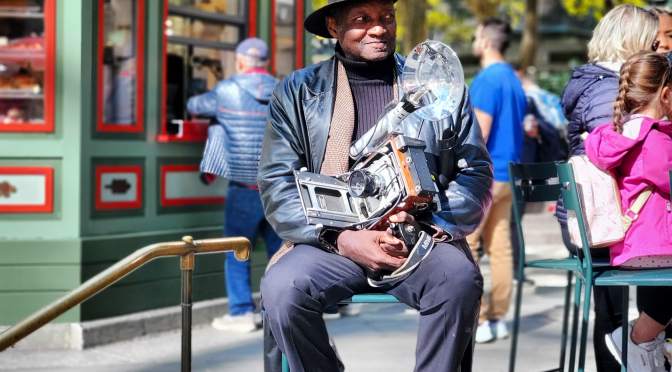
He shuffled up 44th Street on a cold, wet, and gray Friday morning, with his trusty 1940s Speed Graphic camera shining like a lantern.

If I thought I was the only person who broke into a silly smile at the sight of him, the next few hours proved me sorely mistaken. Between his vintage cameras and impeccable style, strangers absolutely gravitate to Louis.

We rode the 2 Train from Times Square to Harlem for breakfast at Jimbo’s Hamburger Palace. From the station to the breakfast table and everywhere in between, I sat front row to the Louis Mendes Show.

“Hey, man, that’s a dope camera!” a young Latino man shouted from a car at a corner we crossed.

“WHAAAAAAT?! NO WAY!” A Lululemon soccer mom exclaimed from a train platform as she snapped as many pictures of him as she could before the doors shut.

And everywhere we went, he lifted my soul with New York’s stories, too. How the mosaic tile leading down to Times Square station was original, the irony of the Harlem Hospital once being segregated, how he’d met James Van Der Zee and even attended Gordon Parks’ funeral.

Like… 🤯

I asked his favorite places to take pictures. “Anywhere I can make money,” he retorted. (Louis has a witty response for just about everything, I quickly learned.)

But after breakfast, he said he’d take me to his favorite rainy day spot: Grand Central Station, one of my favorites too.

That’s where I finally got my picture.

And a couple of invitations to way, way more… 🥰

[Ed. Note: This post is part of a one-time February 2024 mini-series that took me to NYC where I was treated to an abundance of Blackstories first-hand. In place of my usual February content, I chose to share my own real-time (-ish) lived experience to honor the vibrant people New York put in my path.]
NYC, DAY 1 — January 30

Already doing the most before I’ve landed in the City.

A work leadership program kicked off in NYC on the same day I was scheduled to pitch a new client.

I could have thought, “That’s plenty. I’m good.”

But a week before, @thevaleriejune stole my heart live in Austin before mentioning she’d be in New York the following week. WELL, OK GIRL, ME TOO!

When she revealed her venue as the Cafe Carlyle, a tiny hotel cabaret that had once hosted David Bowie, Eartha Kitt, Judy Collins and so many more, I couldn’t even pretend I wasn’t trying to go.

OF COURSE the only tickets available were on the night of my arrival, the night before the pitch and the leadership launch.

And OF COURSE I BOUGHT ONE ANYWAY.

So we came into NYC HOT, changed in the JFK bathroom, and headed straight to the Cafe Carlyle, luggage and all.

And man, did the city rise to meet me.

I’d stressed over how late I was arriving. I was the first person at the bar with my pick of stage view seating in a room capacity of 90.

I’d worried I’d sit there falling asleep after a long travel day, or worse, small-talking with a stranger. Instead, two separate and vibrant Black women sat down next to me, and became my new friends.

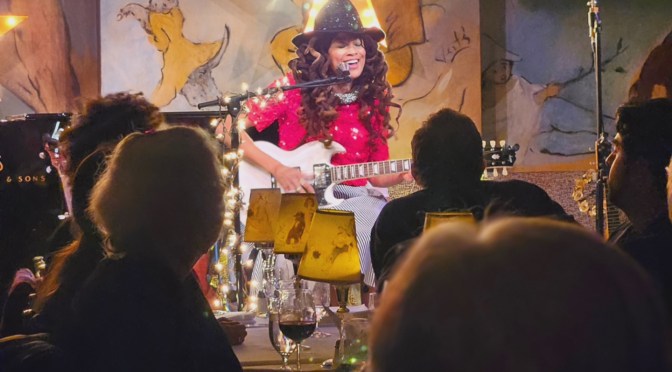
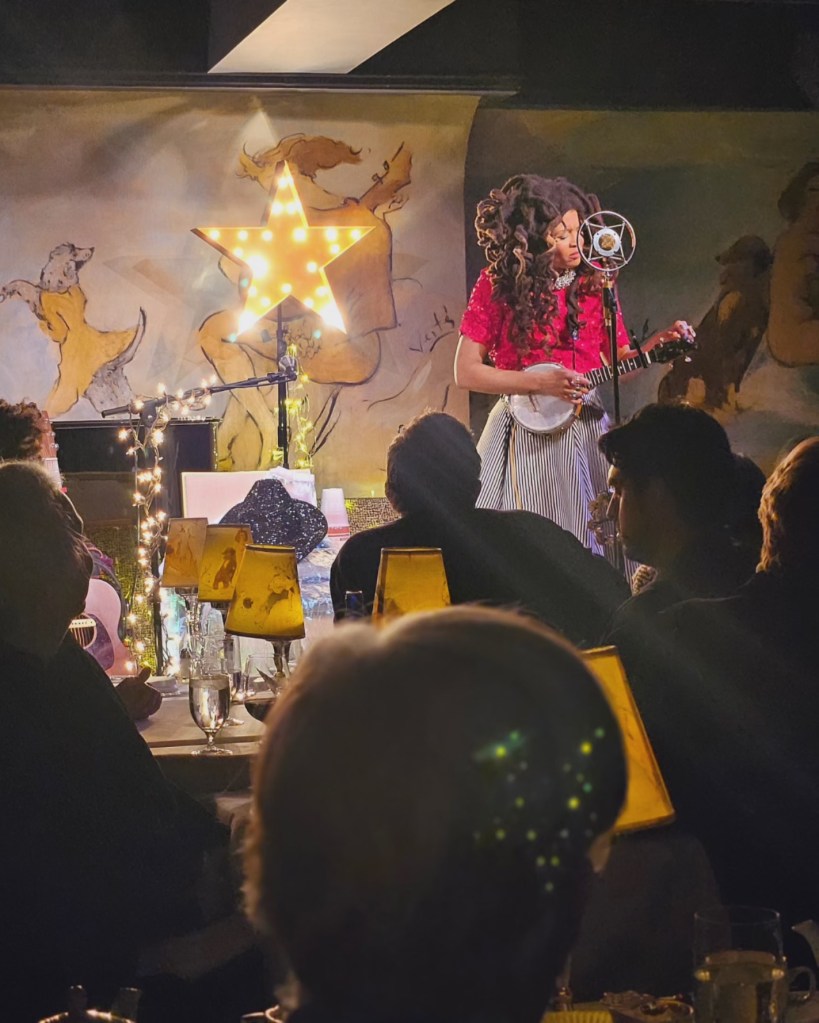
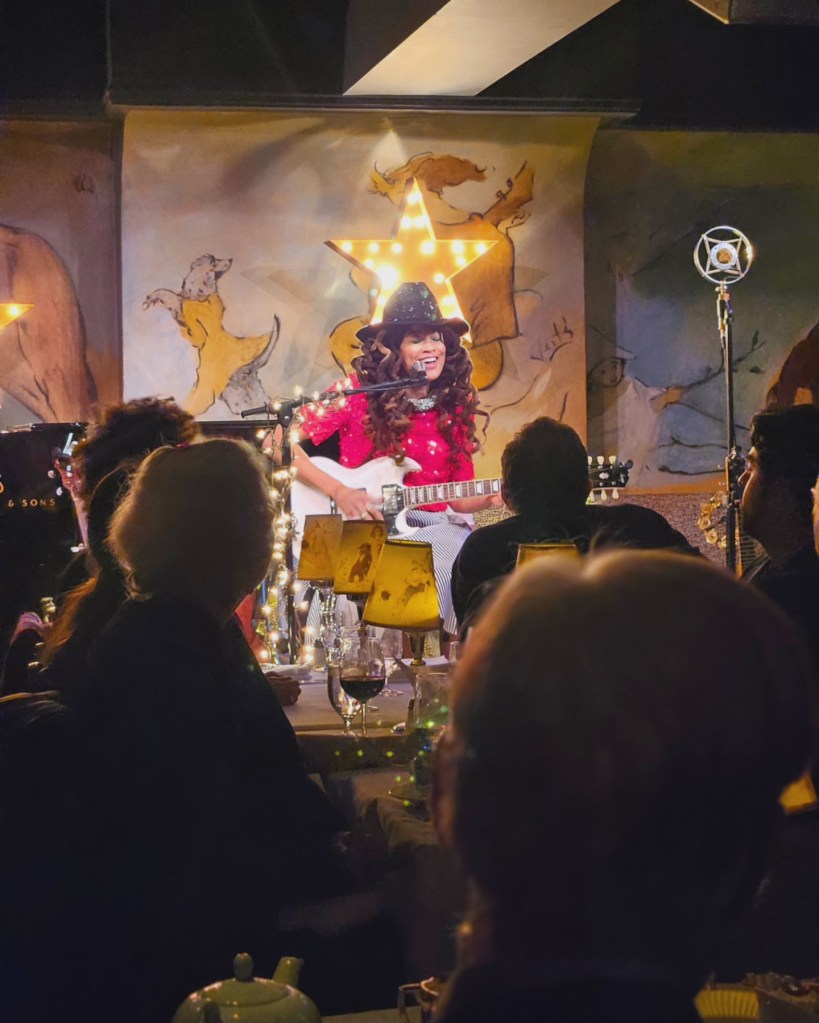
And when the show started, Valerie June appeared in a doorway all of 5 feet away from us, singing a capella, playing a tambourine, and channeling every bit of her southern Black roots.

Time stood still until without any warning, she whisked all her sequins out the venue’s main door, leaving her audience pinned to their seats and still pending checks.

Valerie June reads her poem “A Fairy Tale” live at the Café Carlyle

Both times I’ve seen Valerie June now, it’s felt like those dreams you wake up from and try desperately to fall back asleep into. It’s so good, then it’s just… over.

My new friends and I tried to hold onto the night as long as we could, chatting with GRAMMY-nominated Little Richard documentarian and VJ’s friend @misscortes and slow-sipping our (outstanding) cocktails before retreating to our respective beds.

Besides, between client presentations and @theamericanblackstory, I had work to do.

Luckily for me, NYC is full of dreams and mine with Valerie June wasn’t done quite yet…

[Ed. Note: This post is part of a one-time February 2024 mini-series that took me to NYC where I was treated to an abundance of Blackstories first-hand. In place of my usual February content, I chose to share my own real-time (-ish) lived experience to honor the vibrant people New York put in my path.]

Big Apple Butterflies

So, it’s February 5 and y’all got crickets from me?

It’s because I’ve been full of butterflies.

2024’s Black History Month theme is “African-Americans and the Arts.” And most years, I write the history, but this time, despite my best-laid plans, the ancestors decided that this Black creative would be living it instead.

Chills fr.

I traveled to New York for work last week, and went fully intending to launch on 2/1. Abandoning that plan to accept my ancestors’ gift was the greatest decision I could have made.

Here’s a little teaser of my unforeseen adventure in NYC, starring singer Valerie June, photographer Louis Mendes, luxury house Tiffany & Co., and multi-hyphenate Spike Lee.

Even I can’t believe this was only the beginning of February and there’s still so much more to come.

I’ve said it before, and I’ll say it again:

I. FEEL. INFINITE. ✨

See ya back here real soon living Black art out loud. 😘

[Ed. Note: This post is part of a one-time February 2024 mini-series that took me to NYC where I was treated to an abundance of Blackstories first-hand. In place of my usual February content, I chose to share my own real-time (-ish) lived experience to honor the vibrant people New York put in my path.]

DAY 11 — Seneca Village

Seneca Village - Central Park’s Stolen Foundation

There’s a dark secret buried beneath the greenery of Central Park.

In the mid-1850s, New York was was just beginning to blossom into the global city it’s now become. Brimming with tourists, businessmen and immigrants from around the world, the city needed a grand outdoor space to rival those of London, Paris and other European metropolises, according to New York’s officials and prominent residents too.

Where they didn’t have space to build, city planners took what they needed from the nearby “shanty wasteland” inhabited by “insects, squatters, and bloodsuckers,” as the local papers characterized the small enclave of Seneca Village and its people.

But those descriptions couldn’t have been further from the truth. No one was more invested in the well-being and upkeep of their small corner of the Big Apple than Seneca Village’s own citizens – it had stood as New York’s first community of free black people for 30 years.

Despite the fact that the state of New York didn’t officially free slaves until 1827 and the United States didn’t follow until 1863, the free black men and women of Seneca Village established their middle-class settlement by purchasing adjacent plots of property in 1825. But so much more than pride bound them so fiercely to their estates. In those days, black men were only eligible to vote if they owned at least $250 of land. Of the nearly 14,000 black people documented in New York at the time, only 91 had voting rights and of those, 10 lived in Seneca Village. For their small town, preservation was power.

Albro and Mary Beth Lyons were two prominent abolitionists who were also known citizens of Seneca Village.

But unbeknownst to all of them, just two weeks before the church’s cornerstone was set, city officials had ordered the entire village, from 81st to 89th Streets between 7th and 8th Avenues (near what’s now Central Park West), condemned to make space for their vanity.

With 3 churches, 3 schools, 2 cemeteries and dozens of free-standing homes up to three stories tall, Seneca Village was a thriving community with nearly 600 total residents during the 3 decades it existed. And they had plans for greater longevity. When the cornerstone for their First African Methodist Episcopal Zion Church was laid in 1853, a time capsule was placed inside to preserve the significance for future residents. As a suspected Underground Railroad stop due to the presence of so many abolitionists and the constant influx of new residents, it had become a place of hope for all who passed through and a realized vision of what free black people could be.

An article from the New York Herald documents the coffins unearthed in 1871, noting that they had not been there just 5 years before when trees were planted in the park. Unlikely, as excavations later established it as the location of one of Seneca Village’s cemeteries. (Also note the coffin’s description.)

4 years later in 1857, it was all gone. Despite protests from the citizens and lawsuits that they brought against the city for failing to pay what the property was worth, if they paid anything at all, the then 300 or so men, women and children of Seneca Village didn’t stand a chance against New York’s elite.

It wasn’t just black history that was destroyed either. By the time it was razed, Seneca Village was a shining example of an integrated community, with as many as 30% of its residents having been Irish or German, all attending the same schools, churches and local gatherings.

Seneca Village was only one of many black communities, cemeteries and landmarks lost to the rise of New York, and the city has begun to address this shameful history through places like the African Burial Ground National Monument and historical markers. But some mistakes can never be undone. As signified on the plaque where Seneca Village once stood, after their property and voting rights were lost, Seneca Village was never rebuilt, and while remains have been unearthed there sporadically since 1871, not a single living descendant of the community’s black citizens has ever been found. to make something brand new.

Where Seneca Village would have stood today

KEEP GOING BLACK IN HISTORY:

Explore the study & excavation of this historic community at Columbia University’s Seneca Village Project.