Tag Archives: BLACK CINEMA

NYC, DAY 5 — The Spike Thing

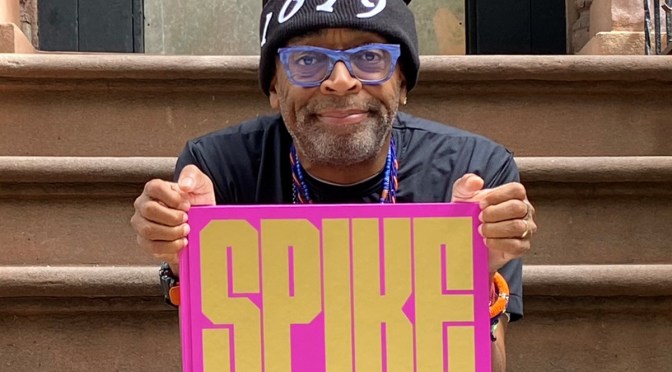
“Spike Lee is having a signing at the Brooklyn Museum on Saturday if you want to go.”

(Tbh, Louis could have asked me to go to Mars at this point, and I’d ask what time.)

So bright and early, we popped up from the Eastern Pkwy station into an entirely empty museum lobby.

OF COURSE only members were allowed before 11. Us plebes were ushered outside where Louis did the mental math. “I’m thinking. Wondering if we should join.”

I reached for my phone. $64 for a dual membership. Joy Barnett & Louis Mendes could swing that.

So with two hours until the signing, we talked. As fans & families gathered, we watched. And through it all, we sat comfortably after Louis pulled the elderly card like he doesn’t put in miles across NYC every day. And when the museum shop opened, we rose to our rightful place at the very front of the line.

Around 11:45, a famous face poked out from a black velvet curtain, scanned the crowd, and did a double-take in our general direction.

That’s when Spike Lee marched over, shook Louis’s hand and picked up the stanchion himself to usher us in.
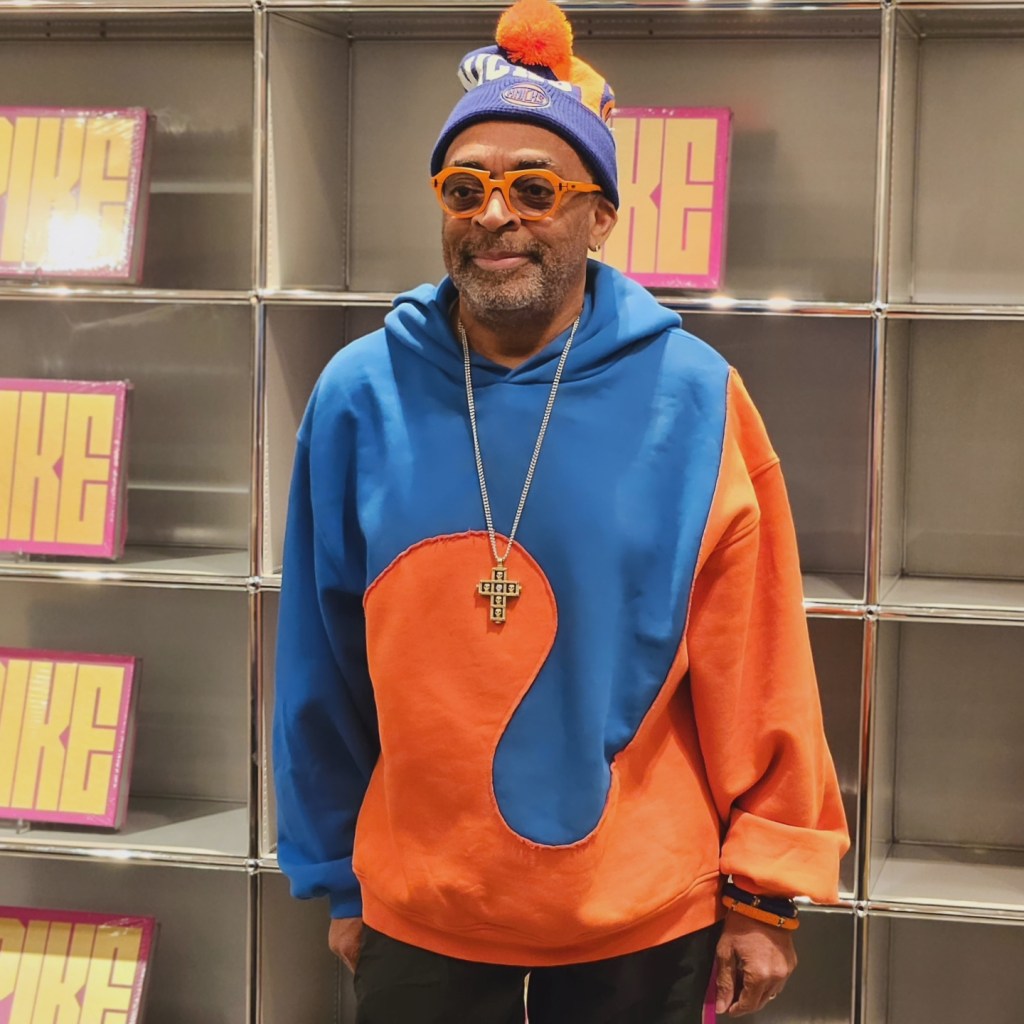
The two of them fell in so fast it almost felt scripted. Spike posed, Louis clicked. Spike handed Louis a bill, shook his hand again and thanked him. Then Louis went off-script.

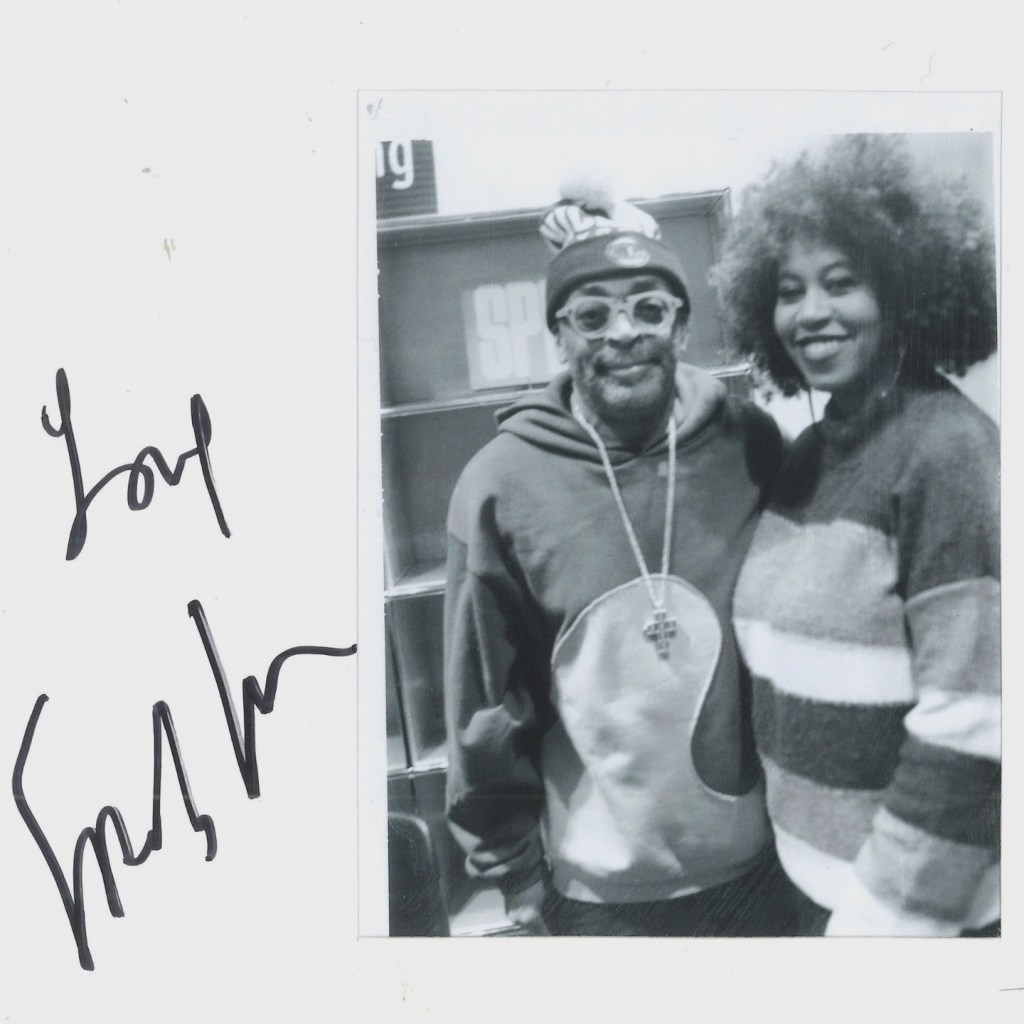
“I wondered if I could get a picture of you and Joy.”

“Come on, baby.”

I scurried over like a rat to a charcuterie board. It’s almost literally written all over my face.

As Louis tucked the photo into his usual cardboard frame, Spike slid it across the table, and wrote without a word: “Love, Spike Lee.”
He began his goodbyes when I awkwardly chimed in to ask if he’d sign our books too.

The relief when he took it as a timely reminder vs. clumsy begging.

“Oh, tell all them people to open their books to THIS page,” Spike pointed a pink spread out to his manager. “I’m only signing THIS page.”

I flipped like my life depended on it, taking the opportunity to thank him for his work. He received my words graciously and signed both books before Louis & I started to slip away.

“Oh…” he called to his manager once more.

“And tell them NO PICTURES either. This is a BOOK SIGNING.”

[Ed. Note: This post is part of a one-time February 2024 mini-series that took me to NYC where I was treated to an abundance of Blackstories first-hand. In place of my usual February content, I chose to share my own real-time (-ish) lived experience to honor the vibrant people New York put in my path.]

DAY 15 — Fredi Washington

Fredi Washington - Light Skinned Actress Leading the Way

Fredi Washington’s porcelain skin and peridot green eyes bought her a level of privilege that was unheard of for black people in the 1920s and 30s.

What was even more unheard of was that she didn’t want it.

Back then, when black actors got mainstream film roles, they were typically small parts as some form of help – maids, teachers, and of course, slaves. Otherwise, their filmographies were exclusively “race films,” segregated movies with all-black casts made for black audiences, and for the first few jobs, this was Fredi’s experience too.

Until 1934, when she landed what’s arguably one of the most pivotal roles performed by a black actress in the history of cinema.

Fredi’s “Imitation of Life” title card

“Imitation of Life,” based on a 1933 book, told the story of an enterprising duo of single mothers, a white widow and black maid, raising their daughters together in the same home. But there was a twist. The black daughter, Peola, had skin light enough to “pass” as a white woman instead. The movie explored the dynamic of white and black women’s friendships and their ingenuity in finding empowerment in a sexist society, but even more impactfully, the ongoing mental, emotional and familial effects of slavery, racial segregation laws and deeply ingrained social stigmas faced by black women in particular. For its groundbreaking work, the movie earned three 1935 Academy Award nominations, including Best Picture.

Having tasted success, Fredi used her platform and privilege to empower others, establishing the Negro Actors Guild in 1937 to provide black actors with more mainstream opportunities and non-stereotypical roles in film. But due in large part to her critically acclaimed performance in “Imitation of Life,” Fredi found herself fighting a typecasting battle of her own. Her crossover success had inspired other filmmakers to explore “passing,” and of course, they all wanted to cast the most recognized name in the business as a black woman capitalizing on her white skin.

But they had gotten Fredi all wrong. As far as she was concerned, she was a black actress portraying black experiences on-screen. It had never been her intention to pass. “You don’t have to be white to be good. No matter how white I look, on the inside I feel black,” she insisted.

And that conviction was truly tested. She was too talented and pretty to be cast in a subservient background role in mainstream white films, but film production codes in Hollywood at the time strictly forbid interracial relationships, so the outspokenly black actress couldn’t be cast as a romantic female lead either. Conversely, her light skin made her a costly distraction in race films. When she attempted radio instead, she found few dramatic roles for black talent, and even fewer with black female protagonists. Because of her stance against being someone she was not, Fredi never again found the level of fame that “Imitation of Life” gained her.

Naturally, journalists were curious why she didn’t follow the example of other actresses at the time like Rita Hayworth (who was actually a passing Spanish-American) and simply pass as a white actress to find the success she so rightfully deserved. She offered without hesitation: “You see I’m a mighty proud gal, and I can’t for the life of me find any valid reason why anyone should lie about their origin, or anything else for that matter. Frankly, I do not ascribe to the stupid theory of white supremacy and hiding the fact that I am a Negro for economic or any other reasons. If I do, I would be agreeing that to be a Negro makes me inferior and that I have swallowed whole hog all of the propaganda dished out by our fascist-minded white citizens.”

Retiring from show business in the 40s, she quickly offered her insider knowledge to assist the NAACP in fighting racism and exclusion in Hollywood, and continued to work toward equality for black creators until her death in 1994. Although Fredi won very few honors herself, her role as a leading black woman in a Hollywood-produced film opened doors to equally iconic black mainstream roles for some of the world’s most influential black thespians like Sidney Poitier and Louis Gossett, Jr., among others.

Fredi struggled to fit in as a light-skinned black creative in her era, but her work has found its way among the most treasured American films of all time. “Imitation of Life” was added to the preserved collection in the United States National Film Registry at The Library of Congress in 2005, and in 2007, TIME Magazine recognized it as one of “The 25 Most Important Films on Race,” solidifying Fredi’s place in history right where she would have wanted it – beloved for being undeniably black.


KEEP GOING BLACK IN HISTORY:

“Imitation of Life” is available on Amazon Prime for $3.99, and I guarantee it’ll be money well spent.

The Amistad Research Center at Tulane University archives an assortment of Fredi’s personal belongings, and a blog entry from the center details how “Imitation of Life” impacted Fredi’s own.

DAY 8 — Frederick Joseph

Frederick Joseph - Superhero in Disguise

Frederick was 8. And he was never dressing as Batman again.

“You’re black. You can’t be black and be a superhero.”

It was a blip in the life of Frederick Joseph, who went on to get an MBA from NYU, and become a successful entrepreneur, marketing professional, and the list goes on. He even founded We Have Stories, a non-profit designed to support underrepresented and marginalized storytellers and content creators.

But like pebbles at a windowpane, tiny reminders of the moment a classmate told him he couldn’t be the Dark Knight kept popping up along the way in the controversies over modern day depictions of James Bond, Hermione Granger, District 11’s Rue… Like Batman, they were not supposed to be black, because black people aren’t heroes.

That is, until one more reminder changed everything.

Marvel’s “Black Panther” didn’t just feature ONE black superhero. It was entirely cast by black superheroes. Black men who were kings; black women who were smart, sexy, and strong; black elders with the knowledge of countless generations; and all living in a place where blackness was not only accepted, but richly celebrated.

How little Frederick might have seen the world if this had been his childhood experience, instead of one where even masks couldn’t hide that the heroes didn’t look like him.

And thus the #BlackPantherChallenge was begun. His initial goal was a humble one: just $10,000 to buy tickets for the The Boys & Girls Club of Harlem. It became one of the most widely participated in GoFundMe campaigns ever, raising nearly $1 million with the help of local communities, celebrities and donors from 50 countries worldwide. Thanks to Frederick’s work, 73,000 children of color were able to see “Black Panther” in theaters last year.

Despite the massive success of the movie, which media outlets like Variety even credited in part to small grassroots efforts like Frederick’s, he recognizes that it’s just one drop in an infinite bucket of exclusion. The task isn’t done because “all children deserve to believe they can save the world, go on exciting adventures, or accomplish the impossible.” So he’s answering the call again with the #CaptainMarvelChallenge.

As Marvel Studios’ first feature film with a female lead and one that introduces more women of color to the Marvel Cinematic Universe, he wants to ensure that the at-risk girls served by Girls Inc. of Greater Los Angeles can attend the premiere on International Women’s Day, and help them reach their goal of serving 2,000 more girls by 2020. “Captain Marvel” star Brie Larson has even signed on, as has GoFundMe, offering to donate $100 to the first 25 local #CaptainMarvelChallenge campaigns.

The bar set by the #BlackPantherChallenge is high, but Frederick hopes to make history again. No matter the outcome, thousands of boys & girls worldwide will be forever changed by a kid who just wanted to be Batman.


KEEP GOING BLACK IN HISTORY:

Accept & share the #CaptainMarvelChallenge!

Read Frederick’s own words about why supporting movies like “Black Panther” and “Captain Marvel” is so important to him.

Revisit the impact Frederick made with his #BlackPantherChallenge!