So, it’s February 5 and y’all got crickets from me?
It’s because I’ve been full of butterflies.
2024’s Black History Month theme is “African-Americans and the Arts.” And most years, I write the history, but this time, despite my best-laid plans, the ancestors decided that this Black creative would be living it instead.
Chills fr.
I traveled to New York for work last week, and went fully intending to launch on 2/1. Abandoning that plan to accept my ancestors’ gift was the greatest decision I could have made.
Here’s a little teaser of my unforeseen adventure in NYC, starring singer Valerie June, photographer Louis Mendes, luxury house Tiffany & Co., and multi-hyphenate Spike Lee.
Even I can’t believe this was only the beginning of February and there’s still so much more to come.
I’ve said it before, and I’ll say it again:
I. FEEL. INFINITE. ✨
See ya back here real soon living Black art out loud. 😘
[Ed. Note: This post is part of a one-time February 2024 mini-series that took me to NYC where I was treated to an abundance of Blackstories first-hand. In place of my usual February content, I chose to share my own real-time (-ish) lived experience to honor the vibrant people New York put in my path.]
I survived Austin’s Winter Oakpocalypse unscathed by fallen branches, only for the pollen that came down with them to get me in the end.
Two ear infections and a sinus infection later, and it’s no surprise that I’m just recently catching my breath.
Wasn’t all rough times though!
I made a friend of the author of Dear Yesteryear and contributor to The 1619 Project Book, Miss Kimberly Annece Henderson. 💖 Met HGTV’s Carmeon Hamilton too!
I collaborated with a Black creative that I mentor to tell the stories of 5 Black co-workers on MullenLowe’s PROUD Stories. I co-led all of the agency’s Black History Month programming.
Last weekend, I’d planned to pick up where I left off to bring you Blackstories 10-28 as promised. But one thing I’ve taken away from this project is that I am living and breathing Black history right now.
The last thing that the people in my stories—who lived and died breaking literal and figurative chains—would want is for me to miss out on my own story for the sake of telling theirs.
All month, my grandmother’s voice repeated in my mind, reminding me of one of her favorite sayings: “The only thing I HAVE TO DO is stay Black and die.”
I’m embracing her energy. 👑
So instead of going back in history, I hope you can grant me a little grace for not giving you 28 stories last month while you catch me and my camera outside later this week, telling Black stories in real time, sequins, and feathers. 💚💛💜
“Skip Intro” is a modern luxury, and according to Netflix, it’s here to stay since we smash it about 136 million times daily.
But it wasn’t always so. Just FIVE years ago, we proved our dedication to a series through the slow agony of watching the same intro over and over again, week after week, episode after episode.
The horror.
But every now and then, an intro kept us riveted, counting down the scenes until our favorite character was introduced for the thousandth time, or calling us from literally anywhere into the living room.
In 1992, one show gave us Xennials all of that and then some.
And that show—X-Men: The Animated Series—would have been nothing without the masterful touch of Larry Houston.
Thug tears, 31 years later.
Larry’s original comic book series, The Enforcers
Though Larry grew up reading Jack Kirby and Stan Lee comics, and even concepted, wrote, drew and ultimately published his own comic in high school, life led him to a more practical career as a computer systems analyst.
And then it led him right back.
He was twenty-something in 1980 when childhood wonder came calling, and Filmation—the production house that brought you tons of Saturday Morning Cartoon favorites like Fat Albert, The New Adventures of Mighty Mouse, Ghostbusters, He-Man and She-Ra—hired Larry as their first Black storyboard artist.
His first production credit was on Thundarr The Barbarian, and the next, on The Tarzan/Lone Ranger/Zorro Adventure Hour, both iconic in their own right.
But it was the next entry on his resume that truly brought everything full circle and launched Larry’s career into orbit. In 1982, he earned great responsibility as a storyboard artist on Marvel Productions’ Spider-Man.
Larry (obvious) with the Marvel crew, including Stan Lee immediately above him. Courtesy of Larry Houston.
From there, his writing, storyboarding, and directing credits read like the Saturday Morning TV Guide.
Larry with Keith David, his “first and only choice” for the voice of T’Challa in “The Fantastic Four.”
The Incredible Hulk. G.I. Joe. The New Adventures of Jonny Quest. Jem and the Holograms. Teenage Mutant Ninja Turtles. Captain Planet. Double Dragon.
And of course, his 1992 pièce de résistance… X-Men: The Animated Series.
Of X-Men’s 76 episodes, Larry storyboarded 44, including the entire opening sequence. From 1992 to 1995, he also produced and directed the series, turning his childhood passion into the canonically-accurate, allegorically-rich, Easter-egg-riddled, gold standard of cartoons that we know and love today.
After all, who better than a BLERD (that’s BLack nERD for the uninitiated) to serve as steward of what Sean Howe, author of Marvel Comics: The Untold Story, called “the most explicitly political of the 1960s Marvel comics.” It was one of the first times in cartoon history that Black children saw themselves represented as powerful leaders rather than at best, sidekicks and comic relief, and at worst, mammies and savages, or dancing fools. Storm and Bishop manipulated weather and time to make weapons of the universe itself. Before a Black woman ever led the country, one led the X-Men. Though we didn’t know it then, a Black man entrusted with bringing all of this to life became a gift to an entire generation.
Storm & Bishop dominating, in action.
But he didn’t stop there. The list above is only a snippet of the incredible artistry Larry Houston brought to nearly every American under 50 years old. NBC’s “Community” even paid homage to his stellar career in 2014, tapping him as a lead storyboard artist in the episode titled “G.I. Jeff.”
— Starburns Industries (@StarburnsInd) July 26, 2014
These days, Larry’s empire has grown into his own entertainment company, he’s writing a superhero screenplay, re-visiting his past comics, and still reminding kids big and small that sometimes a dream is the only superpower you need.
KEEP GOING BLACK IN HISTORY:
Learn more about Larry Houston’s tremendous contributions to comics and cartoons at his website and IMDB.
Keep up with Larry’s work, news and appearances on his Instagram.
Larry talks to SYFY Wire about how his comic expertise kept “X-Men: The Animated Series” true to Stan Lee’s original vision.
Read Rolling Stone’s lost interview with Stan Lee on how the X-Men came to be.
Check out how one of those kids inspired by Stan Lee’s Storm and her cartoon representation by Larry Houston ended up bringing the character to life.
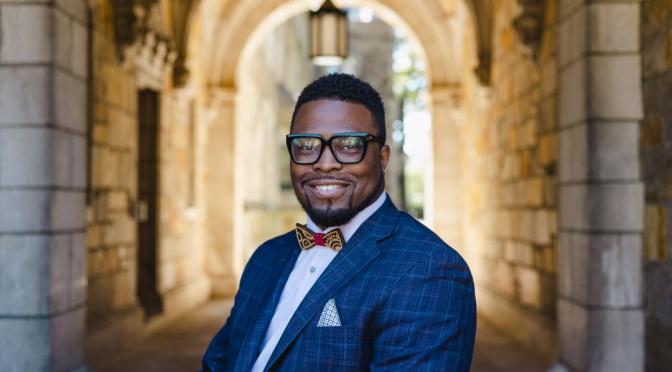
Dr. Feranmi Okanlami experiences discrimination every single day.
It’s not necessarily because he’s a Black man, but because he’s a Black man in a wheelchair.
“Until I started to live life on the other side of the stethoscope… I did not realize how ableist our world was, how inaccessible the world was and how I was unintentionally complicit to this world,” he told Good Morning America.
A different lifetime: Feranmi Okanlami in March 2007, courtesy of the Stanford Invitational.
Dr. O, as he’s nicknamed, didn’t always use a chair. Born in Nigeria and raised in Indiana, he’d graduated Stanford as an All-American track star and captain of his team, then medical school at Michigan, and worked as a third-year resident in orthopedic surgery at Connecticut’s Yale New Haven Hospital. Dr. O was on a brilliant path until a 2013 Fourth of July accident changed his mode of transportation, and then some.
“I jumped into the pool,” he said. “I didn’t do a backflip or anything like that. There was no diving board, but I hit either the ground or the side of the pool or someone’s leg. I can’t be completely sure, but immediately I was unable to move anything from my chest down.”
Most people with his cervical injury “are not expected to ever be able to walk or stand,” his mother Bunmi said.
Dr. O is a man with higher expectations.
“I have an interesting intersection of science and faith, such that even if doctors had said I would never walk again, I wasn’t going to let that limit what I hoped for my recovery,” he said. “I know there is so much we don’t know about spinal cord injury, and I know the Lord can work miracles.”
Dr. O in the operating room where miracles happen.
Two months and countless hours of physical therapy later, Dr. O gained the mobility to extend his leg. With time, he gained something else too: a Master’s degree in Engineering, Science and Technology Entrepreneurship from the University of Notre Dame. “[I was] looking for something I could do to stimulate myself intellectually while I was working myself physically,” he said. Dr. O even finished his medical residency.
After his injury, he accomplished everything he’d set out to do as an able-bodied person, and then some. But Dr. O also found that the outside world put up unnecessary physical barriers every step of the way.
He learned that medical school admissions require physical qualifications that prevent those with certain disabilities from even applying. That’s just one reason why only 2.7% of doctors identify as disabled compared to more than 20% nationwide.
He realized that there have been more advancements in high-end self-driving cars than in making standard vehicles more accessible.
And as an athlete in a wheelchair, finding a good pick-up basketball game was near impossible.
Dr. O suddenly had invaluable insight into the lives of so many of his patients. “I have one foot in one world and one wheelchair wheel in another,” he said. Disabled patients can better relate to disabled doctors, of course. But think of how other patients like the pregnant woman on bedrest, the aging person beginning to lose mobility, even the child with a broken limb might benefit from a doctor who’s compassionately vulnerable.
“How are we supposed to be able to talk to patients and tell them it’s okay, that life can still go on, while creating a culture where the providers themselves must come across as immune to the same ailments we treat our patients for?” he wondered. “My goal is trying to demonstrate to them, through one lens of disability, that we are all going to have our difficulties and our struggles and that’s what makes you human, and believe it or not, sometimes your patients will value seeing the human in you.”
Dr. O knew that the human experiences he’d faced as a newly disabled person weren’t unique to him. So he set about changing those experiences for the better.
Where other doctors rightfully fear being judged for their disabilities, Dr. O used his experience as a spinal trauma patient to help develop a device that makes spinal screw placements more accurate and efficient.
He uses his platform and privilege to be vocal about how airlines treat wheelchairs, reminding PBS that “People don’t think that this is a serious concern and it’s just a matter of finding space to put your wheelchair, like not having enough space for your luggage in the airplane. They miss the fact that this is individuals’ lives that are at stake.
And as Director of Adaptive Sports and Fitness at the University of Michigan, he’s doing his part to ensure that people with disabilities have the same access to physical and outdoor activities that others do.
“Too often, we are judged by what we cannot do, rather than what we can,” he said, speaking to his goal of “Disabusing Disability” and creating a world where equal access and diversity truly extend to everyone.
Dr. O’s dream is for Michigan to combine its talents in medicine, athletics and science to become the premier home for accessible sporting facilities, drawing Paralympic and other elite level athletes from all over the world.
He’s gained so much traction that others are stepping up to help make his dream a reality for countless more. Just last year, the Craig H. Neilsen Foundation, whose mission of “changing the world for those living with spinal cord injuries and the definition of what is possible” aligns perfectly with Dr. O’s, donated $1 million dollars to Michigan Adaptive Sports.
“Disability is not inability."
"Dr. O" has made it his mission to build the adaptive sports and fitness program at the University of Michigan.
But he also recognizes that it doesn’t take millions to make a difference in medicine, just a change of attitude.
“It is not that every Black patient needs a Black doctor, nor that every patient with a disability needs a physician with a disability. Every patient deserves an empathetic doctor,” he said.
And he means EVERY patient. His work at Michigan has earned Dr. O a place on national boards like the Association of American Medical Colleges Steering Committee for Diversity and Inclusion, the National Medical Association’s Council on Medical Legislation, and even the White House Office for Health Equity and Inclusion.
They said he’d never walk again. Today, with assistive devices like his standing frame wheelchair, Dr. O can perform surgeries, stand before an audience, and yes, even walk. He’s working on running, but until then, catch him chasing disability discrimination out of medicine, and with a little luck, the world.
He’s faced worse odds.
Dr. O, just doing his job with a little assist.
KEEP GOING BLACK IN HISTORY:
Get more of Dr. O in GMA host Robin Roberts’s Facebook Watch series, “Thriver Thursday.”
Hear Dr. O and Dr. Lisa Iezzoni from Harvard Medical School and Massachusetts General Hospital discuss how “Medicine Is Failing Disabled Patients” at Science Friday.
66-year-old Lusia Mae Harris wears the most animated expression, bubbly personality, and mischievous voice as she retells the story of her Mississippi high school classmates mocking her colossal six foot stature.
“They would tease me. ‘Long and tall and that’s all.’ That I was tall and I couldn’t do anything else.”
Suddenly, her doe eyes that were locked on the camera lens look away bashfully, and her voice drops nearly to a whisper.
“That wasn’t true.”
Lucy (her chosen nickname) was a humble and shy woman, so even when filmmaker Ben Proudfoot reached out to her directly to document her monumental career, she downplayed her own achievements.
“I said, ‘Lucy, you’re one of the greatest athletes of the 20th century.”
The few who know Lucy Harris call her the “The Queen of Basketball.” The rest have never even heard her name.
Lucy at the rim for Delta State in a file photo from Sports Illustrated, courtesy of the New York Times.
As the eleventh child of sharecroppers, little Lusia was already a pro at teamwork and routine. She’d go to school, come home to help pick the family’s quota of cotton, and wait for the other kids to flock to her front yard. The Harrises owned the neighborhood’s only basketball goal, and though it was a rickety thing, it’s where Lucy built her dreams. She’d even fall asleep at night with a blanket covering her head and a television tuned to Bill Russell or Wilt Chamberlain dominating the court.
When her high school classmates started teasing her, a basketball coach took notice and taught her the fundamentals. By the time she graduated, she’d led her school in Minter City—an unincorporated blip on the map—to the Mississippi state championship.
In 1973, five years after tiny Delta State University in rural Mississippi finally integrated, and just one year after President Nixon signed Title IX into law ensuring equal treatment of the sexes in programs receiving federal funds, Lucy became the only Black member of the Lady Statesmen basketball team.
It was the Lady Statesmens’ first year together too. In 1931, Delta State disbanded their team as basketball was “too rough for women.” Title IX brought the program back. In their second year, Lucy and the Lady Statesmen advanced all the way to the AIAW National Championship, equivalent to the NCAA which had not yet included women’s sports.
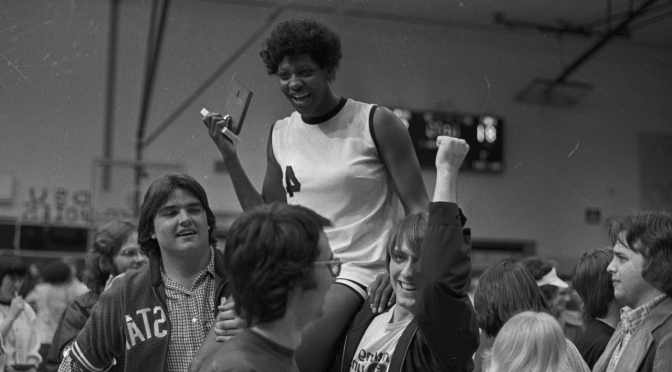
There was no way a tiny university in its second year of play with a rag-tag team of girls who barely knew each other could hold a candle to the three-time consecutive national champions they faced in the finals. But after a nail-biter of a game ending the first women’s tournament ever broadcast nationally by a major network, Lucy and the Lady Statesmen prevailed over the Immaculata Mighty Macs. Queen Lucy held court before millions, the same way she’d once watched the NBA greats.
Lucy is celebrated as the MVP of the Lady Statesmen’s 1975 national championship upset.
Just like their former rivals, Delta State became the team to beat, taking home the national title every year from 1975-1977. But Lucy Harris was absolutely incomparable. Each year, she was awarded the title of MVP and by the time she graduated, Lucy held a laundry list of jaw-dropping stats. 2,981 points and 1,662 rebounds, with an average of 25.9 points and 14.5 rebounds per game.
The 1975 United States Pan-American Games Women’s Basketball Team. Lucy stands at the back middle. Her teammate and future legendary coach Pat Summitt kneels immediately below her.
For all you folks who don’t follow, Lebron James just set the record as the NBA’s all time highest scorer. His average is 27.2 points per game. Kobe Bryant’s was 25. Lucy was putting up superstar numbers. And scouts took notice.
The United States national team hadn’t won a Pan American Games since 1963. After recruiting Lucy as their go-to scorer, the US team went undefeated to win the 1975 gold medal, besting every opponent by an average of over 30 points per game.
The very next year, Lucy took yet another shot seen around the world, becoming the very first woman to score in a women’s Olympic basketball game. The team left Montreal in 1976 draped in silver medals. Lucy left with more than she could have imagined.
Lucy scoring at the 1976 Montreal Olympic Summer Games. Courtesy of the New York Times/ABC Photo Archives/Disney, via Getty Images.
In 1977, with their 7th Draft pick, the New Orleans Jazz chose Olympic center #7, Lusia Mae Harris.
She was the first woman officially drafted to the NBA.
And she turned them down.
There were two reasons. Growing up in a big family, Lucy always wanted one of her own. A professional career came in direct conflict with settling down, and the secret she was carrying: Lucy couldn’t attend training camp pregnant with her first child, nor would she after Jazz officials had the nerve to suggest that they would own future draft rights to her unborn child.
But if she was being honest, “I didn’t think I was good enough,” Lucy told Ben Proudfoot.
In 4 years, Lucy Harris brought basketball’s highest honors to a college, a national team, and a country, ultimately becoming one of the first women inducted into the Basketball Hall of Fame… but didn’t think she was good enough.
Even Shaquille O’Neal disagrees. “Her numbers were way better than my numbers,” he laughed. “She was so good that the people used to watch her games and not the men’s game.” It’s a stark contrast to today’s attitudes towards women’s basketball, and he wanted the world to know exactly who they’d been missing.
“Listen, I’ve seen a lot of great women basketball players, but the fact that I’ve never heard of this woman, I think it was a shame,” he said. That’s why he and Steph Curry signed on as executive producers of Ben Proudfoot’s documentary on “The Queen of Basketball.”
Between Lucy’s remarkable story, Ben Proudfoot’s mastery in capturing it, and the publicity that two NBA legends brought to the table, “The Queen of Basketball” won the 2022 Academy Award for Best Documentary Short Subject. Unfortunately, two months before she saw that added to her win column, Lucy Harris passed away.
“Better late than never,” her son Chris Stewart told the NBA. “Her story is like so many extraordinary Black women especially in America who end up trail blazing and doing amazing things. They effectively get written out of history unfortunately.”
Ben Proudfoot cosigned that wholeheartedly in an op-ed to the the New York Times.
Lucy was so beloved by Delta State’s student body that she was elected their first Black Homecoming Queen. Courtesy of Ben Proudfoot.
“If you traveled to Cleveland to visit the coliseum, you might think Lucy Harris never existed,” he wrote. “You’d pass a towering bronze statue of her coach, Margaret Wade, who was white and never won a national championship without Ms. Harris. You’d pass a plaque in the lobby dedicating the building to Walter Sillers, who, as the longtime speaker of the Mississippi House of Representatives, fought tooth and nail to keep Black students out of Delta State. And finally, you’d arrive at the hardwood itself, which the university dedicated in 2015 to Lloyd Clark, the white high school coach it hired as head coach instead of Ms. Harris.”
That’s how Delta State has honored Lucy’s legacy, and Proudfoot hopes his documentary’s success is just one step toward one big change on campus. He “offered to loan the Oscar indefinitely for exhibition in the lobby of the coliseum — if the university would rename” it after Lusia Mae Harris.
A year later, Ben Proudfoot, Lucy’s family, and others like her former teammate and women’s basketball legend Pat Summitt who called barrier-breaking Lucy Harris “the first truly dominant player of modern women’s basketball,” are still waiting for Delta State to take Ben up on it.
KEEP GOING BLACK IN HISTORY:
You’ll be absolutely delighted by Lucy’s presence & story in the Academy Award winning “The Queen of Basketball”
Read the Friends of Lucy Harris‘ impassioned plea for Delta State to rename the Walter Sillers Coliseum, and sign your name to their petition.
Lucy’s entry at the Basketball Hall of Fame details her amazing career, stats, and multiple claims to fame.
Many of the same circumstances that led to Lucy being forgotten are being echoed in today’s treatment of WNBA and NCAA players. Connect the dots at the New York Times.
Today’s hot goss is all about Beyoncé’s history-making 32nd GRAMMY win, 88th nomination, and how they still won’t give her Album of the Year.
With only two GRAMMY wins, the Fisk University Jubilee Singers are on the complete opposite end of that spectrum. Still, they can relate.
After all, who cares what the Recording Academy’s awarding when you’ve got over 150 years of musical history as a force against racism, multiple world tours and concerts to monarchs, presidents, and other global leaders, and ALL the credit for bringing slave spirituals to mainstream music?
In 1866, Nashville’s Fisk University became America’s first institution of higher learning “to offer a liberal arts education to ‘young men and women irrespective of color.’”
“Originally known as the Fisk Free Colored School, Fisk University was established in 1866 in Nashville (Tenn.) at the site of former Union Army hospital barracks. The school was named after General Clinton Bowen Fisk who arrived with Union occupying forces in Nashville in 1862. Enrollment topped 900 students in the first year and, in 1867, the school was incorporated as Fisk University.” Courtesy of the Tennessee Virtual Archive.
Five years later, the school was nearly bankrupt.
Brief as it had been, Fisk had a legacy to maintain, and they weren’t letting it die without a fight. One man at Fisk held the title of both treasurer and music professor, and he devised a clever plan. A choral ensemble could hold concerts benefitting the university. Besides, there truly was nothing left to lose.
Nine men and women shaped the unnamed ensemble, who’d begin their tour in the small towns near Nashville. Soon, their director had another clever idea: a national tour along the route of the Underground Railroad. Most of Fisk’s student body was comprised of Black students who’d been recently freed from enslavement with the 1863 signing of the Emancipation Proclamation, so a public tour in the locations their ancestors and even parents had secretly sought freedom was a poignant—and marketable—move.
A minstrel show poster depicts a white man’s transformation into Blackface Minstrel. Courtesy of the Smithsonian National Museum of African-American History & Culture.
It was also entirely unheard of. Before this, Black people didn’t perform in public spaces—but white people in minstrel makeup did. Many reviews of the time even noted this phenomenon, with one writing “Those who have only heard the burnt cork caricatures of negro minstrelsy have not the slightest conception of what it really is.” So when the Fisk Singers began touring in earnest in October 1871, many people attended their shows out of the sheer novelty. Nearly all left as fans.
Ella Sheppard, one of the Fisk Jubilee Singers’ original sopranos, went on to form a career of her own in music. Read more at PBS.
Even the singers themselves had to be won over initially. Just because these songs had come from within their culture didn’t mean that every Black person in America knew them. Spirituals were sung in the fields, secretly formed churches, and as code songs, so those who’d been freed from slavery before the Proclamation, or lived in affluent, free-standing communities like Seneca Village had no reason to know them. And when they did, they were reluctant to share them with a racist society.
Ella Sheppard, one of the original members wrote, “Sitting upon the floor (there were but few chairs) [we sang] softly, learning from each other the songs of our fathers. We did not dream of ever using them in public… they were sacred to our parents, who used them in their religious worship and shouted over them… It was only after many months that gradually our hearts were opened… and we began to appreciate the wonderful beauty and power of our songs.”
During one of their first stops, they were forced to use that power against an angry white mob that cornered them at a train station. The Fisk Singers’ worshipful songs, angelic voices, and non-violent response shamed the mob into dispersing. “One by one, the riotous crowd left off their jeering and swearing and slunk back until only the leader stood near Mr. White and finally took off his hat,” Ms. Sheppard wrote. “The leader begged us, with tears falling, to sing the hymn again.”
But those beautiful voices couldn’t save them from racism every time. When they donated the proceeds of one of their first concerts in Cincinnati to victims of the Great Fire of Chicago, they were thanked on their next stop in Columbus with terrible hotel accommodations, name-calling from the newspapers, and all manners of abuse from the locals. It was only their first month on tour, and many of the singers—and their parents who didn’t want to allow their children on the tour for this very reason—were so disheartened, they were ready to throw in the towel.
After a night of prayer, the singers regrouped and to build their spirits, were finally given a name that referenced both their heritage and their musical repertoire: The Jubilee Singers. It’s written in the book of Leviticus that every fifty-first year would be a “year of jubilee” in which all slaves would be set free, and the Fisk singers almost exclusively sang spirituals. It fit, spirits were lifted, and the show went on.
18 months later, the Jubilee Singers sent $40,000 back to Fisk, more than they could ever have earned through organized fundraising efforts alone.
Their fame had also grown too big to turn back. By 1872, invitations to the Fisk Jubilee Singers were pouring in. The World’s Peace Jubilee and International Musical Festival in Boston, President Ulysses S. Grant’s White House, and Steinway Hall in Manhattan were among a few of the venues they performed.
One of many posters preserved from the Jubilee Singers’ early shows, courtesy of the Tennessee State Museum.
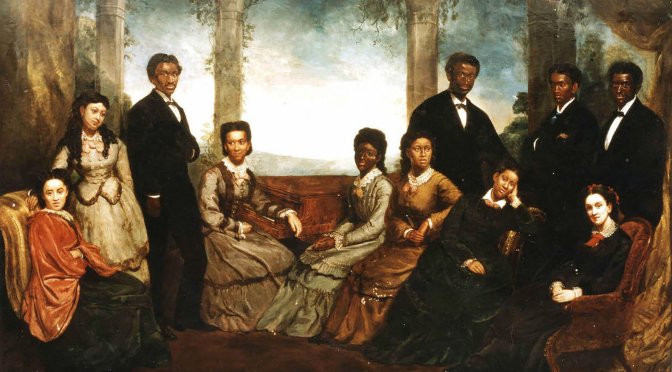
But in 1873 came their crown jewel: a surprise performance and audience with Queen Victoria of England. The Queen requested a handful of songs by name: “Swing Low, Sweet Chariot,” “Did the Lord Deliver Daniel,” and “Go Down Moses.” She made her share of unsavory requests too. “Tell the dark-skinned one to step forward,” Ella Sheppard wrote in her diary, quoting the Queen’s request to have a better look at Jennie Jackson, another of the singers. Still, their appearance, performance and the combination of both left such an impression on the Queen that she commissioned a portrait of the Jubilee Singers that still hangs today in the university’s Jubilee Hall, built with $150,000 the singers earned from their European tour.
The Jubilee Singers’ portrait by the official painter of the Court of St. James after a performance for Queen Victoria in 1873. Ella Sheppard is depicted seated at the piano with Jennie Jackson to the right.
Their reception in Europe mirrored the attitudes in the States. Some places were progressive enough to recognize the Jubilee Singers’ humanity, others were brutally racist.
These conflicts and controversy around them left their toll on the singers. But they also began reshaping attitudes around racism and segregation. George Pullman personally integrated his entire fleet of trains after learning the Jubilee Singers had been automatically denied accommodations because of their race. When Jersey City voted to integrate schools after the Jubilee Singers had been turned away from a local hotel, the New Jersey Journal wrote, “By their sweet songs and simple ways, the Jubilee Singers are moulding and manufacturing public sentiment.”
Those sweet songs also molded American music as we know it today. “If they had not begun to sing the songs of their ancestors in concert halls, this oral tradition, which existed only in the memories of former slaves, would most likely have been lost to history forever.” The New York Times writes. “And if it had disappeared, it would have taken with it the DNA of much of the American music that followed: blues, gospel, jazz, country, rock, and more.”
And not just American music. Before the Jubilee Singers toured Europe again in 2015, Richard Hawley, a Head of Artistic Programming in Birmingham, England said, “They are without doubt responsible for introducing the Black Oral Tradition to the U.K., and are therefore responsible, certainly in part, for the enormous diversity of music we now have in this country.”
Though they briefly disbanded for a year, the Fisk Jubilee Singers still exist and you can witness an enduring American legacy, live and in person. Until then, stream their catalog—past and present—on Spotify or Apple Music, and listen to how through song and struggle, they saved their school, transformed attitudes across two continents, and left a lasting mark on music as the Gospel Group of the Ages.
Listen to the historic sounds of the Fisk Jubilee Singers on Spotify or Apple Music.
KEEP GOING BLACK IN HISTORY:
Visit the digital home of today’s Jubilee Singers for more on their past, present and future.
Learn more about The Fisk Jubilee Singers and some of its original members at the Smithsonian Archives Blog.
Discover the depths of the Jubilee Singers’ “Sacrifice and Glory” at PBS.
“In Walk Together Children: The 150th Anniversary of the Fisk Jubilee Singers, Dr. Paul T. Kwami and the current singers explore the stories of the world-renowned ensemble’s original nine members and reflect on their roles as students and preservers of the group’s legacy.”
Watch the trailer & full-length special now on PBS.
There’s even more about how the Fisk Jubilee Singers changed American music at the New York Times.
“Jubilee: An Inspirational A Capella Tribute” ran in 2019. Revisit scenes from the show & reenactments from Ella Sheppard’s diary here.
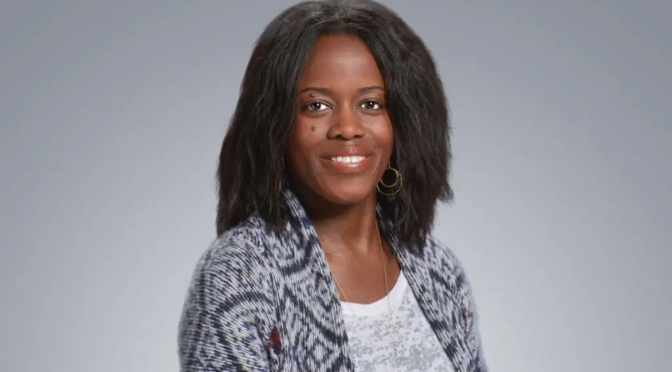
Behind Dr. Mandë Holford’s glowing smile and multiple STEM degrees lies a deep secret.
Efficient killers are her life’s work.
And those killers have the potential to change yours.
Well, they aren’t ALL killers…
The smallest cone snails carry a venom that’s no worse than a bee sting. But the largest of them—still only around 9 inches—pack enough power to kill humans in minutes.
Instead, Dr. Mandë is harnessing that power to kill pain and even cancer.
Like so many creatures of the deep, cone snails are beautiful but deadly. Every single one of the 3,200+ known species is carnivorous and venomous. Their decorative shells blend into the ocean floor, while a proboscis much like an elephant’s, but smaller, searches the water for prey. Once they’ve found a meal, cone snails deploy a small barb that envenomates with precision, incapacitating victims almost immediately.
Watch a cone snail strike moment-by-moment and learn how all of its different parts work to reel in an assortment of prey.
Cone snail venom works so efficiently because each species’ venom has thousands of individual components that each target different life functions. One may paralyze, while another targets respiration, and another blinds, rendering prey completely helpless. The only time a cone snail misses a meal is if it misses altogether.
So what does ANY of that have to do with medicine?
Imagine morphine—and every pain-killing opioid—becoming obsolete. Because cone snail toxins can directly target the nervous system, they can inhibit pain receptors with a medicine created by Mother Nature, instead of pharmaceutical companies.
Imagine stopping cancer’s growth in its tracks with simple, naturally derived injections instead of poisonous radiation treatments.
And imagine all of that from the hands of a little girl who loved the museum. At New York’s American Museum of Natural History, whole worlds unfolded before young Mandë Holford.
The Blue Whale display at the American Museum of Natural History’s Hall of Ocean Life.
But growing up always forces us to choose one.
Still, a BS in mathematics and chemistry and PhD. in Synthetic Protein Chemistry didn’t satisfy Dr. Mandë’s curiosity. But one day, the opportunity to study with a scientist who combined physics, chemistry and biology in his work came along, and reintroduced Dr. Mandë to science through the lens of a kaleidoscope instead of a microscope.
“This is what I would like to do,” she thought. “I’d like to bridge the medical training that I received at Rockefeller with the natural history and the wonder and excitement of studying what’s here in biodiversity. And figure out how to make science—how to do the kind of work that is both beneficial to society, but also exploring the wonder that’s here on our planet.”
And today, that is precisely what she does. Dr. Mandë’s work with cone snails and other venomous mollusks could revolutionize medicine.
See just how approachable & delightful Dr. Mande makes science in her TED Talk.
And that’s not just theoretically speaking. Prialt is an FDA-approved drug 1,000 times as potent as morphine with NONE of its chemical dependency. It’s also a direct derivative of cone snail venom. Dr. Mandë didn’t invent it, but she is working to perfect it. Right now, Prialt can only be administered through painful spinal taps. Dr. Mandë hopes to make it as simple as a booster shot.
But Prialt only utilizes one cone snail venom component, and there are thousands, if not millions, more to unlock for use in medicine. Each venom’s individual components—peptides—are tested to explore their effect on a variety of human cells. One such test revealed a peptide that specifically targeted liver cancer cells and inhibited their growth, a groundbreaking find. “What’s amazing about the peptides that we’re finding in the snail venom is not only are they giving us new drugs, but they’re also giving us new pathways for treating old problems,” says Holford.
All of these experiments and discoveries occur in their own little world bearing Dr. Mandë’s name: the Holford Lab at Hunter College at CUNY. But even outside of her lab, people take notice of Dr. Mandë. On a snail collecting trip to Papua New Guinea, she realized that all of the locals stared at her, a feeling familiar to many Black woman traveling abroad. “And you know, in your subconscious, you’re like, ‘What is it? Is it my hair? Do I have something in my teeth? What’s going on?’” But this time was different. This time, the locals stared because the chief scientist of a research team looked like them.
Discover more about what mollusks have to offer medicine at the Holford Lab.
“And it was something I wasn’t prepared for, because I didn’t view myself as a role model,” Holford says. “And I wasn’t trying to be anybody’s role model. You’re just trying to do your thing… but it was also empowering.”
With all that empowerment, Dr. Mandë hopes to bring other people who look like her into the fold. “I like to say that science is one of the cheapest careers. It’s like soccer—all you need is a ball,” she jokes. “In science, all you need is a brain, and all of us are born that way.”
And if you still aren’t convinced, consider the cone snail. It may be small. It may blend into its surroundings. But even without a backbone, this little creature wields the power of life and death… a power that only a few humans like Dr. Mandë Holford ever have the privilege to behold.
KEEP GOING BLACK IN HISTORY:
Explore the American Museum of Natural History interactively with Dr. Mandë as she works there today, thanks to the magic of Google Arts & Culture.
Learn more about Dr. Mandë’s background and research at Science Friday.
See the snails in action, while Dr. Mandë explains how their venom targets pain receptors and cancer cells on “Breakthrough: The Killer Snail Chemist,” a collaboration between national radio program Science Friday and the Howard Hughes Medical Institute.
Hear a panel of comedians try to get to the bottom of Dr. Mandë’s killer work on live show, podcast, and public radio program “You’re the Expert.”
If you like card games, you’ll love one based on Dr. Mandë’s research! “Killer Snails: Assassins of the Sea,” is supported by the National Science Foundation and 2016 Bit Award Winner for Best Tabletop Game.
With all the obvious arguments against discrimination and segregation, the smoking gun presented to the high court was little two baby dolls wielded by a Black woman.
Dr. Mamie Phipps-Clark photographed at Columbia University.
Dr. Mamie Phipps-Clark would have been a force against racism even without her groundbreaking research. Born in Hot Springs, AR in 1917, Dr. Mamie was one of the rare Black students with the privilege, persistence, and promise to graduate the city’s first high school for Black students with flying colors.
Attending Howard University at the peak of the Great Depression, she graduated with a Master’s in Psychology, a field where women, and especially Black women, were almost unheard of.
Certainly, this was more than anyone could have hoped from a small town girl in a segregated world. But Dr. Mamie’s barrier breaking was only just beginning.
In 1943, she became the first Black woman to graduate Columbia University with a Doctorate in Psychology. And she did so with a thesis that ultimately changed the shape of the nation.
Read the full study as published in the Journal of Social Psychologyhere.
“I became acutely aware of that in childhood, because you had to have a certain kind of protective armor about you, all the time … You learned the things not to do…so as to protect yourself,” she said, describing a phenomenon known to millions of Black children before and since. Dr. Mamie’s initial study included 150 Black children from a DC nursery school, and the results were summed up by her husband and fellow psychologist Dr. Kenneth Clark as “disturbing.” They wanted to dive deeper.
At Columbia, Dr. Mamie leveraged the university’s Ivy League status to further fund, explore and legitimize her work. The 1920s and 30s were widely known as “the era of scientific racism,” the belief that there is empirical and/or biological evidence to support white supremacy. By the late 1930s, Black and progressive white psychologists were working to debunk these theories, but a Black woman fearlessly asserting that “Black people were not limited by innate biological difference but by social and economic barriers to success” was entirely revolutionary.
And so was the evidence to prove it.
The “Doll Test,” as it’s come to be known, had a simple premise. 253 school-aged Black children—134 who attended segregated schools in Arkansas and 119 from integrated schools in Massachusetts—would be presented with four dolls—two Black, two white. But even that simplicity came with challenges: Black dolls weren’t manufactured in 1947, so Dr. Mamie had to paint white dolls Black instead.
With her dolls at the ready, the experiment was on: “Give me the doll that you would like to play with or like best.” “Give me the doll that is the nice doll.” “Give me the doll that looks bad.” “Give me the doll that is a nice color.” “Give me the doll that looks like a White child.” “Give me the doll that looks like a colored child.” “Give me the doll that looks like a Negro child.” “Give me the doll that looks like you.”
The majority associated positive traits to the white doll and negative traits to the Black doll. But these Black childrens’ responses to the last question shook the Clarks so deeply, they didn’t even want to publish the results. When asked to identify the doll that looked most like them, some of the children burst into tears.
Results showed that by age three, Black children were aware of their race and attached negative traits to their own identity, which were then perpetuated by a racist and segregated society. Dr. Kenneth’s summary of the Doll Test was especially clear and truly devastating: “These children saw themselves as inferior and they accepted the inferiority as part of reality.”
Dr. Mamie Phipps-Clark and the children she worked to give self-worth, shot for Vogue Magazine, 1968.
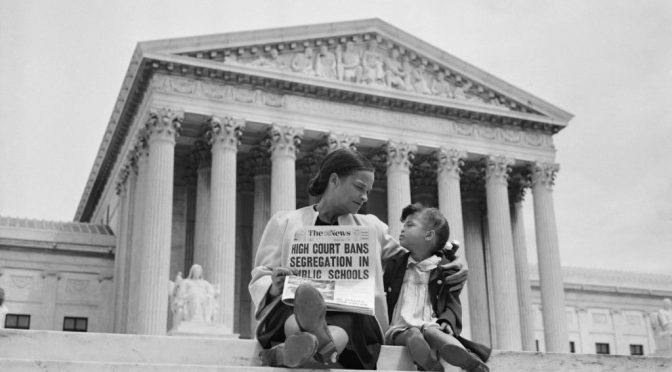
When a young upstart lawyer named Thurgood Marshall discovered the Clarks’ Doll Test, he presented its damning evidence to the Supreme Court in Brown v. Board of Education. And in a historically unanimous decision, Chief Justice Earl Warren agreed with Dr. Kenneth that “To separate [Black children] from others of similar age and qualifications solely because of their race generates a feeling of inferiority as to their status in the community that may affect their hearts and minds in a way unlikely ever to be undone.”
With the 1954 decision, segregation was ruled unconstitutional in the United States. And that’s not all. The Doll Test was the first time social science research was submitted as hard evidence in Supreme Court history.
Nettie Hunt and her daughter Nickie sit on the steps of the U.S. Supreme Court. Nettie explains to her daughter the meaning of the high court’s ruling in the Brown Vs. Board of Education case that segregation in public schools is unconstitutional.
In 2010, nearly 60 years after Brown v. Board, child psychologist and University of Chicago professor Margaret Beale Spencer revised the Doll Test for a pilot study testing both white and Black children. The results were not as progressive as one might hope.
Though all the children demonstrated a positive bias towards whiteness, white children much more frequently identified their own skin with positive attributes and darker skin with negative attributes. For instance, when asked to point to the dumb child, about 76% of the white children pointed to illustrations of the two darkest children. 66% identified the two darkest as “the mean child.” Dr. Spencer’s conclusion differed little from Dr. Kenneth’s all those decades before: “we are still living in a society where dark things are devalued and white things are valued.”
Devastated by the results of the Doll Test and the constant feeling of being an ”unwanted anomaly” in her field, Dr. Mamie Phipps-Clark left experimental psychology. Instead she focused her efforts on undoing the emotional, mental and educational damage inflicted upon Black children by a society that viewed them so negatively.
Read Dr. Mamie’s obituary detailing her many accomplishments at the New York Times.
As a psychologist at the Riverdale Home for Children, she counseled unhomed Black girls until 1946, when she and her husband opened the Northside Center for Child Development to provide psychological services to minority children in Harlem and study racial biases in education. 16 years later, the Clarks opened Harlem Youth Opportunities Unlimited to provide resources for Harlem schools and reduce unemployment among Black high school dropouts.
Though she died in 1983 without seeing her work complete, Dr. Mamie set about treating a wound the United States didn’t even know it had, setting us on a course to finally heal the toxic infection of racism.
KEEP GOING BLACK IN HISTORY:
Smithsonian Magazine details Dr. Mamie’s life, the Doll Test and the impact both had on the world.
(Ed. Note: this Blackstory includes sex work. Discretion advised.)
Over a hundred years before Cardi B ever dreamed of hustling her clients, Mary Jones perfected the art. Like Cardi, Mary was a New York City sex worker and absolutely unashamed.
Unlike Cardi, Mary Jones was born anatomically male.
And the dignity with which Mary carried herself contrast against the notoriety of her crimes made Mary Jones one of the earliest documented transgender people in New York history.
Court records from 1848 misspell Peter’s given name as “Savori,” but include his known alias Julia Johnson and derogatory nickname “Beefsteak Pete.”
Born in 1803 as Peter Sewally, Mary Jones used a whole host of aliases in her exploits: Julia Johnson, Miss Ophelia, and Eliza Smith among a few. But according to The Sun, and many subsequent newspaper reports, the hustle was always consistent.
“During the day, he generally promenades the street, dressed in a dashing suit of male apparel, and at night prowls about the five points and other similar [poor, disreputable] parts of the city, in the disguise of a female, for the purpose of enticing men into the dens of prostitution, where he picks their pockets if practicable, an art in which he is a great adept.”
The papers didn’t expect their readers to ask the obvious question: who needs to dress as a woman JUST to pick pockets?
The papers most certainly didn’t expect that the first time Mary had to answer for her crimes, she’d appear before the court in full female attire so impeccable, officials would ask her to confirm her legal name and born sex, even though she wore the exact same dress she’d been arrested in the first place.
Though the Sun was very tight with details, the New York Herald gladly served the tea: “Sewally has for a long time past been doing a fair business [in] practical amalgamation.” To put it plainly in modern-day language: having interracial sex for money. And it was highly uncommon. Even sex work was segregated, so from opening statements to the reading of the verdict, Mary Jones’ trial was so scandalous that nearly every detail is still recorded in the New York City archives.
As a man, Peter did not simply “promenade the street in a dashing suit of male attire,” he lived and worked as the doorman and butler at a brothel.
“I have been in the practice of waiting upon Girls of ill fame and made up their Beds and received the Company at the door and received the money for Rooms and they induced me to dress in Women’s Clothes,” she testified. “Saying I looked so much better in them and I have always attended parties among the people of my own Colour dressed in this way — and in New Orleans I always dressed in this way —”
Peter’s familiarity with sex work gave him a certain insight: dirty men would do anything to keep their dirty deeds quiet. So if he were to commit a dirty deed in return, what were the chances his crimes would actually be reported? And they would have stayed unreported, had Mary not looked SO much like a woman. One man wanted that woman to give him his money back.
A receipt issued by NYPD reads, “Recd. New York, July 16, 1836 rom the Police Office, Eighteen dollars by the order of the court, the same being part o the money stolen rom me by Mary Jones, alias Peter Sewally. Robert Haslem.”
On a Tuesday night in June 1836, Robert Haslem strolled past Bleecker Street where he met a Black woman, “dressed elegantly and in perfect style with white earrings and a gilt comb in her hair.”
“Where are you going, my pretty maid?” he asked, before gladly accompanying her to a nearby alleyway for some business, if you know what I mean. It wasn’t until departing her company that he noticed his own wallet was missing, and in its place was another man’s.
Haslem tried to return the wallet to its rightful owner, who vehemently denied it, before finally admitting he’d lost his wallet under the very same circumstances that his Good Samaritan had. With his wallet returned, there was even less reason to report. But Robert Haslem was still out of $100, and fully invested. The very next night, Mary was arrested for prostitution. Before being taken into custody, she made a last-ditch effort to dispose of a bit of evidence, but instead, the officer recovered two wallets, one of which belonged to Robert Haslem.
Up until the day of the trial, Robert Haslem insisted and even testified that he had relations with a WOMAN who robbed him. The night Mary was apprehended, even the constable had no reason to believe otherwise until his search uncovered a prosthetic. Realizing the full scope of the con, the cunning of its perpetrator, and the continued naivete of her victim, “his Honor the Recorder, the sedate grave Recorder, laughed till he cried.”
Every aspect of the case presented a truly outrageous scene for a 19th century courtroom. But Mary carried herself with such grace and dignity, despite onlookers who insisted on making her gender identity part of the spectacle.
The image of her reflects her appearance in court: soft, demure, feminine. But it’s titled “Man-Monster.” The trial appeared on the docket as “The People vs. Peter Sewally, alias Mary Jones,” so upon arriving, she was immediately outed and heckled mercilessly. One gallery member even snatched her wig off, eliciting “a tremendous roar of laughter throughout the room.”
Despite her poise and her plea, Mary Jones was found “Guilty” and sentenced to 5 years in Sing Sing for grand larceny.
Court documents show Peter Sewally, alias Mary Jones being sentenced to a term of five years imprisonment.
But she didn’t stop the hustle. Mary Jones and all her aliases appear again and again in newspaper archives and New York District Attorney’s case files as late as 1848, 12 years after her first trial.
Though mocked, maligned and misidentified, Mary Jones never backed down from who she was. Every time she was taken into custody, it was under a woman’s name. And with her courage, she created a precedent, as the first person in New York—home of the Stonewall Riots 133 years later—to go on the record as out, proud and unashamed.
KEEP GOING BLACK IN HISTORY:
Discover all of the spicy details behind Mary’s trial and continued arrests from historians, Jonathan Ned Katz and Tavia Nyong’o at OutHistory.
Image: “The Con Art of Peter Sewally” by Lezley Saar
Born enslaved in 1789, it took 21 years and an agreeable owner to purchase his own independence, and the first thing he did with it? Walked 700 miles from Kentucky to Virginia to free his father too.
Together, the pair walked BACK to Kentucky to liberate John’s mother and siblings. Inspired by John’s tenacity and limited in his own old age, John’s former owner, 100-year-old Paul Meachum, made a once-in-a-lifetime offer: he’d free ALL of his 75+ slaves if John would lead them out of Kentucky and into the free state of Indiana. So John did.
John Berry Meachum purchased & freed his own father for 100 pounds when Virginia was still a British colony.
Little did he know there was MUCH further to go. John returned to Kentucky only to find that his wife’s owners had moved to St. Louis, MO in his absence.
Two guesses what he did next.
By 1815, John and Mary Meachum were reunited in St. Louis where he eventually purchased her liberty, that of their children, and 20 more enslaved strangers as well.
The Meachums’ story could have ended there, happily ever after with everyone they loved free.
But in 1825, he set his sights on a new brand of freedom, founding the first Black church west of the Mississippi. It still exists today as the First Baptist Church of St. Louis. Until 1847, the church’s original basement secretly housed the Tallow Candle School, Missouri’s first school for free and enslaved Black children.
Just the year before, Dred Scott threw the entire state of Missouri into turmoil when he and his wife sued for their freedom in a case that went all the way to the United States Supreme Court. Missouri was a slave state, but its laws read that “once free, always free,” and before they were brought to Missouri, the Scotts had lived in two free states. They were also were church-going people, and Black churches provided a wealth of resources rarely accessible to enslaved people in particular: literature, privacy, and abolitionists.
Woodcarvings depicting Dred and Harriet Scott and their daughters Eliza and Lizzie.
In short, Black churches were a safe haven where slaves might learn to read, and subsequently learn to escape—circumstances that Missouri had to put a stop to. With their 1847 Literacy Act, Missouri forbade Black citizens from being educated, gathering for church services without the presence of law enforcement, and more.
The 1847 Missouri Literacy Law prohibiting Black Missourians from being educated, holding private church services, and moving freely into or out of the state. Read more in the Secretary of State’s Timeline of Missouri African-American History
But the state of Missouri didn’t know Reverend John Berry Meachum’s reputation for subverting the system. Where they made laws, he’d find ways… namely, the United States’ second-largest waterway: the Mississippi River. At its banks, Missouri’s state laws ended and federal regulation began.
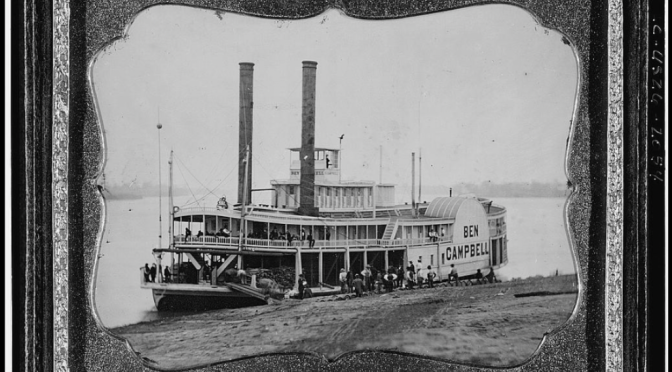
So John bought a steamboat, anchored it square in the middle of the Mighty Mississip’ where neither the state nor any nefarious mischief could touch it, and named it the “Floating Freedom School.”
The steamboat Ben Campbell commonly attributed as John Berry Meachum’s Floating Freedom School. Courtesy of the Library of Congress.
Equipped with its own library, classrooms, and all the standard trappings of a school, the Floating Freedom School was an act of defiance in broad daylight. And because Reverend John planned so carefully, there was absolutely nothing anyone could do about it. Until at least 1860, 13 years after its commission, the Floating Freedom School remained moored in the Mississippi River.
Unfortunately though, the school outlasted its founder. The good Reverend died the same way he lived: while shepherding his flock. On a Sunday morning in 1854, he suffered a heart attack in the midst of delivering his sermon.
Mary Meachum
But his work lived on. John’s wife Mary, who herself had been bonded out of slavery decades before, went on to free hundreds more as a major conductor of the Underground Railroad. One of the National Park Service’s 700 National Underground Railroad Network to Freedom “depots” across 39 states even bears her name: “The Mary Meachum Freedom Crossing.”
John Meachum’s Floating Freedom School also became the foundation and inspiration for more recently subversive “Freedom Schools,” created during the Civil Rights Movement of the 1960s to combat the “sharecropper education” Black students received in so-called “separate, but equal” schools. While their external reason for existing was to fill educational gaps, internally, the Freedom School curriculums included Black history, literature, theater and more, honoring and preserving Black culture in one of the few places they could outside the home.
All of this, set in motion by the footsteps of a man whose own freedom wasn’t enough if he couldn’t bring his people too.
KEEP GOING BLACK IN HISTORY:
Listen to the Atlas Obscura podcast about the Floating Freedom School as one of the “world’s most wondrous, unexpected, even strange places.”
Dive into more Missouri Civil Rights stories here.
Hear the St. Louis Public Radio‘s take on how “John Berry Meachum defied the law to educate” Black Americans.
Hear first-hand accounts from Freedom School students of the 1960s at the Library of Congress blog.


















 THE AMERICAN BLACKSTORY