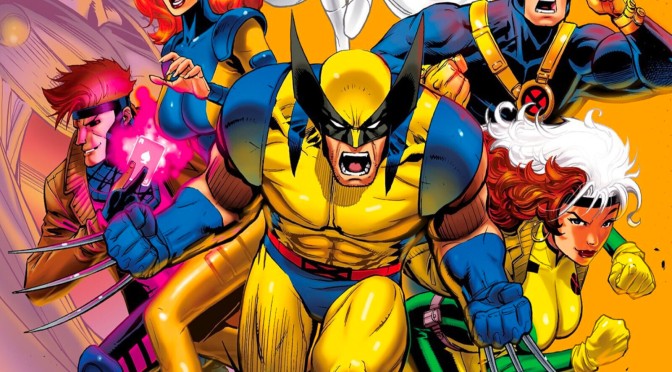
“Skip Intro” is a modern luxury, and according to Netflix, it’s here to stay since we smash it about 136 million times daily.
But it wasn’t always so. Just FIVE years ago, we proved our dedication to a series through the slow agony of watching the same intro over and over again, week after week, episode after episode.
The horror.
But every now and then, an intro kept us riveted, counting down the scenes until our favorite character was introduced for the thousandth time, or calling us from literally anywhere into the living room.
In 1992, one show gave us Xennials all of that and then some.
And that show—X-Men: The Animated Series—would have been nothing without the masterful touch of Larry Houston.

Though Larry grew up reading Jack Kirby and Stan Lee comics, and even concepted, wrote, drew and ultimately published his own comic in high school, life led him to a more practical career as a computer systems analyst.
And then it led him right back.
He was twenty-something in 1980 when childhood wonder came calling, and Filmation—the production house that brought you tons of Saturday Morning Cartoon favorites like Fat Albert, The New Adventures of Mighty Mouse, Ghostbusters, He-Man and She-Ra—hired Larry as their first Black storyboard artist.
His first production credit was on Thundarr The Barbarian, and the next, on The Tarzan/Lone Ranger/Zorro Adventure Hour, both iconic in their own right.
But it was the next entry on his resume that truly brought everything full circle and launched Larry’s career into orbit. In 1982, he earned great responsibility as a storyboard artist on Marvel Productions’ Spider-Man.

Courtesy of Larry Houston.
From there, his writing, storyboarding, and directing credits read like the Saturday Morning TV Guide.

The Incredible Hulk.
G.I. Joe.
The New Adventures of Jonny Quest.
Jem and the Holograms.
Teenage Mutant Ninja Turtles.
Captain Planet.
Double Dragon.
And of course, his 1992 pièce de résistance… X-Men: The Animated Series.
Of X-Men’s 76 episodes, Larry storyboarded 44, including the entire opening sequence. From 1992 to 1995, he also produced and directed the series, turning his childhood passion into the canonically-accurate, allegorically-rich, Easter-egg-riddled, gold standard of cartoons that we know and love today.
After all, who better than a BLERD (that’s BLack nERD for the uninitiated) to serve as steward of what Sean Howe, author of Marvel Comics: The Untold Story, called “the most explicitly political of the 1960s Marvel comics.” It was one of the first times in cartoon history that Black children saw themselves represented as powerful leaders rather than at best, sidekicks and comic relief, and at worst, mammies and savages, or dancing fools. Storm and Bishop manipulated weather and time to make weapons of the universe itself. Before a Black woman ever led the country, one led the X-Men. Though we didn’t know it then, a Black man entrusted with bringing all of this to life became a gift to an entire generation.


But he didn’t stop there. The list above is only a snippet of the incredible artistry Larry Houston brought to nearly every American under 50 years old. NBC’s “Community” even paid homage to his stellar career in 2014, tapping him as a lead storyboard artist in the episode titled “G.I. Jeff.”
These days, Larry’s empire has grown into his own entertainment company, he’s writing a superhero screenplay, re-visiting his past comics, and still reminding kids big and small that sometimes a dream is the only superpower you need.
KEEP GOING BLACK IN HISTORY:


Keep up with Larry’s work, news and appearances on his Instagram.

Larry talks to SYFY Wire about how his comic expertise kept “X-Men: The Animated Series” true to Stan Lee’s original vision.

Read Rolling Stone’s lost interview with Stan Lee on how the X-Men came to be.
 THE AMERICAN BLACKSTORY