
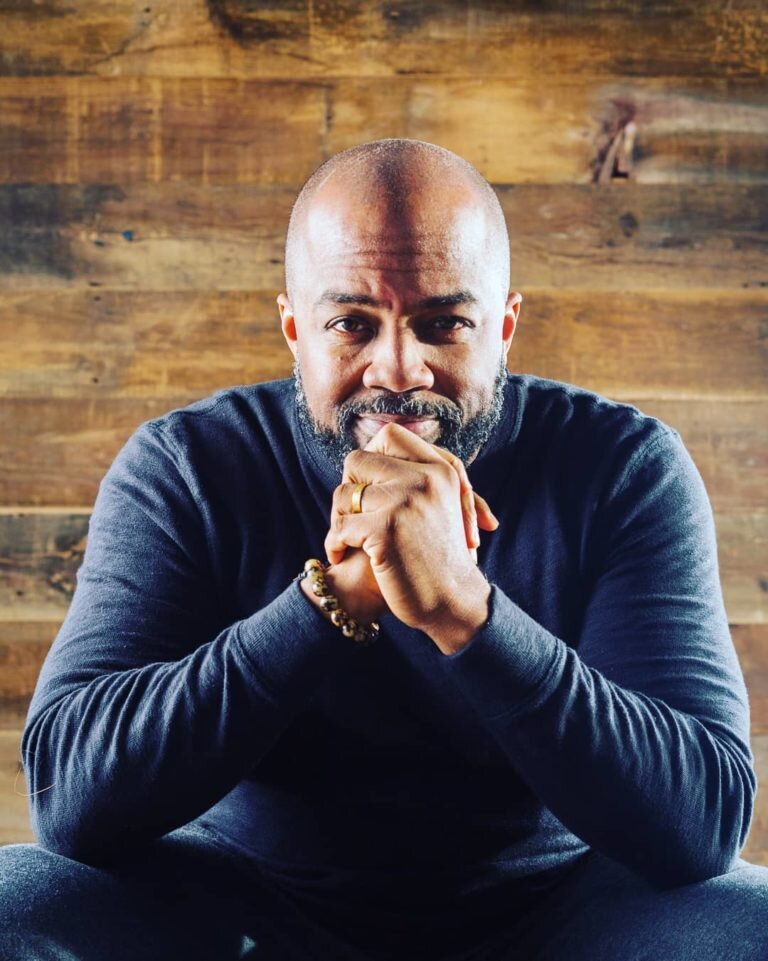
The day Changa Bell’s heart began to stop is the same day his life began to change forever.
His name means “strong as iron” in Yoruba, but the tangle of IVs and electrodes spider-webbing across his hospital bed, and the inescapable dread of closing his eyes for fear he might not open them again made him feel so weak and small. Every now and then, his heart would inexplicably stop, and no one knew for sure why. So here in a still, sterile room Changa, only in his early 30s, laid vowing that before he’d let doctors give him a pacemaker, he’d find a change of pace himself.
And he knew just where to start. The same person who’d taught him to be a man sat with Changa for the very first time and taught him yoga too. “I was raised in the ’80s, and yoga was totally not the cool thing to do,” so even though Changa’s father was a yogi, he’d never felt particularly compelled to practice yoga himself… until now. When his heart arrhythmia stabilized just a few weeks later, Changa was a believer.
But in his hometown of Baltimore where almost 63% of the population is black, he was an anomaly for a lot of reasons. Of course, black yogis are few and far between. But more importantly, yoga helped Changa escape a harsh statistic too many of his peers never did: black men have the lowest life expectancy in the United States. It was an alarming reality because the causes were nearly too innumerable to address – heart disease and stroke that claim 30 and 60 percent more black men than non-Hispanic white men, respectively; a suicide rate 4 times that of black women, when African-Americans are already 10% more likely to suffer serious psychological distress; and of course, inner city gun violence that claims too many young men’s lives.
The thought of all those ills affecting black men just like him could have been overwhelming. But Changa gave an old cliché new purpose when he discovered he could help address all of those issues with one simple solution: meditate on it.
It was a novel, and admittedly “hippie” approach, but one with science on its side too. The National Institutes of Health (NIH) list “stress management, mental/emotional health, promoting healthy eating/activity habits, sleep, and balance” as possible benefits yoga provides, and Changa himself was a living example. But like all things, getting others on board was easier said than done.
Even as someone intimately familiar with the practice of yoga, he couldn’t shake the discomfort that intruded on his peace of mind during every class. “Black men in particular were isolated from the yoga community. I didn’t fit the preconceived mold. We’re marketed as over-sexualized, hyper-violent, hyper-masculine,” he says. “I was the only male in a class of 17 people when I got certified. It was intimidating to me, and I didn’t want black men to not get the life-saving possibilities of yoga because they didn’t feel comfortable in a space with a bunch of strong, mostly white, mostly young women.” The centuries-long practice of yoga couldn’t erase America’s historic social dynamics between white women and black men, especially in a space with so little representation.
Motivated by his mantra “I am my light, my own responsibility, and that I am alone in accountability for the change that I wish to see in my world, which is really the change I wish to see in my life,” Changa took it upon himself to create the The Black Male Yoga Initiative in 2015.
In their own words, “Black Male Yoga Initiative creates integrated, supportive, safe spaces that empower our program participants to break down social stigmas, gain skills for human development and thus create positive social change in their own communities and our global community.” The organization “envisions a future, where race and gender are not social determinants of health, and where individuals are empowered to take on the path of self realization; that we may all join in the understanding that health is our collective heritage.”
An understanding of black men’s journey from commodification to criminalization gives Changa’s yoga practice a very special point of view. No matter what sort of ailments his students suffer from, his message for them remains the same: “You’re welcome here. Come and heal.” And they’ve taken it to heart. “Trauma is deeply intertwined in our existence. We get to express it here,” said one of the BMYI members. “Yoga brings balance. It puts everything I’ve ever went through into perspective.”
Changa hopes that attitude is one that ripples through the black male community, and he can see yoga transform and motivate black men in the same way it did for him. He’s set a goal to train and certify 1,000 yoga instructors aged 16-65 through BMYI, and this year, he’s going nationwide to make it happen on his “Health is Our Heritage Tour.” Pop-up workshops featuring dialogue circles, guided meditations, group life coaching, and of course, yoga sessions in six metropolitan cities will bring wellness to the black men exposed to it least but might need it the most.
It’s how now-47-year-old Changa is transforming his individual misfortune and personal enlightenment into something greater than himself. “We strengthen at an individual level in order to strengthen the community as a whole,” he says. In some circles, “namaste” – meaning, the divine in me recognizes the divine in you – is appropriated and overused, but at BMYI, black men seeing each other to wellness and truly being seen is nothing short of spiritual.
KEEP GOING BLACK IN HISTORY:
Learn more about the The Black Male Yoga Initiative and how to help or participate.

Read People Magazine’s feature on how Changa gives black men the space to love themselves.


 THE AMERICAN BLACKSTORY