Tag Archives: U.S. NAVY

DAY 4 — Shelby Jacobs

Shelly Jacobs - The Man Who Showed Space to the Human Race

“If you impress the crowd, the coach can’t put you on the bench.”

It was a lesson that Shelby Jacobs had carried with him since his high school years in the early 1950s. Even though only 1% of his class was black, he’d managed to become a 3-sport varsity athlete and a senior class president off undeniable hard work and merit. But when his high math and science aptitude scores gained him a scholarship to UCLA, his principal balked, saying “there are no black engineers, so you should take up a trade.”

Undeterred, Shelby attended UCLA anyway, and in three years, he was designing engines, hydraulics, pneumatics and propulsion systems for a NASA contractor. But there, he didn’t find it quite as easy to excel or fit in. As only one of eight black engineers in a company of 5,000, he struggled between seeking the camaraderie of his few black colleagues and becoming further marginalized, or strategically associating himself with successful white engineers and tolerating their constant microaggressions, and sometimes, outright racism in the workplace.

By 1965, Shelby’s juggling act had earned him the opportunity of a lifetime. NASA was launching the Apollo 6 mission in 3 years and needed to solve the problem of how to capture footage of the rocket separation sequence from an unmanned craft. Shelby designed, tested and ultimately perfected the camera system that captured the first iconic footage of the Earth’s curvature and the rocket’s segments burning in the atmosphere, re-igniting the Space Race.

In just a few minutes of film, Shelby Jacobs forever impressed the world.

It was April 4, 1968 – the same day that Dr. Martin Luther King, Jr. was assassinated.

That day held both his proudest moment and a sobering reminder that there was still so far to go.

For the next 28 years, Shelby continued in the space program, working his way up to the executive levels until he quietly retired in 1996. 10 years ago, as the “hidden figures” of the U.S. space program began coming to light, Shelby was officially honored by NASA as an Unsung Hero, and has used that recognition to make appearances, fund scholarships, and advocate for employing, protecting and fairly compensating more women and minorities in professional and technological fields.

Even though he’s 80 years old today, Shelby Jacobs’ personal mission isn’t over yet, because when he changed the world in 1968, “the doors of opportunity were not wide open –– they still aren’t.”

Editor’s Note: In a lovely moment of serendipity, Mr. Jacobs recently discovered that John Reid, one of the first black helicopter pilots in the Navy, was a member of the crew that recovered his film canisters from the ocean upon the camera’s separation from the spacecraft.


KEEP GOING BLACK IN HISTORY:

DAY 24 — Adm. Michelle Howard

Michelle Howard - First Female Four-Star Admiral

Michelle Howard just wanted to do her job. She was a black woman who’d excelled in the U.S. Navy for years, so naturally, all sorts of organizations wanted her to come share her stories, or to clink glasses with her at their parties.

In 1999, she’d become the first black woman to command a Navy ship, the USS Rushmore (LSD 47). And over the years, she’d also commanded tsunami rescue efforts, maritime security operations, and counter-piracy strikes. In fact, just three days into her counter-piracy command, she successfully led the well-documented rescue of Captain Richard Phillips from Somali pirates who’d hijacked & kidnapped him from the Maersk Alabama.

By then, she’d also won the Women of Color STEM Career Achievement Award, the USO Military Woman of the Year Award, the NAACP Chairman’s Award, and the Secretary of the Navy’s Captain Winifred Collins Award. She’d even started her career famously as one of the first women admitted to the United States Naval Academy.

Michelle didn’t get where she was by entertaining distractions. Back when she was little, she’d learned to stay focused after kids on the playground called her a n*gger and when she ran home crying, her father told her “You gotta toughen up. This is the country you live in.”

She wanted to shut out everything but the job when a few words from her mother changed her entire perspective: “You are where you are historically.”

So she embraced her place in history, and anything else that came along with it. Two years later, Michelle came to take it all.

Adm. Howard is pictured here with Rear Adm. Annie B. Andrews (L) and Rear Adm. Lillian E. Fishburne (C, ret.) as the first three black female admirals in the Navy.

On July 1, 2014, she became the first female four-star admiral, as well as the first black person and first woman to serve as Vice Chief of Naval Operations.

On June 7, 2016, she stepped down as Vice Chief of Naval Operations… to lead U.S. Naval Forces Europe-Africa/U.S. Sixth Fleet, becoming the first female four-star admiral to command operational forces in the process. She also leads NATO’s Allied Joint Force Command Naples – JFCNP in Italy. All that, and she’s only 56.

So when it comes to doing her job, as the highest ranking female in U.S. military history, I think it’s safe to say that she’s doing an all-around damn good one.


KEEP GOING BLACK IN HISTORY:

Adm. Howard discusses her experiences overcoming race & gender barriers with The Empowerment Project.

DAY 15 — Raye Montague

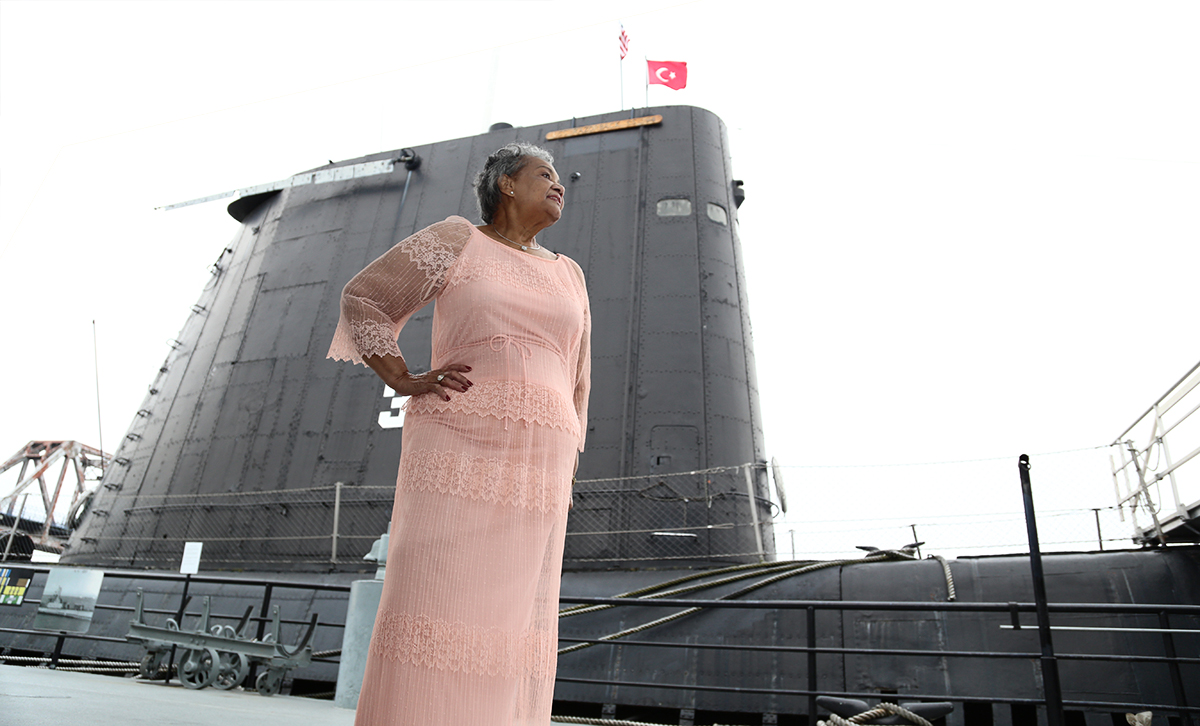
Raye Montague - Submarine Engineer

Raye Montague was 7 years old when she first saw the control panel of a submarine at a museum. When she asked the tour guide how it worked, he replied that understanding that was a job for engineers & she would never have to worry about it.

He was almost right. Because when little Raye grew up & graduated high school, still with a passion for understanding how things worked, she couldn’t get into a single engineering school. Because it was 1952 and she was black. So she went to business school instead.

Being black, female, and in the South, Raye knew that she had three strikes against her when it came to a career, but she also had a slight advantage in that her name was ambiguously gendered, so as long as hiring managers only received her resume, they had no idea that the person behind all that education was a black woman.

When her resume reached the U.S. Navy, someone assumed that with her degree, she knew computers. (She didn’t.) So she taught herself how to use one & write code, and for the next 14 years, she worked her way up the ranks from a system operator to a system analyst. She did her job so well that when President Richard Nixon tasked the Naval Ship Engineering Center with creating a new ship design in 2 months, Raye completed the task in just over 18 hours, becoming the first person to design a U.S. Navy ship with a computer & revolutionizing naval ship design in the process. (For reference, that ship became the USS Oliver Hazard Perry.) She was eventually the U.S. Navy’s first female Program Manager of Ships, as well.

Raye retired in 1990, but along the way, she won a slew of awards, including the Navy’s Meritorious Civilian Service Award and the Society of Manufacturing Engineers Achievement Award, the first woman to receive the honor.

Raye suffered tremendous racism and sexism as a black female civilian in the military, even receiving death threats & being warned not to accept one of her awards because a white woman hadn’t accomplished the same. (She accepted it anyway.) But she kept on working & in the end, she didn’t worry about controlling ships – she just designed them from the ground up.


KEEP GOING BLACK IN HISTORY:

Raye is not only brilliant, she’s a delightfully animated storyteller too. Enjoy a couple of minutes with her.

DAY 14 — John Dabiri

John Dabiri.jpg

You don’t even know it, but with John Dabiri’s help, the jellyfish has changed your future.

He’s one of Popular Science’s “Brilliant 10,” a Bloomberg BusinessweekTechnology Innovator, an MIT Technology Review “35 Under 35,” and a MacArthur Fellows Program “Genius” Grant recipient, because his research combining fluid mechanics, energy & environment, and biology – a field called bio-inspired engineering – has already influenced our lives.

John created reflective particles to track how jellyfish propel themselves through water, and in the process, learned about the human body & the atmosphere too.

Applying the jellyfish’s fluid dynamics to the human heart, he can detect signs of heart failure years in advance. When using his findings in the field of wind energy, he was able to develop a wind turbine that’s 10x smaller than the standard model. The U.S. Navy has him at work developing unmanned submarines that are 30% more efficient than the current design. His research is also inspiring other scientists who before, hadn’t even explored the effect that marine animals could have on how the ocean moves, the same way currents do.

At just 35, John’s entire future (and ours) is still ahead of him. He currently heads Stanford University’s Dabiri Lab, named after him in honor of his groundbreaking discovery & the continued applications of his science. But his brilliance wasn’t always so recognized. When John graduated from high school, the only college he applied to was Princeton. And when he got in, his HS biology teacher told the next class that it was only because he was black.

So much for that idea.


KEEP GOING BLACK IN HISTORY:

John’s MacArthur Fellows video is several years old, but it’s a great place to start understanding more about his research and its future implications.