Tag Archives: U.S. ARMY

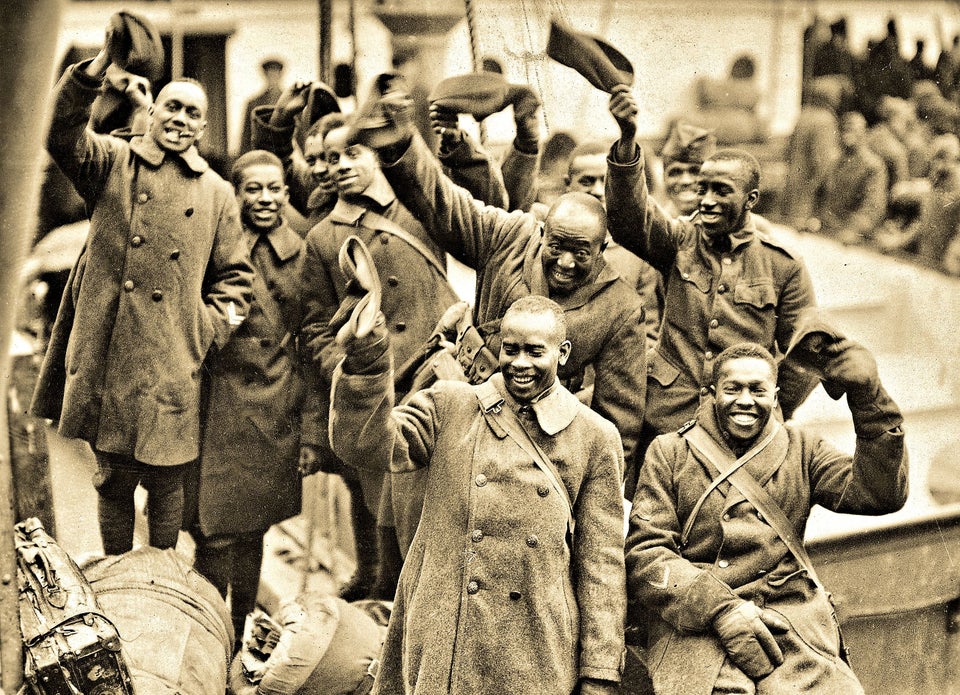
DAY 10 — The Harlem Hellfighters

On January 1, 1863, President Abraham Lincoln wrote:

“I further declare and make known, that such persons of suitable condition, will be received into the armed service of the United States to garrison forts, positions, stations, and other places, and to man vessels of all sorts in said service.”

Having finally received “unalienable” rights and having witnessed the admiration bestowed upon white soldiers over the course of 4 separate wars, many African-American men were hopeful that enlisting and serving the United States by choice would force Americans to think better of the whole race.

But the words of the Emancipation Proclamation couldn’t sway the hearts and minds of men, especially when those words were undermined by another sitting president.

When the Buffalo Soldiers, went to battle on behalf of the U.S. Army in the Spanish-American War, Rough Rider Frank Knox said, “I never saw braver men anywhere.” Lieutenant John J. Pershing wrote, “They fought their way into the hearts of the American people.” President Teddy Roosevelt went on record saying “Negro troops were shirkers in their duties and would only go as far as they were led by white officers.”

Less than a decade later, the Harlem Hellfighters would make him eat crow.

When the United States joined the war against Germany, they did so woefully underprepared. American military forces had never gone to battle overseas before, and the Army’s ranks of a mere 126,000 men wasn’t going to cut it. Of the Armed Forces that existed at the time, only the Army allowed African-Americans to enlist for combat, even though it was hardly on an equitable basis. There were only 4 “colored regiments” and once their ranks were filled, the rest of the Black applicants who’d lined up for service were turned away. When Selective Service began in 1917, men of color were told to tear a corner of their draft card away so they could be easily identified and assigned. In the thick of World War I with the Central Powers devastating Allied forces in Europe, U.S. draft boards used those torn corners to send as many Black men to the front lines as they could.

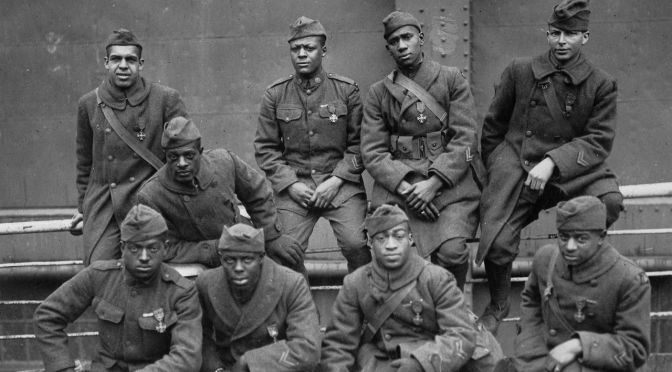
The men of the 369th Regiment however, scrubbed toilets stateside when they first enlisted, relegated to menial and filthy tasks like slaves, even though they’d volunteered for service. But when the war demanded more soldiers, the 369th went from toilets to trenches , being upgraded to Infantry, and shipped off to France for three weeks of combat training before being stationed on the war’s front lines.

The 369th in the trenches.

But even there, they weren’t considered “soldiers.” White Col. William Heyward begged that the 369th be allowed to actually serve on the battlefield, rather than dig trenches, unload ships, and other manual labor they’d been assigned to, as if nothing had changed at all. Army command compromised, assigning the 369th to the French Army instead.

When it came to the 369th and many other all-Black regiments, the Army didn’t send soldiers or reinforcements, they sent human shields expected to die. They never dreamed that the 369th would gain the respect of the French, who’d nickname them “Hommes de Bronze,” or come to be feared by the German Army who first dubbed the 369th as Hollenkampfer (“Hellfighters”). The Army most certainly didn’t expect that the 369th Regiment would be the very first Allied force to breach Germany’s borders.

The Croix de Guerre awarded to Lawrence McVey, a Harlem Hellfighter from Flatonia, TX.

But the Army wasn’t entirely wrong. The Hellfighters spent 191 days in combat, more than any other unit in the war and suffered losses to match, with hundreds dead and thousands wounded over the course of their deployment. Those losses were deeply felt by Captain Arthur Little who wrote, “What have I done this afternoon? Lost half my battalion—driven hundreds of innocent men to their death.” Those who survived fought their way to becoming some of the most decorated American soldiers in history… by another nation. The entire 369th Regiment was awarded the Croix de Guerre, the French Medal of Honor, and over 170 of its servicemen were honored individually. The Hellfighters Band was even honored, being largely credited as Europe’s first introduction to jazz.

The Harlem Hellfighters were so much more than infantry. Their ranks included skilled musicians like James Reese Europe and jazz legend Eubie Blake. Read more about the Harlem Hellfighters Regimental Band here.

Sgt. Henry “Black Death” Johnson earned a personal mention in the war dispatches of Gen. John J. Pershing, commander of the entire American Expeditionary Forces and the same man who, in the words of Col. Heyward, “simply put the black orphan in a basket, set it on the doorstep of the French, pulled the bell, and went away.” With only a bolo, 5-foot-4, 130 pound Sgt. Johnson single-handedly defended himself and his wounded partner against armed German soldiers who raided an Allied outpost. President Roosevelt would later name him as one of the “five bravest Americans” of World War I.

Thousands of New Yorkers welcomed the veterans of the Hellfighters home.

“Up the wide avenue they swung. Their smiles outshone the golden sunlight. In every line proud chests expanded beneath the medals valor had won. The impassioned cheering of the crowds massed along the way drowned the blaring cadence of their former jazz band. The old 15th was on parade and New York turned out to tender its dark-skinned heroes a New York welcome,” the New York Tribune wrote of the Hellfighters’ homecoming parade down Fifth Avenue. See more beautiful newspaper spreads and historic news accounts of that day at the Library of Congress digital archives.

And then forgot them altogether.

Lawrence McVey’s service photo, preserved by the Smithsonian, inscribed “hero.”

In the best cases, the Hellfighters drifted back into their lives, and lived in relative anonymity. In the worst cases, like those of Lawrence Leslie McVey, their remarkable service earned them a death by beating in the streets of New York.

Despite all of those medals abroad and the pretty words spoken, the United States didn’t award the 369th Regiment anything until 2015. By then, no one survived to accept the Congressional Medal of Honor awarded to Sgt. “Black Death” Johnson who was injured in combat 21 times. On August 21, 2021, the entire unit was finally recognized posthumously with a Congressional Gold Medal, awarded since the American Revolution as the country’s “highest expression of national appreciation.”
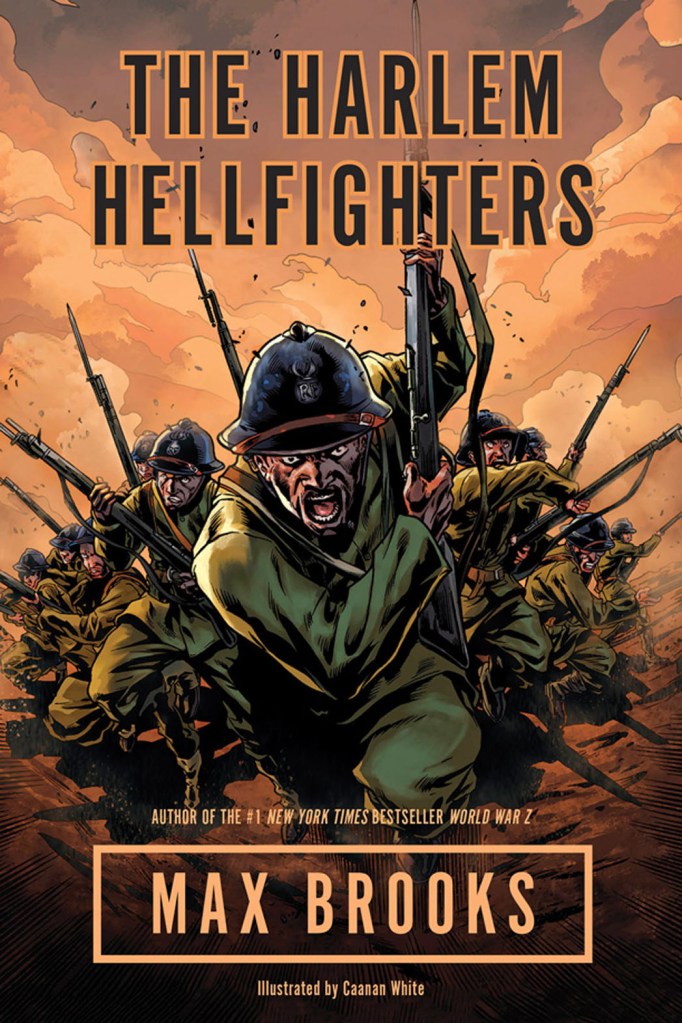
In addition to World War Z, Max Brooks also wrote The Harlem Hellfighters.

Tomorrow, February 11 will be the anniversary of the Hellfighters’ return to the States. The 3,000 men who marched Fifth Avenue that day were only a small portion of the “25 percent of Americans fighting in France [as] hyphenated Americans,” according to Lt. Col. ML Cavanaugh and Max Brooks (yes, World War Z Max Brooks), fellows at West Point’s Modern War Institute. Those other 25% included Choctaw code-talkers whose language was unbreakable abroad, Chinese Americans, Latinos like “Pvt. Marcelino Serna, a Mexican American who migrated to El Paso before the war, took out an enemy machine gun, a sniper, and an entire German platoon on his own, becoming the most decorated Texan of World War I,” and so many more who’ve been forgotten.

I hope you’ll spend the day paying tribute to those Americans who didn’t let the hyphens and racism visited upon them by others stand in the way of sacrifice and the fight for their own unrealized freedom.

KEEP GOING BLACK IN HISTORY:

Read the National Museum of the United States Army account of the wars the Harlem Hellfighters fought at home and abroad.

Smithsonian Magazine features more personal details of the lives, accomplishments and times of the Harlem Hellfighters.

Browse the Smithsonian National Museum of African-American History and Culture’s “Double Victory: the African-American Military Experience” here.

DAY 18 — Charles Gittens

Charles Gittens - Black At the President’s Side

It was the dead of night when hysterical screams came from the First Lady’s Hyannisport bedroom.

Luckily, one of the United States Secret Service’s most level-headed agents was the first to Jackie Kennedy’s side… even though her assailant was only a giant flying bat.

From an early age, the call to serve his country in some capacity was so strong that shortly before he graduated from high school, Charles Gittens decided to enlist in the U.S. Army instead.

There, he earned his GED and a whole lot more. He ultimately served as a lieutenant in Japan during the Korean War, and once discharged, he earned two 4-year degrees in English and Spanish within just 3, with Magna Cum Laude designation.

He’d spent a year teaching in North Carolina when his friends encouraged him to take a government civil service exam. The Drug Enforcement Administration (DEA) was recruiting black agents and it couldn’t hurt to try, right? His high test scores, bilingualism and military background caught the attention of the Secret Service instead.

And so, in 1956, Charles Gittens became the first black agent in the United States Secret Service.

But it almost didn’t come to pass. The civil service exam was given in two parts: written and oral. After having passed the written exam, he traveled to an Atlanta regional office for the oral portion, where for one reason or another, the facilitator had it out for him. “The guy in charge had scribbled things down like, ‘speaks incoherently’ or ‘can’t be understood.’ Can you imagine such a thing?” he recounted. When he insisted on another facilitator he passed with flying colors, but never did get an explanation for the wild discrepancy.

Of course, Charles didn’t let the rough start hold him back. From his initial appointment in North Carolina, he was promoted to the agency’s largest field office in New York, where he investigated counterfeits and protected visiting presidents along with other dignitaries for 10 years. He was such an impressive and inspiring leader that he was subsequently promoted to senior agent of the Island of Puerto Rico, and finally in 1971, special agent in charge of the Washington, D.C. office, a job that put him on regular presidential protection and supervisory duties over more than 100 other agents.

He’d been so welcomed by his peers, dignitaries and presidents, and had operated in a world so separate from civilians that it was often easy to forget the racism that lurked just beyond the government’s most protected walls. But that didn’t mean he was immune to them.

“At that time, I was not a ‘negro,’ I was a Secret Service agent,” explaining how his job had become second nature to him. But the looks on the faces of the diners as he walked straight past a “No Negros” sign and into a restaurant where he was meeting other agents for breakfast told him otherwise. After an awkward wait, the manager came out and told the other agents they wouldn’t serve a black man. Despite the others coming to his defense, Charlie kept his dignity and left the situation, reminding them that they were always representing the President of the United States. (One account says the owner caught up to Charlie, apologized for the disrespect and served him after all.)

By the time Charlie ended his Secret Service career in 1979, he’d become the deputy assistant director overseeing all of the Secret Service field offices. In his 23 years of service, he protected Presidents Eisenhower, Kennedy, Johnson, and Nixon, countless diplomats, and the best interests of the country in myriad ways. And he continued doing so. After retiring from the Secret Service, he joined the Department of Justice’s Office of Special Investigations, tracking down and bringing war criminals hiding in the US to pay for their crimes.

Though he died in 2011 at the age of 82, he left a legacy of inclusion as a living testament to his devotion. During his career, he was a founding member of the National Organization of Black Law Enforcement Executives (NOBLE), dedicated to “fairness in the administration of justice, police community relations, [and greater inclusion] of black police officers.” In each of his ranking positions, the Secret Service encouraged Charlie to recruit more female and black agents. Today, there are nearly 400 of each among approximately 3500 special agents due largely in part to Charlie’s efforts, his leadership and his determination to serve, no matter the return.


KEEP GOING BLACK IN HISTORY:

Upon his death, The Boston Globe featured a complete and truly inspiring obituary for Agent Gittens.

DAY 23 — Bessie Stringfield

Bessie Stringfield - Lifelong Motorcyclist

When 16-year-old Bessie Stringfield asked for a motorcycle, she didn’t even know how to ride one.

That didn’t stop her from becoming the first black woman to complete a solo cross-country motorcycle ride 3 years later in 1930.

Bessie & her 1928 Indian Motorcycle Scout traveled to all 48 continental States, and even a handful of international destinations. But she did so with the knowledge that it would be harder out there on the road for her, especially alone, because she was black. Bessie sometimes slept in parking lots on her motorcycle because no one would rent a room to a black person. A white man once followed and ran her off the road, just because he could. Later in her career, she was regularly harassed by police officers in Miami who would pull her over constantly & told her that “n*gger women are not allowed to ride motorcycles.” They obviously didn’t know Bessie.

Bessie funded her motorcycle rides by performing stunts in local carnivals and winning prize money in motorcycle competitions, and she was so good, people eventually called her the “the Motorcycle Queen of Miami.” But perhaps they should have called her the Motorcycle Queen of the United States, because Bessie wasn’t just an incredible leisure rider — she found a way to use her passion to serve her country too.

During World War II, Bessie was a civilian dispatch rider for the U.S. Army, responsible for carrying messages across distances to other domestic bases, especially when there were fears that military communications were compromised. And she had the perfect cover — no one would have suspected that a black woman on a motorcycle would be carrying important missives for the armed forces, and yet, there she was.

After her first Indian, she switched to Harleys and rode 27 of them in her lifetime, so in 1990, the American Motorcyclist Association honored her in their inaugural “Heroes of Harley-Davidson” exhibit. In 2000, the AMA recognized her again with the “Bessie Stringfield Award,” presented annually to individuals who’d made great strides in introducing new communities to motorcycling. And finally, she was inducted into the AMA Motorcycle Hall of Fame in 2002. Bessie died in 1993 at the ripe old age of 82, so she didn’t live to see most of the honors she received, but when she passed, she was undoubtedly happy. Before her death, doctors advised her to give up riding. Her answer? “I told him if I don’t ride, I won’t live long. And so I never did quit.”


KEEP GOING BLACK IN HISTORY:

DAY 16 — Wereth 11

Wereth 11 - Heroic Artillery Battalion

World War II’s 333rd Field Army Battalion was composed of some of the first black enlisted men trained in combat, rather than service positions.

The 11 men who were the 333rd’s Charley Battery quickly made names for themselves through their deadly accuracy with artillery, destroying a German tank 9 miles away in 90 seconds. But that fame also made them targets to a German army gasping for its last breath.

On December 16, 1944, Charley Battery was separated from their unit. They found safety in the tiny 9-house hamlet of Wereth, Belgium, just on the German border. The Nazi SS was tipped off & raided the village, demanding the soldiers’ surrender. To prevent any harm to the locals, Charley Battery surrendered peacefully.

Rather than being kept as prisoners of war or executed immediately, the 11 men were brutally tortured. Many were missing fingers, had broken legs, suffered bayonet & barrel stock wounds to the eyes & head, and suffered multiple, non-lethal gunshot wounds before they were finally killed & left in the snow, where their bodies remained until documented by the Army in February 1945.

These weren’t the only American soldiers the SS committed war crimes against. But they were the only soldiers whose sacrifice went seemingly ignored. The 1949 Senate Armed Forces subcommittee recorded a dozen similar SS atrocities, but omitted the massacre of Charley Battery. On the 50th Anniversary of the soldiers’ deaths, the son of the man who’d sheltered them erected the monument pictured here, memorializing them as the “Wereth 11.” It’s the only known monument in Europe that honors the black soldiers who fought in World War II.

In 2013, Congress passed a resolution reissuing the original 1949 subcommittee report to include the Wereth 11, awarding them with multiple combat medals, including the Bronze Star and the Purple Heart.

Like many black soldiers who fought in American wars at home & abroad, the Wereth 11 bravely defended a country that didn’t defend them. Throughout our country’s history, but now more than ever, we’ve needed to be reminded that red-blooded Americans come in every color.

In honor of the sacrifices of:
Corporal Bradley Mager
Staff Sergeant Thomas J. Forte
Technical Corporal Robert L. Green
Technical Sergeant William E. Pritchett
Technical Sergeant James A. Stewart
PFC George Davis
PFC Jimmie L. Leatherwood
PFC George W. Moten
PFC Due W. Turner
Private Curtis Adams
Private Nathaniel Moss


KEEP GOING BLACK IN HISTORY:

Read the resolution that finally officially recognized the Wereth 11.

DAY 4 — Drs. Vince & Vance Moss

Moss.jpg

Vance & Vincent Moss are twins. And surgeons. And heroes.

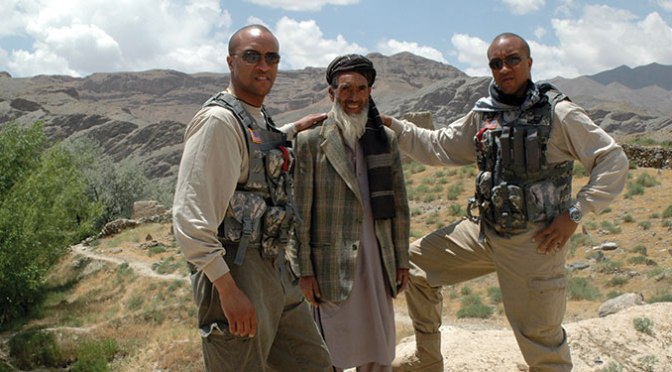
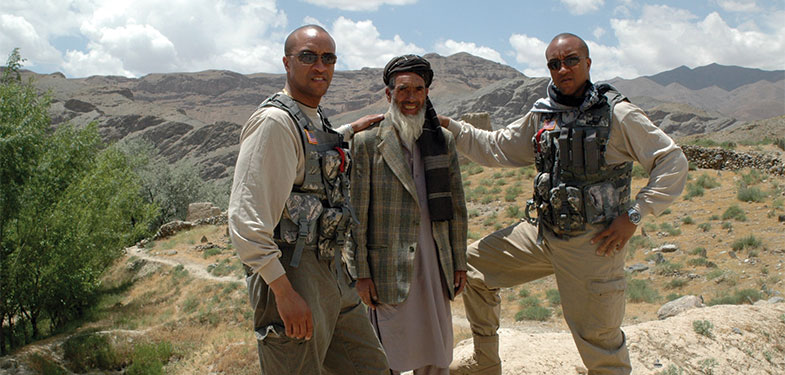
Back in 2006, when they were treating injured veterans at Ft. Bliss and Ft. Jackson as part of their duties in the U.S. Army Reserves Medical Corps, the vets told them stories of how the people who really needed help were the innocent Afghani civilians who’d been injured too, but had no sufficient medical services or facilities. The women & children were in especially dire need.

The brothers went to Army leadership to make a special request to provide their services in treating those civilians, but while the Army supported them, it couldn’t send them in an official capacity. So the brothers hired their own intelligence and security, bought their own medical supplies, chartered their own plane and went.

In between their duties in the Reserves and their joint practice at home as a urology specialist & kidney transplant surgeon (Vince) and a cardiothoracic surgeon (Vance), they’ve treated well over 6,000 Afghanis and performed surgery on 2,000 of them. Their service has been emotional and dangerous, putting them and their patients in dangerous situations – they’ve been robbed, they’ve negotiated with drug lords, and operated in caves, but they’re currently planning another trip to provide free care to anyone who needs them and anyone they can reach. Their rapport with the locals in the regions they serve has allowed them access to places that Army forces couldn’t go themselves.

In recognition of their service that’s included several active duty tours in Operation Enduring Freedom, the brothers have been promoted to Major and received the Army Commendation Medal for distinguishing themselves through heroism, meritorious achievement or meritorious service.


KEEP GOING BLACK IN HISTORY: