Tag Archives: THE AMERICAN BLACKSTORY 2022

DAY 18 — Philip A. Payton Jr.

The major difference between racial terrorism in the North and the South was the publicity.

Escape to the North and you may avoid a spectacle of a lynching, but that still didn’t make you welcome.

Take the case of Harlem, NY.

Now considered one of the most historic African-American communities in the United States, it was once entirely white and there were a lot of folks invested in keeping it that way.

Real estate investors, to be specific.

The neighborhood just north of Manhattan was booming in the late 1800s. Oscar Hammerstein’s first opera house, the world’s largest gothic cathedral in St. John the Divine, and Columbia University all opened or began construction in Harlem within 8 years of each other. Property was being snatched up left and right to support new expensive apartments, some priced up to 800% more than those in Manhattan. Harlem was destined to be the height of luxurious living.
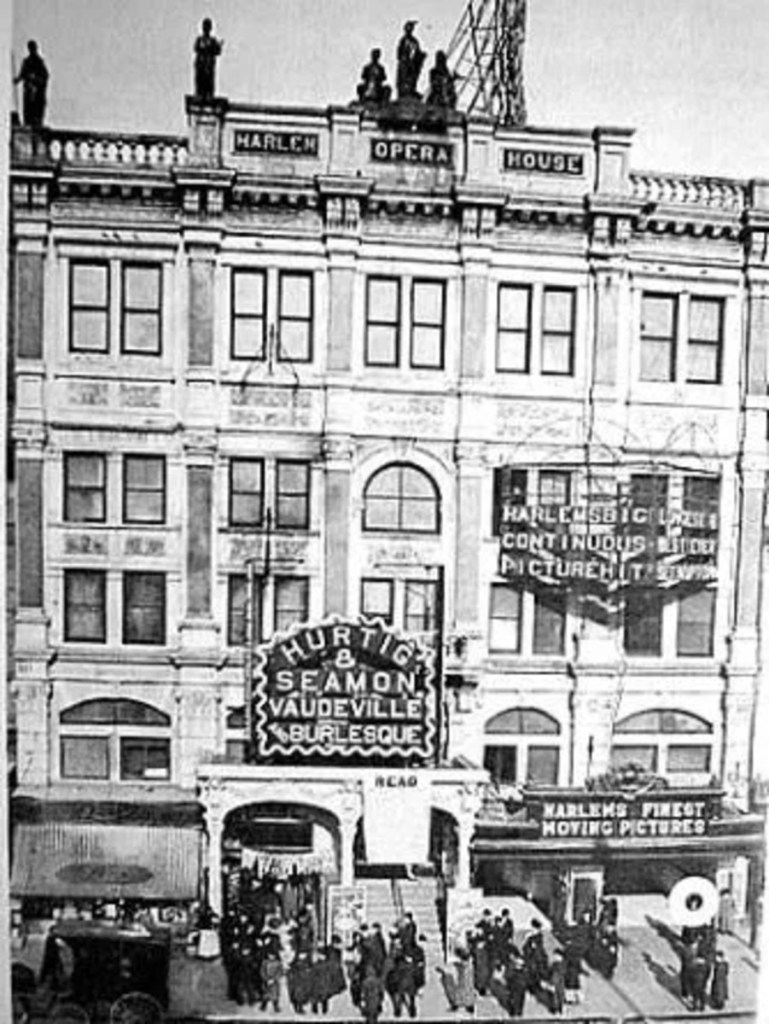
But the city was growing everywhere, and by 1904, developers and dwellers were already on to New York’s next hotspot. All those high-dollar rents were plummeting as whole buildings purchased in anticipation of continued growth suddenly stood empty.

But Philip A. Payton Jr. had been biding his time. After a few odd jobs and small business ventures, he’d discovered a passion for real estate. And then spent his last dime on classified ads. 

“COLORED TENEMENTS WANTED | Colored man makes a specialty of managing colored tenements; references; bond. | Philip A. Payton, Jr., agent and broker, 67 W. 134th.”

If it ain’t broke, don’t fix it. A 1907 New York Age classified ad taken out by Mr. Payton reads almost the same as his first.

Whatever property did come his way would have to come cheap. And racism was about to get Philip out of the red.

“My first opportunity came as a result of a dispute between two landlords in West 134th Street. To ‘get even’ one of them turned his house over to me to fill with colored tenants,” Philip recounted to the New York Age.

An ad in a 1906 issue of the New York Age shows how busy Mr. Payton was with Harlem real estate.

The race to own Harlem was on. With a few rent payments in his pocket, Philip purchased even more luxury properties at rock-bottom prices to pass on to new, Black tenants.

And the locals were not happy about it. White New Yorkers weren’t willing to share their space with people of color and their white brokers knew it. If things kept up at this rate, they’d have even more empty buildings on their hands, so the brokers started biding their time too. The second Philip sold some of his predominantly African-American tenements to free up some cash, the white brokers snatched it up, evicted his tenants, and made the buildings white-only again.

Well, Philip knew how to be slick too.

Two buildings managed by those white brokers were up for sale on the same row, sandwiching the ones he’d sold. He bought those two buildings, evicted all of the white tenants, replaced them with Black ones, and created the exact crisis the white brokers were trying to avoid. Suddenly in the middle of a Black block, the white tenants fled and their brokers had to put the buildings back up on the market.

Guess who bought them for even less than he sold them for.

In the midst of all of this buying and selling, Philip recognized that he couldn’t take on the entire Harlem real estate establishment, so he formed an organization that could. On June 15, 1904, the Afro-American Realty Company was chartered and funded. With 50,000 shares issued at $10 each to wealthy African-Americans, the Afro-American Realty Company bought properties throughout the neighborhood, turning Philip’s vision into whole blocks of thriving Black families.

Read the full article at the NYT’s “Times Machine” here.

He saw Black folks using the circumstances stacked against them to come up. The New York Times saw a “Real Estate Race War.”

The Afro-American Realty Company didn’t last, but the trend did. Philip opened the Philip A. Payton Jr. Company, and spurred by his continued success in the neighborhood, many of Philip’s former AARC co-investors followed suit. By 1905, newspapers reported on the shifting demographics in Harlem like a plague had descended. “An untoward circumstance has been injected into the private dwelling market in the vicinity of 133rd and 134th Streets.” the New York Herald reported. “Flats in 134th between Lenox and Seventh Avenues, that were occupied entirely by white folks, have been captured for occupation by a Negro population… between Lenox and Seventh Avenues has practically succumbed to the ingress of colored tenants.”

Read the full article at the NYT’s “Times Machine” here.

Though their language left something to be desired, the Herald wasn’t wrong about the tidal wave of African-Americans who seemed to own Harlem overnight. By 1915, just over a decade after Philip first moved to an all-white block himself, census records showed nearly 70,000 Black residents had moved in right behind him. In 1917, he officially staked his claim in Harlem with the biggest purchase of property by Black broker that New York had ever seen. Philip bought six buildings at $1.5 million, naming them all for historic Black figures, building more community from that sense of pride.
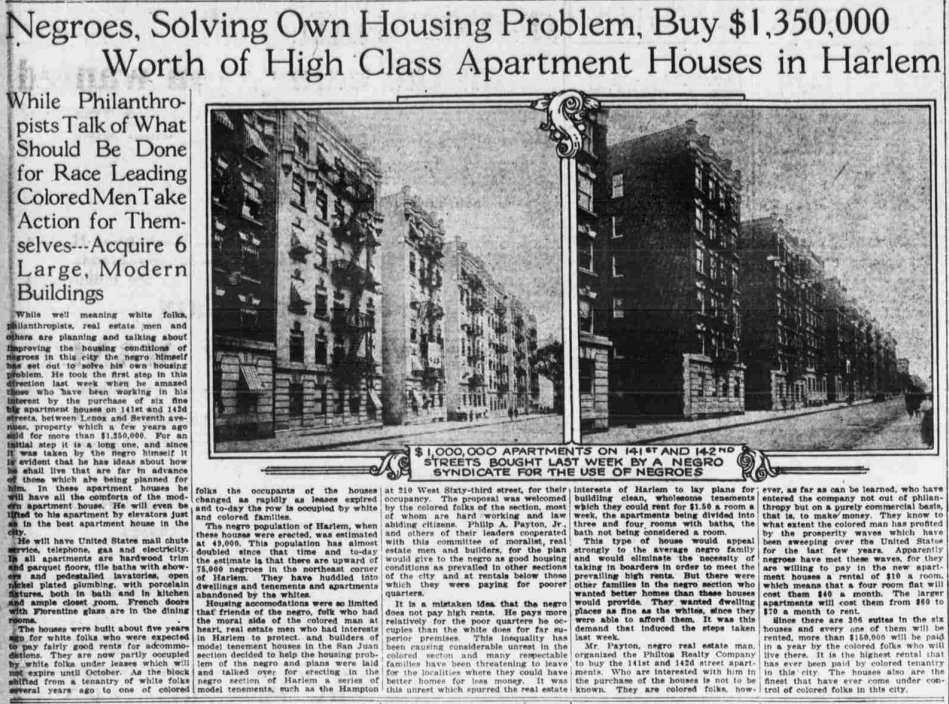
For his lifetime of groundbreaking development, Philip was called the “Father of Harlem,” and though he died at 41 years old, just a month after his historic $1.5 deal, the foundation he laid lived on. It’s no coincidence that in 1920, the Harlem Renaissance officially began. Even the National Institutes of Health recognize that psychological safety—”the belief that you won’t be punished or humiliated for speaking up with ideas, questions, concerns, or mistakes”—leads “to increased proactivity, enhanced information sharing, more divergent thinking, better social capital, higher quality, and deeper relationships, in general, as well as more risk taking.”

Free from the fear of their homes falling under constant threat from the whims of white people, whether they were southern night riders or northern bankers, African-Americans finally had the luxury of creating something beautiful, and in doing so, absolutely changed the world.
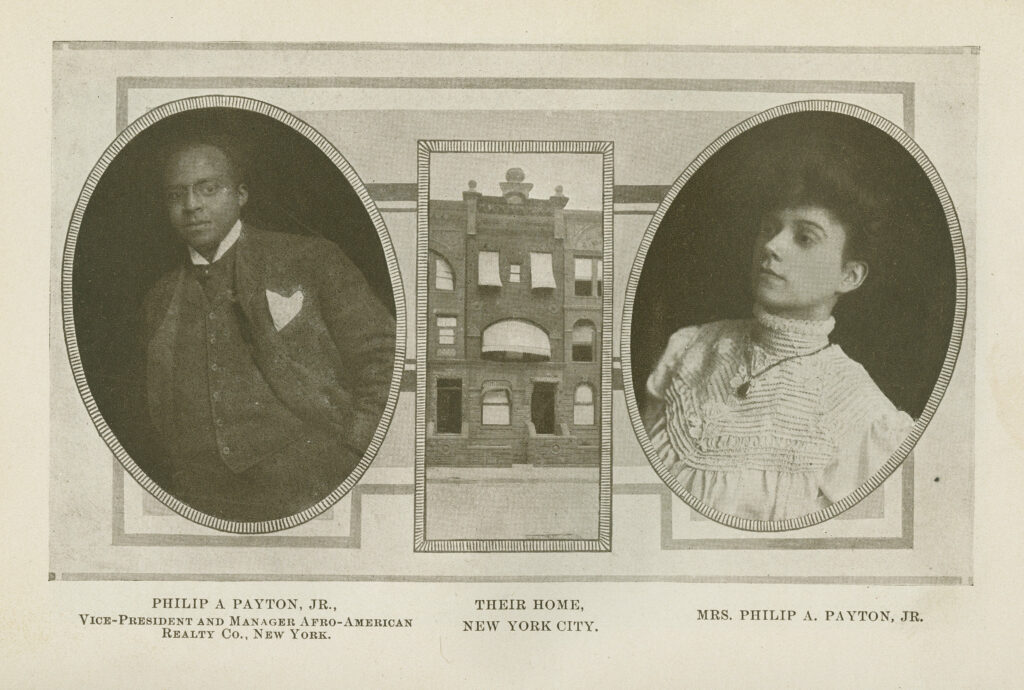
Philip and Mrs. Payton went from rags to riches in Harlem, and were even presented in print like they were royalty.

KEEP GOING BLACK IN HISTORY:

Though the New York Times ran articles about him and what he was doing in Harlem, their Overlooked series is the first to truly acknowledge its positive impact.

Philip wasn’t the only wildly successful Payton. Read through an accounting of his accomplishments, as well as those of his siblings at Westfield State University in the town where the Paytons once flourished.

DAY 17 — Oscarville & Lake Lanier

Death looms so large over Georgia’s Lake Lanier that people say it’s haunted.

Since it was filled in 1956, it’s estimated that nearly 700 people have lost their lives in its waters or at its banks in boating accidents, drownings, and unexplained events. Official reports list at least 24 people as “missing” there because what lies below the lake’s surface makes searching it nearly impossible.

Beneath those unrecovered souls, wrecked boats, discarded nets, and silty waters lie the charred remains of the Africa-American community of Oscarville, GA.

Before 1912, Oscarville’s people thrived as farmers, teachers, ministers and tradespeople of all sorts.

Harrison, Rosalee, Bertie, Fred, Naomi, and Minor Brown were among the thriving residents of Oscarville, in a photo taken in 1896.

Their world started to unravel on September 5th of that year, when a white woman accused a Black man of entering her bedroom and attempting rape. When a local preacher mentioned that perhaps the woman had not been entirely forthcoming in her account, suggesting the encounter may have been consensual, he was nearly beaten to death right in front of the Oscarville courthouse.

Tensions between the segregated populations of Forsyth County were so high that the Governor of Georgia activated the National Guard to stand patrol and keep the peace.

Just 4 days later, that fragile peace was shattered when another white woman was found dying in the local woods, an apparent victim of yet another sexual assault. 

The only evidence police turned up was a pocket mirror claimed to be property of a 16-year-old boy named Ernest Knox. Hardly a smoking gun, but enough to satisfy the white folks of Oscarville, especially when Ernest confessed to the crime and gave up the people who were going to help him dispose of the body. Suppose it didn’t matter much that Ernest made that confession from the bottom of a well just before he was nearly drowned in it.

Ernest and 3 supposed co-conspirators—Oscar Daniel, Oscar’s 22-year old sister Trussie, her boyfriend Big Rob—plus an alleged witness, were all transported to the county jail in Cumming, GA. But there was no point. A mob estimated in the thousands stormed the jail, killed Big Rob, and dragged his body into the street. He was hung from a light post and used as target practice while the others inside could only listen to their potential fate.

A newspaper photo depicts all of the suspects for the rapes of two white women were still alive in their custody.
Left to Right: Trussie Daniel, Oscar Daniel, Tony Howell (defendant in the first case), Ed Collins (witness), Isaiah Pirkle (witness for Howell), and Ernest Knox.

Trussie accepted a plea bargain in exchange for testifying against her brother Oscar and was forced to be his executioner (see the sub-headline in the article above). Charges were dropped against the witness. But Big Rob was already dead, and Ernest and Oscar were doomed to the same fate.

On October 25, 1912, Oscar Daniel and Ernest Knox were publicly lynched before a crowd estimated at as many as 8,000 spectators. People gathered around the gallows for picnics, and PBS reports that one of the boys was so small a special noose was created to ensure the momentum wouldn’t decapitate him and splash anyone’s Sunday dress with blood.

You don’t even have to imagine the scene. You’ve probably seen the images of vast crowds gathering under the feet of a Black man. Though these images are rarities now, in 1908, they were so frequently mailed, the U.S. Postmaster was forced to ban them. “Even the Nazis did not stoop to selling souvenirs of Auschwitz,” TIME Magazine’s Richard Lacayo writes

A postcard shows the sprawling crowd gathered for the 1893 lynching of Henry Smith in Paris, TX.

But the terror didn’t end with two lynchings. Over the next few months, each sunset brought nightmares to Oscarville. 

“Night riders” went door-to-door demanding that Black people vacate the town. When some people didn’t comply, the threat escalated. Their homes were shot into, animals killed, crops destroyed. Anyone who remained after that fled their property in the middle of the night as it went up in flames. Nearly 1,100 African-Americans—around 98% of Forsyth County’s Black population—were forced out of Oscarville, some still paying on property they’d abandoned until it was foreclosed.

Of course, all of that land was immediately seized by you-know-who.

And nearly just as quickly, things started going wrong.

In 1915, a boll weevil infestation killed crops on Oscarville’s land that was illicitly seized by white farmers and banks. Though they ultimately survived the weevils, being one of the few regions in the state to escape total decimation made them eager to share their methods. (It was chicken poop. They got a bunch of chickens to poop in the soil.) Perhaps too eager. They gained the attention of the mayor of Atlanta, who was developing a dam to ensure the city’s water supply, hydroelectric needs, and flood control. He spent 2 years working with the Army Corps of Engineers to seize nearly all of that recovered farmland. What little was actually purchased was far undervalued, and left the handful of African-Americans left who owned their land through generations with nearly nothing.

When the dam was complete, the waters completely submerged charred buildings, cemeteries, bridges, and any trace left of those who lived and died in Oscarville. Then they named those waters after a Confederate soldier. Though Oscarville is the only Black community under Lake Lanier, it wasn’t the only one Black people were run out of. Towns, Union, Fannin, Gilmer and Dawson Counties all have a history of violently exiling its Black residents. Even today, only 4% of Forsyth County’s almost 250,000 residents are Black.

So is Lake Lanier haunted? No one can truly answer that question.

But is it filled with ghosts? Absolutely.

Even Tiktok knows you don’t go on Lake Lanier.

KEEP GOING BLACK IN HISTORY:

A diver captures footage of some of the structures lost under Lake Lanier, both visually and on sonar.
Local news coverage shows the efforts to keep African-Americans and their civil rights out of Forsyth County still alive and well in 1987.

Learn more about the tragic history of Forsyth County, GA in Patrick Phillips’ book, Blood at the Root, then pick up a copy from our friends at Marcus Books.

Get more local articles and historic sources from a story originally published by the Forsyth County News.

The terror in Oscarville and ongoing racial terrorism documented in Forsyth County and throughout the South is detailed at History.com

Read more about the taking of Oscarville and the forming of Lake Lanier at CNN.

Forsyth County church leaders took it upon themselves to create the Forsyth County Descendants Scholarship, “simply an act of love that will be helpful to some descendants whose families have suffered. Is it enough? Of course not. But it is a step.” Learn more & donate here.

Explore an interactive map and see the stories of documented racial terror lynchings throughout the States created by the Equal Justice Initiative.

DAY 16 — Marcus Books

Writers, photographers, dancers, artists, musicians and so many others Black creatives are represented here at The American Blackstory.

Today, we recognize the keepers of all that Black magic.

Marcus Books is the nation’s oldest Black-owned bookstore, serving San Francisco, Oakland, and now, the world, for over 60 years.

For any small business to survive for that length of time is extraordinary.

For a humble bookstore to do so amidst government suppression, a number of foreign wars, several waves of American social sea change, San Francisco gentrification, technological advances, and many economic recessions is almost unbelievable.

And it all started by accident.

Julian and Raye Richardson met each other at Tuskegee University back in the 30s where Black creativity was thriving around them. Booker T. Washington and George Washington Carver were among the university’s professors at the time, and Julian attended classes with Ralph Ellison. When the couple moved to San Francisco, Julian opened a print shop while Raye earned her doctorate in literature at UC Berkeley. Raye’s love for books spilled onto the Richardsons’ friends and neighbors, and soon they found themselves loaning her collection out from the back room of Julian’s print shop. The operation grew until Marcus Books, named for Marcus Garvey, was born.

“My dad in his print shop would want to share books with his friends and never got his books back so he said, ‘Let’s start selling books,’” the Richardsons’ daughter Karen Johnson said. “I asked him, ‘Will white people let you sell Black books?’ He said, ‘It’s not about them. This is what we need.’”

Blanche, another of the Richardsons’ daughters, explains the urgency behind that need. “They shared a love of reading Black books and found them difficult to find and purchase. They realized that for a Black community to be progressive, it must have its own bookstore as a source of information about itself.”

Blanche Richardson, daughter of Julian & Raye, manages the Marcus Books in Oakland.

A simple, admirable, and aspirational goal, no doubt, but some didn’t see it that way.

Hoover’s memo on “black extremist bookstores”

In October 1968, J. Edgar Hoover issued a COINTELPRO memo warning against “increase in the establishment of black extremist bookstores which represent propaganda outlets for revolutionary and hate publications and culture centers for extremism.” In response to the perceived threat, Hoover ordered every FBI office nationwide to “locate and identify black extremist and/or African-type bookstores,… determine the identities of the owners; whether it is a front for any group or foreign interest; whether individuals affiliated with the store engage in extremist activities; the number, type, and source of books and material on sale; the store’s financial condition; its clientele; and whether it is used as a headquarters or meeting place.” Marcus Books was absolutely one of those places, as within its walls organizations like the Black Firefighters Association, the Association of Black Policeman, the Black Nurses Association, and many more were formed to support the Black working class.

Proudly proclaiming that their “very existence was born out of an awareness of anti-Blackness plus a sense of duty to provide a space where we are not simply respected but affirmed” has always put Marcus Books squarely in the sights of American white supremacists. Marcus Books is a family-owned and operated business, and even the Richardsons’ granddaughter Jasmine Johnson says that the bookstore’s entire staff has been met with “white-only-water-fountain-level racism” often. When Marcus Books was supported in 2020 through a GoFundMe after they couldn’t raise the several million dollars to purchase the Fillmore Street location that housed their first official storefront, they were met with racial aggressions, including but not limited to people hiding behind Twitter profiles trolling and undermining their posts with comments like “Why can’t a Black owned bookstore save themselves?”

Kids from an Oakland school hold their selections donated by Marcus Books, in front of a mural on the shops building depicting Malcolm X armed next to a shelf of Black literature. It alludes to his quote: “Armed with the knowledge of our past, we can with confidence charter a course for our future. Culture is an indispensable weapon in the freedom struggle. We must take hold of it and forge the future with the past.”

The folks at Marcus Books have an answer to both the question and the racism they face. ““It’s pretty deeply connected to what happens when you qualify anything as Black. You’re met with suspicion or dismissal. The publishing industry has had a history of framing us as a ‘diversity section,’” Jasmine explains. The African-American Literature Book Club listed over 200 Black-owned bookstores in the 90s. Today, that number is only 118. And Marcus Books’ experience in San Francisco is only further proof that America doesn’t truly value literary diversity. Though many other San Francisco bookstores have been listed as historical landmarks, despite all of the history and culture built there, Marcus Books has never been awarded that designation. 

But with authors like Malcolm X, Toni Morrison, Maya Angelou, Terry McMillan, Walter Mosley, Muhammad Ali, Ishmael Reed, Michael Eric Dyson, Tannarive Due, Randall Robinson, Nikki Giovanni, E. Lynn Harris, and so many more who’ve passed through their doors and graced their shelves, Marcus Books isn’t just a Black bookstore; it’s an American treasure that celebrates Blackness, in a culture that’s actively censoring that celebration in literary spaces elsewhere. In times like these and many other tumultuous eras, Marcus Books endures, inspires, and encourages us to do the same, reminding us that the “call to write our own story, now more than ever, continues.”


KEEP GOING BLACK IN HISTORY:

A PBS short documents Marcus Books through a tour of the store, interview with the owner, and bits of the business’s history.

Support Marcus Books by shopping their website or their storefront on Bookshop.

Cozy up to all the latest releases, cultural literature and happenings at Marcus Books on Instagram.

The Marcus Books GoFundMe is still open if you’d like to contribute to keeping them alive for future generations.

Learn more about the Richardson family and their storefront’s legacy in a 2010 SFGate article celebrating the Marcus Books 50th anniversary here.

Learn more about “The FBI’s War on Black Bookstores” at The Atlantic.

The New York Times compiles some great infographics and more stats on the lack of diversity in the publishing industry here.

DAY 15 — Jourdon Anderson

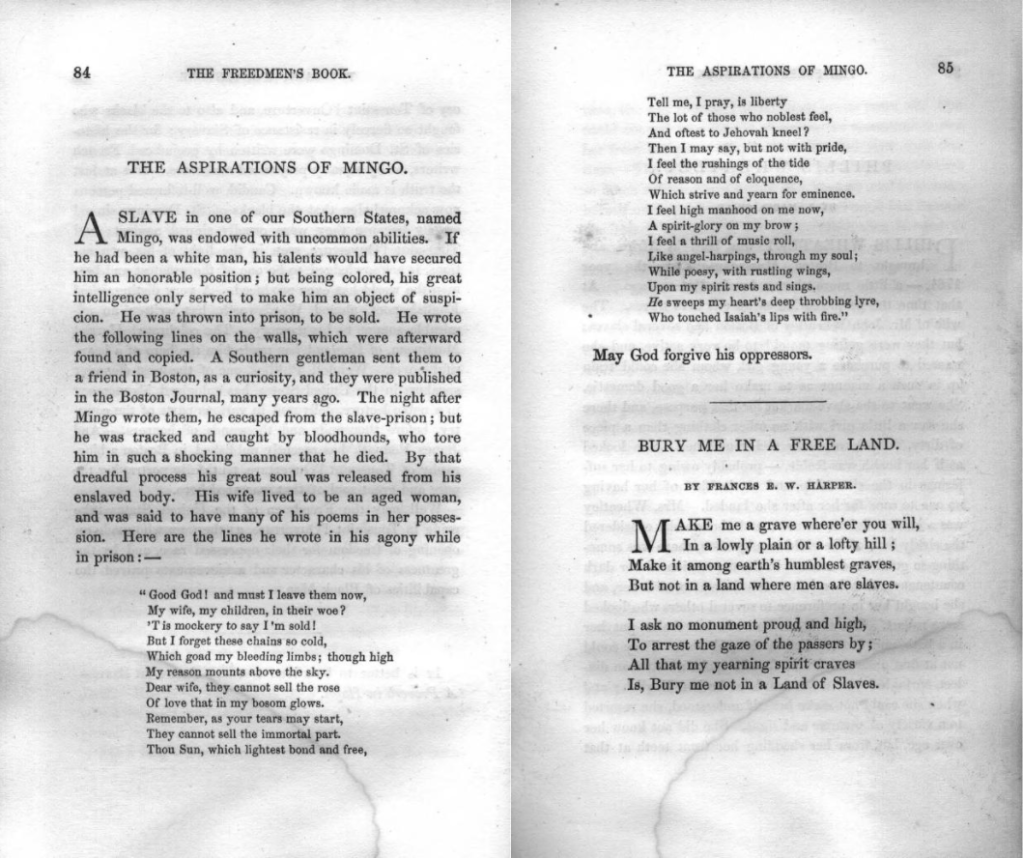
“If he had been a white man, his talents would have secured him an honorable position; but being colored, his great intelligence only served to make him an object of suspicion.”

Those words, written by L. Maria Child, editor of The Freedmen’s Book and an active abolitionist, preface a poem inscribed on a prison wall by an enslaved man named Mingo before he was torn apart by pursuit dogs. 

“The Aspirations of Mingo” was transcribed from a prison wall. Read it in full at the Gutenberg Project’s transcription of the Freedmen’s Book here.

Over 150 years after the Freedmen’s Book went into print, those words still rang true. This time, regarding another writer in the compilation: Jourdon Anderson.

Over the past decade, Jourdon has occasionally gone viral for his response to an 1865 letter from his former owner. Jourdon’s flawless delivery, scathing wit, and audacious request for back pay left “some critics question[ing] the letter’s authenticity,” as Smithsonian Magazine very politely puts it.

Even reputable sources like Business Insider had to publish disclaimers alongside Jourdon’s letter to stifle comments that it was fake.

But it’s also very telling that several outlets that picked up the story compared Jourdon’s writing to another, more famous writer’s style. Mark Twain’s first book was published in 1869, just four years after Jourdon’s letter. If Mark Twain could write so cleverly and with such tremendous style, why couldn’t Jourdon Anderson write like this?:

To my old Master, Colonel P. H. Anderson, Big Spring, Tennessee.

Sir: I got your letter, and was glad to find that you had not forgotten Jourdon, and that you wanted me to come back and live with you again, promising to do better for me than anybody else can. I have often felt uneasy about you. I thought the Yankees would have hung you long before this, for harboring Rebs they found at your house. I suppose they never heard about your going to Colonel Martin’s to kill the Union soldier that was left by his company in their stable. Although you shot at me twice before I left you, I did not want to hear of your being hurt, and am glad you are still living. It would do me good to go back to the dear old home again, and see Miss Mary and Miss Martha and Allen, Esther, Green, and Lee. Give my love to them all, and tell them I hope we will meet in the better world, if not in this. I would have gone back to see you all when I was working in the Nashville Hospital, but one of the neighbors told me that Henry intended to shoot me if he ever got a chance.

I want to know particularly what the good chance is you propose to give me. I am doing tolerably well here. I get twenty-five dollars a month, with victuals and clothing; have a comfortable home for Mandy,—the folks call her Mrs. Anderson,—and the children—Milly, Jane, and Grundy—go to school and are learning well. The teacher says Grundy has a head for a preacher. They go to Sunday school, and Mandy and me attend church regularly. We are kindly treated. Sometimes we overhear others saying, “Them colored people were slaves” down in Tennessee. The children feel hurt when they hear such remarks; but I tell them it was no disgrace in Tennessee to belong to Colonel Anderson. Many darkeys would have been proud, as I used to be, to call you master. Now if you will write and say what wages you will give me, I will be better able to decide whether it would be to my advantage to move back again.

As to my freedom, which you say I can have, there is nothing to be gained on that score, as I got my free papers in 1864 from the Provost-Marshal-General of the Department of Nashville. Mandy says she would be afraid to go back without some proof that you were disposed to treat us justly and kindly; and we have concluded to test your sincerity by asking you to send us our wages for the time we served you. This will make us forget and forgive old scores, and rely on your justice and friendship in the future. I served you faithfully for thirty-two years, and Mandy twenty years. At twenty-five dollars a month for me, and two dollars a week for Mandy, our earnings would amount to eleven thousand six hundred and eighty dollars. Add to this the interest for the time our wages have been kept back, and deduct what you paid for our clothing, and three doctor’s visits to me, and pulling a tooth for Mandy, and the balance will show what we are in justice entitled to. Please send the money by Adams’s Express, in care of V. Winters, Esq., Dayton, Ohio. If you fail to pay us for faithful labors in the past, we can have little faith in your promises in the future. We trust the good Maker has opened your eyes to the wrongs which you and your fathers have done to me and my fathers, in making us toil for you for generations without recompense. Here I draw my wages every Saturday night; but in Tennessee there was never any pay-day for the negroes any more than for the horses and cows. Surely there will be a day of reckoning for those who defraud the laborer of his hire.

In answering this letter, please state if there would be any safety for my Milly and Jane, who are now grown up, and both good-looking girls. You know how it was with poor Matilda and Catherine. I would rather stay here and starve—and die, if it come to that—than have my girls brought to shame by the violence and wickedness of their young masters. You will also please state if there has been any schools opened for the colored children in your neighborhood. The great desire of my life now is to give my children an education, and have them form virtuous habits.

Say howdy to George Carter, and thank him for taking the pistol from you when you were shooting at me.

From your old servant,
Jourdon Anderson.

So why would anyone doubt Jourdon? Because Jourdon was enslaved.

Even before Sojourner Truth’s words were twisted into a mockery, the editor of the Freedmen’s Book knew to defend against the same thing happening to the words within its pages.

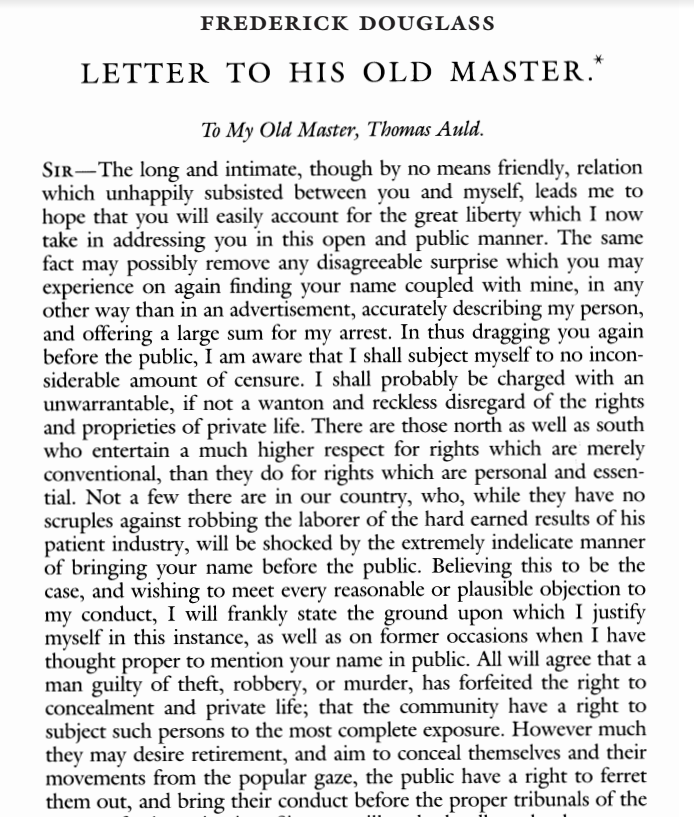
Frederick Douglass also composed a beautifully written yet scathing letter to his former owner, informing him that “I shall make use
of you as a means of exposing the character of the American church
and clergy-and as a means of bringing this guilty nation, with
yourself, to repentance,” and closing with “I am your fellow-man, but not your slave.” Read it in full here.

And again, why?

Because the Trans-Atlantic slave trade couldn’t have survived 400 years if the people enslaved were seen as intelligent, thoughtful, sympathetic and autonomous human beings.

That’s why.

I freely admit bias, so I’ll share independent words from Roy E. Finkenbine, a professor at the University of Detroit-Mercy: “It’s kind of a racist assumption… that when someone is illiterate, we make the assumption they’re stupid. Enslaved people had deep folk wisdom and a rich oral culture,” he adds. “Why would we think that he hadn’t been thinking about these things and couldn’t dictate them to willing abolitionists?” 

The opening quote of this post is just one clear attribution prefacing several inclusions in the Freedmen’s Book, and Jourdon’s letter has one as well: “[Written just as he dictated it.]”

But we don’t have to take the word of the Freedmen’s Book. Historic record backs it up.

Jourdon’s letter is dated August 8, 1865. An issue of The New York Tribune dated August 22, 1865, just two weeks later, ran the same letter (from a Cincinnati paper), with a different certification: “The following is a genuine document. It was dictated by the old servant, and contains his ideas and forms of expression.”

So now that we’ve established a timeline of independent sources, here’s the twist that’s not as frequently reported in this viral tale: Just a month after Jourdon’s letter was written, Col. Anderson was forced to sell his plantation in payment for his debts. The Thirteenth Amendment officially abolishing slavery was ratified by all of the states in December of the same year. Begging Jourdon to come back was quite literally Anderson grasping at straws.

According to Raymond Winbush, director of the Institute for Urban Research at Maryland’s Morgan State University who tracked down some of Col. Anderson’s descendants, to this day, the family is “still angry at Jordan for not coming back, knowing that the plantation was in serious disrepair after the war.” As he’d spent 32 years enslaved by the Andersons, Jourdon was intimately familiar with their plantation, and they’d hoped that if he returned, others they’d enslaved might stay on, even after they’d been freed. Instead, Col. Anderson died destitute in 1867, only two years after his missive to Jourdon.

As for Jourdon, he lived another 40 years in Dayton, OH, passing away at 79 in 1905. His obituary is even referenced in the archives of the Dayton Daily News, and he’s buried next to his Mrs. in Dayton’s Woodland Cemetery and Arboretum.

Jourdon & Mandy, finally resting in peace.

Jourdon’s family and many more prospered too. Among many other achievements in Dayton, Jourdan’s son, Dr. Valentine Winters Anderson, was a supporter of renowned poet Paul Laurence Dunbar in establishing the Dayton Tattler, the city’s first Black newspaper.

Times may change, but Jourdon and his family are shining examples that the power of the written word lives forever… as long as the rewriters of history will let it.

*Ed. Note: As usual, I’ve spelled Jourdon throughout the same way it was spelled in his original letter, not as history recorded him.


KEEP GOING BLACK IN HISTORY:

Read Jourdon’s letter as it was published in the Freedmen’s Book at the Dickenson College Archives.

More records authenticating Jourdon’s life and ancestors, along with those of his enslaver’s, is available with context from current historians, through an article circulated by the Associated Press.

DAY 14 — Mabel Fairbanks

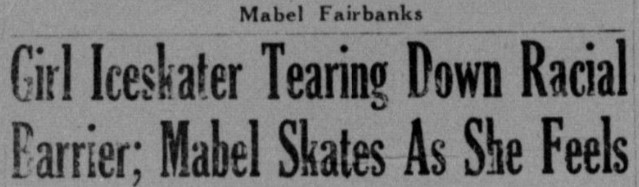
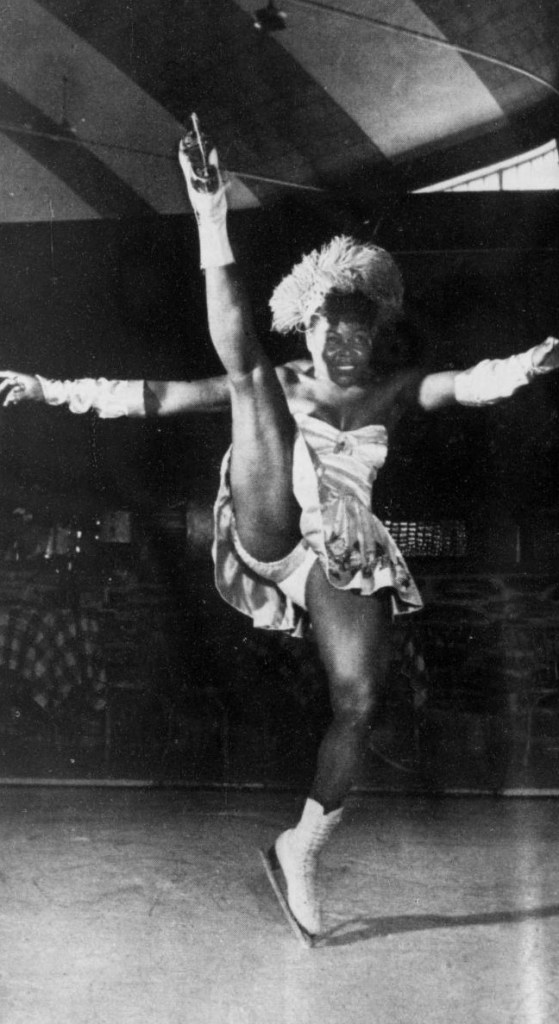
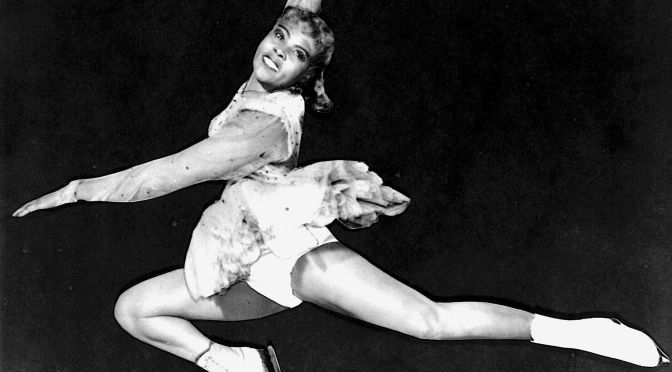
Each winter, from a window high above New York’s Central Park, Mabel Fairbanks gazed down in awe at each of the tiny figures dancing over the frozen pond. One winter, she decided to stop being an onlooker, and with a couple of dollars she’d scraped together from babysitting earnings, Mabel marched down to a nearby pawn shop, and bought herself some brand new used ice skates. Even two sizes too big and stuffed with cotton, they were her first major step toward making it on the rink.

In the late 1920s, she was only fourteen and still too young to know that no matter how much skill she demonstrated on those blades, she’d be iced out of figure skating. Born Black and Seminole, someone like Mabel was a literal blemish against the lily white landscape of the sport.

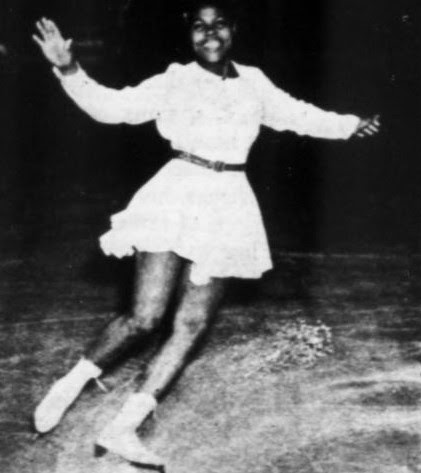
In fact, Mabel’s first experience on the ice was in Harlem. Even though the ice was better in Central Park, she didn’t have the confidence to skate back where she’d first seen it happen, back where people didn’t look like her. But with a little encouragement, she went for it, and her bravery was rewarded. “I got on the pond and then I discovered that I could skate around too, just like the other kids,” she said. “Blacks didn’t skate there. But it was a public place, so I just carried on.” 

Naturally, she stood out among the crowd.

And for once, the color of her skin wasn’t the only reason.

Spectators took notice of Mabel’s talent and one suggested that skills like hers belonged on a real rink. But when she followed that suggestion, Mabel discovered that talent doesn’t matter when you can’t even get through the front door.

“I stood in line and said, ‘I’m next, I’m next!’ but I’d get up front and they would just push me away,” she recalled.

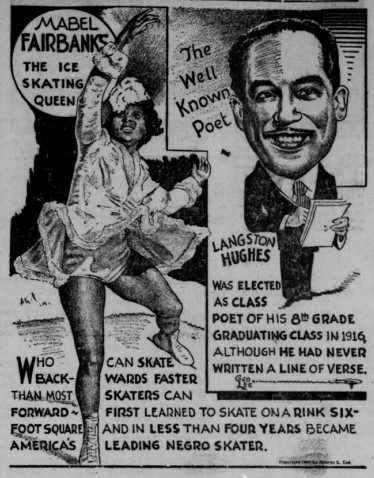
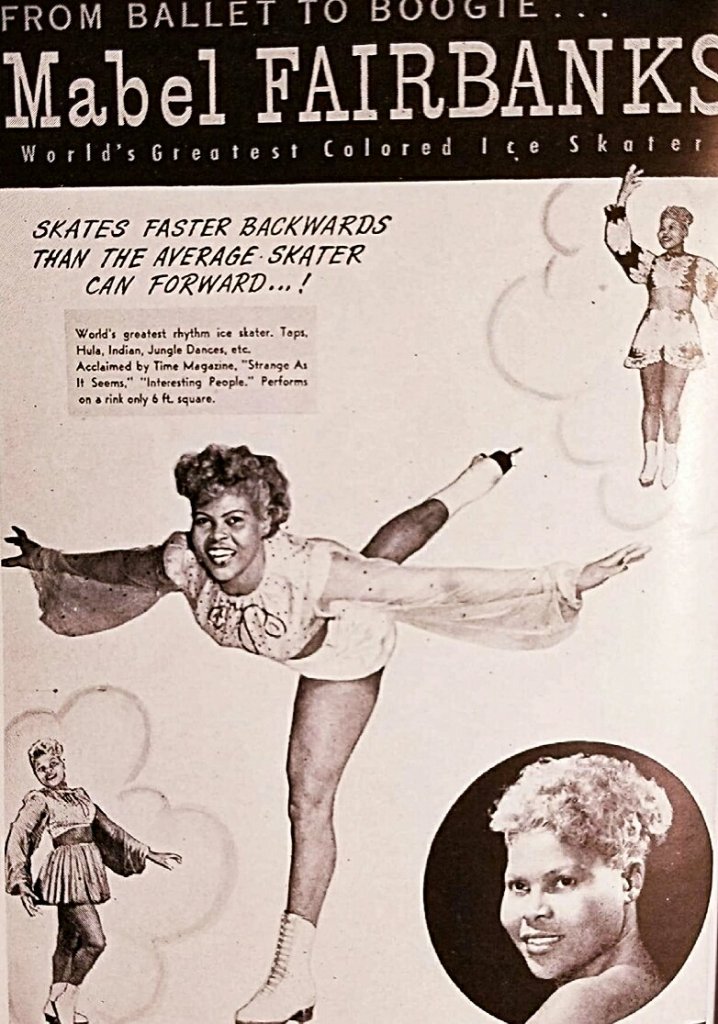
She wasn’t giving up that easily. If Mabel couldn’t get into a rink, she’d bring the rink to her. With the help of a relative, she built her own 6×6 indoor practice rink: a block of wood and dry ice, topped with sheet metal and freezing water.

Mabel’s persistence paid off when she was finally admitted into that real indoor rink (even if it was after hours). She was noticed again, and this time, it was by figure skating royalty. Olympian and nine-time U.S. ladies champion Maribel Vinson Owen helped Mabel perfect her technique and encouraged her to keep going, even if she had to go it on her own.

So Mabel packed up her tiny personal rink and did just that. She took skating places it had never been before like the Renaissance Ballroom, the Apollo Theater, and social clubs all over New York City and Harlem. Each show was more than a novelty; Mabel was skilled enough to perform some of figure skating’s most difficult routines, and create her own moves too. The New York Age, one of America’s most prominent historically Black news publications, credited Mabel as the inventor of the Flying Waltz Jump, the Camel Parade, and the Elevator spin, even though they weren’t named after her as per the standard in figure skating.

By the 1930’s, Little Mabel from Central Park had grown into a sensation.

But she still couldn’t try out for the Olympics, because she couldn’t gain admission to a qualifying event. So once again, Mabel made her own way.

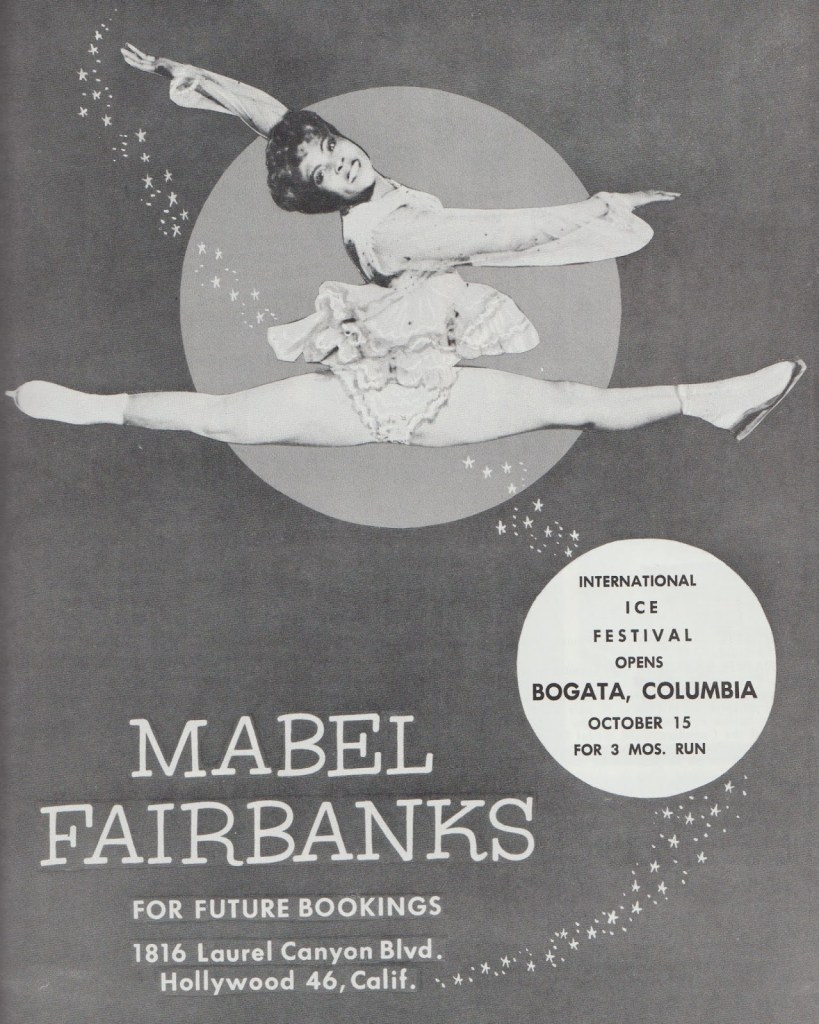
Mabel skated her way through interracial ice tours and USO clubs in France, Germany, Cuba, Japan, and all over the world before coming back to the States as a bonafide star. Her show included flying splits and other death-defying jumps, wildly flexible grabs, and unbelievable balance through it all. When she took that show to Vegas, celebrities and Hollywood flocked to witness Mabel’s talent unlike they had ever seen before, and certainly unlike they’d been allowed to see before from a Black woman.

But she STILL had to run a whole campaign to be able to practice at the Pasadena Winter Gardens, where she and her skates were greeted by a sign reading “Colored Trade Not Solicited” (read: “Melanated people, go elsewhere.”) And even when she toured with the Ice Capades, she was expected to eat separately from the rest of the cast. 

And still, her star power couldn’t be denied. By 1951, Mabel landed a regular role on an LA television show called “Frosty Frolics,” where she could dazzle viewers watching at home. For the next four years, Mabel appeared on television and toured in ice skating shows, until “Frosty Frolics” was finally canceled and she found a new calling. Words from her very first mentor, Maribel Vinson, still echoed in Mabel’s mind: “‘Mabel, there are never going to be Black kids in competitions or even ice shows unless you do something about it.’”

When the Civil Rights Act passed in 1964, Mabel had a stable of Black skaters ready to break into the sport. It was only 2 years before one of her students, Atoy Wilson, became the first African-American figure skating champion. Since then, many more skaters of color like Debi Thomas, Kristi Yamaguchi, and Tai Babilonia have come under her wing and gone on to be champions. She even gave a young Scott Hamilton skating lessons as part of a program she established for skaters whose families couldn’t afford the monumental costs of elite figure skating, as she campaigned for greater accessibility all around in the sport.

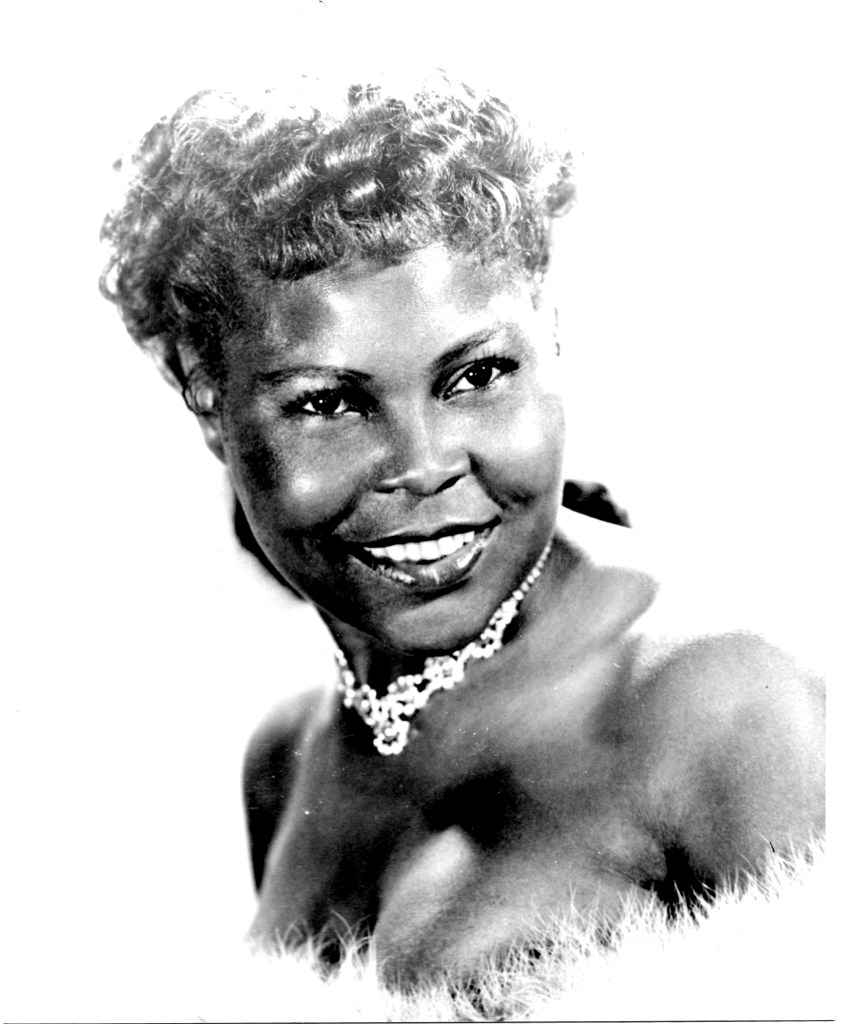
Constantly pushing boundaries, Mabel continued coaching, mentoring and financially assisting skaters until she was 79 years old. Though she was never able to skate competitively herself, Mabel’s tireless contributions to the sport did not go unrecognized, and she was inducted into the United States Figure Skating Hall of Fame in 1997, the first African-American to be so acknowledged.

Before her death in 2001, Mabel told the Los Angeles Times, “If I had gone to the Olympics and become a star, I would not be who I am today.”

And who she was changed the face of figure skating forever.


KEEP GOING BLACK IN HISTORY:

Olympic commentator Terry Gannon broadcast a brief tribute to Mabel’s life featuring interviews with a handful of the skaters whose lives she changed.

Teen Vogue compares and contrasts Mabel’s story with the picture of figure skating today.

The LA84 Foundation, created by the Los Angeles Olympic Organizing Committee has preserved and transcribed Mabel’s whole life story in her own words here.

Read about and donate to the U.S. Figure Skating Association’s “Mabel Fairbanks Skatingly Yours” Fund to “financially assists and supports the training and development of promising figure skaters who are Black, Indigenous and People of Color (BIPOC) with the goal of helping them realize and achieve their maximum athletic potential.”

Keep exploring Mabel’s life through Mental Floss’s extremely well-documented article with links to more historical sources to dive into.

Hear from more underrepresented voices carrying Mabel’s torch into figure skating today and the barriers they still face via NBC News.

DAY 13 — The 1878 Fireburn Queens

By the time the United States purchased the Virgin Islands in 1917, slavery had technically been abolished in most of the colonized world.

But freedom had not come easily to the Virgin Islands, and the United States was buying one of only two territories in the Caribbean that had won that freedom through a fight. It all started when the enslaved people of Frederiksted, one of St. Croix’s most significant cities, got sick and tired of being sick and tired.

In 1847, Danish Governor Peter von Scholten put their freedom on a timetable, presenting a twelve-year plan to give every Crucian (the people of St. Croix) their independence.

Nobody was having that.

Sugar cane was one of the island’s primary exports, and without it, a whole lot of (white) people would go bankrupt. On the other hand, the enslaved saw no reason to wait for what was rightfully theirs. 

The Høgensborg Plantation on St. Croix, Danish West Indies drawn by Frederik von Scholten, June 1838.

A stand-off was brewing on St. Croix. After the Haitian Revolution in the early 1800s claimed nearly 500,000 lives, required a military response from Britain, France and Spain, and brought Haitian slave labor to an end, rebellion lingered in the Caribbean air.

The first match lit in St. Croix was struck just a year after the governor’s abolition law.

St. Croix’s enslaved already had a few key learnings on uprising strategy in the islands. First, as they were expected to provide every bit of labor, they far outnumbered those who kept them in chains. Second, though they’re surrounded by water, islands are particularly vulnerable to fire. And third, any help to quell an uprising would have to come from miles, if not, entire oceans away.

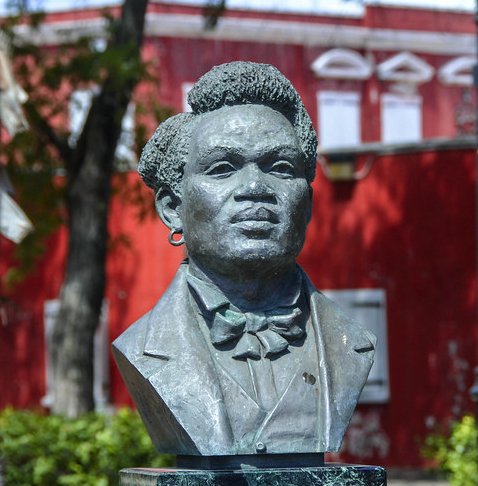
A bust of John Gottlieb (known to locals as “Buddhoe”) stands in Frederiksted.

With that knowledge, and led by skilled worker John Gottlieb, 8,000 Black Crucians stormed Fort Frederik, and demanded their freedom that day, else they’d set all this stuff on fire.

And they got it.

After the 1848 rebellion, Governor Peter von Scholten issued a decree abolishing slavery immediately, not in 12 years after all.

Sort of. Upon receiving the governor’s abolition law, the plantation owners got busy finding loopholes, and they were ready. They presented these newly freed people with contracts, a reasonable expectation upon being freed, right? Except that per these contracts, a worker and their family were obligated to work the plantation they’d signed with for one year. During that year, they could make no complaint on wages, treatment, working conditions or any other labor concern, until “Contract Day.” On that day, and only that day, could contracts be amended.

And had everything been on the up and up, it probably would have been a pretty decent outcome.

But everything was not on the up and up. You’d think the Danes would have learned.

Their newly contracted labor force was not paid a living wage, and most found themselves in worse condition than they had been as slaves. Because the workers were no longer their property, the plantation owners had no interest in ensuring their well-being. Without money for the basic necessities or even medical treatment, Black citizens suffered, but were still expected to serve as the backbone of the labor force. Black women in particular were bearing the full weight of an unjust society. They worked brutal jobs and long hours for insufficient wages, cared for sick and injured husbands and children, foraged food to feed their families, and so many more hardships exacerbated by Danish oppression that they had finally had enough.

So, on Contract Day – October 1, 1878 – THIRTY whole years after the abolition law that was supposed to make them fully free, WOMEN led Black Crucians to demand their grievances be heard.

They were not.

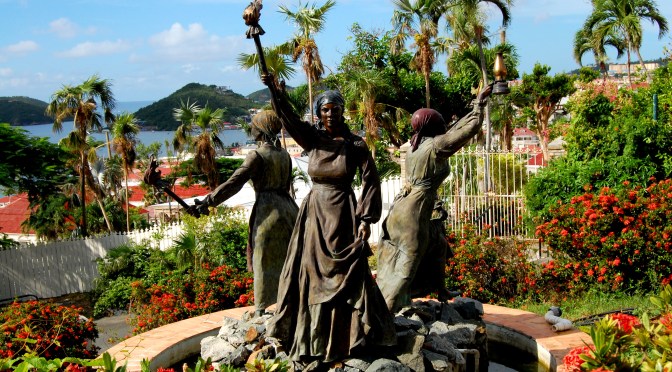
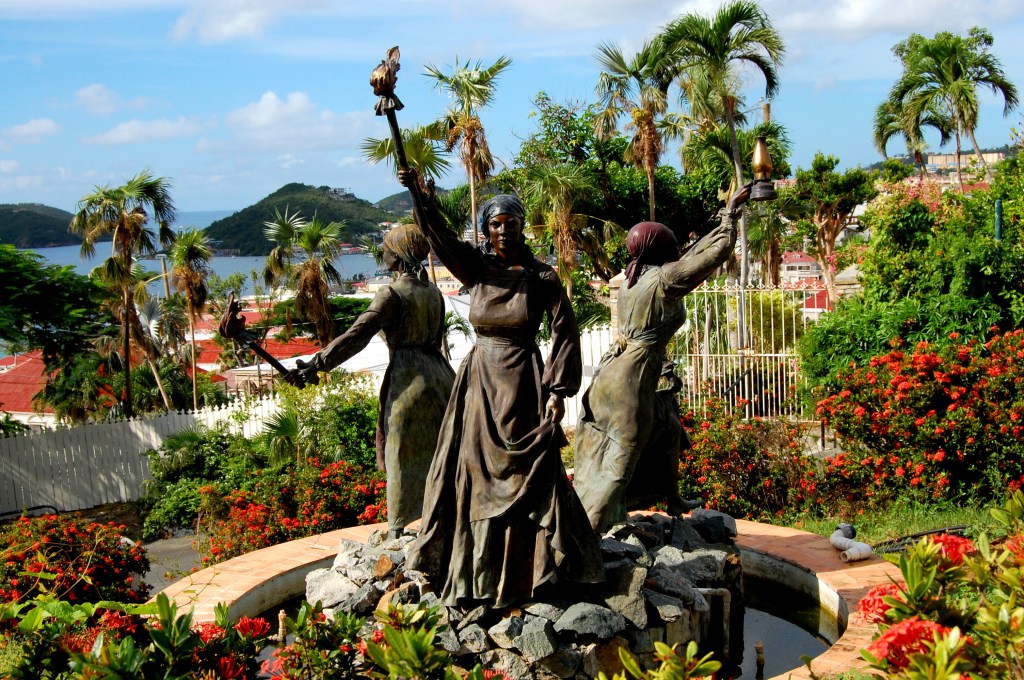
A Frederiksted fountain of Queens Mary, Agnes, and Mathilda. Each carries a symbol of their resistance: a lantern, a cane knife, and torches. The fountain was erected before Susanna’s involvement was fully discovered.

Instead, Danish troops escalated the situation by firing on the crowd. But still massively outnumbered, they were forced to retreat into the walls of the very same fort they’d defended 3 decades before.

With Danish troops self-barricaded and all other Danish colonialists too afraid to intervene, Mary Thomas, Agnes Salomon, Mathilda McBean and Susanna Abrahamson made good on the Black Crucians’ original threat.

Cane fields, plantations, mills, corrupt government buildings… nothing was spared the torch. When the smoke cleared, only 2 soldiers, 1 plantation owner, and less than 100 Black Crucians were dead. 400 were arrested. But nearly 900 acres of Frederiksted had burned to ash.

A November 1878 illustration depicts the moment the Fireburn erupted. You can see women in the illustration’s foreground.

12 people were sentenced to death for their part in the 1878 St. Croix uprising known to the locals as the Fyah Bun. But Queens Mary, Agnes, Mathilda, and Susanna were not among them. Executing them as martyrs might have incited another uprising, but imprisoning them on the island was equally dangerous and unpredictable. Instead, all four women were extradited to Denmark, and sentenced to life in a hard labor prison.

A news article details the property damage done in the uprising.

It wasn’t immediate, but the Black Crucians DID get true freedom, and the scars they left in their fight for it are still visible all over Frederiksted.

“The young [Danish] people ask ‘Why don’t you take care of the ruins? You should rebuild some of the places. There’s so much lost history,’” Crucian historian Frandelle Gerard recalls. “I say to them, ‘Honey, they were burned on purpose! And they will never be rebuilt!’”

But in 2018, something else was. In Copenhagen. Artists  La Vaughn Belle and Jeannette Ehlers, Black women from St. Croix and Denmark respectively, erected their massive 23 foot statue, “I Am Queen Mary,” not far from where its subject was imprisoned and just outside the Danish West Indian Warehouse where imported sugar and rum produced by enslaved people was stored. “Queen Mary” is Copenhagen’s first public monument to a Black woman. She’s fashioned after a seated photograph of Black Panther Huey P. Newton, holding her torch and cane knife fast at hand, and serving as a towering reminder of Huey’s words “You can jail the revolutionary, but you can’t jail the revolution.”

“Queen Mary” standing before the Danish West Indian Warehouse. Read more about her and the artists who created here at Vice. Or visit her at her dedicated website here.

KEEP GOING BLACK IN HISTORY:

Take an even closer look at Queen Mary and hear more from her creators here.

The anniversary of John Gottlieb’s uprising is known as Freedom Day in the U.S. Virgin Islands. Read all about it on St. Croix’s tourism website.

Black Danes are preserving the history of the Fireburn and you can view their archive and more history of the Danish slave trade here.

Learn more about slavery in Danish Colonies like St. Croix at the Danish National Museum’s website.

There’s a documentary on the Fireburn! Watch the trailer here, and keep an eye out for its global availability on Instagram.

DAY 12 — Elizabeth Keckly

“Slavery” is a cold, factual word that tidily boxes up millions of personal indignities repeated over and over again.

“Freedom” is usually considered its opposite, but I’d propose another: “agency.”

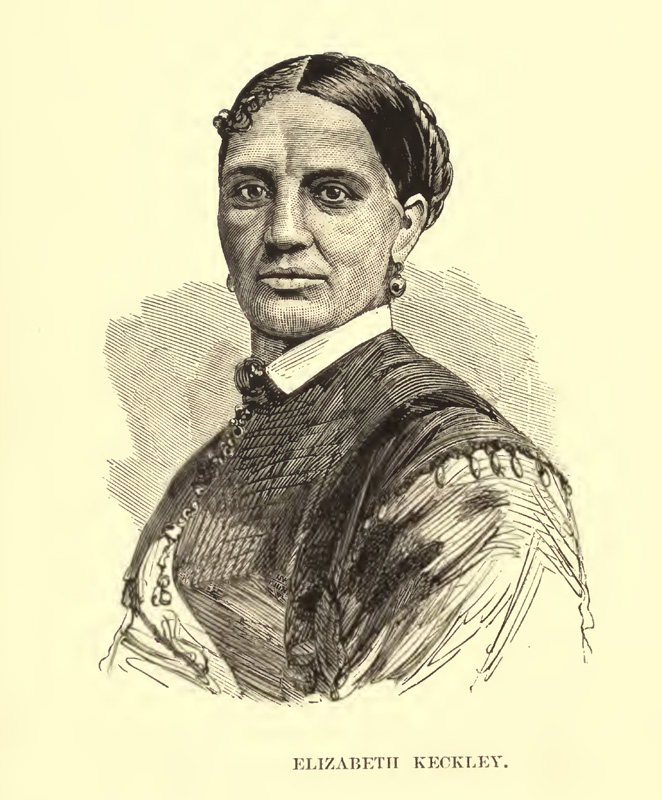
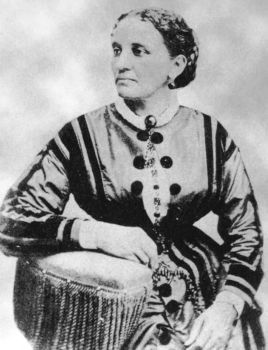
Elizabeth Keckly, in her prime. She came to be known as Madame Keckly among Washington D.C.’s high society.

Everything about the antebellum Virginia world Elizabeth Hobbs Keckly was born into was designed to deprive her of agency. She lived to take it back.

Elizabeth’s mother Aggy wasn’t as fortunate. Her daughter’s father wasn’t her husband George, but her owner Armistead Burwell. She’d attempted to claim what little agency she could in the circumstances by rejecting her enslaver/rapist’s last name in favor of her husband’s: Hobbs. Aggy didn’t share that truth with her daughter until her deathbed. Perhaps it brought back too many bad memories, like how Burwell gave the Hobbs family two hours notice before selling George to a slaver in the West. Elizabeth recalled their collective helplessness in her autobiography: “I can remember the scene as if it were but yesterday;–how my father cried out against the cruel separation; his last kiss; his wild straining of my mother to his bosom; the solemn prayer to Heaven; the tears and sobs–the fearful anguish of broken hearts… the last good-by; and he, my father, was gone, gone forever.”

Prized by the Burwells for her many talents, especially the seamstress skills that she was expected to teach her daughter, Aggy was kept. But Aggy could also read and write, and likely taught her daughter those skills as well. Instead of the domestication expected of her, Elizabeth eventually wielded her needle and pen as silent weapons of subversion instead.

That subversive streak simmered early on. As a teenager, she was sent to North Carolina to work in the service of her (then unknown) half-brother Robert. Perhaps because Robert’s wife Margaret easily guessed the source of Elizabeth’s light skin and wanted to punish her for it, or perhaps simply because she was cruel, Margaret enlisted the help of a neighbor to “break” Elizabeth. When the neighbor summoned Elizabeth, demanding that she strip down for her first humiliating beating, she replied, “You shall not whip me unless you prove the stronger. Nobody has a right to whip me but my own master, and nobody shall do so if I can prevent it.” She could not. Week after week, Elizabeth was beaten until her abuser was too exhausted to continue. Week after week, “I did not scream; I was too proud to let my tormentor know what I was suffering,” she wrote. Eventually, it was he who “burst into tears, and declared that it would be a sin” to continue inflicting such harm upon an innocent human being.

But her torment did not end, and a new owner inflicted a different physical punishment on Elizabeth. “For four years, a white man—I will spare the world his name—had base designs upon me. I do not care to dwell upon the subject, for it is one that is fraught with pain. Suffice it to say that he persecuted me for four years, and I… I became a mother,” she wrote.

Then and now, there is no greater personal indignity, but Elizabeth’s despair over that act went deeper: “I could not bear the thought of bringing children into slavery — of adding one single recruit to the millions bound in hopeless servitude.”

When Armistead Burwell died, Elizabeth returned to Virginia to care for his heirs, then accompanied them to St. Louis. That’s where she began stitching her terrible circumstances into gold.

By then, the family had grown to 17 members, and without a patriarch and his estate, they were destitute. Elizabeth was the only one among them with employable skills, and she was hired out to sew for other families, eventually growing that casual business arrangement into an actual business that single-handedly supported all 17 people.

Seeing her true value, Elizabeth made an offer to her owner. She would buy her freedom and her son’s for $1200. At first, he refused. Then he tried to trick her, saying he would accept no payment, but offering to pay her passage on the ferry across the Mississippi. She was smart enough to know that the Fugitive Slave Act meant she could be returned to her owner anytime, and she refused. In 1855, she finally gained her independence and made her first fateful decision. Elizabeth took her talents to the nation’s capital, where they caught the eye of a very important lady: Mary Todd Lincoln.

Mary Todd Lincoln in the gown Elizabeth made for the President’s inauguration ball.

Under the First Lady’s employ, Elizabeth flourished. In a single season she fashioned almost 20 dresses, many of which were complimented by the President himself. In Mrs. Lincoln, Elizabeth also found a timely friend. Elizabeth and Mary both lost sons in 1861 and 1862, respectively. That experience reshaped their very personal business relationship into a friendship. “Lizabeth, you are my best and kindest friend, and I love you,” Mrs. Lincoln once wrote. Best of all, she put her money where her mouth was.
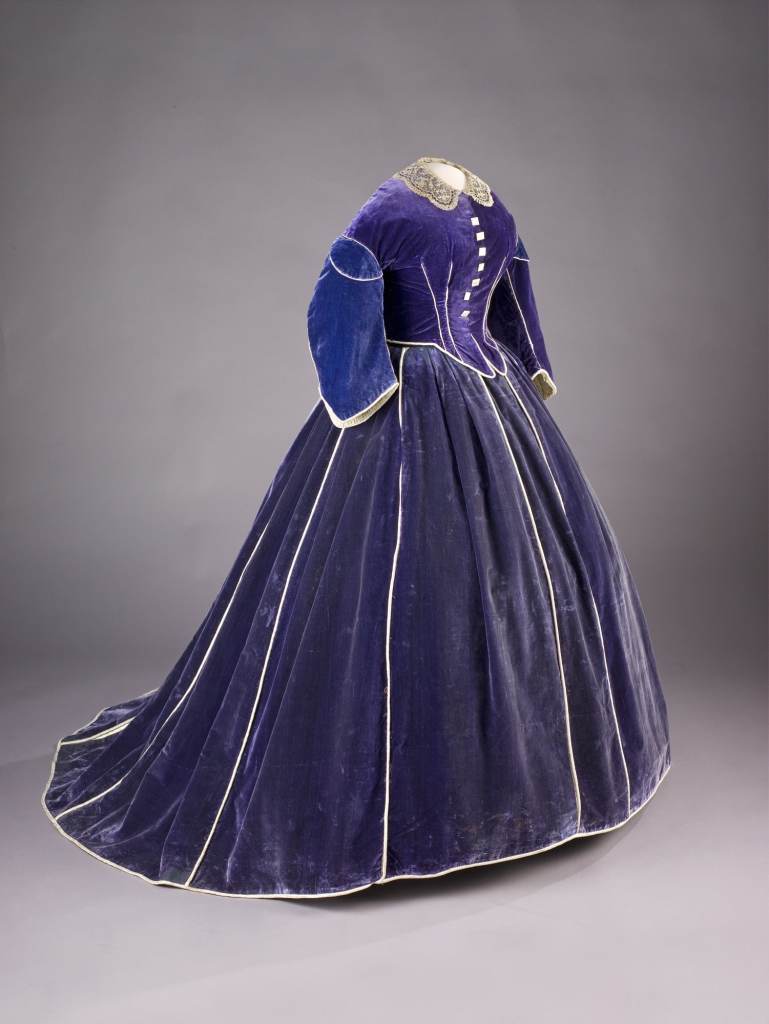
One of the winter dresses Elizabeth made for Mary. See more of her collection in FIT’s digital collection.

Elizabeth was in high demand among D.C.’s high society women, even the wives of Confederacy President Jefferson Davis and General Robert E. Lee. And in true subversive fashion, she used their old southern money to employ more Black women in her shop and create the Contraband Relief Association, an organization that provided support, relief and assistance to formerly enslaved people. 

The First Lady’s letter to the President requesting funds on Elizabeth’s behalf.

Mrs. Lincoln regularly donated to the Contraband Relief Association, and requested that her husband do the same. “Elizabeth Keckley, who is with me and is working for the Contraband Association, at Wash[ington]–is authorized…to collect anything for them here that she can….Out of the $1000 fund deposited with you by Gen Corcoran, I have given her the privilege of investing $200 her.. Please send check for $200…she will bring you on the bill,” she wrote to President Lincoln.

A quilt Elizabeth Keckly fashioned from Mary Todd’s discarded dresses.

But alas, everyone reading knows what came soon enough. President Lincoln was assassinated, and with his death, public opinion of Mary and the ladies’ friendship unraveled. Elizabeth published her autobiography, believing it would salvage both and bolster her income, but her good intentions backfired. 
Elizabeth’s autobiography, Behind the Scenes, or Thirty Years a Slave, and Four Years in the White House.
“Readers in her day, white readers — they took it as an audacious tell-all,” Jennifer Fleischner, author of “Mrs. Lincoln and Mrs. Keckly” said. “You know, ‘How dare she’? There were two categories: the faithful Negro servant or the angry Negro servant. Keckly was neither servant, nor faithful, nor angry. She presented herself, the White House and Mary Lincoln as she saw and knew them. And that didn’t work.”

Even the New York Times published a scathing review of Elizabeth’s book.

Mary was devastated by the personal revelations Elizabeth included, society women found it distasteful and didn’t want to appear in the pages of a book themselves, politicians spun it as reasons African-Americans shouldn’t be able to read, write or integrate with regular society, and that was that for Elizabeth. She died in her sleep in 1907, at a home for poor women & children that the Contraband Relief Association had founded.

But her story didn’t end there. Though it was suppressed upon its initial publication, Elizabeth’s biography is in print once again, and considered one of the most substantial documentations of the Lincoln White House surviving today, and proof of the value in owning your own story.

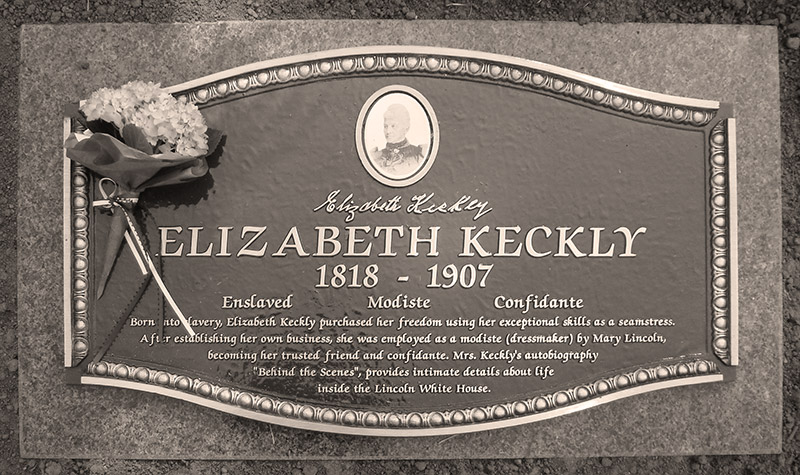
Elizabeth’s gravestone.

*Ed. Note: I’ve spelled Elizabeth’s last name as “Keckly” because that’s how she spelled it. She was historically recorded as “Keckley” and that spelling has persisted.


KEEP GOING BLACK IN HISTORY:

The Smithsonian National Museum of American History details how Elizabeth put her money to work for the people.

The New York Times featured Elizabeth’s biography in their “Overlooked” series that runs modern-day obituaries of famous contributors to American history that their paper overlooked at the time.

The White House Historical Association has thoroughly documented Elizabeth’s life from her autobiography and their own records as part of their “Slavery in the President’s Neighborhood” initiative.

DAY 11 — Jessica Watkins

As a fifth grader at Sally Ride Elementary School, Jessica Watkins daydreamed about life on Mars.

Little did she know that life could be her own.

But first, a few small steps…

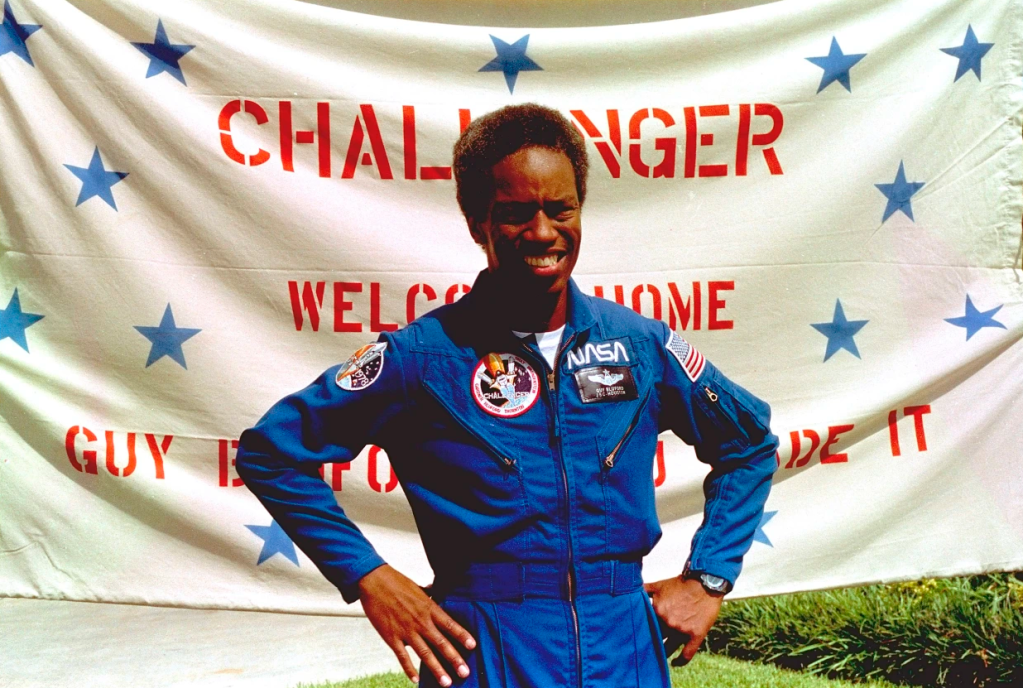
Like becoming the first Black woman to live aboard the International Space Station.

And then, the first to live on the moon.

Jessica is one of 18 astronauts selected for the 2024 Artemis Mission that will return humans to the moon for the first time in 50 years, and our first long-term lunar stay. She’ll become just the 5th African-American woman in space while being accompanied by the second, Stephanie Wilson, who’s spent more time in space than any woman at 42 days, and also served as the voice of mission control during NASA’s first all-female spacewalk. (Jessica Meir and Christina Koch, the spacewalkers, will join Watkins and Wilson on the Artemis Mission.)

NASA is quick to note that they aren’t fully orchestrating all the diversity aboard these recent and upcoming missions, but that it’s a sign of the times: Meir & Koch’s fellow graduating astronaut candidates were 50% women.

But none have been quite like Jessica Watkins.

All of her life experiences—short as it’s been at just 33 years—have led up to this moment.

She describes herself as a “rock nerd,” but she also played rugby for Stanford.

Her PhD in planetary geology is one of many academic reasons she was selected for Artemis, and is a prime candidate for that mission’s post-moon Mars exploration: Jessica was an instrumental member of the science team for the Mars Curiosity Rover Program. She’s one of the mere mortals who knows its surface best. She’s also extensively studied Earth’s changing landscape from deserts, volcanoes, and underwater, as well as the ripple effects of those shifts. The lady knows millions of miles of rocks everywhere.

Her eclectic existence is precisely why Jessica sees so much possibility in space.

“There was something that always pulled me towards space — the idea of exploration, of wanting to push boundaries and capabilities, both technically and physically, but also mentally and spiritually. I kind of stumbled into geology and fell in love with that,” she said. “And then the stars aligned for me to end up here.”

And from the stars, she’ll continue her research.

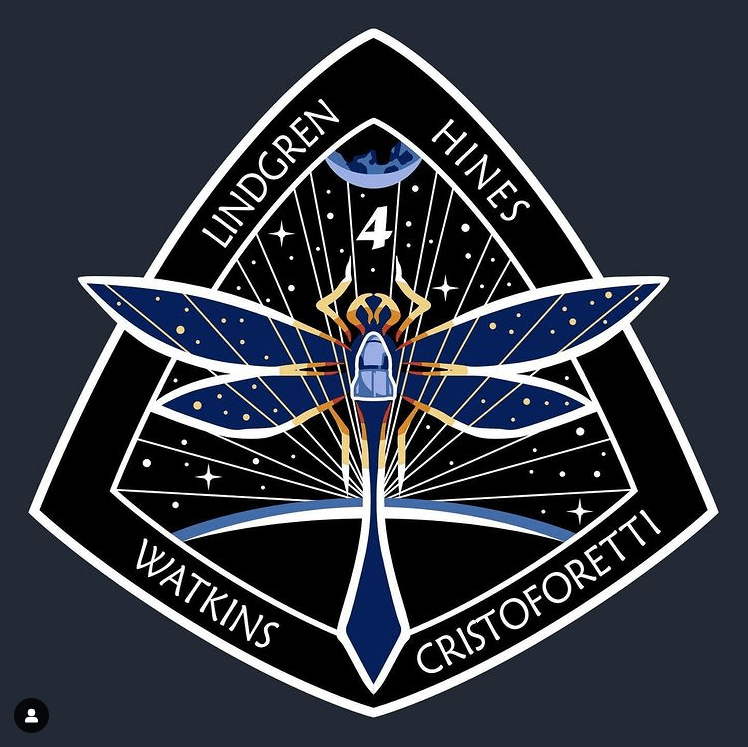
Jessica joins seasoned astronauts Kjell Lindgren and Robert Hines (NASA) and Samantha Cristoforetti (ESA) as members of SpaceX’s Crew-4.

In April, Jessica boards SpaceX’s Crew Dragon capsule to depart for the International Space Station, where she’ll spend 6 months studying earth and space science, biological science, and observing and photographing the geological changes on Earth.

But her mission will still be undeniably human.

Despite global tensions between the two countries peaking at home, the U.S. and Russian segments of the ISS are still docked together. And Jessica, already making so much global history, will add her name as only the 8th African-American to board the station among 250, so few to serve as our ambassadors to the rest of the world.

A NASA map diagrams the global visitors to the International Space Station. See the detailed list of ISS guests, some of whom have been many times, here.

She credits all of her stellar accomplishments and tremendous firsts to being a girl who daydreamed and simply never stopped.

“A dream feels like a big, faraway goal that is going to be difficult to achieve, and something that you might achieve much later in life,” she said. “But in reality, what a dream is — or a dream realized is — is just putting one foot in front of the other on a daily basis. And if you put enough of those footprints together, eventually they become a path towards your dreams.”

In that path toward her dreams, Jessica’s following in some legendary footsteps and taking giant leaps toward a world that looks like home for us all.

Jessica takes the stage for the first time as an official Artemis astronaut.

KEEP GOING BLACK IN HISTORY:

Spend a few minutes learning more about Jessica in her official Artemis press video here.

The Artemis mission is scheduled to launch in 2023. Read more about it at its NASA-dedicated landing page.

Follow Jessica’s journey across the stars on her Instagram.

Read over Jessica’s official NASA astronaut bio, including her full list of qualifications and accomplishments.

Jessica speaks for herself in an interview with NPR about her research and the significance of her inclusion in the Artemis mission.

Learn more about Jessica and the (brief) history of African-Americans in space at the New York Times.

(NASA has further detail on those African-Americans here.)

Scientific-American writes about how “African-American astronauts have been another group of hidden figures in the U.S. space program”.

Marie Claire wonders “Why is Space Still So White?”

DAY 10 — The Harlem Hellfighters

On January 1, 1863, President Abraham Lincoln wrote:

“I further declare and make known, that such persons of suitable condition, will be received into the armed service of the United States to garrison forts, positions, stations, and other places, and to man vessels of all sorts in said service.”

Having finally received “unalienable” rights and having witnessed the admiration bestowed upon white soldiers over the course of 4 separate wars, many African-American men were hopeful that enlisting and serving the United States by choice would force Americans to think better of the whole race.

But the words of the Emancipation Proclamation couldn’t sway the hearts and minds of men, especially when those words were undermined by another sitting president.

When the Buffalo Soldiers, went to battle on behalf of the U.S. Army in the Spanish-American War, Rough Rider Frank Knox said, “I never saw braver men anywhere.” Lieutenant John J. Pershing wrote, “They fought their way into the hearts of the American people.” President Teddy Roosevelt went on record saying “Negro troops were shirkers in their duties and would only go as far as they were led by white officers.”

Less than a decade later, the Harlem Hellfighters would make him eat crow.

When the United States joined the war against Germany, they did so woefully underprepared. American military forces had never gone to battle overseas before, and the Army’s ranks of a mere 126,000 men wasn’t going to cut it. Of the Armed Forces that existed at the time, only the Army allowed African-Americans to enlist for combat, even though it was hardly on an equitable basis. There were only 4 “colored regiments” and once their ranks were filled, the rest of the Black applicants who’d lined up for service were turned away. When Selective Service began in 1917, men of color were told to tear a corner of their draft card away so they could be easily identified and assigned. In the thick of World War I with the Central Powers devastating Allied forces in Europe, U.S. draft boards used those torn corners to send as many Black men to the front lines as they could.

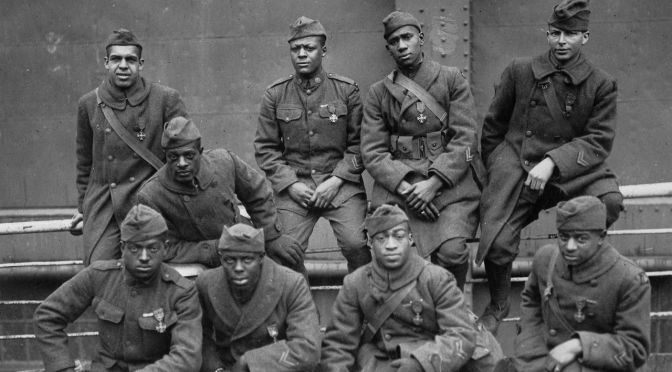
The men of the 369th Regiment however, scrubbed toilets stateside when they first enlisted, relegated to menial and filthy tasks like slaves, even though they’d volunteered for service. But when the war demanded more soldiers, the 369th went from toilets to trenches , being upgraded to Infantry, and shipped off to France for three weeks of combat training before being stationed on the war’s front lines.

The 369th in the trenches.

But even there, they weren’t considered “soldiers.” White Col. William Heyward begged that the 369th be allowed to actually serve on the battlefield, rather than dig trenches, unload ships, and other manual labor they’d been assigned to, as if nothing had changed at all. Army command compromised, assigning the 369th to the French Army instead.

When it came to the 369th and many other all-Black regiments, the Army didn’t send soldiers or reinforcements, they sent human shields expected to die. They never dreamed that the 369th would gain the respect of the French, who’d nickname them “Hommes de Bronze,” or come to be feared by the German Army who first dubbed the 369th as Hollenkampfer (“Hellfighters”). The Army most certainly didn’t expect that the 369th Regiment would be the very first Allied force to breach Germany’s borders.

The Croix de Guerre awarded to Lawrence McVey, a Harlem Hellfighter from Flatonia, TX.

But the Army wasn’t entirely wrong. The Hellfighters spent 191 days in combat, more than any other unit in the war and suffered losses to match, with hundreds dead and thousands wounded over the course of their deployment. Those losses were deeply felt by Captain Arthur Little who wrote, “What have I done this afternoon? Lost half my battalion—driven hundreds of innocent men to their death.” Those who survived fought their way to becoming some of the most decorated American soldiers in history… by another nation. The entire 369th Regiment was awarded the Croix de Guerre, the French Medal of Honor, and over 170 of its servicemen were honored individually. The Hellfighters Band was even honored, being largely credited as Europe’s first introduction to jazz.

The Harlem Hellfighters were so much more than infantry. Their ranks included skilled musicians like James Reese Europe and jazz legend Eubie Blake. Read more about the Harlem Hellfighters Regimental Band here.

Sgt. Henry “Black Death” Johnson earned a personal mention in the war dispatches of Gen. John J. Pershing, commander of the entire American Expeditionary Forces and the same man who, in the words of Col. Heyward, “simply put the black orphan in a basket, set it on the doorstep of the French, pulled the bell, and went away.” With only a bolo, 5-foot-4, 130 pound Sgt. Johnson single-handedly defended himself and his wounded partner against armed German soldiers who raided an Allied outpost. President Roosevelt would later name him as one of the “five bravest Americans” of World War I.

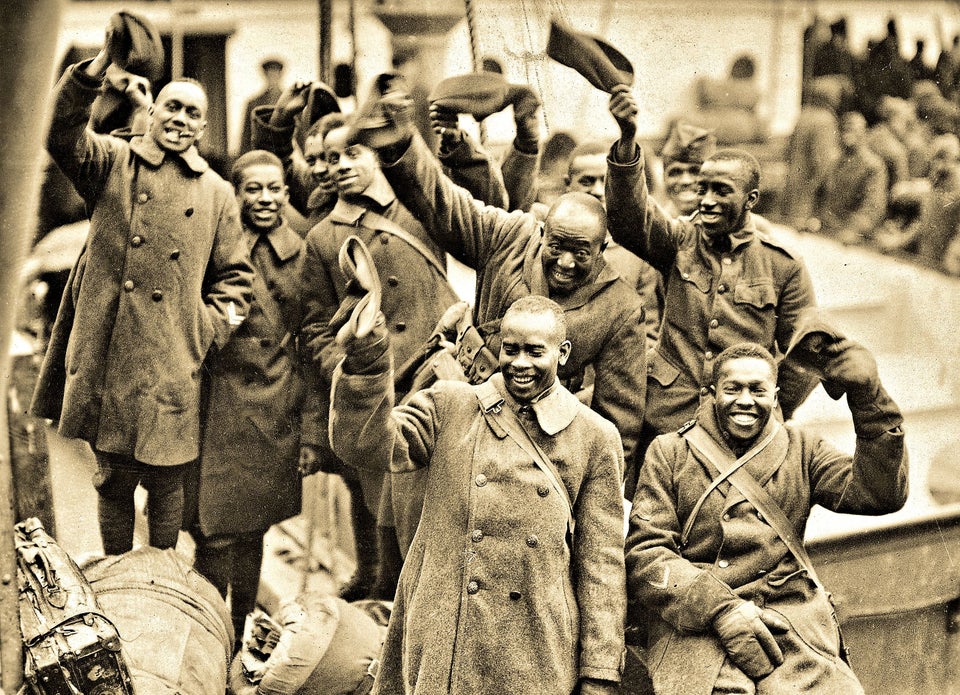
Thousands of New Yorkers welcomed the veterans of the Hellfighters home.

“Up the wide avenue they swung. Their smiles outshone the golden sunlight. In every line proud chests expanded beneath the medals valor had won. The impassioned cheering of the crowds massed along the way drowned the blaring cadence of their former jazz band. The old 15th was on parade and New York turned out to tender its dark-skinned heroes a New York welcome,” the New York Tribune wrote of the Hellfighters’ homecoming parade down Fifth Avenue. See more beautiful newspaper spreads and historic news accounts of that day at the Library of Congress digital archives.

And then forgot them altogether.

Lawrence McVey’s service photo, preserved by the Smithsonian, inscribed “hero.”

In the best cases, the Hellfighters drifted back into their lives, and lived in relative anonymity. In the worst cases, like those of Lawrence Leslie McVey, their remarkable service earned them a death by beating in the streets of New York.

Despite all of those medals abroad and the pretty words spoken, the United States didn’t award the 369th Regiment anything until 2015. By then, no one survived to accept the Congressional Medal of Honor awarded to Sgt. “Black Death” Johnson who was injured in combat 21 times. On August 21, 2021, the entire unit was finally recognized posthumously with a Congressional Gold Medal, awarded since the American Revolution as the country’s “highest expression of national appreciation.”

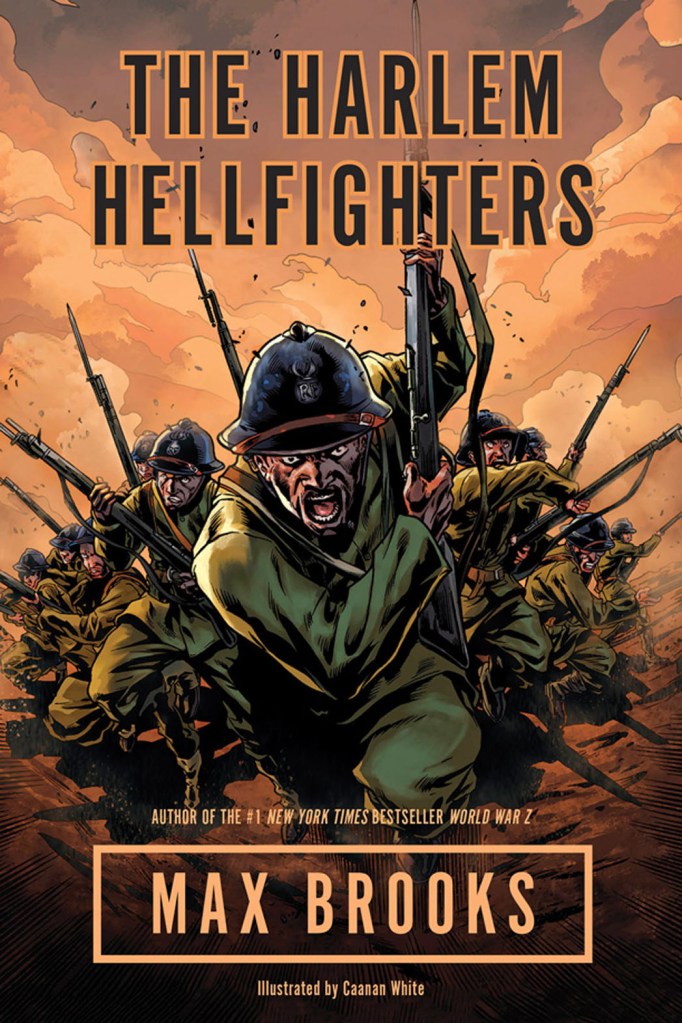
In addition to World War Z, Max Brooks also wrote The Harlem Hellfighters.

Tomorrow, February 11 will be the anniversary of the Hellfighters’ return to the States. The 3,000 men who marched Fifth Avenue that day were only a small portion of the “25 percent of Americans fighting in France [as] hyphenated Americans,” according to Lt. Col. ML Cavanaugh and Max Brooks (yes, World War Z Max Brooks), fellows at West Point’s Modern War Institute. Those other 25% included Choctaw code-talkers whose language was unbreakable abroad, Chinese Americans, Latinos like “Pvt. Marcelino Serna, a Mexican American who migrated to El Paso before the war, took out an enemy machine gun, a sniper, and an entire German platoon on his own, becoming the most decorated Texan of World War I,” and so many more who’ve been forgotten.

I hope you’ll spend the day paying tribute to those Americans who didn’t let the hyphens and racism visited upon them by others stand in the way of sacrifice and the fight for their own unrealized freedom.


KEEP GOING BLACK IN HISTORY:

Read the National Museum of the United States Army account of the wars the Harlem Hellfighters fought at home and abroad.

Smithsonian Magazine features more personal details of the lives, accomplishments and times of the Harlem Hellfighters.

Browse the Smithsonian National Museum of African-American History and Culture’s “Double Victory: the African-American Military Experience” here.

DAY 9 — Ezekiel Mitchell

Babies and cowboys have a reputation for being hard-headed.

So Ezekiel Mitchell’s mother was out of luck from the start when her baby quit football for the rodeo instead. Sorry, Waylon & Willie, you tried.

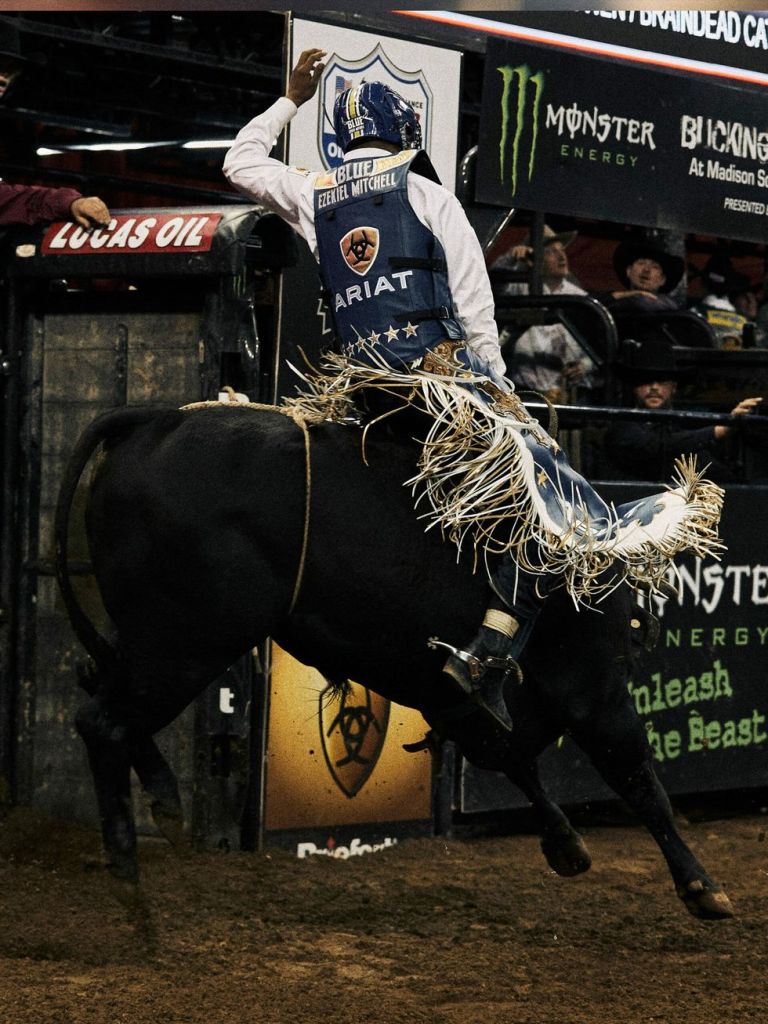
Most kids hop on YouTube to search for how to change a tire, or build a computer, or use chopsticks. Meanwhile, teenage Zeke used the platform to learn how to ride a bull. He even built his own mechanical practice bull right in the yard of his parents Texas home. His mother was NOT pleased.

His parents offered up roping and even bronc riding as alternatives, but Zeke was set on the rush of bull riding. 

“It’s like driving a truck off a cliff and then trying to steer it down. I love taking that complete and utter chaos and being able to control it for once. For those eight seconds at a time.”

Those 8 seconds of chaos are a lot of pressure for anyone, but especially when you’re driving change as the only Black rider in the room.

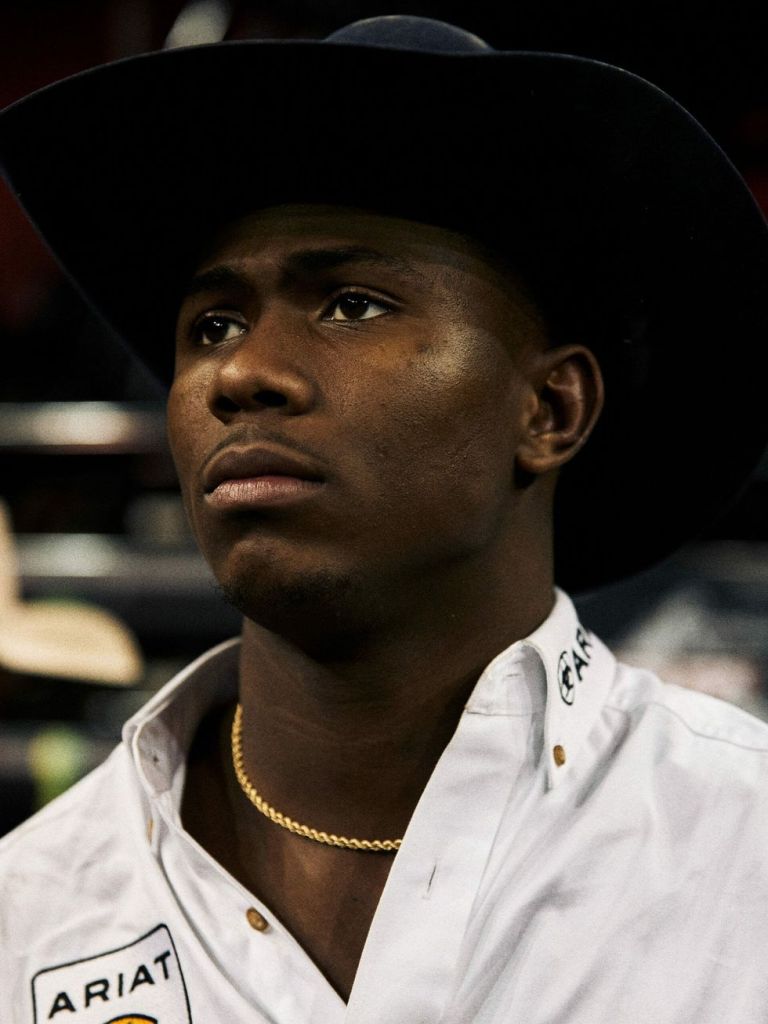
In fact, Zeke Mitchell is the ONLY African-American rider at the elite level on the entire Professional Bull Riders circuit.

“The truth is there are people who hate me because I’m Black, but times change and they have to accept it. Y’all can hate all you want. I don’t care. I’m going to be me. I’m here to ride bull and that’s about it.”

Because regardless of the eyes on him, Zeke’s only got eyes for one thing: the PBR championship title. And he’s ranked as high as second in his race for it.

Charlie Sampson, the first and only African-American professional bull riding world champion.

But when he set that goal, even he didn’t know he was shooting for something historic. 1982 was the first and only year in professional bull riding’s history that a World Championship winner was African-American. Charlie Sampson is a recipient of the PBR Ring of Honor, the highest award a rider can receive.

Though Zeke, Charlie and others like them are anomalies today, that wasn’t always the case: at one point, at least 25% of cowboys were Black.

As it was furthest from Union troops, Texas was slavery’s final stronghold, and nearly 90,000 Texans enlisted in the Confederate Army. In their absence, those they were fighting to keep enslaved tended to the state’s ranches, farms and other agricultural businesses. Though their war was lost, Texans still in need of skilled labor were willing to pay for it rather than see their family ranches fall into disrepair. But take a look at any piece of cowboy lore, cinema, or ephemera, and aside from Bass Reeves, Nat Love, and Bill Pickett, you’ll find a distinct lack of color. 

A Black cowboy who is neither Bass Reeves, Nat Love, or Bill Pickett. Amazing. Read more about the lesser known history of Black cowboys at Smithsonian Magazine.

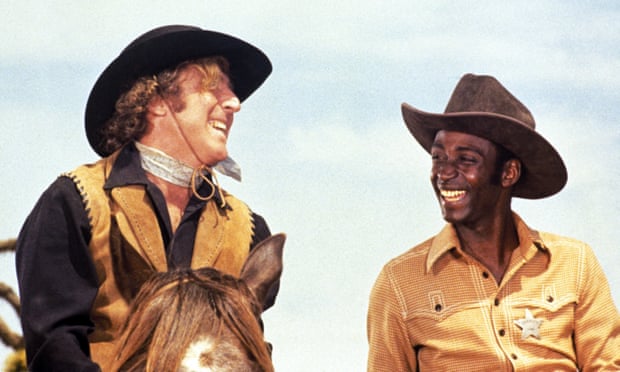
“Cowboy” Mike Searles, a professor emeritus at Augusta State University puts it well. “If something is not in the popular imagination, it does not exist,” he says. In recent years, movies and documentaries like Posse, Django Unchained, Concrete Cowboy, and the Harder They Fall have begun to tell those stories. But why weren’t those stories included in the great American narrative sooner? “The West was where white men were able to show their courage. But if a black man could be heroic and have all the attributes that you give to the best qualities in men, then how was it possible to treat a black man as subservient or as a non-person?”

Denard Butler, fellow Black wrangler.

On a very small level, Denard Butler, another Black rodeo competitor, can relate to the treatment those early cowboys must have received. “When you’re black and competing in places like San Juan Capistrano, California; Price, Utah; and Prescott, Arizona… you will hear the N-word. A lot. I use it for power. I feed off it. I tell myself, ‘You’re going to read about me. You’re going to get sick of seeing me.’ I want it more than most, and so I use it as fuel.”

Zeke takes the arena amid fireworks, and brings his own flash too.

Zeke embraces his differences too. “I don’t fit the mold, but you don’t have to fit the mold,” he says. In fact, he’s intent on breaking it. Zeke Mitchell wears flashy riding gear, cares about growing his social following (he even has a 10-part Snapchat series), and hopes not only that he’ll win a title, but that he’ll become a star doing it, simply for the sake of bringing more people like him into the sport.

That infectious spirit and star power even brought his most reluctant supporter back into the fold: his mother Janie. “Every time I talk to Zeke, I tell him, ‘I’m proud of you, and you didn’t let anyone stop you, not even your mama.’


KEEP GOING BLACK IN HISTORY:

Walk a day in Ezekiel Mitchell’s boots with Gear Patrol.

Watch Zeke’s 10-episode long exclusive Snapchat series, “Life By the Horns”

Zeke’s got such a high profile in riding that even GQ Magazine’s done a great feature on him.

If you’re interested in more modern day representations of Black cowboys, I recommend following eightsecs on Instagram.

Even UK outlets like The Guardian recognizes that Black cowboys in the States have an untold legacy.

The Guardian also creates a detailed timeline of Black cowboys’ cinematic representations.