Tag Archives: THE AMERICAN BLACKSTORY 2020

DAY 29 — Fred Hampton

In the wee hours of December 4, 1969, the residence at 2337 W. Monroe St. on Chicago’s West Side became an all-out war zone. The sounds of wooden doors and their frames erupting into splinters, drywall vaporizing behind shotgun blasts, and indistinguishable shouting over the bedlam tore through the stillness.

By the time the smoke cleared, 100 hot shell casings littered the home, 2 people were dead, and Illinois State Attorney Edward Hanrahan had a perfect explanation at the ready: “The immediate, violent and criminal reaction of the occupants in shooting at announced police officers emphasizes the extreme viciousness of the Black Panther Party. So does their refusal to cease firing at police officers when urged to do so several times.”

In an effort to appear transparent, Hanrahan and the Chicago Police Department staged reenactments of the raid on the Chicago Black Panther headquarters and even invited the press to see the aftermath inside. But when ballistic analysis was done, something didn’t add up.

Of the 100 shots fired, 99 were from Chicago Police. The single round fired by the Black Panthers had come from the gun of Panther security man Mark Clark as he was shot in the heart, involuntarily triggered when he fell dead from his post.

Ballistics also corroborated the story told by five other surviving occupants — one of the deceased hadn’t been killed in the onslaught of gunfire at all. He’d been dragged from bed with serious but non-critical injuries, and then fired upon, killed by two parallel, point-blank gunshots to the head.
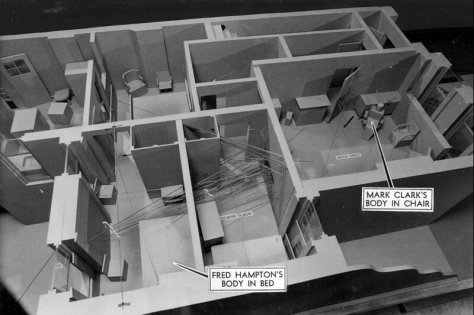
A diagram of the scene at 2337 W. Monroe St.

Witnesses overheard the conversation between officers in another room:

“Is he dead?… Bring him out.”
“He’s barely alive.”
“He’ll make it.”

Suddenly and unexpectedly, two more shots rang out.

“Well, he’s good and dead now.”

HE was Fred Hampton, 21-year-old chairman of the Illinois Black Panther Party, and HE had just been assassinated by the Chicago Police Department and the United States Federal Bureau of Investigation.

Fred Hampton was a rising star in the Black Panther Party. The warm tone and upbeat tempo of his voice made people lean in to listen more closely, and the anti-establishment message he delivered was only magnified by the charisma and congeniality he demonstrated among people of all races.

He first forced the government’s hand when, concerned that inner-city children couldn’t focus on education with empty stomachs, Fred introduced free lunch programs in several predominantly black schools. Ashamed and hoping to quell growing support for the Panthers, the local and federal government implemented their own free lunch programs for the very first time. When the neighborhood’s black children were dying from a genetic epidemic, Fred opened clinics specializing in tests for sickle cell disease. Soon after, government clinics began providing those same tests in their own clinics as well. Even warring Chicago gangs came to a tense but meaningful cease-fire with the help of Fred’s mediation, but when Fred’s leadership and organization skills began crossing racial lines, the FBI, under the directive of J. Edgar Hoover’s COINTELPRO, enacted their plan to “destroy, discredit, disrupt the activities of the Black Panther Party by any means necessary and prevent the rise of a Black Messiah.”

In one of the galvanizing speeches that gave the FBI particular concern about Fred’s ability to “unify and electrify the masses,” he said, “Black people need some peace. White people need some peace. And we are going to have to fight. We’re going to have to struggle. We’re going to have to struggle relentlessly to bring about some peace, because the people that we’re asking for peace, they are a bunch of megalomaniac warmongers, and they don’t even understand what peace means.” As the original founder of the “Rainbow Coalition,” Fred recognized the common goals of the Black Panthers, Puerto Rican Young Lords, and Appalachian Young Patriots sought for each of their respective communities, and unified the three groups to champion the disenfranchised of all races, threatening an imbalance in power that had to be stopped.

The FBI planned a raid on Fred’s apartment and the Panther HQ under the guise of seizing illegal weapons, and recruited the Chicago PD who’d recently lost officers in a shootout with a lone Black Panther to do the dirty work. But too many inconsistencies and surviving witnesses, along with the police’s failure to secure the scene that allowed the public to walk right in to evaluate the crime scene for themselves quickly tanked law enforcement’s credibility. There was even evidence that Fred had been drugged, preventing him from resisting the confrontation and explaining why he was still in bed after what police and witnesses actually agreed was at least 5 straight minutes of gunfire. The “weapons stockpile” police claimed in justifying the raid turned out to be 19 guns and a few hundred rounds of ammo, all legal. Despite mounds of evidence contradicting law enforcement, every officer involved was cleared of any wrongdoing. Though the state’s attorney had the nerve to bring charges of attempted murder of police and resisting arrest against the survivors of the “Massacre on Monroe,” they too were found not guilty as the one shot fired by the Black Panthers came from the gun of a dead man.

Insistent upon accountability for Fred’s death, which still hadn’t been adequately explained by any theory presented on behalf of either the FBI or Chicago PD, his family and the survivors opened a federal civil rights case. In 1983, almost 15 years after Fred’s death, despite the drama of continued cover-ups from judges involved in the case, a failed attempt by the FBI to force the plaintiffs into paying thousands of dollars in labor and printing fees for evidence they didn’t want to turn over, an eventual FBI whistleblower confession, and repeated appeals, the 7th Circuit Court of Appeals decided in the Hamptons & Panthers favor. Federal, state and local law enforcement agencies took equal financial responsibility for Fred Hampton’s death and granted the family a combined $1.85 million settlement.

But the damage was done. Though they hadn’t been successful in keeping it quiet, the goals of COINTELPRO and politicians on the state and local levels had been accomplished. Fred Hampton was dead, the alliances he’d fostered were effectively dissolved, and their smear campaign had played out long enough that in the public eye, the Black Panthers were a violent, racist threat suppressed by peace-keeping law enforcement agencies.

Chi-Town knows the truth, though. In addition to several landmarks around the West Side named after him, December 4th is recognized as Fred Hampton Day according to a resolution that he “made his mark in Chicago history not so much by his death as by the heroic efforts of his life and by his goals of empowering the most oppressed sector of Chicago’s Black community, bringing people into political life through participation in their own freedom fighting organization.”

It’s a fitting tribute for one of the most galvanizing figures of the Civil Rights Movement who once asked, “Why don’t you live for the people? Why don’t you struggle for the people? Why don’t you die for the people?” and then proceeded to inspire generations of people through a brave life and martyr’s death validating each and every word.


KEEP GOING BLACK IN HISTORY:
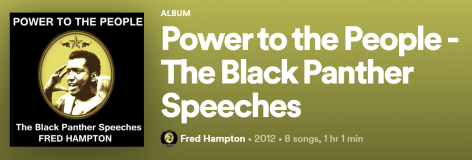
Listen to Fred’s charismatic speeches championing power to ALL of the people via Spotify.

The Chicago Tribune documented Fred’s life, death, and the continued COINTELPRO conspiracy throughout the Hampton v. Hanrahan federal civil rights case.
Videos from the US National Archives show police walkthroughs and testimony vs. that of witnesses and lawyers regarding the events leading to Fred Hampton’s death.

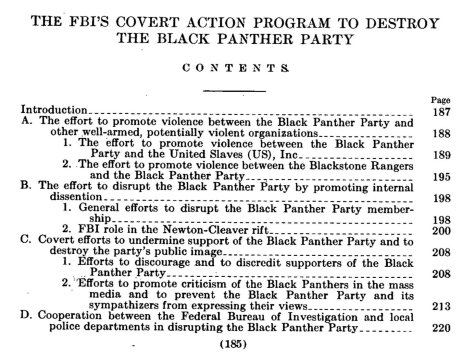
Read the 1976 Senate Select Committee on Intelligence’s detailed investigative report that included a section titled “The FBI’s Covert Action Program To Destroy The Black Panther Party.”

The Committee report also details the FBI’s campaign against other black civil rights leadership, including but not limited to Dr. Martin Luther King Jr., the SNCC, the SCLC, and more “Black Nationalist Hate Groups.”

DAY 28 — Margaret Garner

Sensational news of an enslaved mother murdering her own child was just one contributor to growing unrest over the morality of slavery.

Thomas, Samuel, and Priscilla were all the light of their mother’s life. But it was little Mary, Margaret Garner’s first daughter, who was her mother’s precious beloved.

Through the bitter cold and the blinding snowstorms of 1855’s Long Hard Winter, pregnant Margaret and her husband Robert had holed up together with their 4 children, until suddenly, the miserable chill became their method of escape. The Ohio River had completely frozen over, allowing the family safe and efficient passage from Kentucky where they were enslaved, to the free state of Ohio, a hub of the Underground Railroad.

And they would need it. Robert and Margaret both had individual troubles that threatened to destroy their little family. The most recent owner of their plantation was a cruel man who ruled with the whip just as surely as he ruled by his word. He’d long threatened Robert’s sale to another plantation, but repeated and ever-lengthening loans out to other slavemasters convinced the Garners that it was only a matter of time before Robert was gone forever. The babe still growing in 22-year-old Margaret’s belly belonged to her no more than her other children did, and boy or girl, had a lifetime of enslavement waiting to welcome it into the world. Winter’s brutal but short-lived punishment couldn’t begin to compare with a slave’s perpetually hellish existence.

So on the evening of Sunday, January 27th, 1856 the Garners bundled up their children and Robert’s parents hoping to cross the icy river into Cincinnati, where their family could be free. If all went according to plan, Margaret’s family would take them in until Levi Coffin himself, nicknamed the “President of the Underground Railroad,” came to carry them on to the next stop. By Monday morning, they’d survived patrols enforcing the Fugitive Slave Act and the driving snow to arrive cold, wet and hungry, but alive. With the worst behind them, it’d be just a few more hours before their allies would handle the rest of the journey.

That subsequent departure never came for the Garners. Unbeknownst to them, their master and the U.S. Marshals, unburdened by small children, elderly family members and all of their provisions and belongings, made fast time behind them and now had their cabin surrounded.

The adults knew the terrible fate ahead. IF they survived this confrontation, they’d all be sent back to their respective plantations where the retribution would be swift and without a doubt, severe. The oldest two children at 6 and 4, already knew the despair of slavery. But 2 year old Mary and 9 month old Priscilla were still their mother’s innocent girls. But not for long. Soon, they’d be expected to work, days would turn into years, and her girls would grow into women.

What came next, was no secret to Margaret, or to most enslaved women working in their master’s homes. After all, both of her girls, most likely her youngest son, and almost certainly the child she was carrying had all been fathered by her master A.K. Gaines, one of the men now pounding furiously at her door. A Southern wife’s last trimester was rather distastefully known as “the gander months,” when it was socially acceptable in some circles for her husband to take on a mistress, or enslaved woman, for his personal satisfaction. Almost like clockwork, with the exception of her oldest, Margaret’s babies were born 5 to 7 months after each of the Gaines children, and even Margaret herself was the daughter of a slavemaster.

In the chaos of her thoughts, the armed men moments from storming in, the family members scrambling to hide, and 4 tiny voices all crying in fear, Margaret made a heartbreaking declaration.

“Mother, I shall kill my children before they will be taken back, every one of them.”

Three of the four children suffered head wounds from shovel blows their mother inflicted. But beloved Mary was the last, her mother’s pride and joy, and whatever fate the rest of the family suffered would not, could not befall Margaret’s precious Mary. Just as the men burst through the front door, Margaret reached for a butcher’s knife on the kitchen table, and without hesitation, took her daughter’s life.

The scene was the real-life inspiration for Toni Morrison’s Pulitzer Prize winning book, Beloved.

And yet, the story didn’t end there. All except for little Mary, every member of the family was seized under the Fugitive Slave Act. But Margaret’s horrifying act complicated the matter tremendously. The crime had occurred in Ohio, where black people were free. But the Fugitive Slave Act was federal decree, and allowed slave owners to cross into any state their property might be located. Margaret’s two-week-long trial became a national spectacle and the longest fugitive slave trial in history. Ohio wanted a murder prosecution, fully expecting Margaret would be granted clemency due to the poignant circumstances. Their play was also a strategic one — finding Margaret guilty of murder would require the court to acknowledge her and her child as human beings, setting a federal precedent. On the other hand, indictment under the Fugitive Slave Act would charge Margaret with depriving an owner of his property, and ultimately require that she be returned to him too.

Thousands packed the frigid courtroom for each day’s heated arguments between the attorneys and the circus in the gallery, divided by northern and southern spectators. It was just 5 years before the start of the Civil War, and the trial not only humanized enslaved black people – women in particular – for passive northerners, but also absolutely incensed southerners who saw the trial as nothing but unwelcome northern interference and egotism. Lucy Stone, a white abolitionist did her best to plead on Margaret’s behalf and simultaneously shame her owner, pointing out that “the faded faces of the Negro children tell too plainly to what degradation the female slaves submit. Rather than give her daughter to that life, she killed it. If in her deep maternal love she felt the impulse to send her child back to God, to save it from coming woe, who shall say she had no right not to do so?”

But Lucy’s pleas for empathy fell on deaf ears, and the Garners were all deemed property to be sent back to their respective masters. Though the state of Ohio scrambled to bring their own charges against Margaret anyway, Slavemaster Gaines spirited her away, repeatedly relocating her each time relentless abolitionists closed in. Eventually, Gaines put Margaret and baby Priscilla on a ship to Arkansas, which subsequently wrecked. Priscilla was drowned, and though she didn’t succeed, onlookers reported that Margaret attempted to drown herself as well. Reunited once and for all, Robert and Margaret spent the rest of their days together in New Orleans until Margaret died in 1858, begging her husband to “never marry again in slavery, but to live in hope of freedom.”

Toni Morrison herself spoke to the heart of Margaret’s tragedy, saying “The interest is not the fact of slavery, but of what happens internally, emotionally, psychologically, when you are in fact enslaved and what you do to try to transcend that circumstance.” For Margaret, who loved her children so much that she would sacrifice herself and whatever future she had for them, if death was the only freedom to be found from slavery, better that than no freedom at all.


KEEP GOING BLACK IN HISTORY:

The events leading up to Margaret’s arrest and return to slavery were detailed in the abolitionist newspaper The Anti-Slavery Bugle and archived in the Library of Congress.
(zoom on the paper’s entire second column)

The Ohio Memory Project has an excellent archive of historical documents and newspapers related to Margaret’s tragedy.

When the Michigan Opera Theatre’s Detroit Opera House performed Toni Morrison’s libretto based on her book Beloved and Margaret Garner’s life, they shared one scholar’s essay detailing Margaret’s life and circumstances.

DAY 27 — Dr. Hadiyah Green

Dr. Hadiyah Green - From Physics to the Physical

Hadiyah Green watched helplessly as a monster slowly ravaged her precious aunt and uncle. Her aunt’s hands that once dutifully cleaned homes shriveled away at the mercy of the “woman’s cancer” she willingly left untreated, rather than allow chemo and radiation to steal what little life she had left. Just 3 months after her aunt’s death, her uncle’s rich mahogany skin deteriorated to burnt parchment when the poisons treating his esophageal cancer behaved like an atom bomb, causing total fallout.

“I got to see, with both of them, firsthand, the horrors of cancer, and the horrors of cancer care. It was so devastating that it fell on my heart that there has to be a better way,” she recalls.

When Hadiyah didn’t find one, she put her 3 degrees in physics and optics to work at making a better way herself. Though it was a little out of the ordinary for a physicist to operate in biology, Hadiyah is rather accustomed to standing out. She’s one of fewer than 100 African-American women in the United States with a PhD in Physics among over 22,000 white male peers.

Being a young woman, a woman of color, and a physicist in the field of cancer research may position 37-year-old Hadiyah as an anomaly, but she’s capitalized on her fresh perspective and profound personal motivations to do what no one else before her could — laser-target and destroy cancer cells with no side-effects, no outrageous treatment recovery times, all in a couple of weeks.

Hadiyah’s groundbreaking treatment actually works as a four-in-one, cancer-beating Swiss Army knife — early detection, imaging, direct targeting and selective treatment are all possible with her “particle target laser therapy.” It works much more simply than it sounds.

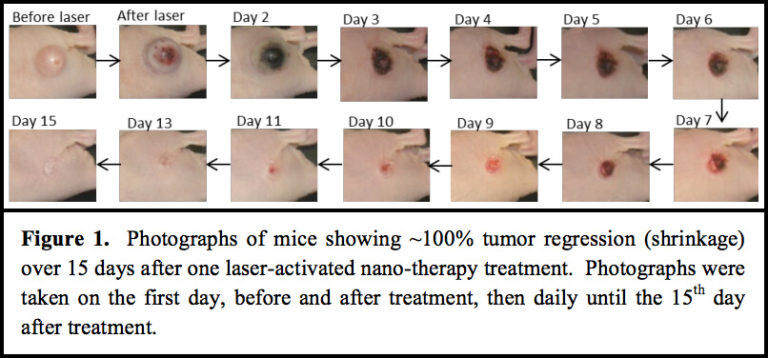
Tumors on/at the skin’s surface are injected with an FDA-approved serum carrying nanoparticles that only attach to cancer cells. When, and only when, those nanoparticles are heated with a laser, cancer cells are burned and destroyed at the microscopic level. After only 10 minutes, tumors are visibly affected, and within 15 days, gone altogether.

The procedure for internal tumors is slightly different, but could be even more significant as it can identify cancers before they turn symptomatic. In this case, fluorescent antibodies carrying the nanoparticles are injected, then attack cancerous cells. The antibodies’ tell-tale glow reveals the cancer on imaging scans, the laser directly targets the nanoparticles, and again the growth is killed while healthy tissue goes unscathed. After just one treatment, 40% of the mass is eliminated.

Hadiyah’s results are so groundbreaking that she’s received approval for HUMAN testing. All she needs is the money. And of course, that number is staggering. Even with all the funding she’s received in awards and research grants, including $1 million from the U.S. Department of Veterans Affairs’ Office of Research & Development, Hadiyah still needs millions more to make her clinical trials a reality. And she’s adamant about not standing by while the cancer epidemic that stole her grandparents ravages the country too. The American Cancer Society estimates that approximately 1.9 million new cases of cancer were diagnosed last year, and over 600,000 people will die in the United States from some form of the disease this year alone. Hadiyah’s therapy is proven on colorectal, ovarian, cervical, breast, brain, pancreatic, bladder, skin and prostate cancers that claimed over 250,000 lives in 2019 that she might have saved. Black women like Hadiyah’s dear aunt Ora Lee are most at risk.

Still, fighting the cancer itself is only part of the goal for Hadiyah. “I want to be a good steward over this technology, and I want it to be available to people that don’t have insurance, to people that are underinsured who may not have other alternatives, who can’t afford the pharmaceuticals, who have been sent home to die,” Hadiyah insists. “If I don’t protect it, nobody else will.” It’s why she’s shunned big pharmaceutical companies that might seek to profit from her work in exchange for funding it, and instead, created her own non-profit research organization, the Ora Lee Smith Cancer Research Foundation.

Nearly every step that Hadiyah’s taken to revolutionize cancer research has been unorthodox or extraordinary, and yet she’s beyond humble about the game-changing work she’s done. “It looks like I’m special, but I’m not. I’m no different from anybody else. When opportunity found me, I was prepared.” The opportunity to be a miracle-worker for future cancer patients is an absolute dream, but there’s one more way Hadiyah hopes to leave her mark on the world. “When I was growing up I didn’t see an example of a Black female scientist…, and when I thought of a physicist, I thought of Albert Einstein,” she explains. “I did not get here by myself. Because of that clarity, I know my responsibility to encourage and mentor the next generation. I hope in the future people will also think of me, a Black female physicist.”

In a future where her treatment is successful & the world is cancer-free, it’s certain Dr. Hadiyah-Nicole Green won’t need to worry about that.


KEEP GOING BLACK IN HISTORY:

See Dr. Hadiyah’s infectious enthusiasm for her work at the 2018 BET Breast Cancer Awareness Awards.

Follow Dr. Green — and her journey to kill cancer once and for all — on Instagram.


DAY 26 — Ms. Mary Hamilton

“We had to practice nonviolence because if we didn’t, we’d get the sh*t kicked out of us.”

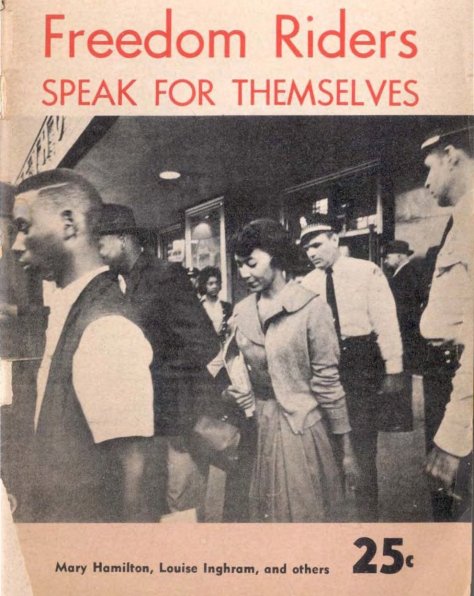
Mary Hamilton was non-violent all right. But the lady had a tongue sharp enough to commit murder, and when the state of Alabama refused to put some respect on her name, she showed them just how deeply she could cut. Like most of the Freedom Riders, Mary was no stranger to gross insults, physical and mental humiliation, petty imprisonments, and violent beatings. Unlike many of her companions, turning the other cheek didn’t come so easily, so if she couldn’t fight back with her hands, Mary wielded words as her weapon of choice. As her daughter later told NPR, “Dr. King called my mother Red, and not for her hair but for her temper. For a nonviolent movement… she was one to get pissed off.” Jailers, doctors, not even the mayor of Lebanon, Tennessee escaped the righteous indignation spoken from the mouth of this black woman.

Men with that level of status were especially not accustomed to such treatment from a woman who could pass for white but self-identified as black, even in the worst of circumstances. In a book of letters from Freedom Riders, she recalled, “The official who checked our money and belongings had put on my slip I was white. When the girl behind me told me, I notified him otherwise. He was very angry. He told me that I was lying. He then took it upon himself to decide what other races I could be, and told the typist to put down that I am Negro, white, Mexican, and I believe that’s all. This made me very angry.”

Identity was everything for Mary DeCarlo who was so committed to living her truth that she dropped her father’s Italian surname in favor of her mother’s more nondescript maiden name. So when all of her activism finally landed her in court and the attorney had the gall to call her by her first name, Mary couldn’t let it go and gave him hell instead. Jailed over yet another act of civil disobedience, Mary’s 1963 hearing in Gadsden, Alabama should have been just another ordinary procedural matter. But Mary Hamilton was anything but ordinary.

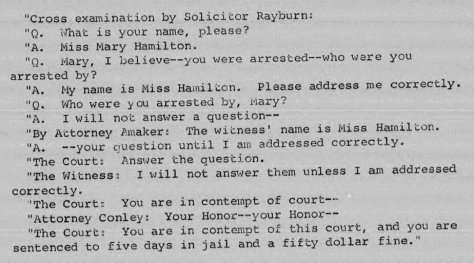
A court transcript of Mary Hamilton’s witness stand exchange.

“Mary, I believe you were arrested…” the prosecuting attorney started. “My name is Miss Hamilton… and I will not answer a question unless I am addressed correctly,” she quickly interjected. Her insubordination wasn’t just shocking, it was an audacious protest right in the middle of open court.

Referring to black people by first name, regardless of rank, class, educational background, or social situation was the norm before the Civil Rights Movement. Dr. Barbara McCaskill from the University of Georgia gives more context, explaining, “Segregation was in the details as much as it was in the bold strokes. Language calls attention to whether or not we value the humanity of people that we are interacting with. The idea was to remind African-Americans, and people of color in general, in every possible way that we were inferior, that we were not capable – to drill that notion into our heads. And language becomes a very powerful force to do that.” Calling grown black men and women “boy” or “girl” was another common linguistic tool that passively reinforced the American social and racial hierarchy.

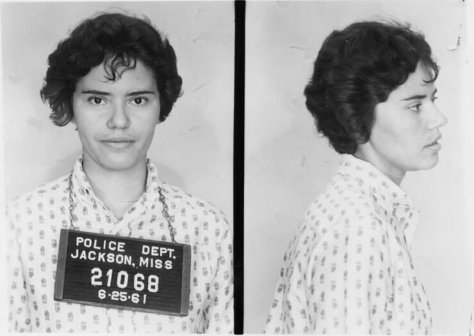
Mary Hamilton’s iconic mugshot from her arrest as a Freedom Rider in Jackson.

Mary had endured stifling southern summers in segregated cells where the black inmates were denied air conditioning, physically invasive jail exams that amounted to sexual abuse, and so many police assaults in her pursuit of freedom that her health was already starting to deteriorate by the time she was 28. After all of that, she’d be damned if she was going to let someone turn her name into a slur.

Absolutely enraged at her calm but repeated refusals to comply until she was addressed respectfully, the judge found Mary in contempt of court that day, and her minor charge escalated to a $50 fine and 5 more days in jail. She dutifully served her sentence, and then appealed her case all the way to the United States Supreme Court. The NAACP filed documents arguing that Alabama’s use of first names perpetuated a “racial caste system” that violated the Equal Protection Clause of the 14th Amendment guaranteeing the same rights, privileges and protections to all citizens of the United States. The Alabama court’s transgression was so evident that without hearing a single oral argument, the Supreme Court decided in Mary’s favor, establishing the 1964 case of Hamilton v. Alabama as the legal decision that gave black adult plaintiffs, witnesses, and experts the same respect granted to white children and convicted criminals for the first time in American history.

Just a year later, Mary married out of the activism circles, but someone close to her had found major inspiration in a minor detail of her story. When Mary received a letter regarding her case, her white roommate and best friend Sheila Michaels couldn’t help but notice how the letter was addressed: Ms. “That’s ME!” she exclaimed. The honorific was rarely used, and even then, only for business correspondence where a woman’s race and marital status might be unknown, not in popular culture and most certainly not by women to describe themselves. Unmarried women in proper society were “miss” and married women were “mrs.” Mainstream language didn’t account for anyone in between. “The first thing anyone wanted to know about you was whether you were married yet,” Sheila said. “Going by ‘Ms.’ suddenly seemed like a solution; a word for a woman who did not ‘belong’ to a man.” Sheila’s campaign to popularize the term led to its adoption as the title of Ms. Magazine, and a new way to show respect was once again inspired by Mary’s work.

Despite Sheila’s best efforts to preserve the story of how Mary’s triumph lead to her linguistic epiphany, the tale of Ms. ultimately overshadowed the struggle to be called anything respectable at all. While Mary’s sharp tongue and unflinching rebellion against systematic racism ended up mostly buried in legal texts, black women today like NAACP lawyer Sherrilyn Ifill who’ve personally experienced the long “fight for respect and dignity against demeaning and ugly stereotypes in the public space” still find inspiration and courage in the woman who’d endured too much of this country’s worst to be called by anything but the best.


KEEP GOING BLACK IN HISTORY:

Read all about Mary’s life and even listen to Mary & Sheila chat together in NPR’s story & archival audio.

Dig into Mary’s first-hand account of her jailhouse treatment published in a book of letters from Freedom Riders.

The New York Times documented Mary’s historic 1964 Supreme Court win.

DAY 25 — Black Masking Indians

The endless mazes of cypress and tupelo trees, cold-blooded predators lurking, and flesh-eating insects guarding the dark, murky Louisiana swamps were all a better fate than the chains waiting for the newly enslaved.

In fleeing their French captors, some survived the swamp’s perils, creating independent, hidden communities called “maroon camps.” (The inhabitants themselves were the “maroons.”) Others perished in the marshlands, but did so as free people, fighting to live.

Many who survived didn’t do it without an unexpected assist from the fiercely independent indigenous peoples of the Choctaw, Blackfoot, Seminole and other local tribes. When the French established the great city of New Orleans in the early 1700s, they did so on already occupied land. The Natives who weren’t scattered by the decimation of their tribes and sacred land were enslaved to build the future Crescent City. Unfortunately for the French, these peoples’ languages and customs, intimate relationship with the terrain, and strategic prowess made their frequent escape a constant liability.

The French didn’t have to wait long for replacement labor, though. In 1719, ships of enslaved people arrived from Africa, Haiti and the West Indies. Without the home advantages native people capitalized on, and terrified of a new, unfamiliar place where humans, plants and animals all held danger, the newly enslaved were much more vulnerable. Rather than live under a slavemaster’s whip, many fled into the nearby swamps, where natives who came upon them fed, clothed, guided them to safety, and sometimes welcomed the newly freed into their own tribal communities. The black and native people even established their own “Swampland Railroad” to liberate those who couldn’t escape to maroon camps on their own.

The deep alliance and mutual cultural respect black and indigenous people shared culminated into the French’s worst fear in the Natchez Revolt of 1729 when 280 slaves and 176 natives joined forces to destroy the tobacco farms further impinging on native lands and enslaving more black people. Their uprising was unsuccessful, but the relationship had been solidified. Though the French repeatedly implemented an assortment of laws and regulations – such as the “Code Noir” that regulated basic behavior like when, where, and if people of color were allowed to gather, leading to the establishment of New Orleans’ historic Congo Square – the two marginalized groups cultivated a friendship that only grew deeper with French suppression.

Having gained so much from the indigenous Americans, by 1746, the free black communities chose to honor and appreciate the tribes in the best way they knew how – by incorporating hallmarks of tribal culture, mythology and textile making into their own creations for the biggest celebration of the year, Mardi Gras. Black people were only allowed to attend the city festivities as servants, and once again couldn’t gather together under French law, but when police were occupied with peacekeeping among the major white-only parties, in black communities, vivid feathers, beaded story scenes, and tribal traditions learned from local natives became the fancy dress of choice. The bravest of black revelers would even craft masks to go with their elaborate suits, and sneak into the society events undetected. Masks were soon outlawed as well, but a centuries-long tradition was born.

Today, the Mardi Gras Indians – or Black Masking Indians as some prefer to be called, since people of color were historically segregated from the festival – preserve the tradition of their African and indigenous forefathers. During Mardi Gras, St. Joseph’s Day, and “Super Sunday” – in recognition of the only day of the week that black free and enslaved people were allowed to congregate, trade and socialize together in Congo Square – dozens of “tribes” of Black Masking Indians parade the streets of New Orleans, hoping they’ll be recognized by the crowds as the prettiest of them all.

“Beads and feathers have always been worn by indigenous people — you can’t hide among a people unless you resemble them,” explains Big Chief Shaka Zulu of the Golden Feather Hunters. “Masking” is the term used to describe dressing in your hand-crafted suit, likely derived from the tendency to subvert segregated Mardi Gras parties by donning a mask. In each tribe’s suit, elements of indigenous, African, and Afro-Caribbean influence all intermingle to create a distinctly southern African-American tradition.

“It is a tradition of resistance. It is an homage to the mutual struggles of both African Americans and indigenous Americans on their quest for freedom, self-actualization, and self-expression in America,” one Black Masking Indian queen proudly explains.

Each Black Masking tribe mirrors a typical native tribe’s hierarchy with a Big Chief, Big Queen, Spy Boy (scout) and Flag Boy (banner man). Tribes throughout New Orleans’ neighborhoods bear names as colorful as their suits, like the Young Maasai Hunters, Bayou Renegades, Black Seminoles and Yellow Pocahontas, many referencing the deep Native American, African and creole cultures that thrived together secretly for centuries. And the suits they hand-sew in the tradition of their allies and ancestors can cost up to $30,000, but are only worn for a single season. It’s a small price to pay to preserve and perpetuate such a beautiful expression of history.

Those who preserve that history today stress its importance to a cultural future in New Orleans, especially in the wake of Hurricane Katrina. “We still have some depressed neighborhoods in New Orleans,” one chief acknowledges. “When the Black Masking Indians meander through their communities, they provide a sense of belonging, a sense of self. It’s about uplifting and empowering [people] to feel good about themselves rather than feeling ‘less than.’”

Some of the Black Masking Indians can trace their lineage back to the original black and indigenous people of Louisiana, others were welcomed and initiated into the society by existing members. But either way, when the Black Masking Indians dance down the streets of New Orleans, cultures that once had to go into hiding come back to life in a bold, storied, and most of all, public display, of black and indigenous southern history at its most beautiful.


KEEP GOING BLACK IN HISTORY:

Watch Huffington Post’s short on the “tradition rooted in rebellion.”
Dive deeper into the customs of the Black Feather Tribe.

Learn more about the Black Masking Indians’ motto of “killin’ em dead with needle and thread.”

Read one queen’s account of what masking means to her.

DAY 24 — Changa Bell

Changa Bell - Namaste with Soul

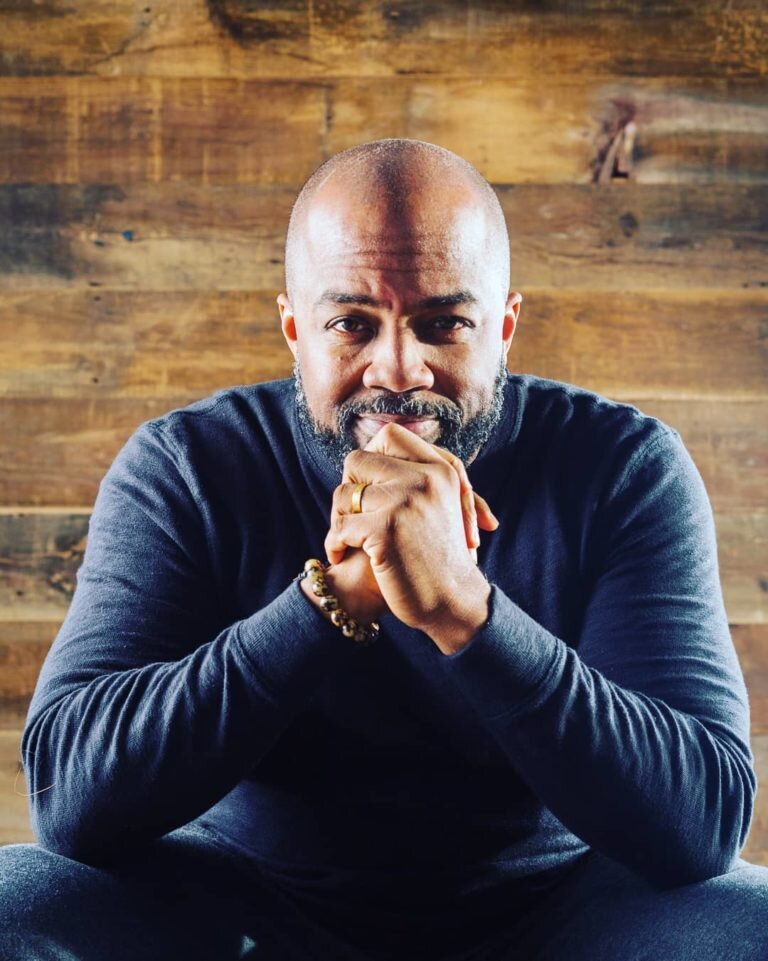
The day Changa Bell’s heart began to stop is the same day his life began to change forever.

His name means “strong as iron” in Yoruba, but the tangle of IVs and electrodes spider-webbing across his hospital bed, and the inescapable dread of closing his eyes for fear he might not open them again made him feel so weak and small. Every now and then, his heart would inexplicably stop, and no one knew for sure why. So here in a still, sterile room Changa, only in his early 30s, laid vowing that before he’d let doctors give him a pacemaker, he’d find a change of pace himself.

And he knew just where to start. The same person who’d taught him to be a man sat with Changa for the very first time and taught him yoga too. “I was raised in the ’80s, and yoga was totally not the cool thing to do,” so even though Changa’s father was a yogi, he’d never felt particularly compelled to practice yoga himself… until now. When his heart arrhythmia stabilized just a few weeks later, Changa was a believer.

But in his hometown of Baltimore where almost 63% of the population is black, he was an anomaly for a lot of reasons. Of course, black yogis are few and far between. But more importantly, yoga helped Changa escape a harsh statistic too many of his peers never did: black men have the lowest life expectancy in the United States. It was an alarming reality because the causes were nearly too innumerable to address – heart disease and stroke that claim 30 and 60 percent more black men than non-Hispanic white men, respectively; a suicide rate 4 times that of black women, when African-Americans are already 10% more likely to suffer serious psychological distress; and of course, inner city gun violence that claims too many young men’s lives.

The thought of all those ills affecting black men just like him could have been overwhelming. But Changa gave an old cliché new purpose when he discovered he could help address all of those issues with one simple solution: meditate on it.

It was a novel, and admittedly “hippie” approach, but one with science on its side too. The National Institutes of Health (NIH) list “stress management, mental/emotional health, promoting healthy eating/activity habits, sleep, and balance” as possible benefits yoga provides, and Changa himself was a living example. But like all things, getting others on board was easier said than done.

Even as someone intimately familiar with the practice of yoga, he couldn’t shake the discomfort that intruded on his peace of mind during every class. “Black men in particular were isolated from the yoga community. I didn’t fit the preconceived mold. We’re marketed as over-sexualized, hyper-violent, hyper-masculine,” he says. “I was the only male in a class of 17 people when I got certified. It was intimidating to me, and I didn’t want black men to not get the life-saving possibilities of yoga because they didn’t feel comfortable in a space with a bunch of strong, mostly white, mostly young women.” The centuries-long practice of yoga couldn’t erase America’s historic social dynamics between white women and black men, especially in a space with so little representation.

Motivated by his mantra “I am my light, my own responsibility, and that I am alone in accountability for the change that I wish to see in my world, which is really the change I wish to see in my life,” Changa took it upon himself to create the The Black Male Yoga Initiative in 2015.

In their own words, “Black Male Yoga Initiative creates integrated, supportive, safe spaces that empower our program participants to break down social stigmas, gain skills for human development and thus create positive social change in their own communities and our global community.” The organization “envisions a future, where race and gender are not social determinants of health, and where individuals are empowered to take on the path of self realization; that we may all join in the understanding that health is our collective heritage.”

An understanding of black men’s journey from commodification to criminalization gives Changa’s yoga practice a very special point of view. No matter what sort of ailments his students suffer from, his message for them remains the same: “You’re welcome here. Come and heal.” And they’ve taken it to heart. “Trauma is deeply intertwined in our existence. We get to express it here,” said one of the BMYI members. “Yoga brings balance. It puts everything I’ve ever went through into perspective.”

Changa hopes that attitude is one that ripples through the black male community, and he can see yoga transform and motivate black men in the same way it did for him. He’s set a goal to train and certify 1,000 yoga instructors aged 16-65 through BMYI, and this year, he’s going nationwide to make it happen on his “Health is Our Heritage Tour.” Pop-up workshops featuring dialogue circles, guided meditations, group life coaching, and of course, yoga sessions in six metropolitan cities will bring wellness to the black men exposed to it least but might need it the most.

It’s how now-47-year-old Changa is transforming his individual misfortune and personal enlightenment into something greater than himself. “We strengthen at an individual level in order to strengthen the community as a whole,” he says. In some circles, “namaste” – meaning, the divine in me recognizes the divine in you – is appropriated and overused, but at BMYI, black men seeing each other to wellness and truly being seen is nothing short of spiritual.


KEEP GOING BLACK IN HISTORY:

Learn more about the The Black Male Yoga Initiative and how to help or participate.

Read People Magazine’s feature on how Changa gives black men the space to love themselves.

Follow Changa’s journey on Instagram.

DAY 23 — Lauren Simmons

Lauren Simmons - NYSE’s Fearless Brown Girl

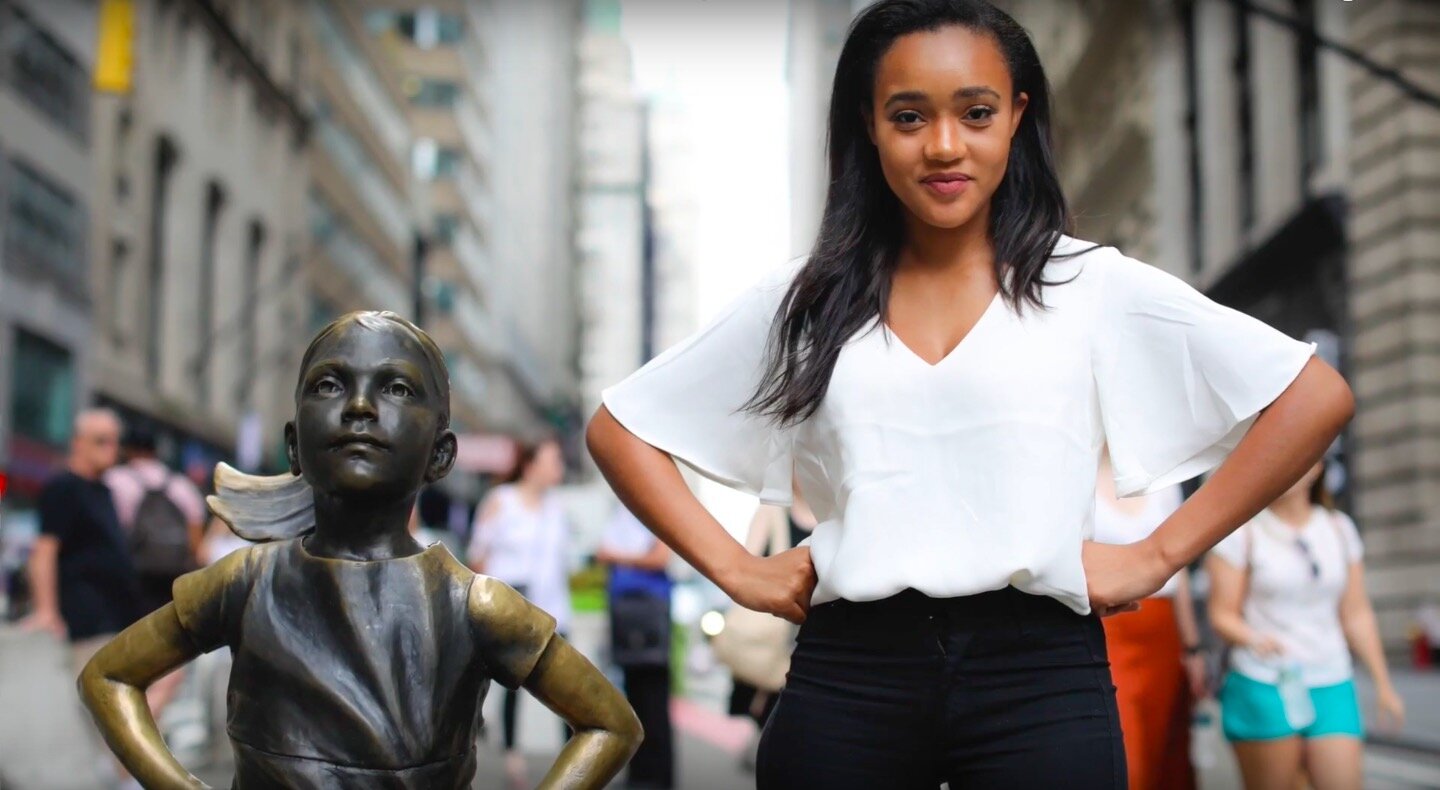
Just a day before the Fearless Girl statue made her debut in New York’s Financial District, her real-life counterpart had already beaten her to the punch.

Lauren Simmons signed her name to the New York Stock Exchange’s constitution like thousands of traders who’d come before her, but unlike most of them, she was making history.

On March 6, 2017, 22-year-old Lauren became the youngest female, only full-time female (at the time), and second ever African-American female trader in the New York Stock Exchange’s 227-year history.

“There was silence on the trading floor. You could only hear the machines whirring. Everyone was in shock,” Lauren said of the day her trader’s exam results came in.

The reaction wasn’t entirely unexpected. As woman from Georgia with a Psychology degree and no experience in finance, it was a surprising turn of events for Lauren, as well. Her education, prior jobs and working skillsets almost read like potential aptitude test results – psychology major, statistics minor, genetic counselor, medical clinic intern, sales manager – but nothing really stuck for Lauren until she applied to a financial securities firm.

She’d moved to New York with no job or home of her own, but determined to make just about anything work, even a position that she was overqualified for in an unknown field. Intrigued by Lauren’s background and tenacity, one of the firm’s partners invited her to apply as a trader instead, and well, the rest became actual history.

“You don’t need 100 ‘yeses,’ you just need that one opportunity,” Lauren encourages.

And her field is one that could use a lot more opportunity for the women and people of color she represents. The same year Lauren became affectionately known as “The Lone Woman on Wall Street,” a Stanford University study showed that men made up 75% of the wealth management field and filled more than 80% of leadership roles. The 25% of women in the field were just as productive, and in some cases outperformed, but were 56% more likely to get fired for a mistake. The numbers are even more dismal when it comes to black female professionals in particular.

Lauren aims to change those statistics with both her presence and her reassurance as someone who’s braved the unknown. “We encourage men to take risks and make failures. And they’re rewarded for it,” Lauren says. “Women don’t get that opportunity as often, but I encourage us all to try.”

Her encouragement couldn’t be better timed. Both sitting presidents of the New York Stock Exchange and the Nasdaq are opportunity-seizing, ceiling-shattering women. The circumstances are a far cry from those in 1967 when Muriel Siebert became the first woman eligible to trade on the NYSE floor, and for efficiency’s sake, was accommodated with a single bathroom stall built right in the trading room.

There’s a proper bathroom now, but Lauren had her own minor struggle with accommodation as well: the jackets identifying traders in the hustle and bustle of the Exchange only come in men’s sizes. No problem for Lauren who’s built her whole career off the belief that to be successful, we have to “be uncomfortable to go after what we want. Do what you’re meant to do and do it well.”

She’s done just that. So well, in fact, that in addition to hundreds of starstruck articles by global authorities like Forbes and Fortune recognizing Lauren’s nontraditional journey to Wall Street, there’s already a biopic being filmed about her seemingly storybook – but in truth, determined – rise to one of America’s most historically exclusive occupations. In the meantime, Lauren’s hung up her trader’s jacket to pursue an even broader range of opportunities like worldwide speaking engagements and executive producing, because despite her success at the NYSE, she reminds her cheering onlookers that “I’m 25. I don’t know if I’ve found my purpose. But I’m open and fearless.”

And a bronze statue’s got nothing a black girl who can say that.


KEEP GOING BLACK IN HISTORY:

Follow Lauren’s day-by-day rise to the top on Instagram!

Peek into Lauren’s convo with 30-year financial service veteran Suzanne Shank, sharing their career experiences in Harper’s Bazaar.

Read a few of Lauren’s smart insights on finance, diversity, and more at U.S. News and World Report.

DAY 22 — Gladys Bentley

Police swarmed the King’s Terrace nightclub in midtown Manhattan. Some upstanding citizen had reported a terrible crime in progress that 1934 night. A “masculine garbed smut-singing entertainer” and her “liberally painted male sepians with effeminate voices and gestures” were traipsing around the stage and right through the audience performing songs so lewd the devil himself would blush.

On the other hand, through the eyes of renowned black poet Langston Hughes, that same performer was an “amazing exhibition of musical energy – a large, dark, masculine lady, whose feet pounded the floor while her fingers pounded the keyboard – a perfect piece of African Sculpture, animated by her own rhythm.”

From the beginning, Gladys Bentley – or Bobbie Minton, depending on where you knew her from – seemed to have a knack for being different things to different people.

A full figure that she clothed in men’s attire, her reputation as a tomboy, and schoolgirl crushes on female teachers were the earliest indicators that Gladys was different from the other girls. Her parents sent her to specialist after specialist to be “fixed,” but when Gladys was 16, she fled their closed-minded Philadelphia home to find a new family in Harlem instead.

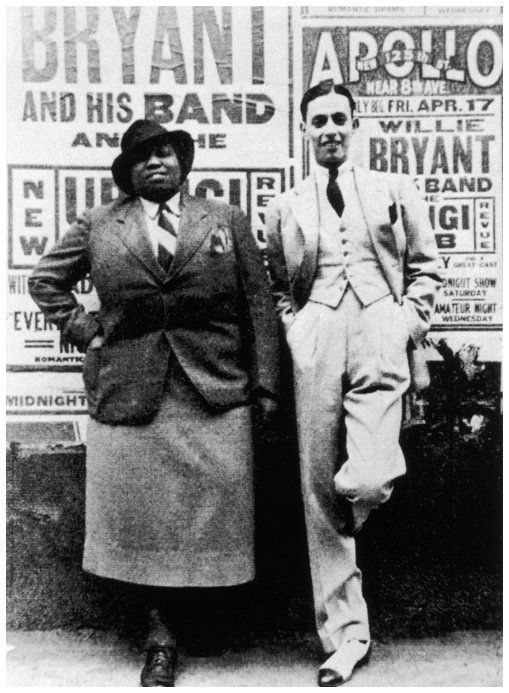
Gladys poses with bandleader Willie Bryant outside the Apollo Theater, April 17, 1936.

She arrived in 1923 during the Renaissance, and after a handful of small gigs around town, an opportunity that seemed tailor-made for her presented itself. The owners of The Clam House, one of Harlem’s most famous gay speakeasies, needed a new man as their sister bar’s nightly pianist, and as far as Gladys was concerned, she fit the qualifications. “But they want a boy,” a friend scolded her. “There’s no better time for them to start using a girl,” Gladys quipped. She arrived at her audition with her hair slicked down and in the finest suit a runaway teenager could find, where she proceeded to bring the owners, the staff and everybody within earshot to their feet in a standing ovation.

There could have been no better validation. But then again, when it came to validation for society’s free-thinkers, there was no better place than Harlem. During the Renaissance, creative, curious and ambitious black minds flocked to Harlem to join the growing collective of visual, performing and written artists flooding the American consciousness. The influx of those new ideas and Harlem’s never-dry, Prohibition-defying nightclubs together catered to and encouraged an “anything goes” atmosphere, drawing all sorts of eccentric subcultures to the heart of the action.

Gladys Bentley, photographed in a Harlem nightclub in 1940, courtesy of the Smithsonian.

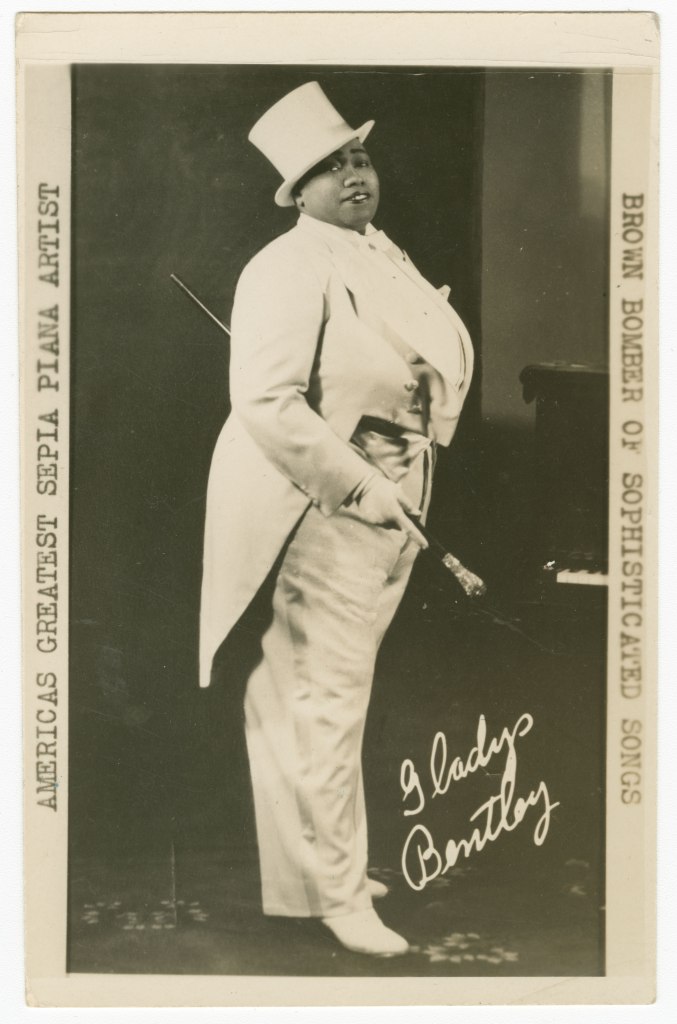
Here, Bobbie was free to be, and what she became was a Harlem legend in a white top hat and full tux, who stomped her feet with the same ferocity that she banged on her piano, transforming innocuous radio-friendly songs into lusty howlers, and unapologetically flirting with every woman in her audiences. In her own original songs, themes of female independence from gender norms and escaping abusive relationships dominated her lyrics, and her signature trumpet-scatting filled the space between. Crowds packed into the variety of clubs Bobbie headlined, hoping in particular to hear her barn-burner “Nothing Now Perplexes Like the Sexes, Because When You See Them Switch, You Can’t Tell Which is Which.”

But for Bobbie, that night at King’s Terrace and the padlock police used to shut the club down only symbolized the beginning of her end in New York. Financial woes plaguing the populace during the Great Depression in the 30s and the end of Prohibition brought the nightclub scene to a grinding halt. The woman who’d once boasted record deals, a $5,000 a month apartment on Park Avenue, and sold out every show would have to find a new home for herself and her act.

Luckily, her fame already preceded her nationwide with tours that took her to Pittsburgh, Cleveland, and as far as California, where she ultimately decided to move. As Los Angeles’ “Brown Bomber of Sophisticated Songs” and “America’s Greatest Sepia Piano Player” she once again dazzled audiences, but it was clear her Harlem heydays were long gone. Laws passed in California forced her to carry special permits to wear men’s clothes and increasing public distaste for non-gender-conforming people continued to stifle the flamboyant show that put Gladys on the map.

By the 1950s, black celebrities who dared to oppose social conventions were being dragged into and condemned at all-white government hearings, victims to McCarthyism and the Red Scare. Her already declining career couldn’t suffer another blow, and in 1952, Gladys submitted an editorial feature to EBONY Magazine, declaring herself cured of her “third sexuality.”

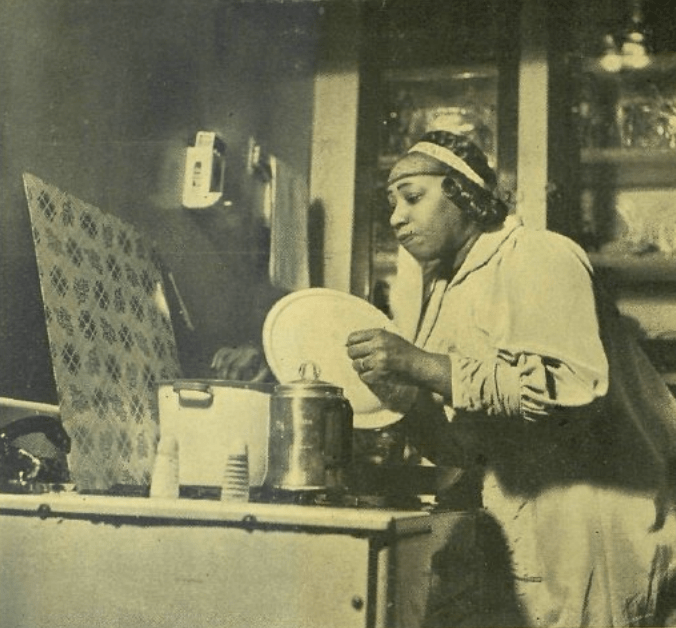
Gladys in a more traditional gender role from a spread in Ebony Magazine.

But in that same article, Gladys slipped a telling insight. “Some of us wear the symbols and badges of our non-conformity,’ she observed. “Others, seeking to avoid the censure of society, hide behind respectable fronts, haunted always by the fear of exposure and ostracism. Society shuns us. The unscrupulous exploit us. Very few people can understand us. In fact, a great number of us do not understand ourselves.“ For someone who claimed to have successfully extracted the “malignant growth festering inside,” her message of self-acceptance and inclusion rang loud and clear.

Sometime over the next 8 years, the bombastic life of Bobbie Minton was put away. Gladys married two different men in short-lived relationships, found religion, and lived with her mother until passing away in 1960 at only 52 years old. Whether Gladys truly found peace with her identity, no one could say, but her brief and once-fearlessly queer life inspired so many to live vibrantly, flout normality, and defy anyone standing in the way of the person they were born to be.


KEEP GOING BLACK IN HISTORY:

Listen to Gladys Bentley’s hit, “Worried Blues” and her signature trumpet vocalizations.

Get all the gossip on the extraordinary Gladys Bentley / Bobbie Minton from BUST Magazine.

Read Gladys’ own words via her EBONY Magazine essay “I am A Woman Again.”

DAY 21 — Major Taylor

Before boxer Jack Johnson, before sprinter Jesse Owens, and 50 years before first baseman Jackie Robinson all broke color barriers in professional sports, Marshall “Major” Taylor rode for 142 of the most agonizing hours of his life to international cycling stardom.

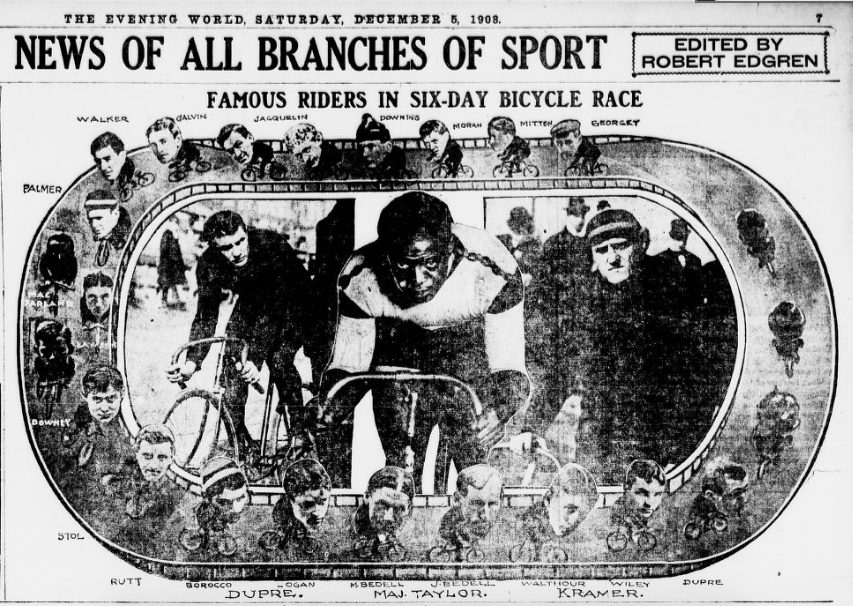
“The Six Days of New York” cycling event held December 6-12, 1896 at Madison Square Garden drew massive global crowds and 28 cyclists, all there for one of the greatest sporting events of the era. For six straight days, riders would circle the specially-constructed velodrome until the completion of the event, or until only one exhausted competitor remained, whichever came first.

It was 18-year-old Major’s first professional race, and for every ounce of anticipation running through his veins, there was a gallon of fear right behind it. Only 30 years beforehand, slavery had been abolished by the 13th Amendment, so a black man in an elite sport was not only uncommon – he was unwanted. But this black man had earned his place among the talented white cyclists, all many years his senior. He’d blown through amateur bike records on his way to the professional league, and despite the naysayers convinced he was a fluke who could never match up to “real” talent, here he was, the only black competitor among a sea of white racers, journalists and 5,000 spectators on the world stage.

It’d been a rough road to ride though. He’d been threatened, sabotaged, and even banned from tracks in his climb to the top – at one point, resorting to bleaching his skin in an attempt to gain entry as a “white” cyclist. The lightening process was so physically and mentally painful that he vowed he’d never do it again. Besides, their racism pushed him to be stronger, faster, and better than every other rider in the field. He said, “My color is my fortune. Were I white I might not amount to a row of shucks in this business.” Still, as proud as he was to be who he was, Major couldn’t deny his “dread of injury every time I start in a race.”

As he expected, Major spent the next several days being elbowed, boxed in, and even deliberately crashed by the competitors. Each time, he righted his bike, bloodied and bruised, but determined to continue. After day 5 and having ridden for 1,732 miles – the distance between New York and Austin – over 142 hours with no sleep, very little food, and in the throes of hallucination, Major withdrew from the contest, finishing in 8th place.

But it didn’t matter. In those 5 days, Major Taylor had become a legend to the international sporting community, the first black man to ever compete in a six-day race and in impressive fashion. So jarring was the experience, Major never entered another six-day race again, and that didn’t matter either. He won 29 of the next 49 races he DID enter, securing 7 world records along the way – all before he turned 20. It was over 30 years later before the last of his records was finally broken.

Still, Major wanted it all. In 1897, his championship hopes had been dashed when southern promoters and cyclists refused to allow him on their tracks, making it impossible to compete in enough races to qualify for world championships. When their threats, physical attacks, and petty tricks like throwing ice water on him and dropping nails in his path forced Major to avoid the chaos by sprinting to the front of the pack and ultimately still winning, racist cyclists conspired to move races to Sundays in 1898. His devout Christianity was a priority, and once again, despite being in contention for the title, Major fell short of the race requirement.

In 1899, that all changed, and finally, Major dodged every physical, structural, and mental roadblock the all-white establishment threw in his path to become the first African-American world champion in ANY sport, and only the second black athlete in the world to hold a title.

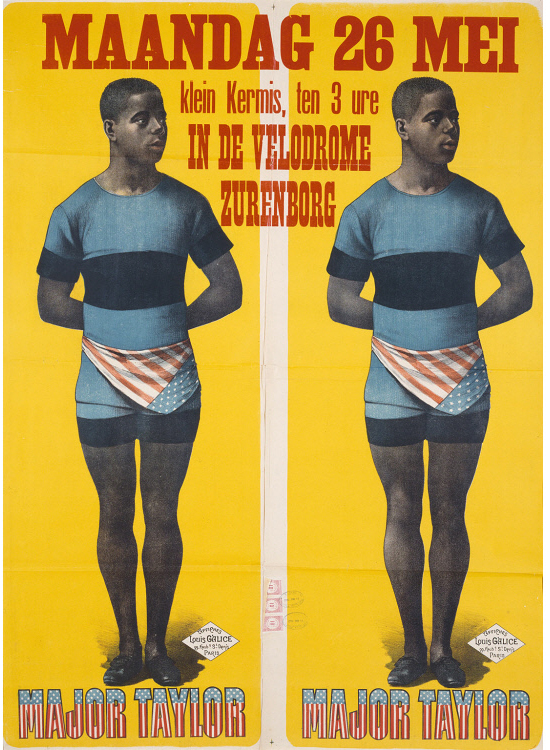
The championships had been held in Montreal, and hearing the “The Star-Spangled Banner” played in celebration of his success, Major later wrote, “I never felt so proud to be an American before, and indeed, I felt even more American at that moment than I ever felt in America.” Despite his global recognition and clear talent, like so many gifted black Americans who came before and after him, Major’s skill amounted to nothing in the face of segregation in the United States. In contrast, he enjoyed superstardom abroad and when he raced in Australia and Europe, including France where he eventually moved, the people and press loved him, nicknaming him “Le Negre Volant,” the flying black man.

At just 32 years old in 1910, Major decided that the round-the-clock schedules, heavy toll on his body, and dangerous racism he still faced from American competitors entered in races abroad had taken enough from him. So with the millions he’d earned from brand endorsements, promotional jobs, and of course, prize winnings from the nearly 20 years he’d competed in amateur and professional cycling, Major retired with all the comforts money could buy. Which was unfortunate, because in the stock market’s decline and eventual historic 1929 crash, Major’s investments were lost as well, and he was penniless. Still, one to overcome every adversity, Major recorded his extraordinary story in his book “The Fastest Bicycle Rider in the World: The Story of a Colored Boy’s Indomitable Courage and Success Against Great Odds: An Autobiography,” which he sold from the trunk of his car.

Only 53 when he died in a Chicago hospital alone and estranged from his family, Major’s death was the polar opposite of his life – unceremonious and unrecognized. By the time his family was notified of his passing, he’d been buried in a pauper’s grave. But even death couldn’t silence his legacy. Learning of Major’s contributions to the sport, iconic bicycle manufacturer Frank Schwinn donated the funds to give him a proper burial in 1948. Major’s newly-placed gravestone was inscribed “World’s champion bicycle racer who came up the hard way without hatred in his heart,” in recognition of a career colored with pioneering achievements and of the equally remarkable content of his character.


KEEP GOING BLACK IN HISTORY:

Watch ESPN’s compelling 7-minute short on Major Taylor’s 6-day triumph.

Read Sports Illustrated’s take on the full fascinating life of Major Taylor.

Browse digitized historic news coverage of Major’s career and his autobiography at The Library of Congress.

DAY 20 — Mike Ford

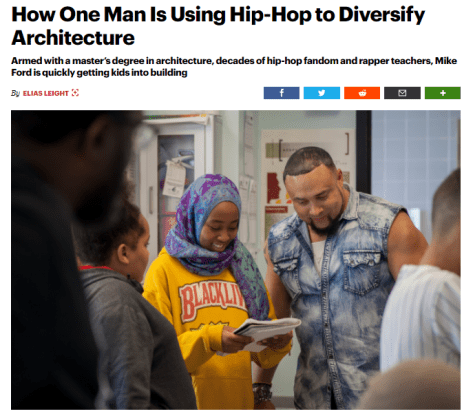
Mike Ford - Building on Hip-Hop

From Atlanta where the players play to the drama of the LBC, and Brooklyn Zoo to 8 Mile Road too, there’s not a corner of this country that hasn’t been touched by hip-hop.

But when summer days driving 2 miles an hour so everybody sees you turn into nights with the sounds of street sweepers and AKs, and even where ya grandma stays carries consequences, one man is making it his mission to give ethnic communities better.

“We hear the lyrics in hip-hop, but the stories that they’re telling are a critique of the environment they live in, so when you hear someone talking about guns or drugs, instead of changing the station, we should be changing those environments,” says Mike Ford.

Mike’s two greatest loves are architecture and hip-hop. It’s an unlikely combination, but at its crossroads, he sees an opportunity to affect generations to come through design justice. It’s a principle that according to MIT Press “is led by marginalized communities and aims explicitly to challenge, rather than reproduce, structural inequalities.” Boiled down, design justice identifies the social, economic, environmental and political issues that exist in community spaces, and uses the community’s knowledge and insight to help solve them. When poor test scores lead to underfunded school districts, and eventually lower economic status or even incarceration, design justice practitioners might learn from moms that thin housing project walls mean kids can’t focus on their studies – solving potential lifelong pitfalls with one simple solution.

How the legends of hip-hop might have grown up writing different rhymes was a concept Mike was so invested in that instead of thinking about it, he decided to be about it, founding the Hip Hop Architecture Camp.

According to Mike, “The Hip Hop Architecture Camp® is a free, one week intensive experience, designed to introduce underrepresented youth to architecture, urban planning, creative place making and economic development through the lens of hip hop culture.” With the help of architects, urban planners, designers, community activists and hip hop artists, kids use professional drafting software and 3D models to build their own cities and communities “so that nobody has to tell those stories in their songs again.”

Aside from the change he hopes to bring to kids’ lives, Mike’s Hip Hop Architecture Camp serves another equally critical purpose, too. “Hip hop has always been the voice of the voiceless,” he says. “In architecture, less than 3% of the professionals are African American. Less than 1 in 5 architects identifies as a racial or ethnic minority, and black women comprise less than 1% of the field.” By giving kids their first introduction to architecture through hip hop, he’s introducing the field of architecture to them, too.

“I’m trying to show architects, planners, and designers that our profession is more than brick and mortar. We create incubators of culture,” Mike explains. “Even if someone is not a fan of hip-hop, or simply doesn’t like the culture, I challenge him or her to understand why it exists, and how our profession necessitated its birth through bad planning and housing practices.”

Take for example the Cross Bronx Expressway. Its construction on Manhattan Island in 1955, created a structural division and environmental nuisance that drove middle- and upper-class residents to build affluent communities and economic districts further south, but left people of color and the poverty-stricken isolated. Today, the Bronx is arguably considered the birthplace of hip hop, a detail that Mike knows isn’t a coincidence.

He regularly quotes NAS whose song “I Can” encourages kids to be – among other skilled professions – architects. Mike’s taking that song’s spirit and laying the foundation for the engineering, mathematical, imaginative, and critical thinking skills it takes to be successful in his field, as early as possible. After all, as an architect, he’s also familiar with the great communities of color like Greenwood in Tulsa and Black Bottom in Detroit, both long decimated. “I’m letting kids know we have a history of building spaces and places,” he contends.

For the 10-to-17-year-olds attending Mike’s Hip Hop Architecture Camp in dozens of cities nationwide, learning their history, analyzing their playlists and tinkering in models are more than just fun ways to spend a week. It’s what Mike hopes builds the right knowledge, experience and dedication to see to it that the people influenced by trap house environments can graduate to corner offices where they’re empowered to change them.


KEEP GOING BLACK IN HISTORY:

Host, attend or just learn more about a national Hip Hop Architecture Camp.

Check out Rolling Stone’s feature on Mike Ford & his camps.

Each session of campers produces their own rap video based on their camp experience and rooted in their city’s history and musical style. Watch & listen to the 2018 Detroit Camp’s banger.