Tag Archives: THE AMERICAN BLACKSTORY 2019

DAY 8 — Frederick Joseph

Frederick Joseph - Superhero in Disguise

Frederick was 8. And he was never dressing as Batman again.

“You’re black. You can’t be black and be a superhero.”

It was a blip in the life of Frederick Joseph, who went on to get an MBA from NYU, and become a successful entrepreneur, marketing professional, and the list goes on. He even founded We Have Stories, a non-profit designed to support underrepresented and marginalized storytellers and content creators.

But like pebbles at a windowpane, tiny reminders of the moment a classmate told him he couldn’t be the Dark Knight kept popping up along the way in the controversies over modern day depictions of James Bond, Hermione Granger, District 11’s Rue… Like Batman, they were not supposed to be black, because black people aren’t heroes.

That is, until one more reminder changed everything.

Marvel’s “Black Panther” didn’t just feature ONE black superhero. It was entirely cast by black superheroes. Black men who were kings; black women who were smart, sexy, and strong; black elders with the knowledge of countless generations; and all living in a place where blackness was not only accepted, but richly celebrated.

How little Frederick might have seen the world if this had been his childhood experience, instead of one where even masks couldn’t hide that the heroes didn’t look like him.

And thus the #BlackPantherChallenge was begun. His initial goal was a humble one: just $10,000 to buy tickets for the The Boys & Girls Club of Harlem. It became one of the most widely participated in GoFundMe campaigns ever, raising nearly $1 million with the help of local communities, celebrities and donors from 50 countries worldwide. Thanks to Frederick’s work, 73,000 children of color were able to see “Black Panther” in theaters last year.

Despite the massive success of the movie, which media outlets like Variety even credited in part to small grassroots efforts like Frederick’s, he recognizes that it’s just one drop in an infinite bucket of exclusion. The task isn’t done because “all children deserve to believe they can save the world, go on exciting adventures, or accomplish the impossible.” So he’s answering the call again with the #CaptainMarvelChallenge.

As Marvel Studios’ first feature film with a female lead and one that introduces more women of color to the Marvel Cinematic Universe, he wants to ensure that the at-risk girls served by Girls Inc. of Greater Los Angeles can attend the premiere on International Women’s Day, and help them reach their goal of serving 2,000 more girls by 2020. “Captain Marvel” star Brie Larson has even signed on, as has GoFundMe, offering to donate $100 to the first 25 local #CaptainMarvelChallenge campaigns.

The bar set by the #BlackPantherChallenge is high, but Frederick hopes to make history again. No matter the outcome, thousands of boys & girls worldwide will be forever changed by a kid who just wanted to be Batman.


KEEP GOING BLACK IN HISTORY:

Accept & share the #CaptainMarvelChallenge!

Read Frederick’s own words about why supporting movies like “Black Panther” and “Captain Marvel” is so important to him.

Revisit the impact Frederick made with his #BlackPantherChallenge!

DAY 7 — Toni Stone

Toni Stone - Lady in a League of Her Own

“Tomboy Toni” spent a whole lot of time on her toes.

Like so many black parents, the Stones had encouraged their 4 children to get an education that no one could take from them. But try as she might, Toni just couldn’t get the hang of books and preferred the cracks of baseball bats in the springtime instead.

When they pleaded with the local priest to talk their 10-year-old daughter out of the fruitless sin of a girl playing baseball, Toni was so persuasive, they all agreed to let her become the first girl on the church league roster, positioned at second base.

But Toni still had bigger dreams. She’d discovered that the manager of the St. Paul (Minnesota) Saints coached a boys’ team not far from where she lived, and was determined to find a way onto it. What she didn’t know was that he was a card-carrying member of the KKK. What he didn’t know was that she was so persistent, he’d eventually surprise himself by letting her show him what she was made of. She surprised him even more when she had skills that were too good to let his racism get in the way of.

While she was training, she also happened to be a ball girl for a local pickup team, and the sharp-eyed manager of the all-male semi pro Twin City Colored Giants noticed that the 15-year-old had an arm that qualified her to be a lot more. A spot on their team gave her a visibility that she didn’t have before, and after proving she had the skills to go even bigger, she kept swinging for the fences.

Toni takes a powder before taking the field

By 25, she’d become a darling of the San Francisco Sea Lions, until she discovered that she was being paid less than her male counterparts, so she took her talents to the Black Pelicans and Creoles of New Orleans instead. Finding love along the way became a unexpected detour. A domineering older husband kept her out of the game for a year, encouraging her to play for the local American Legion instead but her passion was too strong to ignore. “He would have stopped me if he could have, but he couldn’t,” she laughed, and it was seeming more and more obvious that very little could get in Toni Stone’s way.

Her return to baseball couldn’t have been more well timed. The Indianapolis Clowns had just lost a once-in-a-lifetime shortstop named Hank Aaron to the recently integrated Major Leagues. They needed more than just skill to fill his place – they needed a star. In 1953, 32-year old Toni Stone became that star, the first woman to play in the Negro Leagues, and the first female professional in a major baseball organization. Ironically enough, Toni had wanted to play for the All-American Girls Professional Baseball League depicted in “A League of Their Own,” but black women weren’t allowed. Her rejection from their league led her to make even greater strides in her own. (And when asked to wear a skirt herself, she told the Clowns’ owner that she’d “quit first.”)

Even mainstream sports journalists couldn’t deny her unbelievable combination of femininity and fierceness, writing “She belts home runs as easily as most girls catch stitches in their knitting, and the sports boys are goggle-eyed.” Toni’s strength on and off the field was so inspiring to her club that two more women were added to the roster during her tenure. A year later, she transferred to the Kansas City Monarchs where Jackie Robinson once played, and finally retired from baseball in 1955.

Although Toni was inducted into the Women’s Sports Hall of Fame in 1996 three years before she died at the ripe old age of 75, because her race and gender kept her from the Major Leagues she’s still widely regarded as both “the First Lady of the Negro Leagues” and “the best ball player you’ve never heard of.”


KEEP GOING BLACK IN HISTORY:

The modern day St. Paul Saints honored Toni Stone’s legacy by dedicating a diamond in her name.

Marcenia Lyle “Toni” Stone’s husband just so happened to be Aurelious Alberga, the first black officer in the U.S. Army. They rest in power together at the Golden Gate National Cemetery in California.

DAY 6 — Mae Walls & Antoinette Harrell

AntoinetteMaeWells.jpg

Bloodied and desperate, 14-year-old Mae fled into the woods under the cover of darkness.

It wasn’t the first time one of the Walls children had run. The time before, they’d tracked down 9-year-old Annie and begged her to please come back to prevent one or all of them from being killed as punishment. They had good reason to think that’d be the case. When Mae’s father tried to run, he was nearly beaten to death in front of his family to discourage any of them from doing it again.

So when Mae determined that she wasn’t going to pick cotton or clean houses anymore, drink from the same creek where cows bathed anymore, fight the owners’ dogs for leftovers anymore, and above all, wasn’t going to endure being raped alongside her mother anymore like she had since she was 5 years old, it was her father who tearfully beat her so that their owner wouldn’t kill her instead.

And that was how Mae Walls found herself shaking in the bushes in the dead of night on the side of a country road. A lady passing on a cart noticed and rescued the Wall family from their plantation that night… only to put them right back to work in the lady’s own home. When Mae turned 18, she bravely stood up to her masters once again and her obstinance landed her whole family in homelessness… but for the very first time, it was freedom.

And it hadn’t come to the Walls family until 1962.

They were 20th century slaves.

Mistakenly signing a contract he couldn’t read had indebted her father, mother and their 7 children to white landowners. Even though this practice had been outlawed 4 years after slavery was, the Walls family had been so isolated in rural Mississippi they never knew that black people had been emancipated in the first place, let alone that a Civil Rights movement had ever existed. In fact, it wasn’t until 2001 when Mae attended a public meeting on slavery reparations that she even learned that what her family had endured was illegal all along.

From Louisiana to Florida, historian and genealogist Antoinette Harrell, dubbed “The Slavery Detective of the South,” has discovered too many stories like Mae’s in her decades long research that began when she scoured for clues about her own family’s past in historical records. “Seeing my ancestors’ perceived value written on a piece of paper changed me. It also set forth the direction of my life. It was terribly painful, but I needed to know more,” Antoinette said.

That desire to know more led other Southern black families to entrust her with the stories they knew about their pasts, and those they hoped she’d uncover. In her 25 years searching the US National Archives Archival Recovery Program, The Library of Congress, state and local records, Antoinette Harrell has uncovered more than 30,000 case records, accounts from enslaved people, now-sealed FBI files, and even letters to sitting presidents documenting slavery in the South as late as the 1970s.

Even though she lived her early life hidden away from the world, before her death in 2014, Mae Walls’s story touched millions through her appearances and interviews everywhere from ABC News to People Magazine, and talk shows to civil rights rallies.

Standing on the same property where she once suffered unspeakable abuses, Mae whispered to Antoinette, “I told you my story because I have no fear in my heart.” It’s with that same fearless spirit that Antoinette continues uncovering the slave stories of the South today “because it needs to be done.”


KEEP GOING BLACK IN HISTORY:

There’s no comparison and no words for seeing & hearing the work Antoinette does for yourself. This video is 21 minutes long, heartbreaking and necessary.

Read Antoinette’s firsthand account of meeting Mae and how her work as the “peonage detective” began.

People Magazine’s “The Last Slaves of Mississippi?” from 2007 is one of the most extensive accounts of Mae & the Wall siblings’ stories. It is graphic.

“The Untold Story: Slavery in the 20th Century,” winner of the Audience Award at the 2009 PATOIS New Orleans International Human Rights Film Festival, tells Mae’s story alongside the circumstances that allowed slavery to continue in sixteen states and sixteen counties throughout Mississippi well after it was abolished.

Antoinette & others scholars highly recommend Douglas Blackmon’s “Slavery By Another Name: The Re-Enslavement of Black Americans from the Civil War to World War II” as the most extensive reference on post-Civil War slavery. Read an excerpt and buy the book here.

Or watch the 90-minute PBS documentary based on the book that “tells how even as chattel slavery came to an end in 1865, thousands of African Americans were pulled back into forced labor with shocking force and brutality.”

DAY 5 — Joy Buolamwini

Joy Buolamwini - The Face of AI Diversity
Joy Buolamwini, a Black woman coding for facial recognition the only way she can.

“My robot couldn’t see me unless I wore a white mask.”

The hours that Joy Buolamwini had spent writing, testing, and coding her “Aspire Mirror” were countless, and her creation had betrayed her. It wasn’t just that it didn’t work. It was that this supposedly neutral machine reinforced a social subtext black women encounter all too often: YOU ARE INVISIBLE.

Her program was supposed to utilize facial recognition software to replace a user’s face with that of an animal that inspires them. The problem she identified was simple. Why it mattered and what to do about it were not. Because there was a lack of diversity in tech, there was a lack of diversity in digital tools.

Joy pushed through her projects substituting her own face for her mask and that of a white roommate before moving on to other PhD research for the MIT Media Lab. But when she attended an artificial intelligence demo years later in Hong Kong, and ran into the same problem, she realized that it was one with far-reaching consequences.

Right now, 16 states allow the FBI to access DMV photos with facial recognition technology in what Georgetown Law refers to as “The Perpetual Lineup.” Joy’s research found that while facial recognition almost always correctly identified a white man’s race and gender (94% at worst), as skin tones got darker, recognition of race and gender became less accurate, with black women being the least identifiable at only 64%.

What happens if the same faulty code misidentifies people of color already facing bias in our justice and immigration systems? How much identification and accessibility software is rendered null & void for anyone without “normal” face specifications? Who is establishing standards for these technologies that might not only be using flawed historical data or personal biases to code, but reinforcing those biases with their outputs? These weren’t just hypothetical questions.

2 years ago, when Microsoft launched an artificial intelligence on Twitter designed to learn from users, then generate its own tweets, it was pulled within 16 hours because what it had learned was racism & sexism. Even Google Images was caught under fire in 2015 when the algorithm they used to “learn” from aggregated searches tagged photographs of black people as gorillas. The next year, an Asian man’s New Zealand passport application photo was rejected because biased facial recognition incorrectly determined his eyes were closed.

Joy, mask off.

So Joy stepped up. She presented her “Gender Shades” research to the major facial recognition software developers Microsoft, IBM, and Chinese company Face++. Only the IBM Watson team responded, validating Joy’s research and integrating it into tests of their newest facial recognition technology.

But she didn’t stop there. Joy’s since created the Algorithmic Justice League, allying major innovators and organizations in artificial intelligence and facial recognition technology under a code of ethics to ensure fairness, accessibility, transparency, and accountability in an increasingly digital age.

“Can machines ever see my queens as I view them? / Can machines ever see our grandmothers as we knew them?” she pleads. And no one is working harder to answer those questions with a resounding yes so that we ALL have a place in the future.


KEEP GOING BLACK IN HISTORY:

Visit the Algorithmic Justice League to see how they’re fighting what Joy calls “The Coded Gaze,” read about her Gender Shades facial recognition experiments, and find out more about the Safe Face Pledge she’s using to hold digital innovators accountable.

Find out more about the Georgetown Law Perpetual Lineup & how vulnerable images of your face might be to potential local & federal misuse.

Joy refers to herself as a “poet of code,” but she performs a bit of spoken word too. Listen to the piece my closing quote is from “AI, Ain’t I A Woman?”, and see some pretty wild AI misidentifications of some famous black women.

DAY 4 — Shelby Jacobs

Shelly Jacobs - The Man Who Showed Space to the Human Race

“If you impress the crowd, the coach can’t put you on the bench.”

It was a lesson that Shelby Jacobs had carried with him since his high school years in the early 1950s. Even though only 1% of his class was black, he’d managed to become a 3-sport varsity athlete and a senior class president off undeniable hard work and merit. But when his high math and science aptitude scores gained him a scholarship to UCLA, his principal balked, saying “there are no black engineers, so you should take up a trade.”

Undeterred, Shelby attended UCLA anyway, and in three years, he was designing engines, hydraulics, pneumatics and propulsion systems for a NASA contractor. But there, he didn’t find it quite as easy to excel or fit in. As only one of eight black engineers in a company of 5,000, he struggled between seeking the camaraderie of his few black colleagues and becoming further marginalized, or strategically associating himself with successful white engineers and tolerating their constant microaggressions, and sometimes, outright racism in the workplace.

By 1965, Shelby’s juggling act had earned him the opportunity of a lifetime. NASA was launching the Apollo 6 mission in 3 years and needed to solve the problem of how to capture footage of the rocket separation sequence from an unmanned craft. Shelby designed, tested and ultimately perfected the camera system that captured the first iconic footage of the Earth’s curvature and the rocket’s segments burning in the atmosphere, re-igniting the Space Race.

In just a few minutes of film, Shelby Jacobs forever impressed the world.

It was April 4, 1968 – the same day that Dr. Martin Luther King, Jr. was assassinated.

That day held both his proudest moment and a sobering reminder that there was still so far to go.

For the next 28 years, Shelby continued in the space program, working his way up to the executive levels until he quietly retired in 1996. 10 years ago, as the “hidden figures” of the U.S. space program began coming to light, Shelby was officially honored by NASA as an Unsung Hero, and has used that recognition to make appearances, fund scholarships, and advocate for employing, protecting and fairly compensating more women and minorities in professional and technological fields.

Even though he’s 80 years old today, Shelby Jacobs’ personal mission isn’t over yet, because when he changed the world in 1968, “the doors of opportunity were not wide open –– they still aren’t.”

Editor’s Note: In a lovely moment of serendipity, Mr. Jacobs recently discovered that John Reid, one of the first black helicopter pilots in the Navy, was a member of the crew that recovered his film canisters from the ocean upon the camera’s separation from the spacecraft.


KEEP GOING BLACK IN HISTORY:

DAY 3 — Virgil Abloh

Virgil Abloh - LV VIP

Virgil Abloh grew up a middle-class, private-schooled skater kid, graduated college with a B.S. in civil engineering and a Master’s in architecture, and then switched gears to become an intern at Italian luxury giant Fendi.

But he still couldn’t get into a fashion show.

Virgil had been turned away at the door of fashion’s biggest brands often enough that he’d even perfected his strategy of circling the block to try again later. “We got into about 60 percent of those shows. Even when I just walked into a luxury store, people would look at me like I didn’t belong there,” he recounts.

But accustomed to not fitting in, Virgil plunged ahead. When he was hired as creative director of Kanye West’s creative agency, his art direction for “Watch the Throne” earned him a 2011 Grammy nomination for Best Recording Package. Such a major creative success gave him the confidence for solo experiments in fashion, which he began with $40 of Ralph Lauren deadstock that he screen-printed with his own designs and resold for over $550 a piece until he was hungry for something more.

Virgil collaborated with Nike to design Serena Williams’ striking and celebrated 2018 U.S. Open tennis dress.

And so, in 2013, his original brand Off-White c/o Virgil Abloh, the world’s first luxury label designed and owned by a black American, was born. The very next year, Off-White debuted at Paris Fashion Week, and has since become a global phenomenon with 10 standalone stores on 4 continents, and beat out the likes of Prada, Gucci, Balenciaga, and Versace to top the list of 2018’s hottest luxury brands. Virgil’s collaborations have included home goods for IKEA, kicks for Converse, museum exhibitions with famed Japanese artist Takashi Murakami…

…and that was all BEFORE he was tapped to become the first black person to ever serve as menswear artistic director of Louis Vuitton. He’s not only the first in LV’s 165-year history, but the third in leadership at ANY French heritage fashion house.

“When I was growing up, I didn’t know that I could be showing in Paris, because I didn’t see anyone doing that who looked like me. Now we are the establishment. I’m legitimately like, ‘Who can we empower next?’” The access to fashion’s upper echelons that Virgil was initially denied is a now hallmark of his brand. His runways are often streamed on his Instagram, he has fashion “How To” videos on his brand website, and under his creative guidance, black faces that might once have been turned away from fashion shows are now the symbol of luxury.

Virgil at center, styling for his first LV runway show based on The Wizard of Oz.

KEEP GOING BLACK IN HISTORY:

Go behind the scenes at the installation & opening of Virgil’s 2018 exhibition with Takashi Murakami at the Gagosian Art Museum.

Take a virtual visit of Virgil’s 2019 “Figures of Speech” exhibit at the Museum of Contemporary Art Chicago.

His dynamic and innovative Off-White c/o Virgil Abloh runway art direction makes Virgil’s runways entirely unexpected & well worth the watch.

DAY 2 — Nearest Green

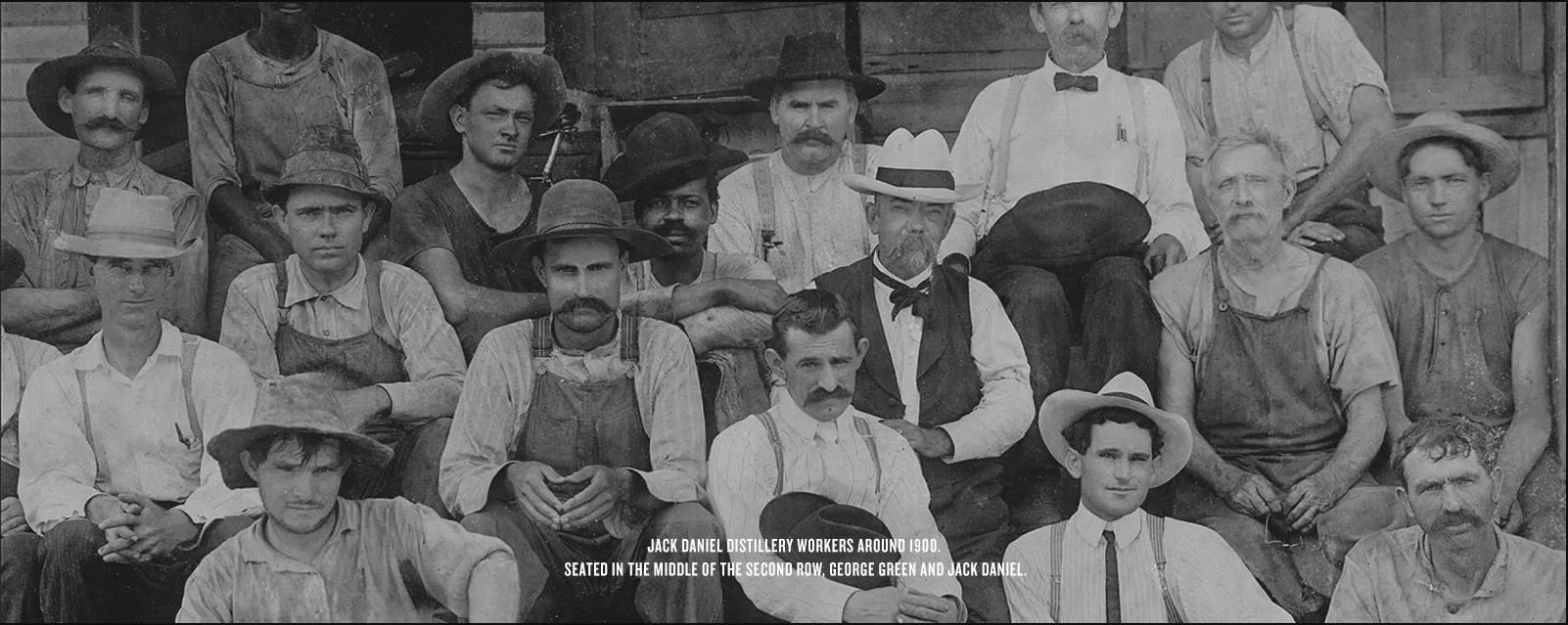
A weathered black and white group portrait hangs in the Lynchburg, Tennessee headquarters of the world’s most famous whiskey distillery. Taken around 1900, it’s a curious mix of overalled workers smudged with the day’s dirt and sharply dressed businessmen. But even more curious is a black face standing out from the crowd, seated immediately to the right hand of the man himself, Jack Daniel. That man is the son of Nearest Green, the formerly enslaved slave who made Jack Daniel’s Tennessee Whiskey a household name.

When a teenaged Jack decided he wanted to learn the local trade of whiskey distilling in the 1850s, local still owner Reverend Dan Call told Jack that his slave “Uncle Nearest is the best whiskey maker I know.” In addition to his duties operating the Call Still, Green was now tasked with teaching the youngster all the ins-and-outs of his craft.

Turns out, it was more than anyone could have anticipated. Green’s expertise and recipes were eventually used as the basis for the Lincoln County Process, the modern standard that qualifies a spirit as an authentic Tennessee Whiskey. He was also formally recognized as Jack Daniel’s Tennessee Whiskey’s first master distiller and the first documented black master distiller in the United States.

Near the end of the Civil War, Rev. Call sold his operation to Jack, but upon the ratification of the Thirteenth Amendment in 1865, the slaves of the Call Still were freed. As is expected, many wanted nothing to do with work they’d been forced into. But Uncle Nearest had a reputation to uphold, and had been such an integral part of the still’s local success that it wouldn’t have been the same without him. Jack immediately and officially employed Nearest as the (paid) master of the new Jack Daniel’s Distillery, where he crafted until the early 1880s.

But his legacy lived on. For seven straight generations, one of Nearest Green’s descendants has been continually employed within the Jack Daniel’s body of brands, and from his original process and recipe, Jack Daniel’s has grown to generate over $3 billion in revenues per year. The woman responsible for bringing Uncle Nearest’s past to light has created her own whiskey brand, Uncle Nearest 1856, the proceeds of which go to the Nearest Green Foundation providing for his descendants and preserving his heritage. The over 10,000 documents and artifacts collected on Green will be memorialized in an exhibit at the Smithsonian National Museum of African American History and Culture recognizing him as a key figure in the American whiskey-making tradition.

So the next time you raise a glass of Jack Daniel’s remember that you’re actually drinking to the House that Uncle Nearest Built, and consider making your next bottle of whiskey one with his name on it instead.


KEEP GOING BLACK IN HISTORY:

Award-winning actor Jeffrey Wright narrates a short film detailing the life of Nearest Green.

DAY 1 — Octavia Butler

Octavia Butler - Author of Time & Space

Before Gene Roddenberry brought diversity “where no one had gone before,” and Stan Lee imagined a hidden African country as the most technologically advanced on earth, a little black girl with a big pink notebook had already given the keys to space and time to people who looked like her.

It was the early 1950s in Pasadena, California, where the devastatingly shy, 7-year-old Octavia would fill her notebook with fantasy to get away from her reality – one where she entered the homes that her mother cleaned through the back door, overheard the slurs the homeowners used, and was picked on for being the dyslexic black girl who didn’t fit in with anyone in her integrated neighborhood. Her writing was indelibly tied to her circumstances, as she explained about one of her most successful books, KINDRED: “if my mother hadn’t put up with all those humiliations, I wouldn’t have eaten very well or lived very comfortably. So I wanted to write a novel that would make others feel the history: the pain and fear that black people have had to live through in order to endure.”

Octavia’s treasured notebook containing her personal prophecy.

When she grew into a teenager becoming serious about her craft, her family reminded her that in the world they lived in, “negroes can’t be writers.” But science fiction was a genre where anything could happen. After years of styling her works after those of white male sci-fi writers without receiving their level of success, Octavia attended a workshop specifically geared toward minority writers, and got the encouragement to seize her own voice.

Her writing was so groundbreaking in the genre that by 1983, her story “Speech Sounds” was published in Asimov’s Science Fiction Magazine, and was later awarded the World Science Fiction Society’s Hugo Award, one of the top honors for science fiction & fantasy achievement. Her career took off from there, and in 1995, she became the very first science fiction writer to win the prestigious MacArthur Foundation’s “Genius Grant.” In all of the 15 novels and numerous short stories Octavia wrote before her death in 2006, black characters starred as time-travelers, telepaths, shape-shifters, and vampires in stories that explored deep and intersectional themes like racism, technology, morality, religion, mental health, climate change and more.

Octavia Butler’s work was not only lauded for its scientific accuracy and universality that lead to her nickname “The Grand Dame of Science Fiction,” but it inspired the cultural aesthetic known today as “afrofuturism,” that integrates the African diaspora with futuristic fashion, technology and concepts to include our past and present experiences in what could be to come. It’s an impressive legacy for a woman who once simply stated: “When I began writing science fiction, when I began reading, heck, I wasn’t in any of this stuff I read. The only black people you found were occasional characters or characters who were so feeble-witted that they couldn’t manage anything, anyway. I wrote myself in, since I’m me and I’m here and I’m writing.”


KEEP GOING BLACK IN HISTORY:

Someone wrote of Octavia “It is a rare writer who can use sci-fi not simply to chart an escape from reality, but as a pointed reflection of the most minute and magnified experiences that frame and determine the lives of those who live in black skin. Octavia E. Butler was one such writer.”

Curious? Two Butler scholars discuss where to start with her books & where to go from there after you fall in love.

VICE republished Octavia’s 1980 essay “The Lost Races of Science Fiction” and it is still wildly relevant & required reading if you made it this far.