Tag Archives: PAST

DAY 10 — Louis Jordan

Louis Jordan - Big Band’s Biggest Breakthrough

Louis Jordan didn’t mean to be a show-stealer.

He’d never quite fit in just right, running off to play the clarinet, piano and saxophone, instead of work the farm. Joining the brass section of one the best black big bands of the 1930s, only to be mistaken for its leader.

He wasn’t trying to be the center of attention. He just played that way.

So when he was fired from aforementioned big band in 1938, it’s only natural that he would go on to do something REALLY big.

Louis Jordan & the Tympany Five

And the Tympany Five was most certainly not your average big band. Composed of only a guitar, bass, drums, piano and horns, Louis’s band was a stark departure from everything in music at the time. Because the big band sound was so popular among audiences black and white, no one dared change the style, content and respectability that white big bands had established in the genre.

Not Louis. He’d gotten where he was black and he was going to stay that way.

And he was richly rewarded for it. Within a few years of setting out on his own, Louis’s “jump music” – a fast-paced blend of jazz, swing, blues and boogie-woogie styles combined with call-and-response vocals filled with slang and controversial topics – was topping the charts. 1942’s “I’m Gonna Leave You on the Outskirts of Town” hit Billboard’s Harlem Hit Parade charts at # 2 and remained for weeks.

In fact, turning new experiments into wild successes was something that Louis Jordan and the Tympany Five began making a habit of. In 1942, Louis started creating theatrically directed film shorts called “soundies” to accompany his music. Adding a visual component to his already unexpected sound made him irresistible to just about everyone. His 1943 song “Ration Blues” reached number 1 on the R&B charts… then the country charts… and finally landed on the exclusively white pop charts at #11, making him one of the very first “crossover” artists AND one of the forefathers of the modern day music video.

The tremendous response to his music, his performances and the wild abandon with which he approached both was entirely unprecedented. Between 1943 and 1950, Jordan had a song holding the number one spot on the R&B charts for 113 weeks, a feat that earned him the nickname “King of the Jukebox.” His longest running #1 hit, “Saturday Night Fish Fry,” held the spot for 12 weeks straight, a feat that wouldn’t be accomplished again until 45 years later in 1993. That song is also considered among music academia as one example of both the original rap performance and first rock track.

But Louis wasn’t just changing the face of popular music across races and genres, he was changing the entire structure of it. The success of his five piece set meant that venues and labels could book a huge sound for a lot less money than a big band, and that money went further among a smaller group too. It was a win-win for everybody. Combined with the fact that Louis was the first to regularly use the word “rock” in his electric guitar and vocals-driven music, he’s widely credited as the true Godfather of Modern Day Rock and Roll.

Unfortunately, the complex musical arrangements that gave Louis Jordan and the Tympany Five their signature sound made their music nearly impossible to precisely duplicate, and that untouchability meant he was left out of the revolution he created. Because white musicians who had greater access to radio and TV audiences couldn’t successfully cover his songs, they covered those he’d inspired instead, leading Chubby Checker, Little Richard, Chuck Berry and so on to widespread fame.

But Louis wasn’t one to fade away. Although his last hit was in 1951, he recorded through 1972, had a significant role in 6 mainstream films and a TV show, and appeared alongside greats like Bing Crosby and Ella Fitzgerald along the way before he died in 1975. He was posthumously inducted into the Rock & Roll Hall of Fame in 1987 as an “Early Influencer,” solidifying his legacy as a magician of sound and showmanship who stole a space for artists of all races, but especially people of color, to make something brand new.


KEEP GOING BLACK IN HISTORY:

DAY 7 — Toni Stone

Toni Stone - Lady in a League of Her Own

“Tomboy Toni” spent a whole lot of time on her toes.

Like so many black parents, the Stones had encouraged their 4 children to get an education that no one could take from them. But try as she might, Toni just couldn’t get the hang of books and preferred the cracks of baseball bats in the springtime instead.

When they pleaded with the local priest to talk their 10-year-old daughter out of the fruitless sin of a girl playing baseball, Toni was so persuasive, they all agreed to let her become the first girl on the church league roster, positioned at second base.

But Toni still had bigger dreams. She’d discovered that the manager of the St. Paul (Minnesota) Saints coached a boys’ team not far from where she lived, and was determined to find a way onto it. What she didn’t know was that he was a card-carrying member of the KKK. What he didn’t know was that she was so persistent, he’d eventually surprise himself by letting her show him what she was made of. She surprised him even more when she had skills that were too good to let his racism get in the way of.

While she was training, she also happened to be a ball girl for a local pickup team, and the sharp-eyed manager of the all-male semi pro Twin City Colored Giants noticed that the 15-year-old had an arm that qualified her to be a lot more. A spot on their team gave her a visibility that she didn’t have before, and after proving she had the skills to go even bigger, she kept swinging for the fences.

Toni takes a powder before taking the field

By 25, she’d become a darling of the San Francisco Sea Lions, until she discovered that she was being paid less than her male counterparts, so she took her talents to the Black Pelicans and Creoles of New Orleans instead. Finding love along the way became a unexpected detour. A domineering older husband kept her out of the game for a year, encouraging her to play for the local American Legion instead but her passion was too strong to ignore. “He would have stopped me if he could have, but he couldn’t,” she laughed, and it was seeming more and more obvious that very little could get in Toni Stone’s way.

Her return to baseball couldn’t have been more well timed. The Indianapolis Clowns had just lost a once-in-a-lifetime shortstop named Hank Aaron to the recently integrated Major Leagues. They needed more than just skill to fill his place – they needed a star. In 1953, 32-year old Toni Stone became that star, the first woman to play in the Negro Leagues, and the first female professional in a major baseball organization. Ironically enough, Toni had wanted to play for the All-American Girls Professional Baseball League depicted in “A League of Their Own,” but black women weren’t allowed. Her rejection from their league led her to make even greater strides in her own. (And when asked to wear a skirt herself, she told the Clowns’ owner that she’d “quit first.”)

Even mainstream sports journalists couldn’t deny her unbelievable combination of femininity and fierceness, writing “She belts home runs as easily as most girls catch stitches in their knitting, and the sports boys are goggle-eyed.” Toni’s strength on and off the field was so inspiring to her club that two more women were added to the roster during her tenure. A year later, she transferred to the Kansas City Monarchs where Jackie Robinson once played, and finally retired from baseball in 1955.

Although Toni was inducted into the Women’s Sports Hall of Fame in 1996 three years before she died at the ripe old age of 75, because her race and gender kept her from the Major Leagues she’s still widely regarded as both “the First Lady of the Negro Leagues” and “the best ball player you’ve never heard of.”


KEEP GOING BLACK IN HISTORY:

The modern day St. Paul Saints honored Toni Stone’s legacy by dedicating a diamond in her name.

Marcenia Lyle “Toni” Stone’s husband just so happened to be Aurelious Alberga, the first black officer in the U.S. Army. They rest in power together at the Golden Gate National Cemetery in California.

DAY 4 — Shelby Jacobs

Shelly Jacobs - The Man Who Showed Space to the Human Race

“If you impress the crowd, the coach can’t put you on the bench.”

It was a lesson that Shelby Jacobs had carried with him since his high school years in the early 1950s. Even though only 1% of his class was black, he’d managed to become a 3-sport varsity athlete and a senior class president off undeniable hard work and merit. But when his high math and science aptitude scores gained him a scholarship to UCLA, his principal balked, saying “there are no black engineers, so you should take up a trade.”

Undeterred, Shelby attended UCLA anyway, and in three years, he was designing engines, hydraulics, pneumatics and propulsion systems for a NASA contractor. But there, he didn’t find it quite as easy to excel or fit in. As only one of eight black engineers in a company of 5,000, he struggled between seeking the camaraderie of his few black colleagues and becoming further marginalized, or strategically associating himself with successful white engineers and tolerating their constant microaggressions, and sometimes, outright racism in the workplace.

By 1965, Shelby’s juggling act had earned him the opportunity of a lifetime. NASA was launching the Apollo 6 mission in 3 years and needed to solve the problem of how to capture footage of the rocket separation sequence from an unmanned craft. Shelby designed, tested and ultimately perfected the camera system that captured the first iconic footage of the Earth’s curvature and the rocket’s segments burning in the atmosphere, re-igniting the Space Race.

In just a few minutes of film, Shelby Jacobs forever impressed the world.

It was April 4, 1968 – the same day that Dr. Martin Luther King, Jr. was assassinated.

That day held both his proudest moment and a sobering reminder that there was still so far to go.

For the next 28 years, Shelby continued in the space program, working his way up to the executive levels until he quietly retired in 1996. 10 years ago, as the “hidden figures” of the U.S. space program began coming to light, Shelby was officially honored by NASA as an Unsung Hero, and has used that recognition to make appearances, fund scholarships, and advocate for employing, protecting and fairly compensating more women and minorities in professional and technological fields.

Even though he’s 80 years old today, Shelby Jacobs’ personal mission isn’t over yet, because when he changed the world in 1968, “the doors of opportunity were not wide open –– they still aren’t.”

Editor’s Note: In a lovely moment of serendipity, Mr. Jacobs recently discovered that John Reid, one of the first black helicopter pilots in the Navy, was a member of the crew that recovered his film canisters from the ocean upon the camera’s separation from the spacecraft.


KEEP GOING BLACK IN HISTORY:

DAY 2 — Nearest Green

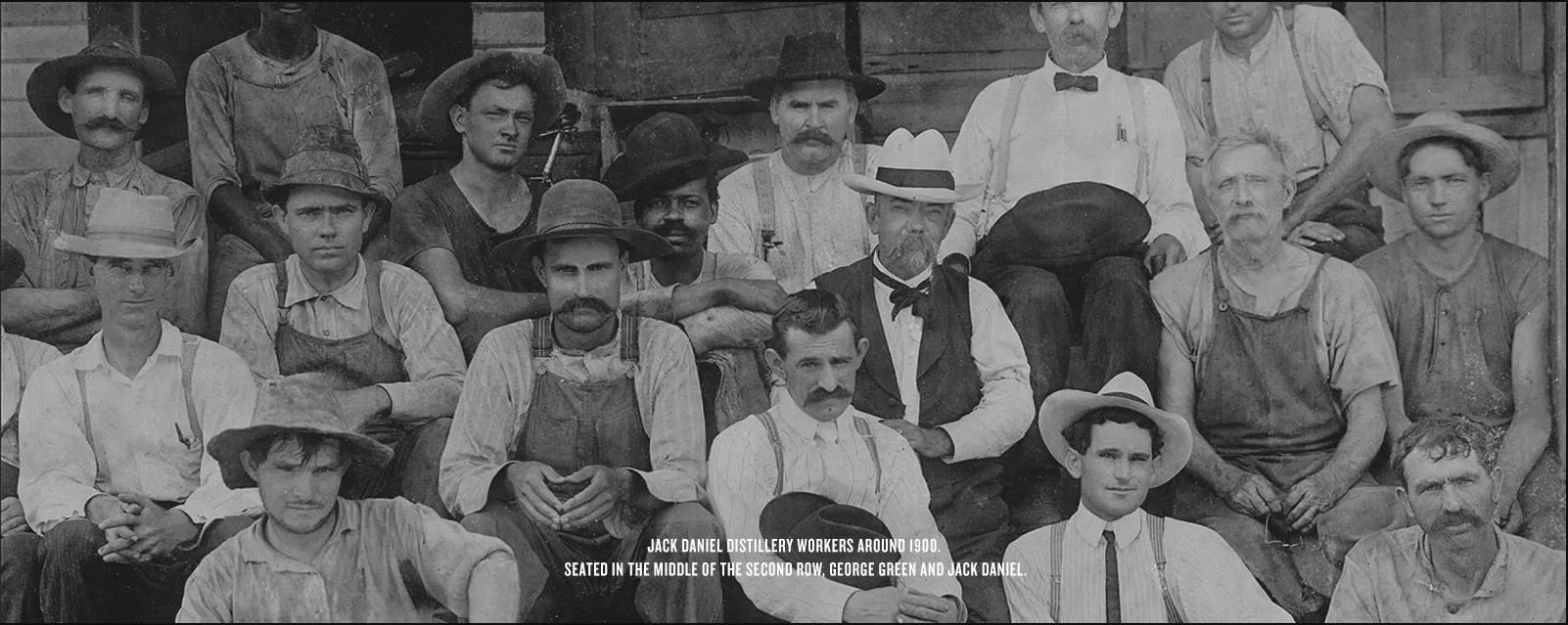
A weathered black and white group portrait hangs in the Lynchburg, Tennessee headquarters of the world’s most famous whiskey distillery. Taken around 1900, it’s a curious mix of overalled workers smudged with the day’s dirt and sharply dressed businessmen. But even more curious is a black face standing out from the crowd, seated immediately to the right hand of the man himself, Jack Daniel. That man is the son of Nearest Green, the formerly enslaved slave who made Jack Daniel’s Tennessee Whiskey a household name.

When a teenaged Jack decided he wanted to learn the local trade of whiskey distilling in the 1850s, local still owner Reverend Dan Call told Jack that his slave “Uncle Nearest is the best whiskey maker I know.” In addition to his duties operating the Call Still, Green was now tasked with teaching the youngster all the ins-and-outs of his craft.

Turns out, it was more than anyone could have anticipated. Green’s expertise and recipes were eventually used as the basis for the Lincoln County Process, the modern standard that qualifies a spirit as an authentic Tennessee Whiskey. He was also formally recognized as Jack Daniel’s Tennessee Whiskey’s first master distiller and the first documented black master distiller in the United States.

Near the end of the Civil War, Rev. Call sold his operation to Jack, but upon the ratification of the Thirteenth Amendment in 1865, the slaves of the Call Still were freed. As is expected, many wanted nothing to do with work they’d been forced into. But Uncle Nearest had a reputation to uphold, and had been such an integral part of the still’s local success that it wouldn’t have been the same without him. Jack immediately and officially employed Nearest as the (paid) master of the new Jack Daniel’s Distillery, where he crafted until the early 1880s.

But his legacy lived on. For seven straight generations, one of Nearest Green’s descendants has been continually employed within the Jack Daniel’s body of brands, and from his original process and recipe, Jack Daniel’s has grown to generate over $3 billion in revenues per year. The woman responsible for bringing Uncle Nearest’s past to light has created her own whiskey brand, Uncle Nearest 1856, the proceeds of which go to the Nearest Green Foundation providing for his descendants and preserving his heritage. The over 10,000 documents and artifacts collected on Green will be memorialized in an exhibit at the Smithsonian National Museum of African American History and Culture recognizing him as a key figure in the American whiskey-making tradition.

So the next time you raise a glass of Jack Daniel’s remember that you’re actually drinking to the House that Uncle Nearest Built, and consider making your next bottle of whiskey one with his name on it instead.


KEEP GOING BLACK IN HISTORY:
Award-winning actor Jeffrey Wright narrates a short film detailing the life of Nearest Green.

DAY 1 — Octavia Butler

Octavia Butler - Author of Time & Space

Before Gene Roddenberry brought diversity “where no one had gone before,” and Stan Lee imagined a hidden African country as the most technologically advanced on earth, a little black girl with a big pink notebook had already given the keys to space and time to people who looked like her.

It was the early 1950s in Pasadena, California, where the devastatingly shy, 7-year-old Octavia would fill her notebook with fantasy to get away from her reality – one where she entered the homes that her mother cleaned through the back door, overheard the slurs the homeowners used, and was picked on for being the dyslexic black girl who didn’t fit in with anyone in her integrated neighborhood. Her writing was indelibly tied to her circumstances, as she explained about one of her most successful books, KINDRED: “if my mother hadn’t put up with all those humiliations, I wouldn’t have eaten very well or lived very comfortably. So I wanted to write a novel that would make others feel the history: the pain and fear that black people have had to live through in order to endure.”

Octavia’s treasured notebook containing her personal prophecy.

When she grew into a teenager becoming serious about her craft, her family reminded her that in the world they lived in, “negroes can’t be writers.” But science fiction was a genre where anything could happen. After years of styling her works after those of white male sci-fi writers without receiving their level of success, Octavia attended a workshop specifically geared toward minority writers, and got the encouragement to seize her own voice.

Her writing was so groundbreaking in the genre that by 1983, her story “Speech Sounds” was published in Asimov’s Science Fiction Magazine, and was later awarded the World Science Fiction Society’s Hugo Award, one of the top honors for science fiction & fantasy achievement. Her career took off from there, and in 1995, she became the very first science fiction writer to win the prestigious MacArthur Foundation’s “Genius Grant.” In all of the 15 novels and numerous short stories Octavia wrote before her death in 2006, black characters starred as time-travelers, telepaths, shape-shifters, and vampires in stories that explored deep and intersectional themes like racism, technology, morality, religion, mental health, climate change and more.

Octavia Butler’s work was not only lauded for its scientific accuracy and universality that lead to her nickname “The Grand Dame of Science Fiction,” but it inspired the cultural aesthetic known today as “afrofuturism,” that integrates the African diaspora with futuristic fashion, technology and concepts to include our past and present experiences in what could be to come. It’s an impressive legacy for a woman who once simply stated: “When I began writing science fiction, when I began reading, heck, I wasn’t in any of this stuff I read. The only black people you found were occasional characters or characters who were so feeble-witted that they couldn’t manage anything, anyway. I wrote myself in, since I’m me and I’m here and I’m writing.”


KEEP GOING BLACK IN HISTORY:

Someone wrote of Octavia “It is a rare writer who can use sci-fi not simply to chart an escape from reality, but as a pointed reflection of the most minute and magnified experiences that frame and determine the lives of those who live in black skin. Octavia E. Butler was one such writer.”

Curious? Two Butler scholars discuss where to start with her books & where to go from there after you fall in love.

VICE republished Octavia’s 1980 essay “The Lost Races of Science Fiction” and it is still wildly relevant & required reading if you made it this far.

DAY 26 — Leontyne Price

Leontyne Price - Opera Singer

When 9-year-old Leontyne Price saw famous singer Marian Anderson live in Jackson, Mississippi, she was so starstruck that she knew she’d be an opera singer too.

She pursued her dream so steadfastly that she was accepted to Julliard on a full scholarship. She was “discovered” during a student performance there, leading to her 1952 Broadway stage debut. Later that same year, she starred in the tour of Porgy and Bess & gave 305 performances in the lead role. Her voice was so distinctly rich and entirely unmatched that by 1955 she was cast as Tosca in NBC’s Opera Theater TV broadcast, making her the first black woman to sing opera on U.S. national television.

But it was also then that she discovered that as her fame grew, so too would her encounters with fragile racists who, like it or not, had the power to affect her career. Because she was cast opposite an Italian-American man & thus paired in an interracial relationship, 11 Southern states refused to air the NBC broadcast. When she went on tour with opera companies, her performances were protested and rioted. When black people were able to afford to see her, even paying for the privilege didn’t guarantee they’d receive it. At one of her shows, black people in orchestra seats were asked to move so as not to upset the white patrons.

But Leontyne persisted.

Leontyne as Cleopatra, 1968

She became the first black woman to be a season’s leading artist for the Metropolitan Opera before they asked her to officially join the company in 1960. In her company debut, she received a 42-minute standing ovation. Leontyne made history as a black woman in some of the most monumental roles opera had to offer — Aida, Cio-Cio-San in Madame Butterfly, and Cleopatra in Antony and Cleopatra, as just a couple of examples. By the time her career was through, she’d sang in every major opera house in the world, and won a whole host of awards including: the Presidential Medal of Freedom in 1964, the National Medal of Arts, 2 Emmys, and 19 Grammys (including a Lifetime Achievement Award), more Grammys than any classical singer ever.

Although she was never an activist in the truest sense of the word, Leontyne found a way to fight back against the racism she’d faced early in her career & used her place in history to open doors for black people in the most relevant way she could: if venues wanted to have one of the best opera singers in the world grace their stages, they had to let black people sit in their seats too.


KEEP GOING BLACK IN HISTORY:

Listen in on Leontyne singing opposite Luciano Pavarotti at the Met’s 100th Anniversary Gala.

DAY 25 — Bayard Rustin

Bayard Rustin literally wrote the book on successful protest organization. When an unbelievable 200,000 people participated in the civil rights March On Washington for Jobs and Freedom in August 1963, it was Bayard Rustin who’d planned EVERYTHING from advertising to uniting feuding speakers, and from barring violent racists to bathroom logistics. And there’s a reason that he’s been largely left out of history.

Bayard Rustin was openly gay.

If there was a person who most typified The Resistance of the time, it could be argued that it was him. In 1944, he was sentenced to 2 years in prison for refusing his World War II draft order due to his deep-seated, strictly non-violent Quaker faith. In 1953, he spent 60 days in jail for homosexuality (“sex perversion” was the specific charge). And 13 years before Rosa Parks had, Bayard was one of the first to refuse to give up his seat to white people on a Mississippi bus, a monumental action that led to the founding of the Southern Christian Leadership Coalition and his role as a key advisor to Dr. Martin Luther King.

But strangely enough, Bayard found himself fighting twice as hard against unlikely enemies. Because he was gay, both black and white people tried to blackmail him in efforts to discredit him. His skills were so revolutionary & so effective that white enemies like Senator Strom Thurmond knew that removing him from the movement would be devastating. The power he held within the movement was so great that heterosexual blacks didn’t feel that a gay man should have it & sought it for themselves.

But Bayard didn’t let that stop him one way or another. He knew that he was fighting at the intersection of two historic causes, both of which were too significant to be undermined. His partner, Walter Naegle recounted that “Bayard was willing to stand up for people — even though they had mistreated him — it was a matter of principle.”

Bayard & Walter. An interracial gay couple with a huge age difference. Such scandal.

After the Civil Rights and Voter Rights Acts were passed in the 60s, he was actively involved in the Gay Rights Movement, but felt compelled to take up a third cause. He became a vocal proponent of Workers’ Rights, demanding increased minimum wage (which was only a ridiculous 75 cents at the time) and federal programs to train & place unemployed workers.

Over the course of his life, Bayard successfully advanced the efforts of three of the most significant modern rights movements in the world, and few people recognized him. In 2013, just two months after the 50th anniversary of what Dr. King called “the greatest demonstration for freedom in American history,” President Obama posthumously awarded Bayard with the Presidential Medal of Freedom, an honor that Walter touchingly accepted on his behalf.

In a quote that sums up the person he was, the values he held, and the hopes he had for future generations, Bayard once said “We need, in every community, a group of angelic troublemakers.”


KEEP GOING BLACK IN HISTORY:

Take a moment to enjoy a short super reel of Bayard’s incredible speeches and the power he had to mobilize the people.

DAY 23 — Bessie Stringfield

Bessie Stringfield - Lifelong Motorcyclist

When 16-year-old Bessie Stringfield asked for a motorcycle, she didn’t even know how to ride one.

That didn’t stop her from becoming the first black woman to complete a solo cross-country motorcycle ride 3 years later in 1930.

Bessie & her 1928 Indian Motorcycle Scout traveled to all 48 continental States, and even a handful of international destinations. But she did so with the knowledge that it would be harder out there on the road for her, especially alone, because she was black. Bessie sometimes slept in parking lots on her motorcycle because no one would rent a room to a black person. A white man once followed and ran her off the road, just because he could. Later in her career, she was regularly harassed by police officers in Miami who would pull her over constantly & told her that “n*gger women are not allowed to ride motorcycles.” They obviously didn’t know Bessie.

Bessie funded her motorcycle rides by performing stunts in local carnivals and winning prize money in motorcycle competitions, and she was so good, people eventually called her the “the Motorcycle Queen of Miami.” But perhaps they should have called her the Motorcycle Queen of the United States, because Bessie wasn’t just an incredible leisure rider — she found a way to use her passion to serve her country too.

During World War II, Bessie was a civilian dispatch rider for the U.S. Army, responsible for carrying messages across distances to other domestic bases, especially when there were fears that military communications were compromised. And she had the perfect cover — no one would have suspected that a black woman on a motorcycle would be carrying important missives for the armed forces, and yet, there she was.

After her first Indian, she switched to Harleys and rode 27 of them in her lifetime, so in 1990, the American Motorcyclist Association honored her in their inaugural “Heroes of Harley-Davidson” exhibit. In 2000, the AMA recognized her again with the “Bessie Stringfield Award,” presented annually to individuals who’d made great strides in introducing new communities to motorcycling. And finally, she was inducted into the AMA Motorcycle Hall of Fame in 2002. Bessie died in 1993 at the ripe old age of 82, so she didn’t live to see most of the honors she received, but when she passed, she was undoubtedly happy. Before her death, doctors advised her to give up riding. Her answer? “I told him if I don’t ride, I won’t live long. And so I never did quit.”


KEEP GOING BLACK IN HISTORY:

DAY 20 — Ona Judge

*PRESIDENT’S DAY EDITION*

On May 24, 1796, the Pennsylvania Gazette published the ad here requesting the capture of Oney Judge, First Lady Martha Washington’s personal, runaway slave.

Ona “Oney” Judge was born into slavery at Mount Vernon, VA around 1773, and was groomed as Martha Washington’s body attendant. She was so treasured by the First Family that she was one of 8 slaves who moved to the nation’s new capitol of Philadelphia with them in 1790. Her status as an upper echelon household slave afforded Oney luxuries that others didn’t have — she could accompany her mistress in town, or go alone to enjoy the local attractions, she wore nice clothes, and she even had a room of her own! What more could a slave want?

The Washingtons soon found out. In 1796, Martha’s granddaughter back home was married, and she promised Oney to the newlyweds as a gift. Oney knew that if she went back south to Virginia, the home of American slavery, she’d never return. So when she packed her bags to leave the Washingtons, she decided that those bags were packed for freedom.

And for years, she ran. Oney escaped that day, but she was never actually free. The Washingtons were shocked & infuriated by her disloyalty, and doggedly attempted to recover her. Ads like the one shown here were placed in newspapers, and on at least three separate occasions over the years, the President’s friends & associates attempted to facilitate Oney’s return by negotiation or by force.

Oney settled in New Hampshire, married a free man & had children, but there was no statute of limitations on slavery. If she had ever been captured, she would have been immediately returned to the Washingtons, and her children would become slaves too — the Washingtons property rights over their mother took precedent over their free father’s parental rights. So for the next several decades, she hid until she was in her 70s, hoping to be forgotten or too old to be worth the trouble.

When she finally granted her first newspaper interview in 1845, the reporter asked if she regretted escaping into isolation & poverty, in contrast to the affluence she could have have had with the Washingtons. Her response was moving: “No, I am free.”


KEEP GOING BLACK IN HISTORY:

Read author transcriptions of two of the only surviving interviews of Oney Judge.

On Juneteenth 2021, Mount Vernon erected a historical marker to preserve Ona’s story in the place where it happened. It’s the first marker in all of Fairfax County, VA recognizing a Black person.

Ona is “among the 19 enslaved people highlighted in ‘Lives Bound Together: Slavery at George Washington’s Mount Vernon,’ and the subject of Never Caught: The Washingtons’ Relentless Pursuit of Their Runaway Slave, Ona Judge by Erica Armstrong Dunbar.
Read more on both at the New York Times.

Dive deeper into the daily lives of Ona & another of the Washingtons’ slaves, William Lee.

DAY 19 — Greenwood, Tulsa

Greenwood District, Tulsa, Oklahoma - The Black Wall Street Massacre

In the early 20th century, black businessmen bought land in Tulsa, Oklahoma, and developed it into one of the most successful & affluent black communities ever built in America.

The Greenwood district in Tulsa, Oklahoma was once so self-sufficient & financially stable that it was known as “Black Wall Street” where black people lived, worked, bought, sold & traded with others, and everyone succeeded for it. Greenwood had its own banks, pharmacies, lawyers, doctors (including a Mayo Clinic endorsed surgeon), and published two newspapers. Large segments of the population lived with trappings of wealth that were rare even for black people in integrated northern states, like private planes.

But on May 31, 1921, it all literally burned to the ground. In a story that plays like a broken record, a rumor about a black man assaulting a white woman somehow justified genocide, and Tulsa’s racists, bolstered by the KKK, destroyed EVERYTHING in Greenwood. The community was bombed from the air & torched from below in a 2-day riot that no law enforcement official stopped & no one was ever held accountable for.

Over 800 people were injured, an estimated 10,000 were left homeless when 35 city blocks of over 1,256 residences were destroyed, more than a dozen churches and 600 successful businesses were lost, including 21 restaurants, 30 grocery stores, two movie theaters and a hospital. Greenwood’s founder alone lost over $200,000 in property assets. Archaeologists & historians estimate that as many as 300 died that day, and their bodies were dumped in a mass grave outside of the local cemetery. Known today as the Tulsa Race Riot, if estimates are correct, it ranks as the second deadliest attack on American soil behind 9/11.

Needless to say, Greenwood never recovered its original glory, and the story of what happened there only survived history because it destroyed a key milestone in black history. But it was hardly the only story of its kind. Between 1906 and 1923, notable mass murders of dozens of black people were carried out in Atlanta, East St. Louis, Rosewood, FL, and Slocum, TX. Similarly to the Tulsa Riot, ultimately, no one was held responsible for committing any of these crimes of murder, arson, kidnapping, rape, robbery and so on.

Today, when we point elsewhere to condemn senseless acts of terrorism, we should humbly acknowledge that our country has much to atone for to our own citizens in our not-so-distant past as well.


KEEP GOING BLACK IN HISTORY:

The Tulsa Historical Society & Museum has preserved an incredible collection of images of the day of the massacre, but also of black life in Greenwood before it was stolen away.

CNN produced a very thorough 7-minute short featuring images of Greenwood & its citizens in their prime, more from the day of the massacre, newspaper articles, and an interview with an elderly survivor.