Tag Archives: PAST

DAY 2 — Jack Trice

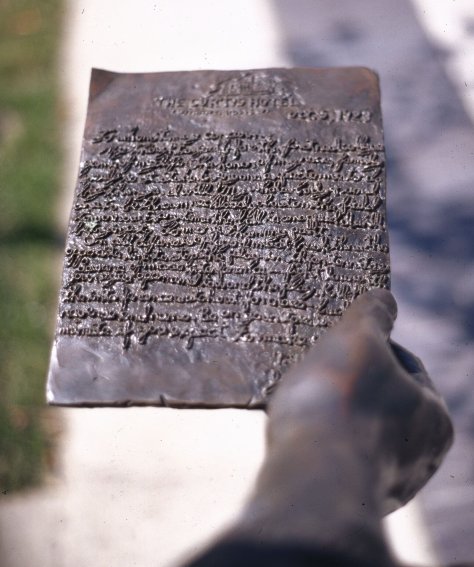
“My thoughts just before the first real college game of my life. The honor of my race, family, and self are at stake. Everyone is expecting me to do big things. I will!”

In pointed, anxious cursive, Jack Trice took his innermost thoughts to the stationery of the Curtis Hotel in Minneapolis, Minnesota. After all, there was no one else for the 21-year-old to share his excitement, anticipation, and gameplan with. As Iowa State University’s only black player, the segregated accommodations at away games meant he ate dinner in an empty room, and unburdened his true feelings to the only person he could: himself. Once he’d claimed his victory on paper, he folded the letter, humbly tucked it inside his suit pocket and prepared for the game of his life.

Three days later, that bright young life was lost. Jack Trice died on October 8, 1923 from injuries sustained in his second ever college varsity football game.

Back then, for a football player to be critically injured, or even die, wasn’t entirely out of the norm. Without the protection of pads, facemasks and other safety developments that came later, the game could be brutal. But in Jack’s case, there was another dynamic at play. In 1923, Iowa State was one of only 10 integrated major college football teams. On the field, the 215-pound tackle, who by all accounts was a quiet force who worked hard to succeed and blend in at Iowa State, couldn’t have stood out more to the University of Minnesota Gophers. Whether it was out of fear of his race, his indomitable blocking, or both, the opposing team focused their efforts on one man.

His teammate Johnny Behm reflected on the events that led to Jack’s untimely death, quite aptly capturing the conflicting feelings about what was at least a very public demise: “One person told me that nothing out of the ordinary happened. Another who saw it said it was murder.”

In just the second play of the game, Jack’s collarbone was broken, but he insisted on staying in. Toward the end of the third quarter, Jack was trampled by Minnesota linemen, and still only begrudgingly allowed himself to be carried off the field. He was treated and sent home to Ames with his team, where he finally succumbed to internal bleeding days later.

Despite “we’re sorry” chants from Minnesota’s fans as the Cyclones hauled Jack’s broken body off the field, that game’s events led to Iowa State’s refusal to play Minnesota again for 66 years in protest of Trice’s mistreatment on the Gophers’ home field. Jack’s integrity and tenacity so inspired Iowa State fans that they launched a 24-year-long campaign to officially name their football stadium in his honor, making it the only NCAA Football Division I stadium to bear the name of a black man.

One account surmised that Jack was so determined to stay on the field in spite of his fateful injuries because he hadn’t achieved what he set out to do in his letter, which was to “make good” on his promises to himself. But by 1930, just 7 years after Jack’s death, four more Division I teams were integrated, and 42 years later, every major college football program in the United States had a black player. Though he didn’t survive to see it, Jack Trice’s legacy was to open the door for thousands of others to make good on his handwritten promises forever.


KEEP GOING BLACK IN HISTORY:
See more Jack Trice images and history at the Iowa State Digital Archives.

DAY 27 — Ellen & William Craft

Ellen & William Craft - Lovers in Hiding in Plain Sight

“It is true, our condition as slaves was not by any means the worst; but the thought that we couldn’t call the bones and sinews that God gave us our own haunted us for years.”

William and Ellen Craft had lived with that demoralizing detachment as a married enslaved couple for 2 years, but their dread was only growing worse.

Ellen wanted children but refused because she herself had been torn from her family on her mistress’s whim as a child. Her light skin led strangers to mistake her for a member of her master’s family (and she was: he was her father), and it so infuriated the owner’s wife that when Ellen was 11, she was simply given away. Some of the Crafts’ friends had even suffered worse: each member of their family was separated from each other and sexually abused by their owners until they either escaped or bought each others freedom. Even if all they had was each other, William & Ellen had too much to lose.

A child of rape, Ellen’s skin was light enough to pass, an unfortunate circumstance she and William took full advantage of

But their escape in particular was more complicated by the fact that William and Ellen had two different owners. If they were going to flee Georgia, they’d have to figure out a way to do it together and be discreet about it, a tough task considering that their near opposite skin tones made them a conspicuous pair. Because they were both trusted in their households, they were each granted passes to visit family nearby. So with one problem down and a head start on their owners, they decided to hide in plain sight.

Whomever came looking for them would be keeping a watchful eye for a black man and white-passing woman, but William and Ellen both knew firsthand that no one batted an eye over a master accompanied by his or her slave. So they devised an elaborate scheme that both of them almost didn’t have the nerve to go through with. Ellen’s hair was cut short in the style of rich white plantation owners, and her jaw and neck were wrapped in gauze to appear as though she had some sort of affliction, when it was really to hide her soft, slender face and lack of facial hair from anyone who might look too closely. They even put her arm in a cast so as to deter anyone who might ask her to write or sign anything, as she’d never be taught to read or write. And on December 21, 1848, they made their daring escape by train, boat and on foot.

It was 6 full days before Ellen’s heart stopped pounding out of her chest.

Just a day into the trip, who was seated on the train next to them but a friend of Ellen’s master, a man who knew her well. He spent the whole ride shouting to make conversation with her. She spent it pretending she was deaf.

In South Carolina, their next passage was denied by a steward insisting on William’s ownership papers. Abolitionists had been kidnapping slaves from their rightful southern owners and granting them freedom in northern states, and this particular steward was serious about his job, refusing to sell them tickets until Ellen produced papers. Just then, the captain from their previous trip happened by & vouched for the couple, never realizing he’d been duped himself.

In Baltimore, the last stop to freedom, this time officials pulled them from the ship, demanding William’s documentation. Ellen pulled out every trick she knew, stalling, huffing and puffing until finally, the ship began to depart. Fooled by the cast and face wraps still hiding Ellen’s true identity, the official pitied a sickly man and allowed him (her) to carry on with the trip.

An artist’s depiction of Ellen Craft in disguise

The disguise was so good that even William found himself thwarting would be rescuers who advised him on how to abandon his disabled “master” for freedom in the north.

The couple arrived in Philadelphia on December 26, where Ellen collapsed into tears under the weight of the nearly weeklong ruse and relief from the fear of what being discovered would have meant for them.

They were taught to read, write, and found a prosperity in Philadelphia that neither of them had experienced before. But their great escape wasn’t over yet.

The Fugitive Slave Act allowed masters to recover their escaped property by any means necessary and with the help of federal authorities, which is exactly what William and Ellen’s owners did.

So in 1850, the pair fled again. This time to England, where rather than life out their days quietly as free people, they joined others who’d escaped slavery to successfully convince Parliament not to ally with Confederate forces in the Civil War. For the next 20 years, William and Ellen Clark made a name for themselves as prominent abolitionists, raised a family, and financed philanthropic causes in Africa.

But even in the worst of circumstances, there’s no place like home, so once slavery was finally abolished in the United States, the Clarks returned to Georgia in 1868, using the education they’d received in England to open a school for newly freed black students, putting their considerable finances toward purchasing a plantation of their own, and living the rest of their lives fighting for even greater black freedoms, together.


KEEP GOING BLACK IN HISTORY:

Read Ellen & William’s autobiography, including their daring escape, in the 1860 book, Running a Thousand Miles For Freedom.

DAY 26 — Victor Green & The Green Book

Victor Green - The Black Guide to America

“Would a Negro like to pursue a little happiness at a theater, a beach, pool, hotel, restaurant, on a train, plane, or ship, a golf course, summer or winter resort? Would he like to stop overnight at a tourist camp while he motors about his native land ‘Seeing America First?’ Well, just let him try!”

That was the state of affairs according to the NAACP’s magazine in 1947, as they warned black people against buying into the Great Northern Railway & National Park Service’s ad campaign encouraging Americans to vacation close to home. And lest someone doubt it, they need only look to examples of the plain warnings posted just outside thousands of “sundown towns”:

“N—–, Don’t Let The Sun Go Down On You.”

These weren’t just occasional backwoods towns. As late as the 1960’s there were still as many as 10,000 active sundown towns documented in the United States, some that were well-known and well-populated like Glendale, CA and over half of the incorporated towns in Illinois.

It was a difficult dilemma for black people who’d been encouraged to buy cars as soon as they could to avoid the humiliation of being forced to the back of public transportation vehicles, but couldn’t freely use those cars to travel beyond the relative safety of their immediate surroundings. If they did, they often packed extra food, gas and portable facilities to avoid being forced in dangerous situations for necessities.

Victor Hugo Green had done his share of getting around. As a postal worker, and later World War II soldier and music manager, he’d learned to navigate where he was welcome and would repeatedly visit those same establishments for both his own safety and to contribute to their continued success.

After some close calls himself and hearing stories from strangers and friends alike about running into racism whether traveling for business or pleasure, he decided that he’d curate a book to help “give the Negro traveler information that will keep him from running into difficulties, embarrassments and to make his trip more enjoyable.”

When he ran his inaugural 10-page issue in 1936, it was titled the “Negro Motorist Green Book,” and it primarily focused on lodgings, gas stations, restaurants and travel advice in New York, but by the very next year, it was popular enough to reach national distribution. By picking the brains of his fellow postal workers and offering to pay the Green Book’s readers $1 for providing new leads, Victor grew his publication annually until he left for the war in 1940, and when he returned in 1946, he began expanding the Green Book to include safe spaces in international destinations like Mexico, Canada, the Bahamas and Europe. By 1949, the Green Book was up to 80 pages including ads, many of which were from black female entrepreneurs who found freedom and greater personal wealth in running their own businesses and benefited from the word-of-mouth.

But what the Green Book omitted was as much a warning as inclusion was a welcome. Not a single restaurant was featured in Alabama in the 1949 issue. In Texas, only Austin and Waco were included in ANY Green Book. On the contrary, New Mexico was highlighted as a state that primarily practiced “cash over color.” The information contained (or not) within the pages of the Green Book was so extensive and reputable, a member of the Little Rock Nine even called it “one of the survival tools of segregated life.”

Recognizing that ultimately, black travelers just wanted to have positive experiences, Victor always ensured that the tone of the Green Book, while cautious was always uplifting, and he often featured travel quotes like his twist on Mark Twain’s “Travel is fatal to prejudice” to reassure black travelers that eventually things would change. In fact, at their peak of printing 15,000 copies annually, Victor himself once wrote, “There will be a day sometime in the near future when this guide will not have to be published… It will be a great day for us to suspend this publication for then we can go wherever we please, and without embarrassment.”

Victor passed away in 1960 and didn’t live to see the signing of the Civil Rights Act of 1964 outlawing discrimination on the basis of race, but his hope was indeed realized. With the passage of the Act, the dire necessity for his guide slowly decreased, and after nearly 30 years in circulation, the Green Book was finally retired in 1966, having made a whole era of travel possible for black people who wanted to take their growing freedoms on the road too.


KEEP GOING BLACK IN HISTORY:

Explore the New York Public Library’s digital catalogue of Green Books published 1936-1967.

The Bitter Southerner created a really lovely featurette illustrating personal vignettes about using the Green Book.

DAY 23 — Robert Abbott

Robert Abbott - Defender of Black Voices

Twice, Robert Abbott had risen to his full potential only to be thwarted by the color of his skin.

He’d studied the printing trade in college, but when he graduated, the only jobs he was offered were in unskilled labor for which he was overqualified.

He’d gone back to school and graduated with a law degree, but before he could build his own practice, an established Chicago lawyer informed him that he was “a little too dark to make any impression on a court.”

So Robert combined his talents and went to work for someone who’d never stand in his way: himself and the people who looked just like him.

In 1905, The Chicago Defender was established.

What started with a 25 cent investment and a 300-copy first run printed from Robert’s landlady’s kitchen grew to 250,000 copies per week and became the most highly circulated black newspaper in the country.

When Robert read white mainstream papers, he was disheartened that the primary news of black people revolved around their crimes, lynchings and the riots against them. He knew better.

His newspaper painted black people in a whole new light. He featured black successes, ran news of black interest, promoted black landlords and properties, rallied for black equality, and once his paper’s distribution reached over 100,000 with nearly two-thirds of that beyond Chicago, he created a whole campaign designed to improve the lot of black readers everywhere. Having noticed that a large number of the derogatory stories and negative events around black people were coming from Southern states where slavery (and thus its effects) had lingered, he appealed to those affected readers to move to Chicago where there was more freedom, a richly cultured and diverse black community and most importantly, personal opportunity.

The “Great Migration” as the surge of black Southerners to northern states was called, began in 1915, but Robert put an urgency to it, even calling for a “Great Northern Drive” on May 15, 1917 as a mass protest exodus of sorts. Between 1916 when The Defender’s campaign began and 1918, Chicago’s black population more than tripled from 40,000 to 150,000, a growth rate that many today and back then largely attributed to Robert’s successful advertising.

It’s no surprise that such a positive force for black people quickly drew the wrong kind of attention and in many southern states, The Defender became anathema. Just before World War I, the U.S. government investigated Robert on charges of sedition after he called for black servicemen to demand equal rights in the military. Klansmen began attacking anyone black seen reading the The Defender, news outlets refused to carry it, and for a very short time, the paper was in jeopardy.

But by then, Robert was a master at using his hustle to overcome adversity.

He bundled the paper in luggage and distributed it among black railroad porters who created a network that gained him an even greater readership than he’d had before. They’d deliver individual copies to riders covertly, redistribute weekly editions among themselves, or drop off whole stacks in local black barber shops, churches and community centers where they’d be seen and shared by up to 500,000 black readers per edition.

While the Defender had long grown from its kitchen production, its distribution eventually had such a high volume that it had to be moved to its own building entirely, becoming the first black newspaper with its own printing press, and in the early 1920’s, its founder who originally couldn’t break into the printing industry became one of America’s first self-made black millionaires.

Robert Abbott died in 1940, but by 1956, The Chicago Defender had become the largest black owned daily newspaper in the world. Although it’s circulation is much smaller now, (as are most newspapers) it’s still in print today, and the goals of its founding principles are just as relevant in 2019 as they were in 1905 when one man determined to overcome racism made a difference for millions.


“The Chicago Defender’s Bible”

1. American race prejudice must be destroyed;
2. Opening up all trade unions to blacks as well as whites;
3. Representation in the President’s Cabinet;
4. Hiring black engineers, firemen, and conductors on all American railroads, and to all jobs in government;
5. Gaining representation in all departments of the police forces over the entire United States;
6. Government schools giving preference to American citizens before foreigners;
7. Hiring black motormen and conductors on surface, elevated, and motor bus lines throughout America;
8. Federal legislation to abolish lynching; and
9. Full enfranchisement of all American citizens.


KEEP GOING BLACK IN HISTORY:

The Chicago Defender continues its legacy of reporting on positivity in the Black community still today.

DAY 22 — Autherine Lucy

Autherine Lucy - Bama’s Boldest

After her 3-year fight to become the The University of Alabama’s first black student was finally won on February 3, 1956, Autherine Lucy was put out within 3 days.

At least she’d actually attended. The friend who’d first suggested it was ousted before she even set foot on campus.

Autherine and Pollie Myers had several Associate’s and Bachelor’s degrees between them, and when they submitted letters of inquiry to the university for their Master’s in 1952, their pedigrees were so impressive that they both received offer letters back within less than 2 weeks. But as soon as they submitted their official applications denoting their race, Alabama rescinded their offers, apologizing for the admittance “mistake.”

The NAACP immediately took on the case, and a young lawyer by the name of Thurgood Marshall warned the ladies that they could expect an uphill battle. Two years in, the landmark Brown vs. Board of Education case that ruled segregation in public schools unconstitutional was an incredible victory for all black students, and 13 months later, Autherine & Pollie were successfully readmitted.

But during the course of the trial, the university had hired private investigators to dig up any dirt they could find on the girls, hoping to call their character into question. Sure enough, they’d discovered that Pollie, now married and with a child, had conceived her child before taking vows. That was a violation of the University of Alabama’s morality code and Pollie was once again disqualified from attending.

Since Pollie was the driving force behind the attempt anyway, university officials hoped Autherine would find the whole affair to be too much trouble and withdraw her application herself. She did not.

On February 3, 1956, Autherine Lucy proudly attended her first day of classes, and having survived her first 48 hours with only a few hundred rocks, eggs and slurs thrown her way, she thought it had actually gone about as well as could be expected.

By February 6, the riots had reached such a violent fever pitch that Autherine sat after her first class for hours, waiting for the mob outside to dissipate before officers would even attempt escorting her out to the police cruiser necessary to transport her around campus. That same day, the University of Alabama expelled Autherine “for her own safety.”

Once again, the NAACP lawyers brought charges against the university, but one of those initial charges alleged that the university had conspired in the riot. Unconvinced they could prove it in court, the charge was withdrawn, but not before Alabama caught wind of it. They claimed that the allegation amounted to defamation and this time, Autherine’s expulsion was official, final and devastating.

“Whatever happens in the future, remember for all concerned, that your contribution has been made toward equal justice for all Americans and that you have done everything in your power to bring this about,” Thurgood Marshall wrote to her, reassuring her that though her fight had been lost, it had not been in vain.

9 years later, Autherine’s fight indeed came to fruition when Vivian Malone became the University of Alabama’s first black graduate.

Autherine’s own redemption was much longer in the making.

After two Alabama history professors invited this living legend into their classrooms to share her firsthand account as a pioneer and petitioned the university to overturn her expulsion, 60-year-old Autherine Lucy returned to the University of Alabama for her Master’s in Elementary Education.

But this time, she didn’t go alone. Autherine and her daughter Grazia were both admitted in 1989 and subsequently graduated together in an incredibly touching and monumental moment that truly illustrated the impact Autherine’s sacrifice had.

Today, the Autherine Lucy Clock Tower, the Autherine Lucy $25,000 Scholarship Endowment, and three individual tributes stand on the University of Alabama campus in honor of the woman whose name school officials once couldn’t get off the register fast enough.


KEEP GOING BLACK IN HISTORY:

Watch 88-year-old Autherine Lucy speak at the 2017 dedication of her historical marker on the University of Alabama’s campus.

DAY 18 — Charles Gittens

Charles Gittens - Black At the President’s Side

It was the dead of night when hysterical screams came from the First Lady’s Hyannisport bedroom.

Luckily, one of the United States Secret Service’s most level-headed agents was the first to Jackie Kennedy’s side… even though her assailant was only a giant flying bat.

From an early age, the call to serve his country in some capacity was so strong that shortly before he graduated from high school, Charles Gittens decided to enlist in the U.S. Army instead.

There, he earned his GED and a whole lot more. He ultimately served as a lieutenant in Japan during the Korean War, and once discharged, he earned two 4-year degrees in English and Spanish within just 3, with Magna Cum Laude designation.

He’d spent a year teaching in North Carolina when his friends encouraged him to take a government civil service exam. The Drug Enforcement Administration (DEA) was recruiting black agents and it couldn’t hurt to try, right? His high test scores, bilingualism and military background caught the attention of the Secret Service instead.

And so, in 1956, Charles Gittens became the first black agent in the United States Secret Service.

But it almost didn’t come to pass. The civil service exam was given in two parts: written and oral. After having passed the written exam, he traveled to an Atlanta regional office for the oral portion, where for one reason or another, the facilitator had it out for him. “The guy in charge had scribbled things down like, ‘speaks incoherently’ or ‘can’t be understood.’ Can you imagine such a thing?” he recounted. When he insisted on another facilitator he passed with flying colors, but never did get an explanation for the wild discrepancy.

Of course, Charles didn’t let the rough start hold him back. From his initial appointment in North Carolina, he was promoted to the agency’s largest field office in New York, where he investigated counterfeits and protected visiting presidents along with other dignitaries for 10 years. He was such an impressive and inspiring leader that he was subsequently promoted to senior agent of the Island of Puerto Rico, and finally in 1971, special agent in charge of the Washington, D.C. office, a job that put him on regular presidential protection and supervisory duties over more than 100 other agents.

He’d been so welcomed by his peers, dignitaries and presidents, and had operated in a world so separate from civilians that it was often easy to forget the racism that lurked just beyond the government’s most protected walls. But that didn’t mean he was immune to them.

“At that time, I was not a ‘negro,’ I was a Secret Service agent,” explaining how his job had become second nature to him. But the looks on the faces of the diners as he walked straight past a “No Negros” sign and into a restaurant where he was meeting other agents for breakfast told him otherwise. After an awkward wait, the manager came out and told the other agents they wouldn’t serve a black man. Despite the others coming to his defense, Charlie kept his dignity and left the situation, reminding them that they were always representing the President of the United States. (One account says the owner caught up to Charlie, apologized for the disrespect and served him after all.)

By the time Charlie ended his Secret Service career in 1979, he’d become the deputy assistant director overseeing all of the Secret Service field offices. In his 23 years of service, he protected Presidents Eisenhower, Kennedy, Johnson, and Nixon, countless diplomats, and the best interests of the country in myriad ways. And he continued doing so. After retiring from the Secret Service, he joined the Department of Justice’s Office of Special Investigations, tracking down and bringing war criminals hiding in the US to pay for their crimes.

Though he died in 2011 at the age of 82, he left a legacy of inclusion as a living testament to his devotion. During his career, he was a founding member of the National Organization of Black Law Enforcement Executives (NOBLE), dedicated to “fairness in the administration of justice, police community relations, [and greater inclusion] of black police officers.” In each of his ranking positions, the Secret Service encouraged Charlie to recruit more female and black agents. Today, there are nearly 400 of each among approximately 3500 special agents due largely in part to Charlie’s efforts, his leadership and his determination to serve, no matter the return.


KEEP GOING BLACK IN HISTORY:

Upon his death, The Boston Globe featured a complete and truly inspiring obituary for Agent Gittens.

DAY 16 — James Van Der Zee

James Van Der Zee - The All-Seeing Eye of Harlem

James Van Der Zee was a master of composition, but his most brilliant works were created not behind his violin or piano, but through the lens of his camera.

When he made his way to Harlem in 1906, it wasn’t his first time. He’d visited often from his small hometown in Massachusetts, and marveled at the pictures he’d taken in the big city since he was 14, honing his eye along the way.

A couple enters James Van Der Zee’s 135th Street brownstone basement GGG Photo Studio in Harlem.

But photography couldn’t pay the bills, and surprisingly enough, his skill as a musician could, so he created and subsequently packed theater houses with the Harlem Orchestra. He even performed with jazz icons, but still his eye wandered back to the camera. Having regularly worked small jobs between music gigs, it was no surprise when in 1915, he landed one as a darkroom assistant whose skill was proven so quickly that he was promoted to portraitist within a year, and opened his own studio on 135th Street within two.

Jean-Michel Basquiat, and his cat.

His talent couldn’t have come to fruition at a more fortuitous time for both James and the residents of Harlem. With the start of the Harlem Renaissance around 1918, black art, literature and culture was gaining international recognition, and being celebrated within black communities on its own merits and for its success in the mainstream. Black photographers were included in this praise, and also key to capturing the social, economic, and personal benefits that many black people were enjoying for the first time in America. In James’s studio, some of the most meaningful moments in everyday black lives and in all of black history were captured on film. Baby pictures, young newlyweds, funerals, civic groups and iconic portraits of black leaders and celebrities were all included in his exquisite body of work which spanned until 1982, nearly right up until his death a year later at the age of 96.

But his photographs are so much more than the sum of their parts. He didn’t just capture a black middle-class in the height of their recognition by a society that had previously enslaved them. At the start of his professional career, he made it a point to sign, date and number each of his photographs. Such care for his craft and attention to detail meant that when his work was discovered in 1967 by a researcher for The New York Metropolitan Museum of Art, his then 75,000 photographs became one of the most fully verifiable and extensive archives of black life since slave records. Because marriage/birth records and the ability to freely own property weren’t available to black people until in some cases well after the Civil War ended in 1865, further proof of our generations, personal wealth and especially a positive visual record of both beyond often sparse government and media documentation was tremendous to the culture and to the further preservation of our place in America’s past.

As a black man positioned behind a camera during one of the most significant eras of black history, James was able to show the whole world an entirely novel perspective on his subjects, no matter their status or the gravity of the occasion. When asked why and how he created such ethereal and regal images, he remarked “I wanted to make the camera take what I thought should be there.” What James Van Der Zee and his camera left behind was a legacy of black excellence.


KEEP GOING BLACK IN HISTORY:

James’ Metropolitan Museum of Art exhibit was accompanied by a catalogue of newspaper articles and curated images from Van Der Zee and other black photographers, available here.

DAY 15 — Fredi Washington

Fredi Washington - Light Skinned Actress Leading the Way

Fredi Washington’s porcelain skin and peridot green eyes bought her a level of privilege that was unheard of for black people in the 1920s and 30s.

What was even more unheard of was that she didn’t want it.

Back then, when black actors got mainstream film roles, they were typically small parts as some form of help – maids, teachers, and of course, slaves. Otherwise, their filmographies were exclusively “race films,” segregated movies with all-black casts made for black audiences, and for the first few jobs, this was Fredi’s experience too.

Until 1934, when she landed what’s arguably one of the most pivotal roles performed by a black actress in the history of cinema.

Fredi’s “Imitation of Life” title card

“Imitation of Life,” based on a 1933 book, told the story of an enterprising duo of single mothers, a white widow and black maid, raising their daughters together in the same home. But there was a twist. The black daughter, Peola, had skin light enough to “pass” as a white woman instead. The movie explored the dynamic of white and black women’s friendships and their ingenuity in finding empowerment in a sexist society, but even more impactfully, the ongoing mental, emotional and familial effects of slavery, racial segregation laws and deeply ingrained social stigmas faced by black women in particular. For its groundbreaking work, the movie earned three 1935 Academy Award nominations, including Best Picture.

Having tasted success, Fredi used her platform and privilege to empower others, establishing the Negro Actors Guild in 1937 to provide black actors with more mainstream opportunities and non-stereotypical roles in film. But due in large part to her critically acclaimed performance in “Imitation of Life,” Fredi found herself fighting a typecasting battle of her own. Her crossover success had inspired other filmmakers to explore “passing,” and of course, they all wanted to cast the most recognized name in the business as a black woman capitalizing on her white skin.

But they had gotten Fredi all wrong. As far as she was concerned, she was a black actress portraying black experiences on-screen. It had never been her intention to pass. “You don’t have to be white to be good. No matter how white I look, on the inside I feel black,” she insisted.

And that conviction was truly tested. She was too talented and pretty to be cast in a subservient background role in mainstream white films, but film production codes in Hollywood at the time strictly forbid interracial relationships, so the outspokenly black actress couldn’t be cast as a romantic female lead either. Conversely, her light skin made her a costly distraction in race films. When she attempted radio instead, she found few dramatic roles for black talent, and even fewer with black female protagonists. Because of her stance against being someone she was not, Fredi never again found the level of fame that “Imitation of Life” gained her.

Naturally, journalists were curious why she didn’t follow the example of other actresses at the time like Rita Hayworth (who was actually a passing Spanish-American) and simply pass as a white actress to find the success she so rightfully deserved. She offered without hesitation: “You see I’m a mighty proud gal, and I can’t for the life of me find any valid reason why anyone should lie about their origin, or anything else for that matter. Frankly, I do not ascribe to the stupid theory of white supremacy and hiding the fact that I am a Negro for economic or any other reasons. If I do, I would be agreeing that to be a Negro makes me inferior and that I have swallowed whole hog all of the propaganda dished out by our fascist-minded white citizens.”

Retiring from show business in the 40s, she quickly offered her insider knowledge to assist the NAACP in fighting racism and exclusion in Hollywood, and continued to work toward equality for black creators until her death in 1994. Although Fredi won very few honors herself, her role as a leading black woman in a Hollywood-produced film opened doors to equally iconic black mainstream roles for some of the world’s most influential black thespians like Sidney Poitier and Louis Gossett, Jr., among others.

Fredi struggled to fit in as a light-skinned black creative in her era, but her work has found its way among the most treasured American films of all time. “Imitation of Life” was added to the preserved collection in the United States National Film Registry at The Library of Congress in 2005, and in 2007, TIME Magazine recognized it as one of “The 25 Most Important Films on Race,” solidifying Fredi’s place in history right where she would have wanted it – beloved for being undeniably black.


KEEP GOING BLACK IN HISTORY:

“Imitation of Life” is available on Amazon Prime for $3.99, and I guarantee it’ll be money well spent.

The Amistad Research Center at Tulane University archives an assortment of Fredi’s personal belongings, and a blog entry from the center details how “Imitation of Life” impacted Fredi’s own.

DAY 13 — Cheryl Brown

Cheryl Brown - The Realest Representation of Miss America

“Contestants must be of good health and of the white race.”

Rule 7 of the Miss America Pageant Handbook had been on paper since 1930, and finally overturned in 1950, but here it was 1970 and still not a single black contestant.

Even that hadn’t been without a fight though. Two years beforehand, the NAACP had challenged the lack of diversity in the pageant, and the Miss America organization had responded less enthusiastically than they’d hoped. So black entrepreneurs created their own Miss Black America Pageant in 1968 and held it in Atlantic City on the very same day as their counterpart to point out the hypocrisy in a “Miss America” without women of color, and to challenge European beauty standards that automatically disqualified black women’s dark skin, full lips, round noses, kinky hair and thick curves.

A 1968 clipping from The New York Times features the Miss America and Miss Black America pageant winners side-by-side. Read both articles for a good laugh, especially from the first blonde Miss America in 11 years.

At the same time, feminists from all races were protesting the existence of the Miss America Pageant altogether, with white women likening it to a meat market and women of color calling it “racism with roses,” in reference to their official and unofficial exclusion for so many years.

Amidst all this ongoing unrest, a black ballet dancer from New York won the title of Miss Iowa 1970, allowing her to compete as the Miss America Pageant’s first black contestant in their then 50-year history.

Cheryl Adrienne Browne was only in Iowa to attend Luther College at her pastor’s recommendation. She had participated in the pageant to win scholarship money to support her while she was away from her family, and was just as surprised as anyone else when she actually won both the swimsuit and talent competitions, and then the whole thing.

But that success didn’t come without its share of obstacles, too. When she wasn’t fighting the criticism that a black woman wasn’t worthy of a pageant win, she had to answer to those who didn’t want a non-native Iowan representing them, and those who fell into both camps. Between this and the other protests, there was so much controversy surrounding Cheryl’s win that even other Miss America contestants couldn’t help but notice the increased security presence in and around their rehearsals, travel routes and hotels.

Cheryl and Miss Maryland Sharon Ann Cannon, on the Atlantic City Boardwalk just before the Miss America 1971 pageant.

On September 12, 1970, Cheryl didn’t win the Miss America 1971 crown. She didn’t even place in the Top 10. But she did go on to represent the pageant on USO tours in one of the last groups to visit Vietnam, and served as a judge to bring equality to subsequent competitions. Today, she’s very humble about her place in history, saying “I don’t feel I personally changed the pageant, but I feel that my presence expanded people’s minds and their acceptance. And, in subsequent years, they were much more open to African-American candidates.”

Nia Imani Franklin, Miss America 2019.

And indeed they were. 13 years later, Vanessa Williams was crowned the first black Miss America in 1983, and there have been 8 more since, including this year’s Nia Franklin, all living proof that beauty, talent and brains know no racial boundaries.


KEEP GOING BLACK IN HISTORY:

DAY 11 — Seneca Village

Seneca Village - Central Park’s Stolen Foundation

There’s a dark secret buried beneath the greenery of Central Park.

In the mid-1850s, New York was was just beginning to blossom into the global city it’s now become. Brimming with tourists, businessmen and immigrants from around the world, the city needed a grand outdoor space to rival those of London, Paris and other European metropolises, according to New York’s officials and prominent residents too.

Where they didn’t have space to build, city planners took what they needed from the nearby “shanty wasteland” inhabited by “insects, squatters, and bloodsuckers,” as the local papers characterized the small enclave of Seneca Village and its people.

But those descriptions couldn’t have been further from the truth. No one was more invested in the well-being and upkeep of their small corner of the Big Apple than Seneca Village’s own citizens – it had stood as New York’s first community of free black people for 30 years.

Despite the fact that the state of New York didn’t officially free slaves until 1827 and the United States didn’t follow until 1863, the free black men and women of Seneca Village established their middle-class settlement by purchasing adjacent plots of property in 1825. But so much more than pride bound them so fiercely to their estates. In those days, black men were only eligible to vote if they owned at least $250 of land. Of the nearly 14,000 black people documented in New York at the time, only 91 had voting rights and of those, 10 lived in Seneca Village. For their small town, preservation was power.

Albro and Mary Beth Lyons were two prominent abolitionists who were also known citizens of Seneca Village.

But unbeknownst to all of them, just two weeks before the church’s cornerstone was set, city officials had ordered the entire village, from 81st to 89th Streets between 7th and 8th Avenues (near what’s now Central Park West), condemned to make space for their vanity.

With 3 churches, 3 schools, 2 cemeteries and dozens of free-standing homes up to three stories tall, Seneca Village was a thriving community with nearly 600 total residents during the 3 decades it existed. And they had plans for greater longevity. When the cornerstone for their First African Methodist Episcopal Zion Church was laid in 1853, a time capsule was placed inside to preserve the significance for future residents. As a suspected Underground Railroad stop due to the presence of so many abolitionists and the constant influx of new residents, it had become a place of hope for all who passed through and a realized vision of what free black people could be.

An article from the New York Herald documents the coffins unearthed in 1871, noting that they had not been there just 5 years before when trees were planted in the park. Unlikely, as excavations later established it as the location of one of Seneca Village’s cemeteries. (Also note the coffin’s description.)

4 years later in 1857, it was all gone. Despite protests from the citizens and lawsuits that they brought against the city for failing to pay what the property was worth, if they paid anything at all, the then 300 or so men, women and children of Seneca Village didn’t stand a chance against New York’s elite.

It wasn’t just black history that was destroyed either. By the time it was razed, Seneca Village was a shining example of an integrated community, with as many as 30% of its residents having been Irish or German, all attending the same schools, churches and local gatherings.

Seneca Village was only one of many black communities, cemeteries and landmarks lost to the rise of New York, and the city has begun to address this shameful history through places like the African Burial Ground National Monument and historical markers. But some mistakes can never be undone. As signified on the plaque where Seneca Village once stood, after their property and voting rights were lost, Seneca Village was never rebuilt, and while remains have been unearthed there sporadically since 1871, not a single living descendant of the community’s black citizens has ever been found. to make something brand new.

Where Seneca Village would have stood today

KEEP GOING BLACK IN HISTORY:

Explore the study & excavation of this historic community at Columbia University’s Seneca Village Project.