Tag Archives: PAST

DAY 13 — The 1878 Fireburn Queens

By the time the United States purchased the Virgin Islands in 1917, slavery had technically been abolished in most of the colonized world.

But freedom had not come easily to the Virgin Islands, and the United States was buying one of only two territories in the Caribbean that had won that freedom through a fight. It all started when the enslaved people of Frederiksted, one of St. Croix’s most significant cities, got sick and tired of being sick and tired.

In 1847, Danish Governor Peter von Scholten put their freedom on a timetable, presenting a twelve-year plan to give every Crucian (the people of St. Croix) their independence.

Nobody was having that.

Sugar cane was one of the island’s primary exports, and without it, a whole lot of (white) people would go bankrupt. On the other hand, the enslaved saw no reason to wait for what was rightfully theirs. 

The Høgensborg Plantation on St. Croix, Danish West Indies drawn by Frederik von Scholten, June 1838.

A stand-off was brewing on St. Croix. After the Haitian Revolution in the early 1800s claimed nearly 500,000 lives, required a military response from Britain, France and Spain, and brought Haitian slave labor to an end, rebellion lingered in the Caribbean air.

The first match lit in St. Croix was struck just a year after the governor’s abolition law.

St. Croix’s enslaved already had a few key learnings on uprising strategy in the islands. First, as they were expected to provide every bit of labor, they far outnumbered those who kept them in chains. Second, though they’re surrounded by water, islands are particularly vulnerable to fire. And third, any help to quell an uprising would have to come from miles, if not, entire oceans away.
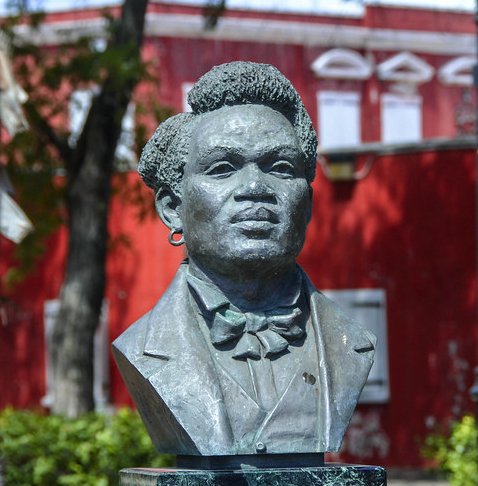
A bust of John Gottlieb (known to locals as “Buddhoe”) stands in Frederiksted.

With that knowledge, and led by skilled worker John Gottlieb, 8,000 Black Crucians stormed Fort Frederik, and demanded their freedom that day, else they’d set all this stuff on fire.

And they got it.

After the 1848 rebellion, Governor Peter von Scholten issued a decree abolishing slavery immediately, not in 12 years after all.

Sort of. Upon receiving the governor’s abolition law, the plantation owners got busy finding loopholes, and they were ready. They presented these newly freed people with contracts, a reasonable expectation upon being freed, right? Except that per these contracts, a worker and their family were obligated to work the plantation they’d signed with for one year. During that year, they could make no complaint on wages, treatment, working conditions or any other labor concern, until “Contract Day.” On that day, and only that day, could contracts be amended.

And had everything been on the up and up, it probably would have been a pretty decent outcome.

But everything was not on the up and up. You’d think the Danes would have learned.

Their newly contracted labor force was not paid a living wage, and most found themselves in worse condition than they had been as slaves. Because the workers were no longer their property, the plantation owners had no interest in ensuring their well-being. Without money for the basic necessities or even medical treatment, Black citizens suffered, but were still expected to serve as the backbone of the labor force. Black women in particular were bearing the full weight of an unjust society. They worked brutal jobs and long hours for insufficient wages, cared for sick and injured husbands and children, foraged food to feed their families, and so many more hardships exacerbated by Danish oppression that they had finally had enough.

So, on Contract Day – October 1, 1878 – THIRTY whole years after the abolition law that was supposed to make them fully free, WOMEN led Black Crucians to demand their grievances be heard.

They were not.
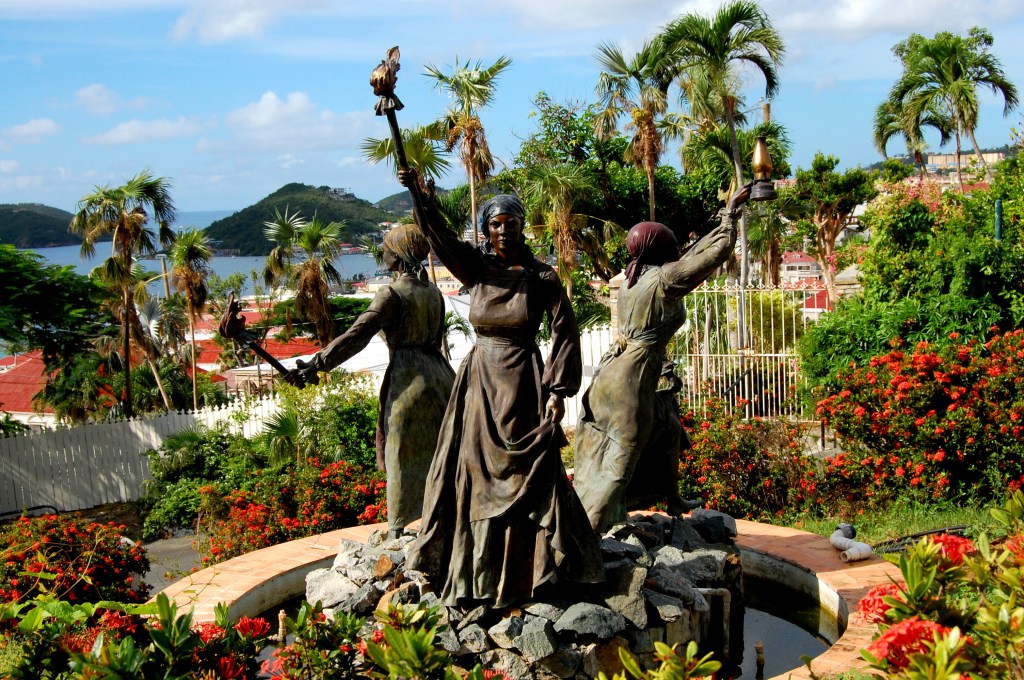
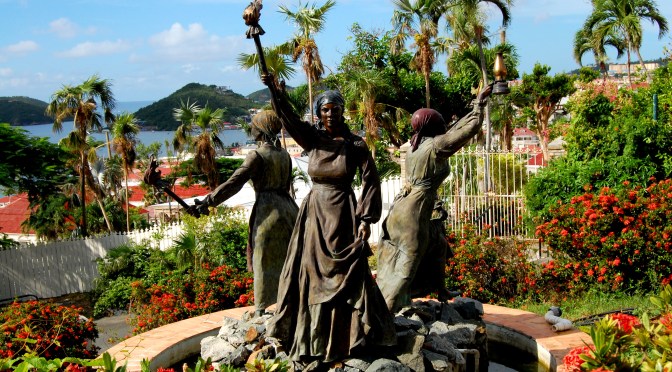
A Frederiksted fountain of Queens Mary, Agnes, and Mathilda. Each carries a symbol of their resistance: a lantern, a cane knife, and torches. The fountain was erected before Susanna’s involvement was fully discovered.

Instead, Danish troops escalated the situation by firing on the crowd. But still massively outnumbered, they were forced to retreat into the walls of the very same fort they’d defended 3 decades before.

With Danish troops self-barricaded and all other Danish colonialists too afraid to intervene, Mary Thomas, Agnes Salomon, Mathilda McBean and Susanna Abrahamson made good on the Black Crucians’ original threat.

Cane fields, plantations, mills, corrupt government buildings… nothing was spared the torch. When the smoke cleared, only 2 soldiers, 1 plantation owner, and less than 100 Black Crucians were dead. 400 were arrested. But nearly 900 acres of Frederiksted had burned to ash.

A November 1878 illustration depicts the moment the Fireburn erupted. You can see women in the illustration’s foreground.

12 people were sentenced to death for their part in the 1878 St. Croix uprising known to the locals as the Fyah Bun. But Queens Mary, Agnes, Mathilda, and Susanna were not among them. Executing them as martyrs might have incited another uprising, but imprisoning them on the island was equally dangerous and unpredictable. Instead, all four women were extradited to Denmark, and sentenced to life in a hard labor prison.

A news article details the property damage done in the uprising.

It wasn’t immediate, but the Black Crucians DID get true freedom, and the scars they left in their fight for it are still visible all over Frederiksted.

“The young [Danish] people ask ‘Why don’t you take care of the ruins? You should rebuild some of the places. There’s so much lost history,’” Crucian historian Frandelle Gerard recalls. “I say to them, ‘Honey, they were burned on purpose! And they will never be rebuilt!’”

But in 2018, something else was. In Copenhagen. Artists  La Vaughn Belle and Jeannette Ehlers, Black women from St. Croix and Denmark respectively, erected their massive 23 foot statue, “I Am Queen Mary,” not far from where its subject was imprisoned and just outside the Danish West Indian Warehouse where imported sugar and rum produced by enslaved people was stored. “Queen Mary” is Copenhagen’s first public monument to a Black woman. She’s fashioned after a seated photograph of Black Panther Huey P. Newton, holding her torch and cane knife fast at hand, and serving as a towering reminder of Huey’s words “You can jail the revolutionary, but you can’t jail the revolution.”

“Queen Mary” standing before the Danish West Indian Warehouse. Read more about her and the artists who created here at Vice. Or visit her at her dedicated website here.

KEEP GOING BLACK IN HISTORY:

Take an even closer look at Queen Mary and hear more from her creators here.

The anniversary of John Gottlieb’s uprising is known as Freedom Day in the U.S. Virgin Islands. Read all about it on St. Croix’s tourism website.

Black Danes are preserving the history of the Fireburn and you can view their archive and more history of the Danish slave trade here.
Learn more about slavery in Danish Colonies like St. Croix at the Danish National Museum’s website.

There’s a documentary on the Fireburn! Watch the trailer here, and keep an eye out for its global availability on Instagram.

DAY 12 — Elizabeth Keckly

“Slavery” is a cold, factual word that tidily boxes up millions of personal indignities repeated over and over again.

“Freedom” is usually considered its opposite, but I’d propose another: “agency.”

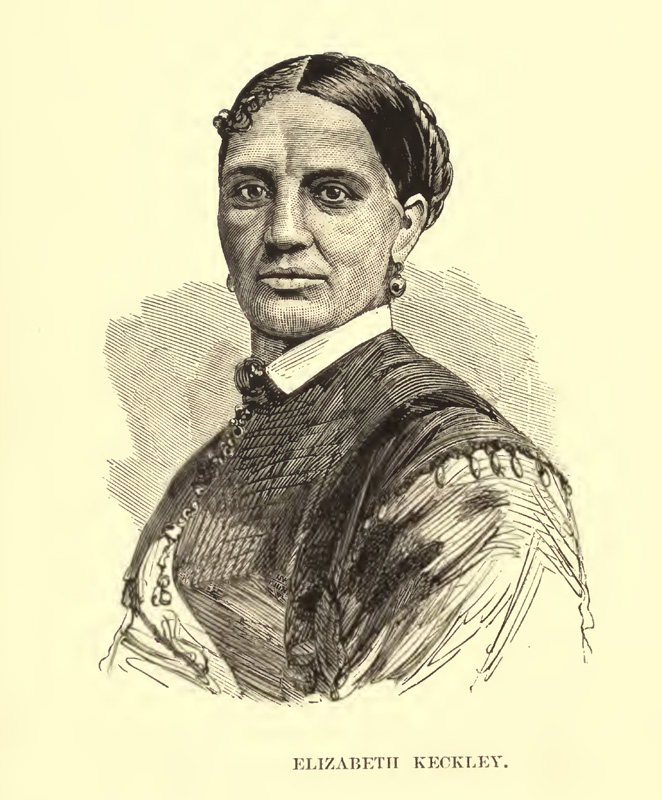
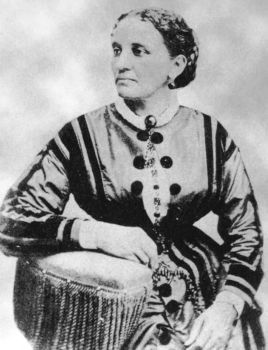
Elizabeth Keckly, in her prime. She came to be known as Madame Keckly among Washington D.C.’s high society.

Everything about the antebellum Virginia world Elizabeth Hobbs Keckly was born into was designed to deprive her of agency. She lived to take it back.

Elizabeth’s mother Aggy wasn’t as fortunate. Her daughter’s father wasn’t her husband George, but her owner Armistead Burwell. She’d attempted to claim what little agency she could in the circumstances by rejecting her enslaver/rapist’s last name in favor of her husband’s: Hobbs. Aggy didn’t share that truth with her daughter until her deathbed. Perhaps it brought back too many bad memories, like how Burwell gave the Hobbs family two hours notice before selling George to a slaver in the West. Elizabeth recalled their collective helplessness in her autobiography: “I can remember the scene as if it were but yesterday;–how my father cried out against the cruel separation; his last kiss; his wild straining of my mother to his bosom; the solemn prayer to Heaven; the tears and sobs–the fearful anguish of broken hearts… the last good-by; and he, my father, was gone, gone forever.”

Prized by the Burwells for her many talents, especially the seamstress skills that she was expected to teach her daughter, Aggy was kept. But Aggy could also read and write, and likely taught her daughter those skills as well. Instead of the domestication expected of her, Elizabeth eventually wielded her needle and pen as silent weapons of subversion instead.

That subversive streak simmered early on. As a teenager, she was sent to North Carolina to work in the service of her (then unknown) half-brother Robert. Perhaps because Robert’s wife Margaret easily guessed the source of Elizabeth’s light skin and wanted to punish her for it, or perhaps simply because she was cruel, Margaret enlisted the help of a neighbor to “break” Elizabeth. When the neighbor summoned Elizabeth, demanding that she strip down for her first humiliating beating, she replied, “You shall not whip me unless you prove the stronger. Nobody has a right to whip me but my own master, and nobody shall do so if I can prevent it.” She could not. Week after week, Elizabeth was beaten until her abuser was too exhausted to continue. Week after week, “I did not scream; I was too proud to let my tormentor know what I was suffering,” she wrote. Eventually, it was he who “burst into tears, and declared that it would be a sin” to continue inflicting such harm upon an innocent human being.

But her torment did not end, and a new owner inflicted a different physical punishment on Elizabeth. “For four years, a white man—I will spare the world his name—had base designs upon me. I do not care to dwell upon the subject, for it is one that is fraught with pain. Suffice it to say that he persecuted me for four years, and I… I became a mother,” she wrote.

Then and now, there is no greater personal indignity, but Elizabeth’s despair over that act went deeper: “I could not bear the thought of bringing children into slavery — of adding one single recruit to the millions bound in hopeless servitude.”

When Armistead Burwell died, Elizabeth returned to Virginia to care for his heirs, then accompanied them to St. Louis. That’s where she began stitching her terrible circumstances into gold.

By then, the family had grown to 17 members, and without a patriarch and his estate, they were destitute. Elizabeth was the only one among them with employable skills, and she was hired out to sew for other families, eventually growing that casual business arrangement into an actual business that single-handedly supported all 17 people.

Seeing her true value, Elizabeth made an offer to her owner. She would buy her freedom and her son’s for $1200. At first, he refused. Then he tried to trick her, saying he would accept no payment, but offering to pay her passage on the ferry across the Mississippi. She was smart enough to know that the Fugitive Slave Act meant she could be returned to her owner anytime, and she refused. In 1855, she finally gained her independence and made her first fateful decision. Elizabeth took her talents to the nation’s capital, where they caught the eye of a very important lady: Mary Todd Lincoln.

Mary Todd Lincoln in the gown Elizabeth made for the President’s inauguration ball.

Under the First Lady’s employ, Elizabeth flourished. In a single season she fashioned almost 20 dresses, many of which were complimented by the President himself. In Mrs. Lincoln, Elizabeth also found a timely friend. Elizabeth and Mary both lost sons in 1861 and 1862, respectively. That experience reshaped their very personal business relationship into a friendship. “Lizabeth, you are my best and kindest friend, and I love you,” Mrs. Lincoln once wrote. Best of all, she put her money where her mouth was.

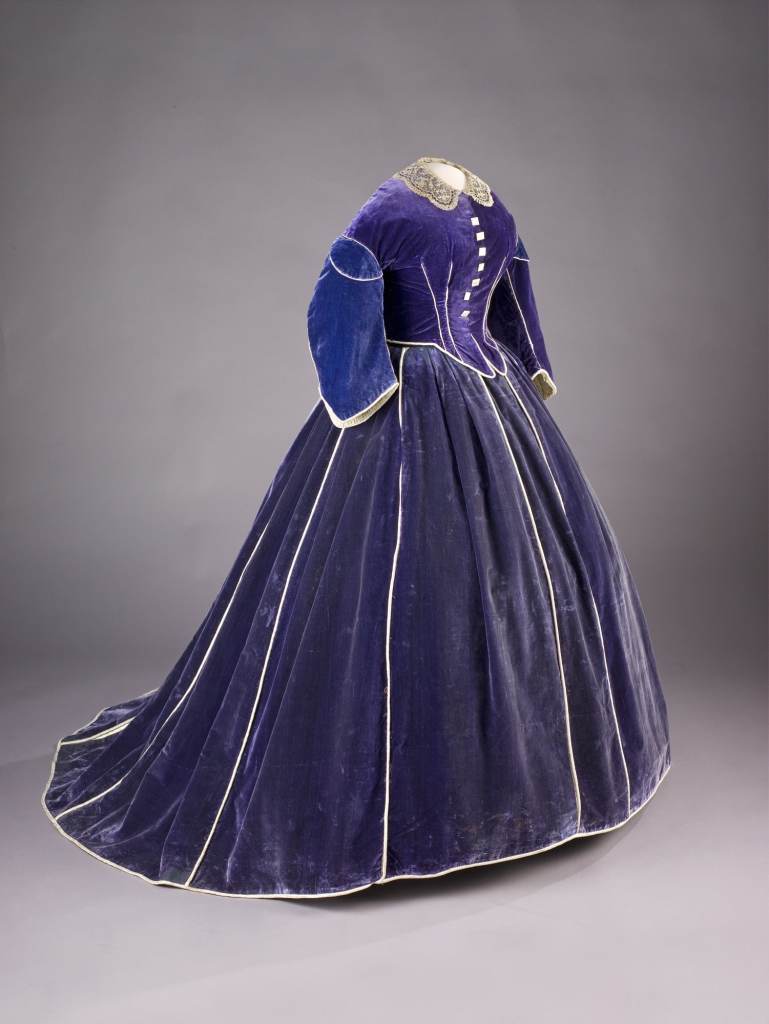
One of the winter dresses Elizabeth made for Mary. See more of her collection in FIT’s digital collection.

Elizabeth was in high demand among D.C.’s high society women, even the wives of Confederacy President Jefferson Davis and General Robert E. Lee. And in true subversive fashion, she used their old southern money to employ more Black women in her shop and create the Contraband Relief Association, an organization that provided support, relief and assistance to formerly enslaved people. 

The First Lady’s letter to the President requesting funds on Elizabeth’s behalf.

Mrs. Lincoln regularly donated to the Contraband Relief Association, and requested that her husband do the same. “Elizabeth Keckley, who is with me and is working for the Contraband Association, at Wash[ington]–is authorized…to collect anything for them here that she can….Out of the $1000 fund deposited with you by Gen Corcoran, I have given her the privilege of investing $200 her.. Please send check for $200…she will bring you on the bill,” she wrote to President Lincoln.

A quilt Elizabeth Keckly fashioned from Mary Todd’s discarded dresses.

But alas, everyone reading knows what came soon enough. President Lincoln was assassinated, and with his death, public opinion of Mary and the ladies’ friendship unraveled. Elizabeth published her autobiography, believing it would salvage both and bolster her income, but her good intentions backfired. 

Elizabeth’s autobiography, Behind the Scenes, or Thirty Years a Slave, and Four Years in the White House.

“Readers in her day, white readers — they took it as an audacious tell-all,” Jennifer Fleischner, author of “Mrs. Lincoln and Mrs. Keckly” said. “You know, ‘How dare she’? There were two categories: the faithful Negro servant or the angry Negro servant. Keckly was neither servant, nor faithful, nor angry. She presented herself, the White House and Mary Lincoln as she saw and knew them. And that didn’t work.”

Even the New York Times published a scathing review of Elizabeth’s book.

Mary was devastated by the personal revelations Elizabeth included, society women found it distasteful and didn’t want to appear in the pages of a book themselves, politicians spun it as reasons African-Americans shouldn’t be able to read, write or integrate with regular society, and that was that for Elizabeth. She died in her sleep in 1907, at a home for poor women & children that the Contraband Relief Association had founded.

But her story didn’t end there. Though it was suppressed upon its initial publication, Elizabeth’s biography is in print once again, and considered one of the most substantial documentations of the Lincoln White House surviving today, and proof of the value in owning your own story.

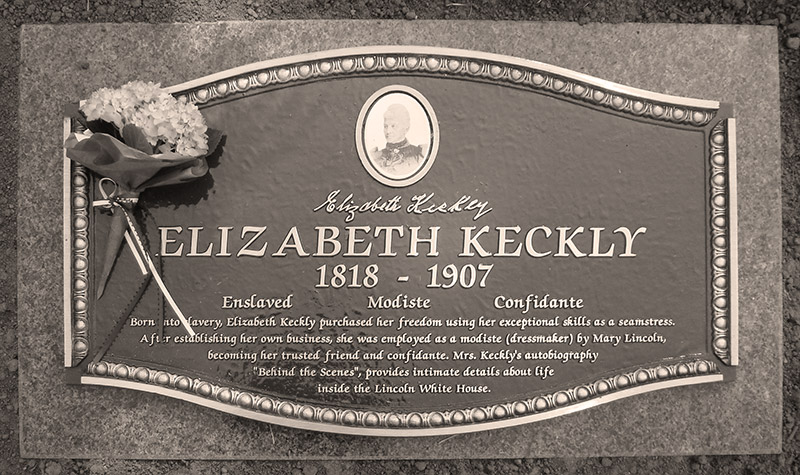
Elizabeth’s gravestone.

*Ed. Note: I’ve spelled Elizabeth’s last name as “Keckly” because that’s how she spelled it. She was historically recorded as “Keckley” and that spelling has persisted.


KEEP GOING BLACK IN HISTORY:

The Smithsonian National Museum of American History details how Elizabeth put her money to work for the people.

The New York Times featured Elizabeth’s biography in their “Overlooked” series that runs modern-day obituaries of famous contributors to American history that their paper overlooked at the time.

The White House Historical Association has thoroughly documented Elizabeth’s life from her autobiography and their own records as part of their “Slavery in the President’s Neighborhood” initiative.

DAY 10 — The Harlem Hellfighters

On January 1, 1863, President Abraham Lincoln wrote:

“I further declare and make known, that such persons of suitable condition, will be received into the armed service of the United States to garrison forts, positions, stations, and other places, and to man vessels of all sorts in said service.”

Having finally received “unalienable” rights and having witnessed the admiration bestowed upon white soldiers over the course of 4 separate wars, many African-American men were hopeful that enlisting and serving the United States by choice would force Americans to think better of the whole race.

But the words of the Emancipation Proclamation couldn’t sway the hearts and minds of men, especially when those words were undermined by another sitting president.

When the Buffalo Soldiers, went to battle on behalf of the U.S. Army in the Spanish-American War, Rough Rider Frank Knox said, “I never saw braver men anywhere.” Lieutenant John J. Pershing wrote, “They fought their way into the hearts of the American people.” President Teddy Roosevelt went on record saying “Negro troops were shirkers in their duties and would only go as far as they were led by white officers.”

Less than a decade later, the Harlem Hellfighters would make him eat crow.

When the United States joined the war against Germany, they did so woefully underprepared. American military forces had never gone to battle overseas before, and the Army’s ranks of a mere 126,000 men wasn’t going to cut it. Of the Armed Forces that existed at the time, only the Army allowed African-Americans to enlist for combat, even though it was hardly on an equitable basis. There were only 4 “colored regiments” and once their ranks were filled, the rest of the Black applicants who’d lined up for service were turned away. When Selective Service began in 1917, men of color were told to tear a corner of their draft card away so they could be easily identified and assigned. In the thick of World War I with the Central Powers devastating Allied forces in Europe, U.S. draft boards used those torn corners to send as many Black men to the front lines as they could.

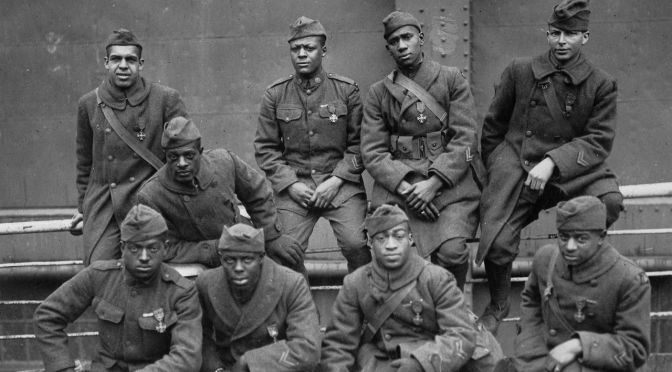
The men of the 369th Regiment however, scrubbed toilets stateside when they first enlisted, relegated to menial and filthy tasks like slaves, even though they’d volunteered for service. But when the war demanded more soldiers, the 369th went from toilets to trenches , being upgraded to Infantry, and shipped off to France for three weeks of combat training before being stationed on the war’s front lines.

The 369th in the trenches.

But even there, they weren’t considered “soldiers.” White Col. William Heyward begged that the 369th be allowed to actually serve on the battlefield, rather than dig trenches, unload ships, and other manual labor they’d been assigned to, as if nothing had changed at all. Army command compromised, assigning the 369th to the French Army instead.

When it came to the 369th and many other all-Black regiments, the Army didn’t send soldiers or reinforcements, they sent human shields expected to die. They never dreamed that the 369th would gain the respect of the French, who’d nickname them “Hommes de Bronze,” or come to be feared by the German Army who first dubbed the 369th as Hollenkampfer (“Hellfighters”). The Army most certainly didn’t expect that the 369th Regiment would be the very first Allied force to breach Germany’s borders.

The Croix de Guerre awarded to Lawrence McVey, a Harlem Hellfighter from Flatonia, TX.

But the Army wasn’t entirely wrong. The Hellfighters spent 191 days in combat, more than any other unit in the war and suffered losses to match, with hundreds dead and thousands wounded over the course of their deployment. Those losses were deeply felt by Captain Arthur Little who wrote, “What have I done this afternoon? Lost half my battalion—driven hundreds of innocent men to their death.” Those who survived fought their way to becoming some of the most decorated American soldiers in history… by another nation. The entire 369th Regiment was awarded the Croix de Guerre, the French Medal of Honor, and over 170 of its servicemen were honored individually. The Hellfighters Band was even honored, being largely credited as Europe’s first introduction to jazz.

The Harlem Hellfighters were so much more than infantry. Their ranks included skilled musicians like James Reese Europe and jazz legend Eubie Blake. Read more about the Harlem Hellfighters Regimental Band here.

Sgt. Henry “Black Death” Johnson earned a personal mention in the war dispatches of Gen. John J. Pershing, commander of the entire American Expeditionary Forces and the same man who, in the words of Col. Heyward, “simply put the black orphan in a basket, set it on the doorstep of the French, pulled the bell, and went away.” With only a bolo, 5-foot-4, 130 pound Sgt. Johnson single-handedly defended himself and his wounded partner against armed German soldiers who raided an Allied outpost. President Roosevelt would later name him as one of the “five bravest Americans” of World War I.

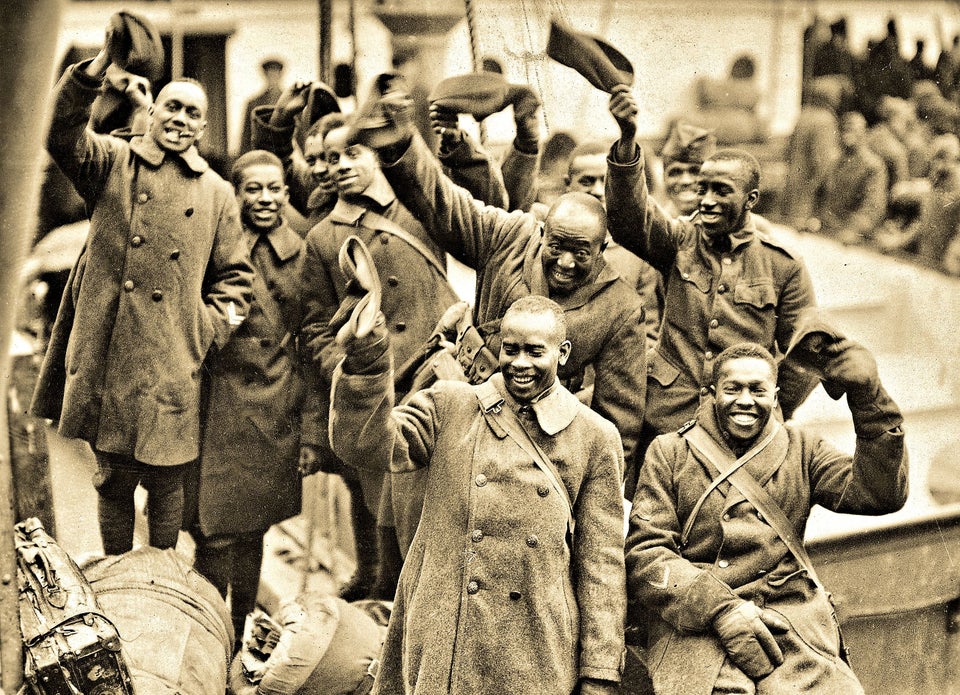
Thousands of New Yorkers welcomed the veterans of the Hellfighters home.

“Up the wide avenue they swung. Their smiles outshone the golden sunlight. In every line proud chests expanded beneath the medals valor had won. The impassioned cheering of the crowds massed along the way drowned the blaring cadence of their former jazz band. The old 15th was on parade and New York turned out to tender its dark-skinned heroes a New York welcome,” the New York Tribune wrote of the Hellfighters’ homecoming parade down Fifth Avenue. See more beautiful newspaper spreads and historic news accounts of that day at the Library of Congress digital archives.

And then forgot them altogether.

Lawrence McVey’s service photo, preserved by the Smithsonian, inscribed “hero.”

In the best cases, the Hellfighters drifted back into their lives, and lived in relative anonymity. In the worst cases, like those of Lawrence Leslie McVey, their remarkable service earned them a death by beating in the streets of New York.

Despite all of those medals abroad and the pretty words spoken, the United States didn’t award the 369th Regiment anything until 2015. By then, no one survived to accept the Congressional Medal of Honor awarded to Sgt. “Black Death” Johnson who was injured in combat 21 times. On August 21, 2021, the entire unit was finally recognized posthumously with a Congressional Gold Medal, awarded since the American Revolution as the country’s “highest expression of national appreciation.”

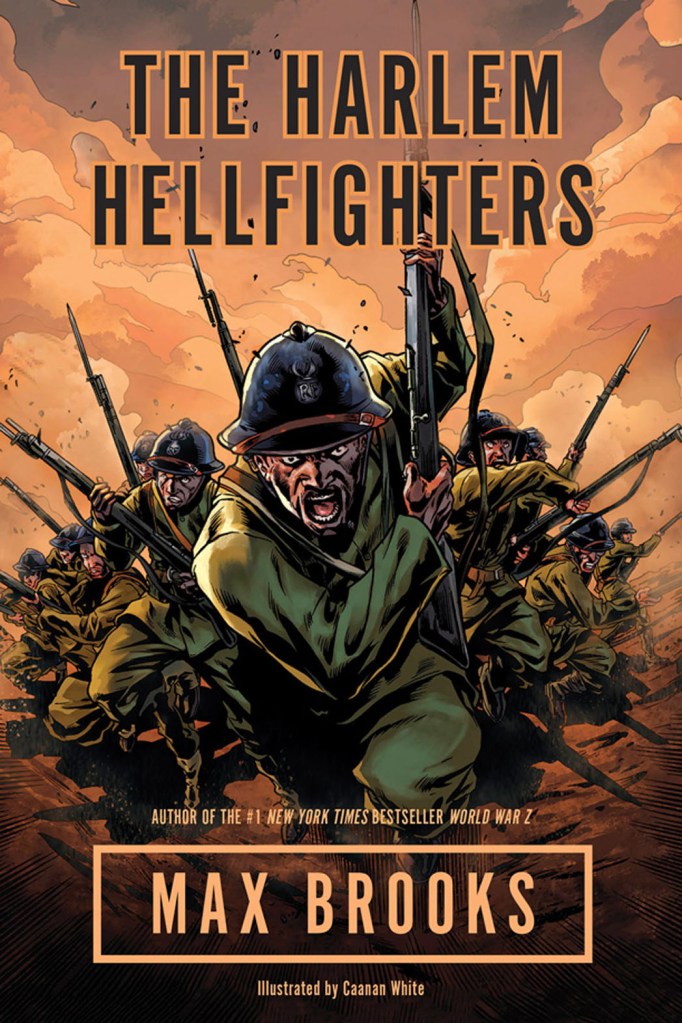
In addition to World War Z, Max Brooks also wrote The Harlem Hellfighters.

Tomorrow, February 11 will be the anniversary of the Hellfighters’ return to the States. The 3,000 men who marched Fifth Avenue that day were only a small portion of the “25 percent of Americans fighting in France [as] hyphenated Americans,” according to Lt. Col. ML Cavanaugh and Max Brooks (yes, World War Z Max Brooks), fellows at West Point’s Modern War Institute. Those other 25% included Choctaw code-talkers whose language was unbreakable abroad, Chinese Americans, Latinos like “Pvt. Marcelino Serna, a Mexican American who migrated to El Paso before the war, took out an enemy machine gun, a sniper, and an entire German platoon on his own, becoming the most decorated Texan of World War I,” and so many more who’ve been forgotten.

I hope you’ll spend the day paying tribute to those Americans who didn’t let the hyphens and racism visited upon them by others stand in the way of sacrifice and the fight for their own unrealized freedom.


KEEP GOING BLACK IN HISTORY:

Read the National Museum of the United States Army account of the wars the Harlem Hellfighters fought at home and abroad.

Smithsonian Magazine features more personal details of the lives, accomplishments and times of the Harlem Hellfighters.

Browse the Smithsonian National Museum of African-American History and Culture’s “Double Victory: the African-American Military Experience” here.

DAY 7 — Willi Ninja

Greta Garbo, Marilyn Monroe, Marlene Dietrich, Joe DiMaggio, Marlon Brando, James Dean, Grace Kelly, Jean Harlow, Gene Kelly, Fred Astaire, Ginger Rogers, Rita Hayworth, Lauren Bacall, Katherine Hepburn, Lana Turner, and Bette Davis.

Notice anyone missing?

(Aside from a single Black person? I digress.)

If there’s one name that unequivocally belongs among those listed in Madonna’s “Vogue,” it’s Willi Ninja.

He’s frequently described as “the Godfather of vogueing,” but I’m not sure he’d care for that title because Willi Ninja was a mother, honey.

And he got it from his own. 

If you recall from Marie Van Britten Brown’s post, being a mother in Queens where Willi was born in 1961, was a tough gig. The borough was in the thick of a heroin epidemic, civil rights protests, and turmoil over the Vietnam War. Hardly what we’d call a “safe” neighborhood for raising children, but Ms. Esther Leake did her best. That included recognizing when her son (then known by William Roscoe Leake), who was a brilliantly budding dancer, was also quietly but deeply struggling with being “different” than the other boys on the block.

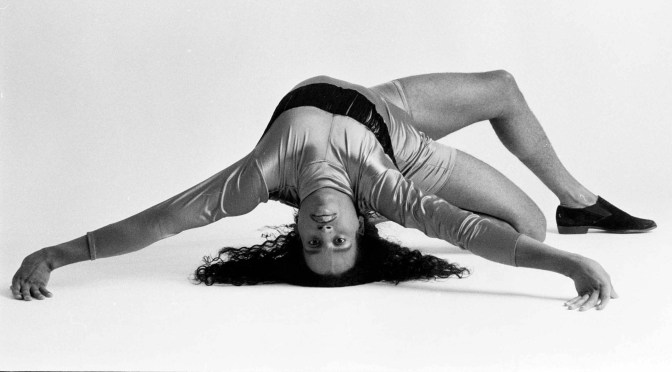
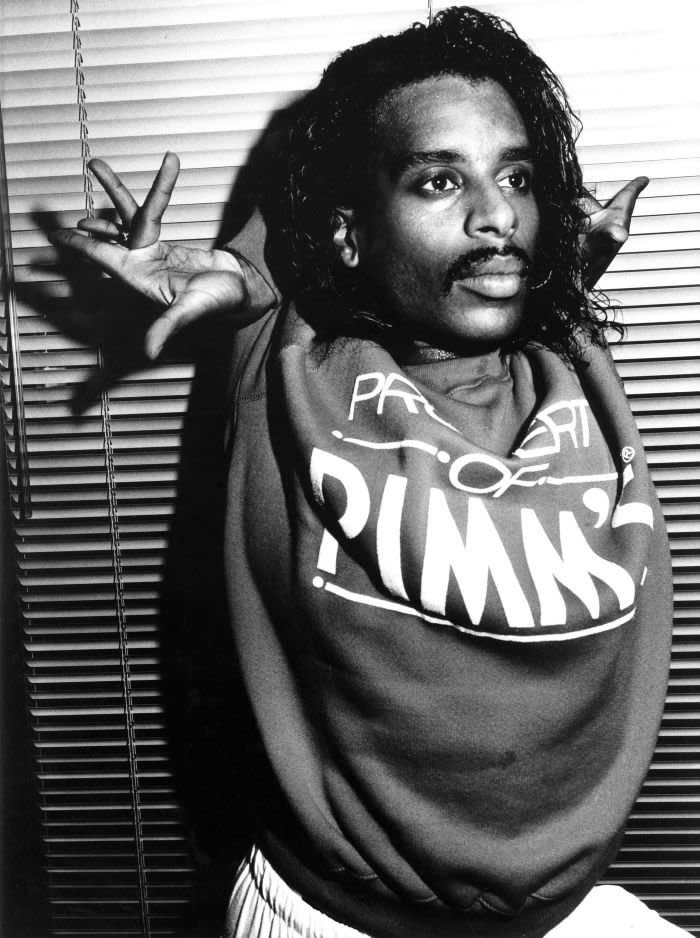
Willi never exactly “came out” to his mother. She coaxed him out, and not only supported his pursuits of dance and fashion, but encouraged them. Willi developed his own approach to voguing, the Harlem gay underground’s preeminent dance form, closely studying the movements of dancers like Michael Jackson and Fred Astaire, Olympic gymnasts, Asian martial artists, and the figures drawn in Kemetic hieroglyphics. (“Kemetic” refers to ancient Egypt, known as Kemet, or “black land”) And then he perfected it, diving headfirst into gay dance communities popping up around New York’s famous queer outdoor gathering places like Christopher Street Pier. 

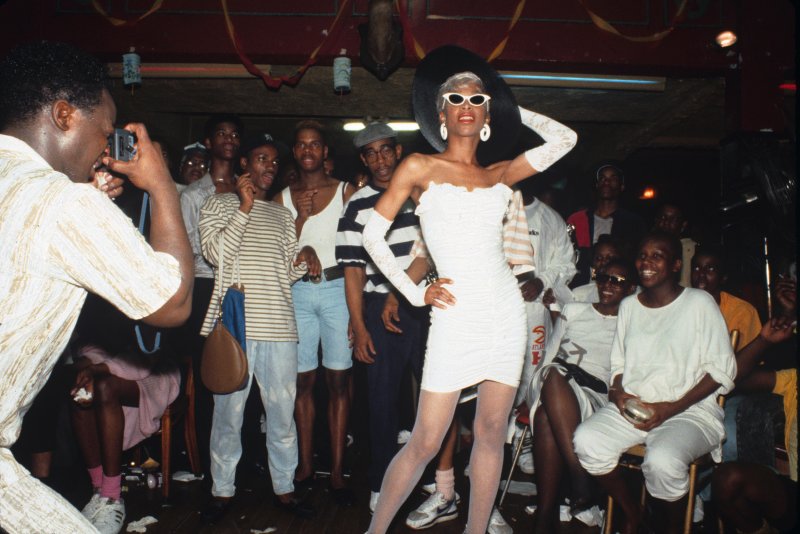
Those spaces became the forerunners and foundations of New York’s LGBTQ ballroom culture. Technically, ballroom culture has existed globally for centuries, but its earliest appearances in New York were to flout laws against wearing “clothes associated with the opposite gender.” Though those early balls were integrated, the judge’s panels were all-white, driving African- and Latino-American dancers back to Harlem’s underground in the 60s and 70s where they established their own balls . Fresh off the heels of Marsha P. Johnson’s stand-off at Stonewall, New York’s gay culture had been empowered to stand its ground, and ballroom culture let them claim space where gender, race, sexuality, and class had no place to define them.

Having always known acceptance, thanks to his mother, in the ballrooms, Willi danced with a freedom and confidence unlike anyone else in the scene, and those iconic moves made him a fixture of New York ballroom culture. But the society Willi and his fellow pioneers rejoined outside of the balls cast all the glam and good vibes they celebrated inside into stark contrast.

There, LGBTQ teenagers outcast from their families after coming out or running away had nowhere else to go but the streets. Gentrification was beginning to push lower-income families in Brooklyn and Manhattan out of their homes already. Non-profit organizations and shelters in the midst of a Reaganomics depression had less to go around than ever. Unemployment was at an all-time high. If that New York was unsafe and uncertain for everyone, it was especially so for a 16-year-old transgender person.

From those circumstances, houses were born. Each “house” specializes in an aspect of ballroom culture. They’re headed by a mother or father, and its children are cared for with food, shelter, clothing, or simply love and encouragement, by all their brothers and sisters. And the House of Ninja grew to become one of the most long-lasting and well-respected of them all. Willi welcomed people from all walks of life into his house, becoming “mother” to one of the most inclusive houses in ballroom culture, even as it endures today. That influence Willi brought to ballroom is also reflected today in long-running and tremendously diverse TV representations of LGBTQ characters like those in “Pose,” “Ru-Paul’s Drag Race,” and “Queer Eye.”

As the ranks of his house expanded, so did Willi’s own dance skills, becoming so absolutely flawless and otherworldly that even mainstream entertainment took notice. Willi danced alongside Janet Jackson in two of her Rhythm Nation videos, walked runways for couturiers Thierry Mugler and Jean-Paul Gaultier, and even taught supermodels like Iman and Naomi Campbell how to own a catwalk in ways only he could.

Of course, all of that was behind the scenes. If you’ve ever heard Willi Ninja’s name before, it is almost undoubtedly associated with the landmark documentary “Paris is Burning.” The film, preserved by the Library of Congress’s National Film Registry, is compiled from six years of study, interviews, first-person footage, and immersion into the African-American, Latino-American, gay and transgender communities forming New York ballroom culture. The filmmaker Jennie Livingston describes it not as a dance documentary, but a tale of “people who have a lot of prejudices against them and who have learned to survive with wit, dignity and energy.”

But not all did survive. Willi’s endlessly shooting star was snuffed out by yet another American social ill: the AIDS epidemic. In his 45 short years, Willi Ninja was instrumental in launching vogue and ballroom culture into the global phenomenon it is today, and brought the community, the triumphs and the plights of Black and Latino LGBTQ faces to the forefront of mainstream culture. Willi died on September 2, 2006 from AIDS-related heart failure, giving everything he had for his children, right down to the last beat. As family does, the House of Ninja returned that love, using their ballroom winnings to care for Willi’s mother in his absence.

All no thanks to Madonna.


KEEP GOING BLACK IN HISTORY:

If you’ve never seen “Paris is Burning,” have a look at the trailer where you’ll see a few of Willi’s moves & a bit of his personality.

French photographer Chantal Regnault spent 3 years photographing Willi & the Harlem ballroom scene. This post’s cover photo is from her series, and accompanies Chantal’s first-person account of her ballroom experience, which you can read here.

TIME Magazine recognizes the history of voguing and the importance its culture still holds for marginalized people today.

Even the Financial Times has in-depth articles on “how the mainstream discovered voguing.” My how far we’ve come.

One last look as Vox spends a few minutes with a member of a house to dive into ballroom’s past, present and future.

DAY 5 — June Bacon-Bercey

June Bacon-Bercey was called by a lot of things, but there was one she simply could not abide: weather girl.

“My mom was always about definitions. When she was called a weather girl, she would smile and say how proud she was to be a meteorologist,” her daughter Dail St. Claire says.

June Bacon-Bercey, proud meteorologist. NOT a weather girl.

After all, June earned it. Because June Bacon-Bercey was the first African-American woman to graduate with a degree in meteorology, and the first female broadcast meteorologist in the United States.

Dianne White, the first African-American “weather girl”

Words matter here because June wasn’t the first African-American woman to present the weather on broadcast TV. That designation belongs to Dianne White Clatto, an Avon saleswoman whose poise and beauty earned her a spot in front of the camera, even though she had no idea what to do. “‘When those two red lights come on, start talking.’ And I said, ‘About what?’,” she recounted. “And they said, ‘Preferably something about the weather.’ ”

But June’s fascination with the weather was spurred by much higher stakes. Just a child when the atomic bombs were dropped on Hiroshima and Nagasaki, she wondered what effects nuclear fallout might have on the global atmosphere.

That curiosity propelled her through earning one math degree (with honors) in Kansas before transferring to UCLA for her 4-year degree in atmospheric sciences, where she was highly encouraged to seek another field.

“When I chose my major, [they] advised me to go into home economics… I got a D in home economics and an A in thermodynamics.”

Earning that degree despite her naysayers, June immediately put it to work at the National Meteorological Center (now the National Oceanic Aviation Administration), then at tech/aerospace corporation Sperry Rand (now Unisys), and at the United States Atomic Energy Commission (now the U.S. Department of Energy) while earning a journalism degree at night school, before finally joining a Buffalo NBC affiliate in 1970 as their science broadcast reporter. It didn’t take long for June to gain national exposure thanks to her coverage of the Attica prison uprising in 1971.

June, reporting live with WGR-TV 2 (now WGRZ) in Buffalo, NY

But why not the weather? All of her training was PRECISELY why June was adamantly against broadcasting the weather. Before women broke into the field of atmospheric science, news stations hired “weather girls” like Dianne to broadcast the day’s highs and lows. These women weren’t actually expected to know anything about the weather, and in the worst cases, were trotted out in swimsuits to sensationalize summer segments. June found it wholly demeaning, and she soundly refused. Until the day that her station’s weatherman got caught up in a scandal, and the station manager, knowing June’s wide-ranging talents and skilled background, begged her to step in.

June, stepping in as on-set meteorologist. Clearly the star of the show.

“All hell broke loose at the station when our weather guy robbed the bank, and they needed someone who was there to fill in for the day,” she recounted. “I already knew from my calculations that there was going to be a heat wave. When the heat wave hit the next day, the job was mine.”

The AMS Seal of Approval launched in 1957, recognizing on-air meteorologists for sound delivery of the weather to the public.

Little did her station manager know that June’s forecasted heat wave would usher in a whole new era of equality for women—especially Black women and other women of color on broadcast television. By 1972, June was honored as both the first female and African-American recipient of the American Meteorological Society Seal of Approval for Excellence in Television Weathercasting.

4 years after a chance occurrence found her breaking weather barriers on TV, June thirsted for more science, and took her talents back to the NOAA. But her passion for paving the way persisted.

A capture from broadcast footage shows June in action, predicting a wet winter for the greater Buffalo area.

She became a contestant on a game show called “The $128,000 Question,” winning $64,000 after correctly answering a series of questions about John Philip Souza, her favorite composer. June studied ruthlessly with the goal of using her prize money to establish a scholarship fund for women of color studying meteorology. “That was my plan at the beginning, and it’s still my plan,” she told the Washington Post after her win. “I was discouraged (from becoming a meteorologist), and other women were discouraged. If they feel they’ve got some money behind them, it might be better.”

Applications for the June Bacon-Bercey Scholarship in Atmospheric Sciences for Women opens in TWO days, on February 7, 2022!

With that seed money, The June Bacon-Bercey Scholarship In Atmospheric Sciences For Women was established. Working into her 80s, June never ceased earning awards and degrees, serving her country in meteorology, and creating ways for more underrepresented faces to be seen in the atmospheric sciences. “She made personal sacrifices for those who would come after her to give them a fighting chance at success in her field,” Dorothy Tucker, president of the National Association of Black Journalists, said. Her trail blazed so brightly in fact, that just last year, the American Meteorological Society officially renamed their most prestigious and coveted Broadcaster of the Year award to the June Bacon-Bercey Award for Broadcast Meteorology in recognition of her impact on the field.

June passed away in 2019, leaving a stunning legacy as proof of her dedication to making science more equitable, but even she acknowledged that one person can only do so much. “Society, too, has a moral obligation to put aside the past myths about black Americans not only in the meteorological field but in all of the technical fields.”

Until that day is fully realized, her daughter Dail continues sharing June’s story saying, “Her legacy serves as inspiration for all and is a powerful example of our limitless capability and strength.”

Of that, there is a 100% chance.


KEEP GOING BLACK IN HISTORY:

June’s daughter Dail St. Claire spoke with The Weather Channel about her mother’s legacy in meteorology and broadcast television.

Visit AccuWeather for “the untold story of the 1st American woman to become a TV meteorologist.”

EOS, the American Geophysical Union‘s news site, thoroughly details of June’s life and accomplishments.

Between 1978 and 1990, 13 women received funding for their studies in atmospheric science. It was June’s dying wish that her scholarship be reinstated. Donate now, or apply starting February 7, 2022.

DAY 1 — Henrietta Wood

The President may issue each year a proclamation designating February 1 as National Freedom Day to commemorate the signing by Abraham Lincoln on February 1, 1865, of the joint resolution adopted by the Senate and the House of Representatives that proposed the 13th amendment to the Constitution.

U.S. Code § 124 – National Freedom Day

But in 1853, Henrietta Wood couldn’t afford to keep waiting.

Until that year, her life had not been unlike that of most African-Americans. Henrietta was born into slavery around 1818 in northern Kentucky, worked for one master until he died, was sold to another, relocated elsewhere, rinse and repeat.

Until the day in 1844 when one of her masters, a merchant and French immigrant took leave from his New Orleans estate, and its mistress stole Henrietta away to the free state of Ohio, seeking to make her own fortune by hiring Henrietta out to Northerners in need of help. That plan backfired as creditors left high & dry in New Orleans saw Henrietta’s value too. Rather than allow her to be seized as an asset, the mistress begrudgingly granted Henrietta’s freedom. 

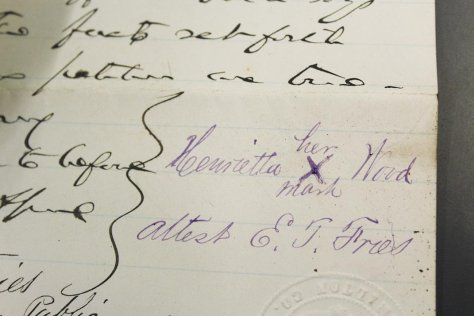
And for nine years, Henrietta savored it. But unwilling to let their dowry slip away, the master’s daughter and son-in-law hired Zebulon Ward, a notorious Kentucky deputy sheriff, slave trader, and future Father of Convict Leasing, to kidnap Henrietta back across state lines.

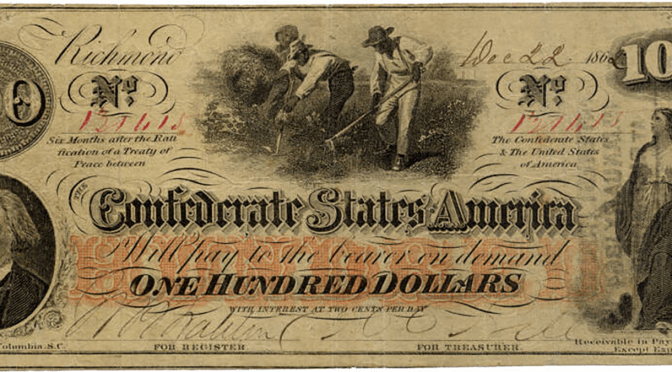
Slavery as the literal currency of the South. A Confederate States of America $100 bill bears enslaved people in cotton fields as its central image.

Despite her status, The Fugitive Slave Act of 1850 legislated Henrietta’s silence. Under its rule, enslaved people were not entitled to a trial, and were forbidden from speaking in their own defense should they obtain one. Adding insult to injury, Federal commissioners overseeing these sham proceedings were paid $10 for every person they deemed a fugitive, but only $5 for every freedman. Anyone mounting a case against the system was already at a loss.

But against those insurmountable odds came an intervention. John Joliffe—the same lawyer who’d defended Margaret Garner—argued a 2-year long lawsuit on Henrietta’s behalf. And once more, freedom seemed futile. The Cincinnati courthouse where Henrietta’s papers had been filed had burned to the ground, and any hope of defense with it.

She’d spend the next 14 years re-enslaved, sold this time to Gerard Brandon, the son of a Mississippi governor, in 1855. With the Brandons, freedom would only continue to be snatched from Henrietta’s grasp. Afer the Emancipation Proclamation was issued, Master Brandon marched all 300 of his slaves over 400 miles to Texas where it’d take Union soldiers another 2 years to arrive on June 19, 1865.

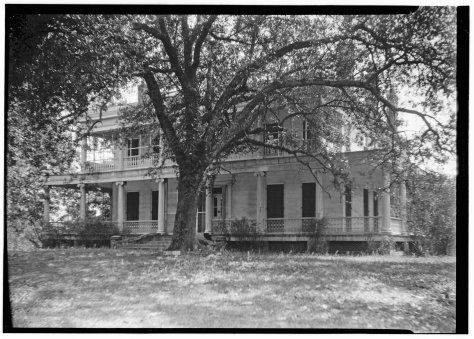
A 1936 photo of Brandon Hall in Natchez, MS, where Henrietta Wood was re-enslaved (via Library of Congress Prints and Photographs Division) vs. today (via Brandon Hall Plantation).

But papers and proclamations hardly made enslaved people free, and Henrietta was living proof. Slavery was still legal in many islands off the coast of the United States, and her own story demonstrated the lengths that slavers would go to profit off “free” human beings. Henrietta reluctantly accepted a formal employment contract from the Brandons promising $10 a month, which she held was never actually paid. Either way, the score was far from settled, her worth was much higher, and Henrietta had every intention of pursuing both.

A diagram of the arduous path Henrietta endured before finally gaining her freedom (via Smithsonian Mag)

In 1878, Federal Judge Philip Swing presided over Wood vs. Ward, where the plaintiff sought $20,000 in restitution for her kidnapping and re-enslavement. Black people weren’t allowed to sit in juries until a 1935 case brought to the Supreme Court by one of the Scottsboro Boys made it illegal to systematically exclude Black people from service (note: systematically). So the notion that an all-white jury would see fit to award a formerly enslaved woman without documentation any dollar amount was likely more about the principle than the actual court judgment.

“Henrietta Wood V. Zeb Ward — Verdict
We the jury on the above titled cause, do find for the plaintiff and assess her damages in the premise of Two thousand and five hundred dollars $2500. (signed), Foreman.”

But in 1879, twenty-six years after Henrietta was sold back into slavery, a jury handed down $2,500—nearly $90,000 today—the highest dollar amount ever awarded by a court in restitution for enslavement.

That award funded her son Arthur’s college education. Born early into Henrietta’s re-enslavement, Arthur Simms had also lived on both sides of freedom, and took full advantage of his newfound rights. In 1889, he graduated as the first Black man to earn a degree from Northwestern University’s Union College of Law, and died as the school’s oldest living alumnus in 1951 at 95 years young, a testament that true freedom keeps paying dividends.

Happy Freedom Day & Happy Black History Month, y’all. Let it ring.


KEEP GOING BLACK IN HISTORY:

W. Caleb McDaniel, the same historian who allied against Fort Bend ISD in support of preserving the Sugar Land 95 uncovered Henrietta’s story. Read his take on her story and interact with Henrietta’s route to freedom at the Smithsonian.

Mr. McDaniel continued over at the New York Times, explaining how Henrietta’s case has re-opened a “dark chapter in American history that in many ways remains open.”

McDaniels’ book Sweet Taste of Liberty: A True Story of Slavery and Restitution in America won a 2020 Pulitzer Prize. Read an excerpt at the National Endowment for Humanities and see more about Harriet’s case at the book’s page.

In 1876, Henrietta told her own story to the Cincinnati Commercial newspaper. It’s collected here in four parts and is the most complete accounting of her story that survives.

Even Henrietta’s descendants didn’t know about her until Mr. McDaniel shared her incredible story. Read how they put together the pieces, and unknowingly, made her fight for freedom “worth it.”

DAY 29 — Fred Hampton

In the wee hours of December 4, 1969, the residence at 2337 W. Monroe St. on Chicago’s West Side became an all-out war zone. The sounds of wooden doors and their frames erupting into splinters, drywall vaporizing behind shotgun blasts, and indistinguishable shouting over the bedlam tore through the stillness.

By the time the smoke cleared, 100 hot shell casings littered the home, 2 people were dead, and Illinois State Attorney Edward Hanrahan had a perfect explanation at the ready: “The immediate, violent and criminal reaction of the occupants in shooting at announced police officers emphasizes the extreme viciousness of the Black Panther Party. So does their refusal to cease firing at police officers when urged to do so several times.”

In an effort to appear transparent, Hanrahan and the Chicago Police Department staged reenactments of the raid on the Chicago Black Panther headquarters and even invited the press to see the aftermath inside. But when ballistic analysis was done, something didn’t add up.

Of the 100 shots fired, 99 were from Chicago Police. The single round fired by the Black Panthers had come from the gun of Panther security man Mark Clark as he was shot in the heart, involuntarily triggered when he fell dead from his post.

Ballistics also corroborated the story told by five other surviving occupants — one of the deceased hadn’t been killed in the onslaught of gunfire at all. He’d been dragged from bed with serious but non-critical injuries, and then fired upon, killed by two parallel, point-blank gunshots to the head.

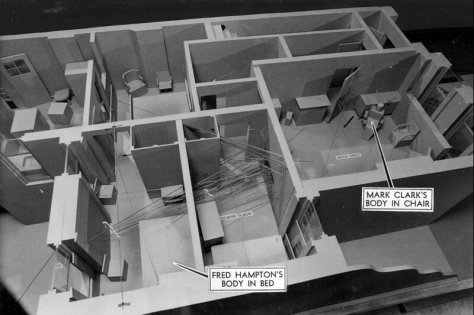
A diagram of the scene at 2337 W. Monroe St.

Witnesses overheard the conversation between officers in another room:

“Is he dead?… Bring him out.”
“He’s barely alive.”
“He’ll make it.”

Suddenly and unexpectedly, two more shots rang out.

“Well, he’s good and dead now.”

HE was Fred Hampton, 21-year-old chairman of the Illinois Black Panther Party, and HE had just been assassinated by the Chicago Police Department and the United States Federal Bureau of Investigation.

Fred Hampton was a rising star in the Black Panther Party. The warm tone and upbeat tempo of his voice made people lean in to listen more closely, and the anti-establishment message he delivered was only magnified by the charisma and congeniality he demonstrated among people of all races.

He first forced the government’s hand when, concerned that inner-city children couldn’t focus on education with empty stomachs, Fred introduced free lunch programs in several predominantly black schools. Ashamed and hoping to quell growing support for the Panthers, the local and federal government implemented their own free lunch programs for the very first time. When the neighborhood’s black children were dying from a genetic epidemic, Fred opened clinics specializing in tests for sickle cell disease. Soon after, government clinics began providing those same tests in their own clinics as well. Even warring Chicago gangs came to a tense but meaningful cease-fire with the help of Fred’s mediation, but when Fred’s leadership and organization skills began crossing racial lines, the FBI, under the directive of J. Edgar Hoover’s COINTELPRO, enacted their plan to “destroy, discredit, disrupt the activities of the Black Panther Party by any means necessary and prevent the rise of a Black Messiah.”

In one of the galvanizing speeches that gave the FBI particular concern about Fred’s ability to “unify and electrify the masses,” he said, “Black people need some peace. White people need some peace. And we are going to have to fight. We’re going to have to struggle. We’re going to have to struggle relentlessly to bring about some peace, because the people that we’re asking for peace, they are a bunch of megalomaniac warmongers, and they don’t even understand what peace means.” As the original founder of the “Rainbow Coalition,” Fred recognized the common goals of the Black Panthers, Puerto Rican Young Lords, and Appalachian Young Patriots sought for each of their respective communities, and unified the three groups to champion the disenfranchised of all races, threatening an imbalance in power that had to be stopped.

The FBI planned a raid on Fred’s apartment and the Panther HQ under the guise of seizing illegal weapons, and recruited the Chicago PD who’d recently lost officers in a shootout with a lone Black Panther to do the dirty work. But too many inconsistencies and surviving witnesses, along with the police’s failure to secure the scene that allowed the public to walk right in to evaluate the crime scene for themselves quickly tanked law enforcement’s credibility. There was even evidence that Fred had been drugged, preventing him from resisting the confrontation and explaining why he was still in bed after what police and witnesses actually agreed was at least 5 straight minutes of gunfire. The “weapons stockpile” police claimed in justifying the raid turned out to be 19 guns and a few hundred rounds of ammo, all legal. Despite mounds of evidence contradicting law enforcement, every officer involved was cleared of any wrongdoing. Though the state’s attorney had the nerve to bring charges of attempted murder of police and resisting arrest against the survivors of the “Massacre on Monroe,” they too were found not guilty as the one shot fired by the Black Panthers came from the gun of a dead man.

Insistent upon accountability for Fred’s death, which still hadn’t been adequately explained by any theory presented on behalf of either the FBI or Chicago PD, his family and the survivors opened a federal civil rights case. In 1983, almost 15 years after Fred’s death, despite the drama of continued cover-ups from judges involved in the case, a failed attempt by the FBI to force the plaintiffs into paying thousands of dollars in labor and printing fees for evidence they didn’t want to turn over, an eventual FBI whistleblower confession, and repeated appeals, the 7th Circuit Court of Appeals decided in the Hamptons & Panthers favor. Federal, state and local law enforcement agencies took equal financial responsibility for Fred Hampton’s death and granted the family a combined $1.85 million settlement.

But the damage was done. Though they hadn’t been successful in keeping it quiet, the goals of COINTELPRO and politicians on the state and local levels had been accomplished. Fred Hampton was dead, the alliances he’d fostered were effectively dissolved, and their smear campaign had played out long enough that in the public eye, the Black Panthers were a violent, racist threat suppressed by peace-keeping law enforcement agencies.

Chi-Town knows the truth, though. In addition to several landmarks around the West Side named after him, December 4th is recognized as Fred Hampton Day according to a resolution that he “made his mark in Chicago history not so much by his death as by the heroic efforts of his life and by his goals of empowering the most oppressed sector of Chicago’s Black community, bringing people into political life through participation in their own freedom fighting organization.”

It’s a fitting tribute for one of the most galvanizing figures of the Civil Rights Movement who once asked, “Why don’t you live for the people? Why don’t you struggle for the people? Why don’t you die for the people?” and then proceeded to inspire generations of people through a brave life and martyr’s death validating each and every word.


KEEP GOING BLACK IN HISTORY:

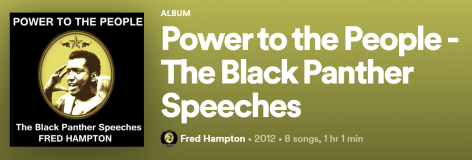
Listen to Fred’s charismatic speeches championing power to ALL of the people via Spotify.

The Chicago Tribune documented Fred’s life, death, and the continued COINTELPRO conspiracy throughout the Hampton v. Hanrahan federal civil rights case.

Videos from the US National Archives show police walkthroughs and testimony vs. that of witnesses and lawyers regarding the events leading to Fred Hampton’s death.

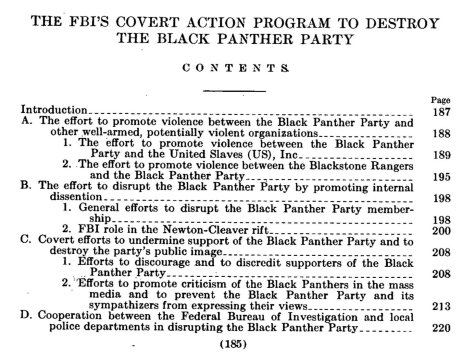
Read the 1976 Senate Select Committee on Intelligence’s detailed investigative report that included a section titled “The FBI’s Covert Action Program To Destroy The Black Panther Party.”

The Committee report also details the FBI’s campaign against other black civil rights leadership, including but not limited to Dr. Martin Luther King Jr., the SNCC, the SCLC, and more “Black Nationalist Hate Groups.”

DAY 28 — Margaret Garner

Sensational news of an enslaved mother murdering her own child was just one contributor to growing unrest over the morality of slavery.

Thomas, Samuel, and Priscilla were all the light of their mother’s life. But it was little Mary, Margaret Garner’s first daughter, who was her mother’s precious beloved.

Through the bitter cold and the blinding snowstorms of 1855’s Long Hard Winter, pregnant Margaret and her husband Robert had holed up together with their 4 children, until suddenly, the miserable chill became their method of escape. The Ohio River had completely frozen over, allowing the family safe and efficient passage from Kentucky where they were enslaved, to the free state of Ohio, a hub of the Underground Railroad.

And they would need it. Robert and Margaret both had individual troubles that threatened to destroy their little family. The most recent owner of their plantation was a cruel man who ruled with the whip just as surely as he ruled by his word. He’d long threatened Robert’s sale to another plantation, but repeated and ever-lengthening loans out to other slavemasters convinced the Garners that it was only a matter of time before Robert was gone forever. The babe still growing in 22-year-old Margaret’s belly belonged to her no more than her other children did, and boy or girl, had a lifetime of enslavement waiting to welcome it into the world. Winter’s brutal but short-lived punishment couldn’t begin to compare with a slave’s perpetually hellish existence.

So on the evening of Sunday, January 27th, 1856 the Garners bundled up their children and Robert’s parents hoping to cross the icy river into Cincinnati, where their family could be free. If all went according to plan, Margaret’s family would take them in until Levi Coffin himself, nicknamed the “President of the Underground Railroad,” came to carry them on to the next stop. By Monday morning, they’d survived patrols enforcing the Fugitive Slave Act and the driving snow to arrive cold, wet and hungry, but alive. With the worst behind them, it’d be just a few more hours before their allies would handle the rest of the journey.

That subsequent departure never came for the Garners. Unbeknownst to them, their master and the U.S. Marshals, unburdened by small children, elderly family members and all of their provisions and belongings, made fast time behind them and now had their cabin surrounded.

The adults knew the terrible fate ahead. IF they survived this confrontation, they’d all be sent back to their respective plantations where the retribution would be swift and without a doubt, severe. The oldest two children at 6 and 4, already knew the despair of slavery. But 2 year old Mary and 9 month old Priscilla were still their mother’s innocent girls. But not for long. Soon, they’d be expected to work, days would turn into years, and her girls would grow into women.

What came next, was no secret to Margaret, or to most enslaved women working in their master’s homes. After all, both of her girls, most likely her youngest son, and almost certainly the child she was carrying had all been fathered by her master A.K. Gaines, one of the men now pounding furiously at her door. A Southern wife’s last trimester was rather distastefully known as “the gander months,” when it was socially acceptable in some circles for her husband to take on a mistress, or enslaved woman, for his personal satisfaction. Almost like clockwork, with the exception of her oldest, Margaret’s babies were born 5 to 7 months after each of the Gaines children, and even Margaret herself was the daughter of a slavemaster.

In the chaos of her thoughts, the armed men moments from storming in, the family members scrambling to hide, and 4 tiny voices all crying in fear, Margaret made a heartbreaking declaration.

“Mother, I shall kill my children before they will be taken back, every one of them.”

Three of the four children suffered head wounds from shovel blows their mother inflicted. But beloved Mary was the last, her mother’s pride and joy, and whatever fate the rest of the family suffered would not, could not befall Margaret’s precious Mary. Just as the men burst through the front door, Margaret reached for a butcher’s knife on the kitchen table, and without hesitation, took her daughter’s life.

The scene was the real-life inspiration for Toni Morrison’s Pulitzer Prize winning book, Beloved.

And yet, the story didn’t end there. All except for little Mary, every member of the family was seized under the Fugitive Slave Act. But Margaret’s horrifying act complicated the matter tremendously. The crime had occurred in Ohio, where black people were free. But the Fugitive Slave Act was federal decree, and allowed slave owners to cross into any state their property might be located. Margaret’s two-week-long trial became a national spectacle and the longest fugitive slave trial in history. Ohio wanted a murder prosecution, fully expecting Margaret would be granted clemency due to the poignant circumstances. Their play was also a strategic one — finding Margaret guilty of murder would require the court to acknowledge her and her child as human beings, setting a federal precedent. On the other hand, indictment under the Fugitive Slave Act would charge Margaret with depriving an owner of his property, and ultimately require that she be returned to him too.

Thousands packed the frigid courtroom for each day’s heated arguments between the attorneys and the circus in the gallery, divided by northern and southern spectators. It was just 5 years before the start of the Civil War, and the trial not only humanized enslaved black people – women in particular – for passive northerners, but also absolutely incensed southerners who saw the trial as nothing but unwelcome northern interference and egotism. Lucy Stone, a white abolitionist did her best to plead on Margaret’s behalf and simultaneously shame her owner, pointing out that “the faded faces of the Negro children tell too plainly to what degradation the female slaves submit. Rather than give her daughter to that life, she killed it. If in her deep maternal love she felt the impulse to send her child back to God, to save it from coming woe, who shall say she had no right not to do so?”

But Lucy’s pleas for empathy fell on deaf ears, and the Garners were all deemed property to be sent back to their respective masters. Though the state of Ohio scrambled to bring their own charges against Margaret anyway, Slavemaster Gaines spirited her away, repeatedly relocating her each time relentless abolitionists closed in. Eventually, Gaines put Margaret and baby Priscilla on a ship to Arkansas, which subsequently wrecked. Priscilla was drowned, and though she didn’t succeed, onlookers reported that Margaret attempted to drown herself as well. Reunited once and for all, Robert and Margaret spent the rest of their days together in New Orleans until Margaret died in 1858, begging her husband to “never marry again in slavery, but to live in hope of freedom.”

Toni Morrison herself spoke to the heart of Margaret’s tragedy, saying “The interest is not the fact of slavery, but of what happens internally, emotionally, psychologically, when you are in fact enslaved and what you do to try to transcend that circumstance.” For Margaret, who loved her children so much that she would sacrifice herself and whatever future she had for them, if death was the only freedom to be found from slavery, better that than no freedom at all.


KEEP GOING BLACK IN HISTORY:

The events leading up to Margaret’s arrest and return to slavery were detailed in the abolitionist newspaper The Anti-Slavery Bugle and archived in the Library of Congress.
(zoom on the paper’s entire second column)

The Ohio Memory Project has an excellent archive of historical documents and newspapers related to Margaret’s tragedy.

When the Michigan Opera Theatre’s Detroit Opera House performed Toni Morrison’s libretto based on her book Beloved and Margaret Garner’s life, they shared one scholar’s essay detailing Margaret’s life and circumstances.

DAY 26 — Ms. Mary Hamilton

“We had to practice nonviolence because if we didn’t, we’d get the sh*t kicked out of us.”

Mary Hamilton was non-violent all right. But the lady had a tongue sharp enough to commit murder, and when the state of Alabama refused to put some respect on her name, she showed them just how deeply she could cut. Like most of the Freedom Riders, Mary was no stranger to gross insults, physical and mental humiliation, petty imprisonments, and violent beatings. Unlike many of her companions, turning the other cheek didn’t come so easily, so if she couldn’t fight back with her hands, Mary wielded words as her weapon of choice. As her daughter later told NPR, “Dr. King called my mother Red, and not for her hair but for her temper. For a nonviolent movement… she was one to get pissed off.” Jailers, doctors, not even the mayor of Lebanon, Tennessee escaped the righteous indignation spoken from the mouth of this black woman.

Men with that level of status were especially not accustomed to such treatment from a woman who could pass for white but self-identified as black, even in the worst of circumstances. In a book of letters from Freedom Riders, she recalled, “The official who checked our money and belongings had put on my slip I was white. When the girl behind me told me, I notified him otherwise. He was very angry. He told me that I was lying. He then took it upon himself to decide what other races I could be, and told the typist to put down that I am Negro, white, Mexican, and I believe that’s all. This made me very angry.”

Identity was everything for Mary DeCarlo who was so committed to living her truth that she dropped her father’s Italian surname in favor of her mother’s more nondescript maiden name. So when all of her activism finally landed her in court and the attorney had the gall to call her by her first name, Mary couldn’t let it go and gave him hell instead. Jailed over yet another act of civil disobedience, Mary’s 1963 hearing in Gadsden, Alabama should have been just another ordinary procedural matter. But Mary Hamilton was anything but ordinary.

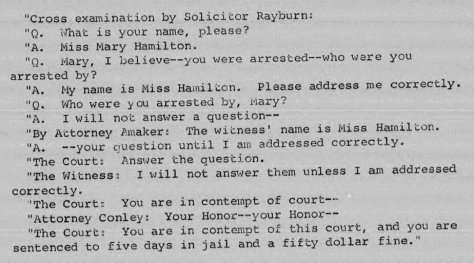
A court transcript of Mary Hamilton’s witness stand exchange.

“Mary, I believe you were arrested…” the prosecuting attorney started. “My name is Miss Hamilton… and I will not answer a question unless I am addressed correctly,” she quickly interjected. Her insubordination wasn’t just shocking, it was an audacious protest right in the middle of open court.

Referring to black people by first name, regardless of rank, class, educational background, or social situation was the norm before the Civil Rights Movement. Dr. Barbara McCaskill from the University of Georgia gives more context, explaining, “Segregation was in the details as much as it was in the bold strokes. Language calls attention to whether or not we value the humanity of people that we are interacting with. The idea was to remind African-Americans, and people of color in general, in every possible way that we were inferior, that we were not capable – to drill that notion into our heads. And language becomes a very powerful force to do that.” Calling grown black men and women “boy” or “girl” was another common linguistic tool that passively reinforced the American social and racial hierarchy.

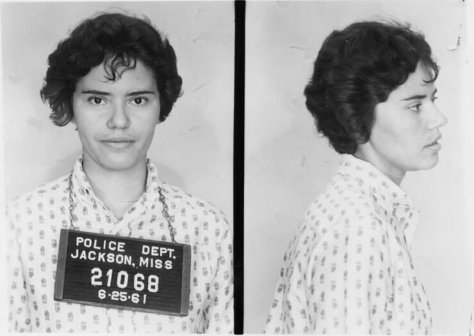
Mary Hamilton’s iconic mugshot from her arrest as a Freedom Rider in Jackson.

Mary had endured stifling southern summers in segregated cells where the black inmates were denied air conditioning, physically invasive jail exams that amounted to sexual abuse, and so many police assaults in her pursuit of freedom that her health was already starting to deteriorate by the time she was 28. After all of that, she’d be damned if she was going to let someone turn her name into a slur.

Absolutely enraged at her calm but repeated refusals to comply until she was addressed respectfully, the judge found Mary in contempt of court that day, and her minor charge escalated to a $50 fine and 5 more days in jail. She dutifully served her sentence, and then appealed her case all the way to the United States Supreme Court. The NAACP filed documents arguing that Alabama’s use of first names perpetuated a “racial caste system” that violated the Equal Protection Clause of the 14th Amendment guaranteeing the same rights, privileges and protections to all citizens of the United States. The Alabama court’s transgression was so evident that without hearing a single oral argument, the Supreme Court decided in Mary’s favor, establishing the 1964 case of Hamilton v. Alabama as the legal decision that gave black adult plaintiffs, witnesses, and experts the same respect granted to white children and convicted criminals for the first time in American history.

Just a year later, Mary married out of the activism circles, but someone close to her had found major inspiration in a minor detail of her story. When Mary received a letter regarding her case, her white roommate and best friend Sheila Michaels couldn’t help but notice how the letter was addressed: Ms. “That’s ME!” she exclaimed. The honorific was rarely used, and even then, only for business correspondence where a woman’s race and marital status might be unknown, not in popular culture and most certainly not by women to describe themselves. Unmarried women in proper society were “miss” and married women were “mrs.” Mainstream language didn’t account for anyone in between. “The first thing anyone wanted to know about you was whether you were married yet,” Sheila said. “Going by ‘Ms.’ suddenly seemed like a solution; a word for a woman who did not ‘belong’ to a man.” Sheila’s campaign to popularize the term led to its adoption as the title of Ms. Magazine, and a new way to show respect was once again inspired by Mary’s work.

Despite Sheila’s best efforts to preserve the story of how Mary’s triumph lead to her linguistic epiphany, the tale of Ms. ultimately overshadowed the struggle to be called anything respectable at all. While Mary’s sharp tongue and unflinching rebellion against systematic racism ended up mostly buried in legal texts, black women today like NAACP lawyer Sherrilyn Ifill who’ve personally experienced the long “fight for respect and dignity against demeaning and ugly stereotypes in the public space” still find inspiration and courage in the woman who’d endured too much of this country’s worst to be called by anything but the best.


KEEP GOING BLACK IN HISTORY:

Read all about Mary’s life and even listen to Mary & Sheila chat together in NPR’s story & archival audio.

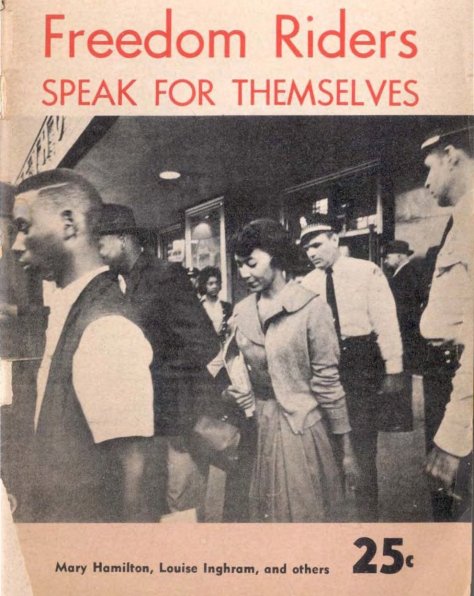
Dig into Mary’s first-hand account of her jailhouse treatment published in a book of letters from Freedom Riders.

The New York Times documented Mary’s historic 1964 Supreme Court win.

DAY 22 — Gladys Bentley

Police swarmed the King’s Terrace nightclub in midtown Manhattan. Some upstanding citizen had reported a terrible crime in progress that 1934 night. A “masculine garbed smut-singing entertainer” and her “liberally painted male sepians with effeminate voices and gestures” were traipsing around the stage and right through the audience performing songs so lewd the devil himself would blush.

On the other hand, through the eyes of renowned black poet Langston Hughes, that same performer was an “amazing exhibition of musical energy – a large, dark, masculine lady, whose feet pounded the floor while her fingers pounded the keyboard – a perfect piece of African Sculpture, animated by her own rhythm.”

From the beginning, Gladys Bentley – or Bobbie Minton, depending on where you knew her from – seemed to have a knack for being different things to different people.

A full figure that she clothed in men’s attire, her reputation as a tomboy, and schoolgirl crushes on female teachers were the earliest indicators that Gladys was different from the other girls. Her parents sent her to specialist after specialist to be “fixed,” but when Gladys was 16, she fled their closed-minded Philadelphia home to find a new family in Harlem instead.

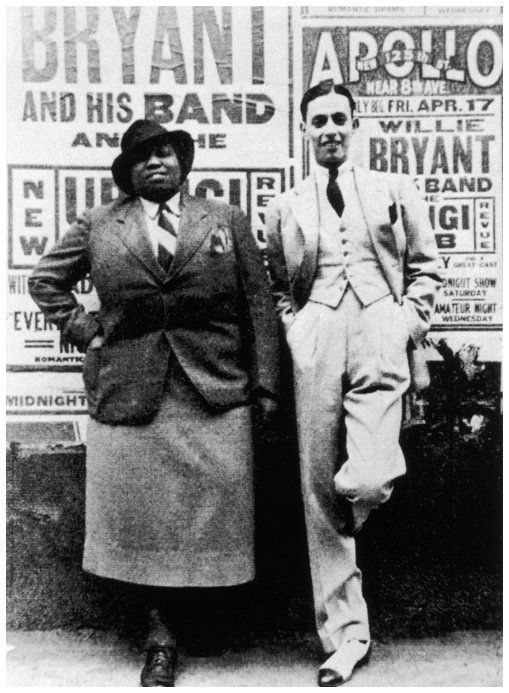
Gladys poses with bandleader Willie Bryant outside the Apollo Theater, April 17, 1936.

She arrived in 1923 during the Renaissance, and after a handful of small gigs around town, an opportunity that seemed tailor-made for her presented itself. The owners of The Clam House, one of Harlem’s most famous gay speakeasies, needed a new man as their sister bar’s nightly pianist, and as far as Gladys was concerned, she fit the qualifications. “But they want a boy,” a friend scolded her. “There’s no better time for them to start using a girl,” Gladys quipped. She arrived at her audition with her hair slicked down and in the finest suit a runaway teenager could find, where she proceeded to bring the owners, the staff and everybody within earshot to their feet in a standing ovation.

There could have been no better validation. But then again, when it came to validation for society’s free-thinkers, there was no better place than Harlem. During the Renaissance, creative, curious and ambitious black minds flocked to Harlem to join the growing collective of visual, performing and written artists flooding the American consciousness. The influx of those new ideas and Harlem’s never-dry, Prohibition-defying nightclubs together catered to and encouraged an “anything goes” atmosphere, drawing all sorts of eccentric subcultures to the heart of the action.

Gladys Bentley, photographed in a Harlem nightclub in 1940, courtesy of the Smithsonian.

Here, Bobbie was free to be, and what she became was a Harlem legend in a white top hat and full tux, who stomped her feet with the same ferocity that she banged on her piano, transforming innocuous radio-friendly songs into lusty howlers, and unapologetically flirting with every woman in her audiences. In her own original songs, themes of female independence from gender norms and escaping abusive relationships dominated her lyrics, and her signature trumpet-scatting filled the space between. Crowds packed into the variety of clubs Bobbie headlined, hoping in particular to hear her barn-burner “Nothing Now Perplexes Like the Sexes, Because When You See Them Switch, You Can’t Tell Which is Which.”

But for Bobbie, that night at King’s Terrace and the padlock police used to shut the club down only symbolized the beginning of her end in New York. Financial woes plaguing the populace during the Great Depression in the 30s and the end of Prohibition brought the nightclub scene to a grinding halt. The woman who’d once boasted record deals, a $5,000 a month apartment on Park Avenue, and sold out every show would have to find a new home for herself and her act.

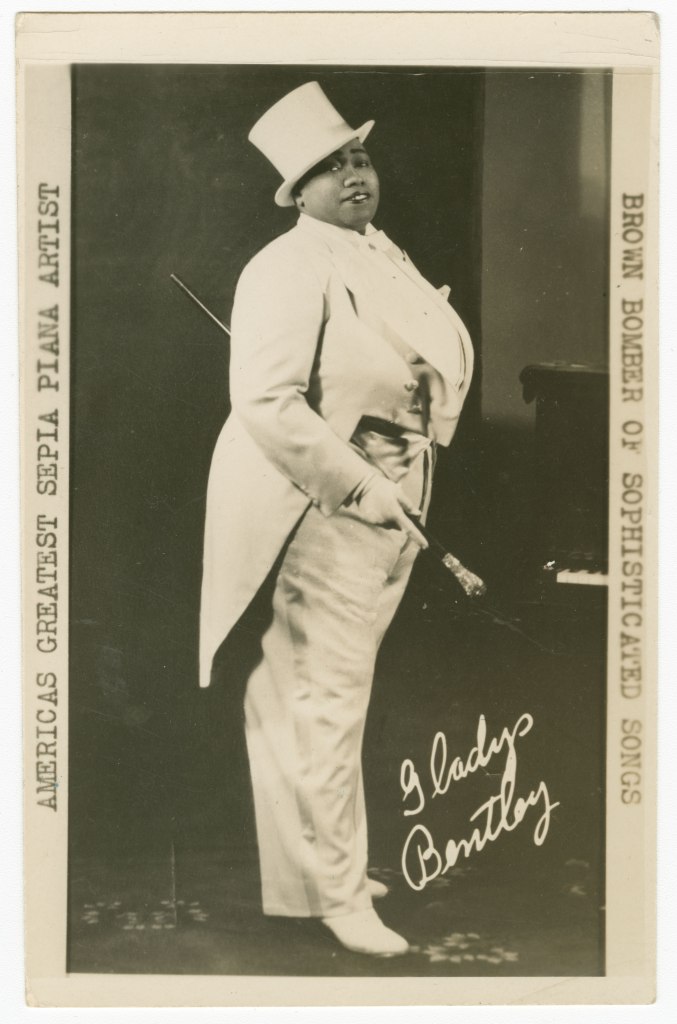
Luckily, her fame already preceded her nationwide with tours that took her to Pittsburgh, Cleveland, and as far as California, where she ultimately decided to move. As Los Angeles’ “Brown Bomber of Sophisticated Songs” and “America’s Greatest Sepia Piano Player” she once again dazzled audiences, but it was clear her Harlem heydays were long gone. Laws passed in California forced her to carry special permits to wear men’s clothes and increasing public distaste for non-gender-conforming people continued to stifle the flamboyant show that put Gladys on the map.

By the 1950s, black celebrities who dared to oppose social conventions were being dragged into and condemned at all-white government hearings, victims to McCarthyism and the Red Scare. Her already declining career couldn’t suffer another blow, and in 1952, Gladys submitted an editorial feature to EBONY Magazine, declaring herself cured of her “third sexuality.”

Gladys in a more traditional gender role from a spread in Ebony Magazine.

But in that same article, Gladys slipped a telling insight. “Some of us wear the symbols and badges of our non-conformity,’ she observed. “Others, seeking to avoid the censure of society, hide behind respectable fronts, haunted always by the fear of exposure and ostracism. Society shuns us. The unscrupulous exploit us. Very few people can understand us. In fact, a great number of us do not understand ourselves.“ For someone who claimed to have successfully extracted the “malignant growth festering inside,” her message of self-acceptance and inclusion rang loud and clear.

Sometime over the next 8 years, the bombastic life of Bobbie Minton was put away. Gladys married two different men in short-lived relationships, found religion, and lived with her mother until passing away in 1960 at only 52 years old. Whether Gladys truly found peace with her identity, no one could say, but her brief and once-fearlessly queer life inspired so many to live vibrantly, flout normality, and defy anyone standing in the way of the person they were born to be.


KEEP GOING BLACK IN HISTORY:

Listen to Gladys Bentley’s hit, “Worried Blues” and her signature trumpet vocalizations.

Get all the gossip on the extraordinary Gladys Bentley / Bobbie Minton from BUST Magazine.

Read Gladys’ own words via her EBONY Magazine essay “I am A Woman Again.”