Tag Archives: PAST

DAY 5 — Stormé DeLarverie

Stonewall had a formidable security team, and her name was Stormé.

And though Marsha P. Johnson, another famous face at Stonewall, may not have participated as once believed, everybody agrees that Stormé DeLarverie was not only there on June 27, 1969—she got her lick in.
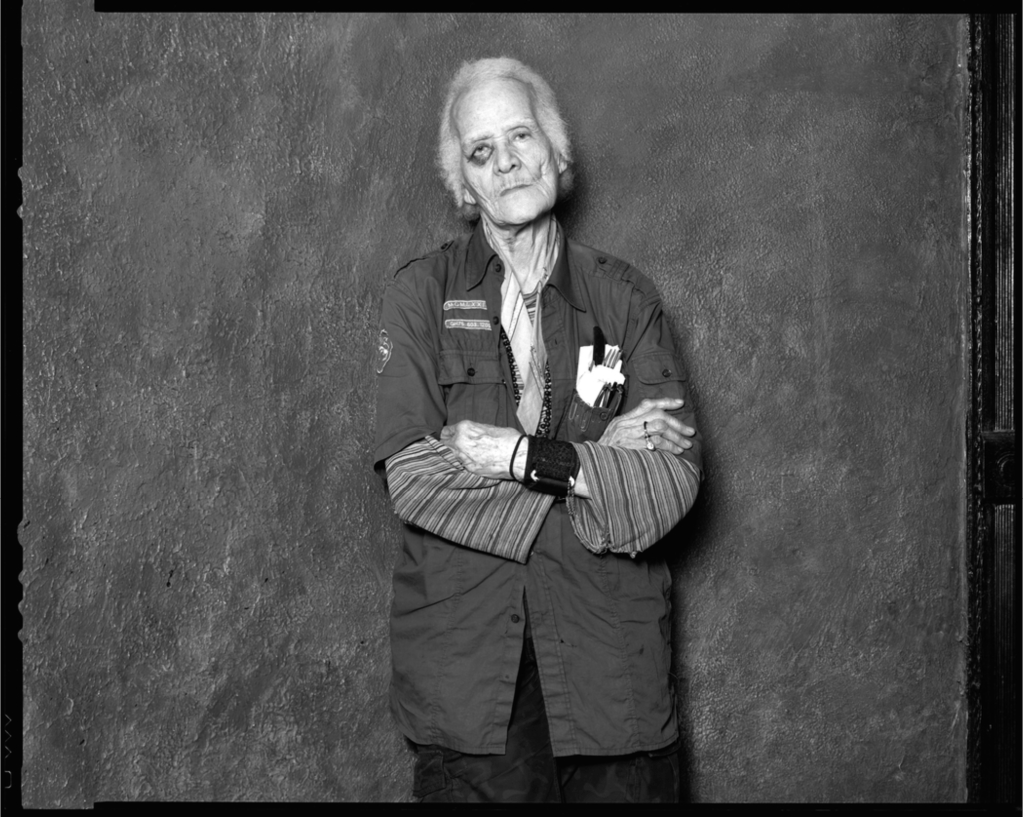
Storme DeLarverie – January 27, 2010 12:45am,” by Tony Notarberardino. Stormé would have been approximately 90 years old here in a portrait taken at NYC’s Chelsea Hotel. Read the backstory here.

“She literally walked the streets of downtown Manhattan like a gay superhero,” her friend Lisa Cannistraci told the New York Times.

Well-known for her neighborhood patrols—and her gun permit—Stormé didn’t tolerate “ugliness” in her community. But that’s exactly what met her when she rushed to the chaotic raid at the Stonewall Inn.

“Move along, f****t,” NYPD spat at her.

New York penal code prohibited cross-dressing, but police had to know someone was cross-dressing to enforce it. Stormé had been a chameleon all her life.

That night, she lived up to her name.

Stormé defied police orders, insisting on standing watch over their treatment of her “children” at Stonewall.

Her resistance was met with a club to the face.

In return, the man attached to that club officially met Stormé.

“I walked away with an eye bleeding, but he was laying on the ground, out,” she recounted to PBS.

The New York Times features an interesting article comparing Stonewall from the perspectives of two of its major players, Stormé and Deputy Inspector Seymour Pine.

NYPD couldn’t have known it, but never backing down was Stormé’s specialty.

Born in 1920 as Viva May Thomas, the clear offspring of a Black mother and white father in a time when interracial relationships were still illegal, Stormé had grown up a pariah. She was once so badly bullied, she was left hanging from a fence by her leg, an injury she carried her entire life. The trauma stuck with her too. Even as a queer elder, Stormé wouldn’t repeat the names she’d been called as a child.

“Somebody was always chasing me – until I stopped running,” she said in one documentary.
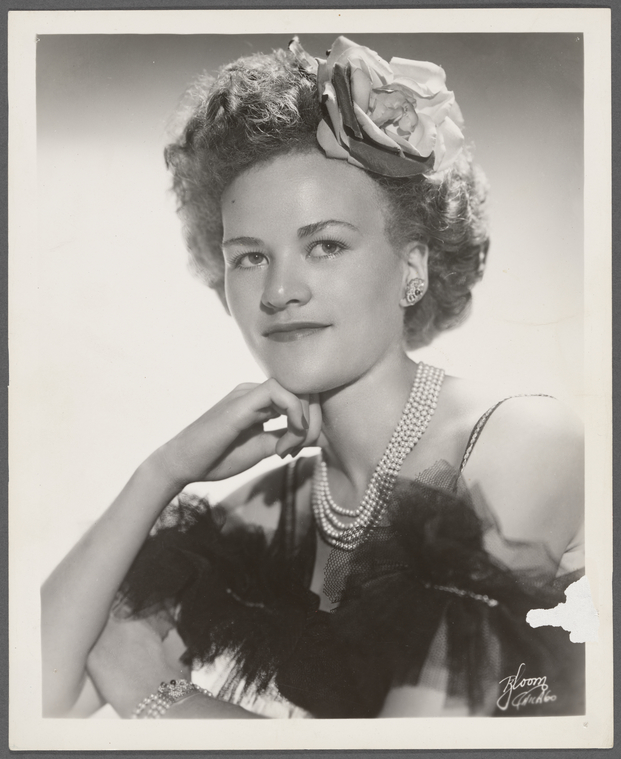
Viva May as a fresh-faced 30 year old, courtesy of NYPL.

Finally done running, Stormé started shining.

From a prolific local singing career to a side-saddle horse act with the Ringling Brothers Circus, Stormé confidently found her place center-stage.

But somewhere along the line—public documentation of Stormé’s life starts to get intermittent as her name changed several times throughout the years—she also discovered that she wanted to shine a little differently.

In 1955, Stormé remerged as the only female-born performer at the Jewel Box Revue, a drag burlesque and variety show. At the same time, she unveiled a whole new face.

Stormé remembers that “somebody told me that I would completely ruin my reputation, and…didn’t I have enough problems being Black? I said, I didn’t have any problem with it. Everybody else did.”

Stormé slowly perfected that face until as far as casual observers, paying customers, and consequently, police officers, were concerned, at least on her performance nights, they were looking at a man.
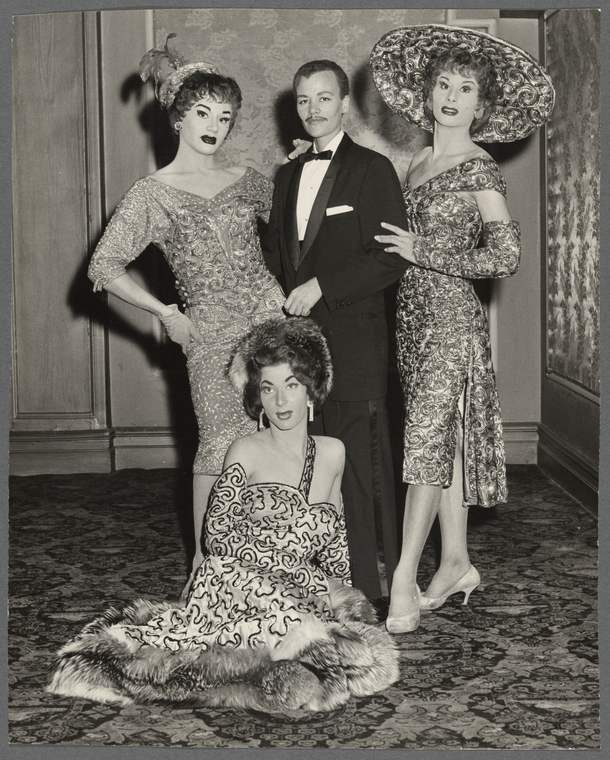
June 27, 1969 was one of those nights.

And though Stormé faded from the straight gaze once again, from that night on, she symbolized security in her community in more ways than one.

On July 11, just two weeks after the incident, Stormé became a founding member and Chief of Security of the Stonewall Rebellion Veterans Association

She worked as a bodyguard, volunteer street patrol, and bouncer for several gay clubs still operating in New York like The Cubby Hole and Henrietta Hudson, but hated those titles.

Stormé packing heat in front of the Cubby Hole in 1986.

“I consider myself a well-paid babysitter of my people, all the boys and girls,” a friend recalled her saying.

When AIDS ravaged New York’s gay communities in the 80’s, that same friend asked Stormé for a $5 donation to buy Christmas gifts for those affected.

“Several hours later Stormé walked back into the restaurant with over $2,000,” and subsequently made it her annual tradition, he wrote.

In 1999, Services & Advocacy for LGBTQ+ Elders awarded Stormé their Lifetime achievement award for “crashing the gates of segregation and for the gender-bending example she showed the world,” noting that “she lives her life quietly and does much of what she does very quietly, sometimes anonymously… because what matters to her is that she does what she does, not that it makes a big splash.”

Unfortunately, that quiet life did not serve Stormé well. As she aged and her financial, living, and mental conditions all deteriorated, friends and admirers found themselves rallying others to her aid. Describing her as “someone who gave willingly of herself so that others might live meaningful, fulfilling lives free of discrimination and harassment,” their attempts at supporting an aging Stormé ultimately fell to a non-profit organization.

“I feel like the gay community could have really rallied, but they didn’t,” her friend Lisa told a Times reporter who found Stormé’s absence from NY’s 2010 Pride parade so unusual, he made it his headline.

Four years later, at the ripe old age of 93 (miraculous for anyone, but especially among queer elders), Stormé passed away quietly and alone.

But not forgotten.

When the National LGBTQ Wall of Honor was unveiled inside the Stonewall Inn, 50 names adorned the plaque in honor of the Rebellion’s 50th anniversary.

One of those names was Stormé DeLarverie.

Stormé DeLarvarie’s name holds a central place on the National LGBTQ Wall of Honor.

KEEP GOING BLACK IN HISTORY:

Listen in on PBS In the Life’s profile and interview with Stormé.
Hear more from Stormé including her singing, perhaps for the very last time, at 2:30.

There’s no more complete history of Stormé’s entire life than the one created by Chris Starfire here.

The Stonewall Veterans’ Association has an extensive entry on Stormé’s activism here.

The Code Switch podcast tackles Stormé’s story through an intersectional lens of queer pride, police brutality and racism, all topics prevalent throughout her life and still relevant today. Listen in here.
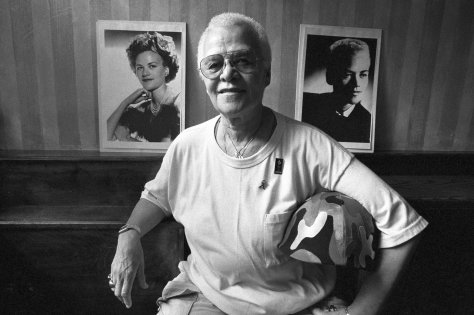
Read Stormé’s obituary published in the New York Times on May 30, 2014.
DAY 4 — The Buffalo Soldiers

Courtesy of the Smithsonian.

The Buffalo Soldiers have a deceptive name.

And I’m not talking about the “Buffalo” part.

Yes, reports do vary as to whether that nickname came from the heavy buffalo fur coats these Black regiments wore on the American frontier, or from their hair texture that seemed nearly identical to the buffalo’s.

It’s the “soldier” that reasonably implies that all these men did was fight.

From their establishment in 1866 to the last regiment’s formal service disbanding in 1951, their military contributions are too tremendous to count.

But their peaceful contributions here at home are absolutely stunning.

In fact, if you’ve ever been to ANY major national park west of the Mississippi, chances are you’ve walked directly in their footsteps and don’t even know it.

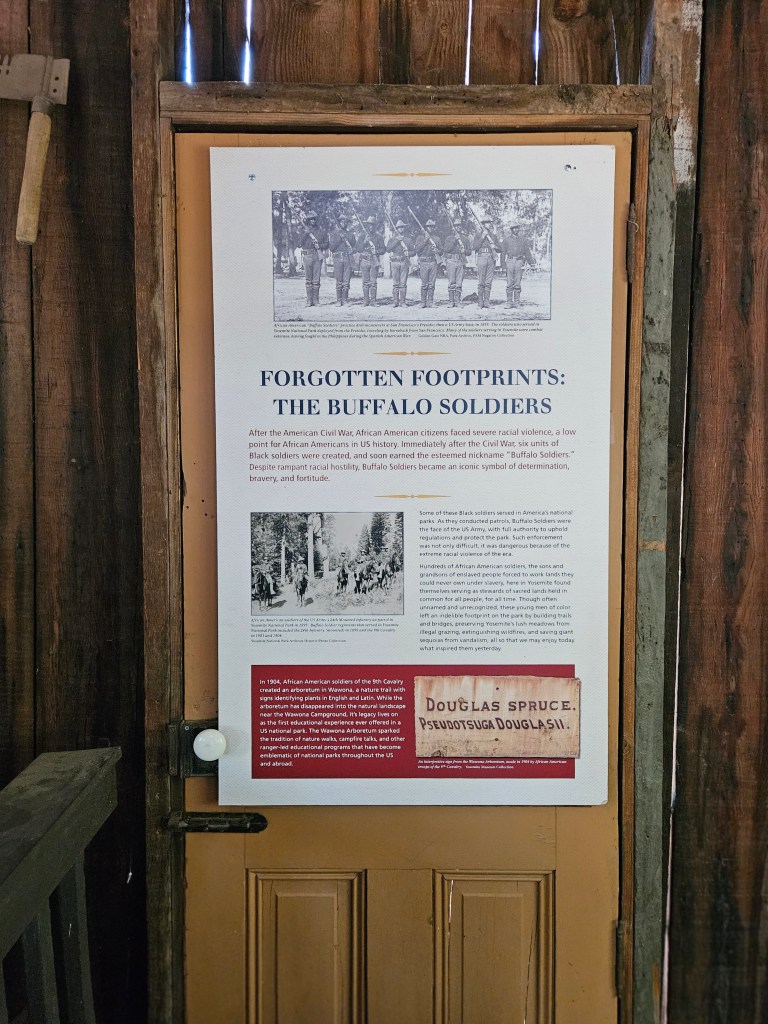
Yosemite, Yellowstone, Hawai’i Volcanoes, Klondike, and Sequoia & Kings Canyon National Parks simply would not exist without the Buffalo Soldiers’ relentless work.

Browse National Park Service sites related to the Buffalo Soldiers.

And that’s still just a fraction of the trails they blazed across the United States.

Between 1866 and 1891 alone, the Buffalo Soldiers are documented at 250 sites across twelve different states.

One of the furthest is Hawaii, and its “highly challenging” 36-mile Mauna Loa Trail. 30 of those miles leading to the 13,681-foot summit were painstakingly carved out of solid lava by the Buffalo Soldiers with 12-pound hammers as their only tools.

Further north in California, Brigadier General Charles Young—who later became the first Black U.S. national park superintendent and the highest ranking Black Army officer until he died in 1922—led his company in clearing a road into Sequoia & Kings Canyon National Park, allowing public citizens access to the giant trees for the first time ever.

When leadership suggested naming a sequoia for then-Colonel Young, he refused, humbly requesting the tree be named for Booker T. Washington instead. If sentiments were the same in 20 years, he said, only then might he accept the honor. Spoiler alert…

But that wasn’t the only big work the Buffalo Soldiers took on in California. If you’ve ever taken the trail up nearby Mt. Whitney, the highest peak in the lower 48, you got it. Buffalo Soldiers.

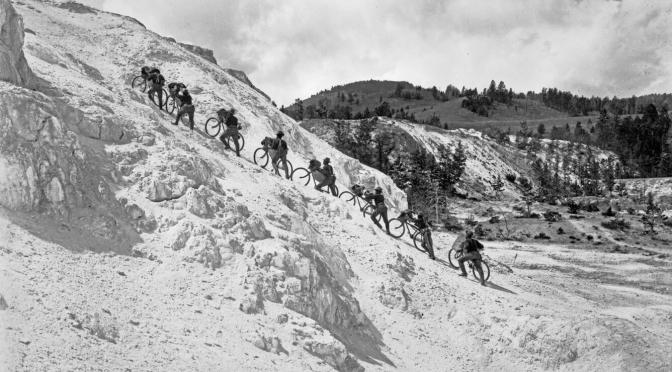
Lt. James A Moss’s 25th Infantry, U. S. Army Bicycle Corps, atop Minerva Terrace at Mammoth Hot Springs in Yellowstone National Park. [August 1896 per Moss’s diary]

Among the first people to survey and create trails through the land that would become Yellowstone National Park, the nine men of the 25th Infantry bicycled from Missoula, MT to Yellowstone, crossing the Continental Divide twice over a 800-mile round trip. Since Yellowstone was still a largely uncharted place, there were no permanent accommodations. By necessity, these men carried over 100 pounds of gear, munitions and provisions, all on their bikes.

Compared to those assignments, Yosemite’s pristine landscape was a “cavalryman’s paradise” actively sought out by soldiers from all corners of the States. And yet, to this day, Yosemite specifically names the Buffalo Soldiers as the “stars of its story” and “safeguards of its mountain cathedrals.”

Buffalo Soldiers atop Yosemite’s Fallen Monarch in the Mariposa Forest. (NPS)

All of these trailblazing acts of service by the Buffalo Soldiers were before the National Park System was created. So more than just pioneers and explorers, the U.S. Army served as the country’s original Park Rangers.

In Yosemite, that service was especially vital as the park was especially vulnerable to all sorts of dangers like poachers, wildfires and overgrazing. The Buffalo Soldiers regularly patrolled against those dangers and were fully prepared to oppose them if necessary. When they weren’t protecting Yosemite’s borders, they built the Wawona Arboretum in 1903, and in the process, launched the U.S. National Parks’ first educational program, a cornerstone of the system today.

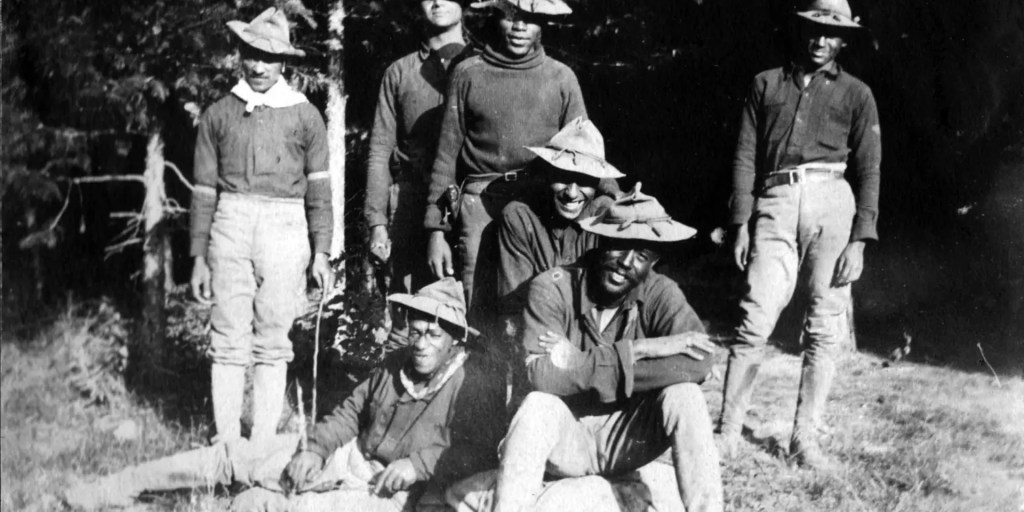
The 24th Infantry Buffalo Soldiers patrol Yosemite armed and on horseback in 1899. (NPS)

Now, if you’re paying attention, you might notice a theme. The Buffalo Soldiers were frequently sent to the most remote and rugged parts of the U.S. territories to forge new lands and protect them through military force if necessary. Aside from poachers, fires and livestock, the Army was almost certain to confront Indigenous People.

And Army leadership knew they had a secret advantage in the Buffalo Soldiers, because they’d learned it from some of the first U.S. pioneers, Meriwether Lewis & William Clark.

When native tribes encountered Lewis and Clark, it was frequently their curiosity or admiration of York, the expedition’s enslaved man, that gave those tribes any incentive to speak to white men at all.

It’d be naive to believe this didn’t influence the Buffalo Soldiers’ peacekeeping AND wartime assignments, where they were deployed against native Americans, the Spanish, Filipinos, and Mexicans among many others. Whether it was that they were expendable against other brown people, or that they unknowingly served as a shock tactic against them, the Buffalo Soldiers valiantly fought on behalf of the United States anyway.

The Army enlisted fighters, but look closer and you’ll find the Buffalo Soldiers’ true legacy still growing along the most peaceful streams, under purple mountains, and so many more places that make America beautiful.


KEEP GOING BLACK IN HISTORY:

Watch Yosemite Ranger Shelton Johnson discuss preserving the traditions of the Buffalo Soldiers in National Parks today.

Listen in on Ranger Johnson’s historically based podcast “A Buffalo Soldier Speaks” here.

The Smithsonian National Museum of African American History & Culture maintains an extensive Buffalo Soldiers collection here.

Learn more about their historic service at the Buffalo Soldiers National Museum.

Browse the beautifully crafted history of the Buffalo Soldiers maintained by Yosemite.

Explore the National Parks Service archive of the Buffalo Soldiers 85 year long impact on the foundation of the United States.

There’s still more about how and why the Buffalo Soldiers were the first national park rangers at History.com.

DAY 3 — Jesse Stahl

Every 8 seconds, Jesse Stahl’s life must have flashed before his eyes.

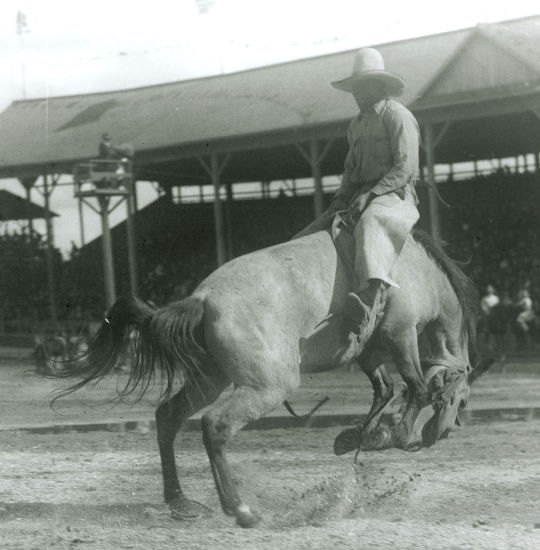
Jesse Stahl at the Pendleton, Oregon Roundup. (Courtesy of Oregon Historical Society)

He was more than “just” a rodeo rider.

Jesse Stahl demonstrated some of the most legendary horsemanship the world’s rodeo circuit has ever seen.

When his name was called, the whole arena knew they were about to see the show of a lifetime.

They also knew that no matter how skilled, how risky, or how dazzling Jesse’s ride, there was no way he’d actually win.

Though his talent was famously touted far and wide, Jesse Stahl was infamous, even among his competitors for “winning first, but getting third.”

No matter how hard Jesse rode, almost all of the judges he faced refused to score his ride higher than a white man’s. Dozens of others would allow him to ride for show, but wouldn’t let him compete at all.

The adage is that we have to work twice as hard to get half as far. And Jesse worked even harder, becoming widely renowned for feats of horsemanship no other cowboy would even attempt.

His pièce de résistance was riding a bucking bronco backwards. As if that weren’t already incredible, Jesse’s routine variations on that trick were almost superhuman.

He and Kentucky Black cowboy Ty Stokes often teamed up for what they called the “suicide ride,” where both men rode a bucking bronco simultaneously, with Ty facing forward and Jesse facing backward. According to another cowboy, Jesse even rode at least once backwards with a suitcase in his hand, exclaiming “I’m going home!”

But riding backwards was hardly the only trick up Jesse’s sleeve.

Hoolihanding,” the act of jumping from the back of a horse directly onto a bull’s before taking it down by the horns was invented and perfected by Jesse before it was eventually outlawed as too dangerous for the animals.

(Fellow Black cowboy Bill Pickett altered the move, jumping from a horse to simply wrestle a steer down by the horns, inventing what’s today known as “bulldogging.”)

A 1912 rodeo in Salinas, CA brought Jesse one of his most fearsome opponents, a bucking bronc forebodingly named Glass Eye. This unbroken horse terrified other competitors, but Jesse handled the gravity-defying ride with such ease, he even had time to ham it up.

Jesse Stahl and Glass Eye, 1912.

Despite these daring displays that literally put his life on the line, most sources—from fellow cowboys to local oral histories to museums—all agree that Jesse rarely ever won.

But as 2019 Blackstory feature Shelby Jacobs said, “If you impress the crowd, the coach can’t put you on the bench.”

Jesse may not have been able to win the judges, but he had so much crowd appeal, that today, some local writers credit Jesse for putting whole rodeos on the map, while giving him the superstar status of a “cowboy Steph Curry.”

Jesse is spoken of warmly as news of his passing is publicized in the April 24, 1935 Corning (CA) Daily Observer

And his fellow riders loved him most of all. Because Jesse depended on rodeos that would allow him to ride AND place well AND pay him—all tall orders for a Black person in the early 20th century—he died penniless. Rather than allow a legend to rest in a pauper’s grave, friends and competitors paid for his proper burial.

And though his name receded into history for a while, he was finally honored by the whole of the rodeo industry with his 1979 induction into the National Rodeo Hall of Fame, only the second Black cowboy after his friend Bill Pickett.

Like so many other incredible Black people, Jesse’s only just recently begun to receive his flowers. It speaks not only to the resurgence of Black cowboy culture, but why it had to resurge in the first place.

Leaps and bounds beyond his competitors, one single attribute kept Jesse Stahl’s name in the depths of history: his Blackness.

In the wake of that resurgence, we’re celebrating brand new milestones like the 8 Seconds Juneteenth Rodeo where I first learned of Jesse’s marvelous rides, and most recently, Beyoncé’s wins for her debut country record Cowboy Carter, including Best Country Album, the first EVER in the genre by a Black woman.

One of many unsung Black rodeo cowboys, and perhaps one of the best of any race, Jesse Stahl’s legacy made way for the spectacular accomplishments Black people are making in the rodeo, Western lifestyle, and country music industries today. Every moment of it that we’re able to enjoy now, he fought for 8 seconds at a time.


KEEP GOING BLACK IN HISTORY:

Learn more about Jesse’s exploits and those of many other Black Cowboys at the Oregon Historical Society.

Browse a more complete list of Jesse’s nationwide appearances & accomplishments over his decades on the rodeo circuit at The Active Historian.

Read “Let’s Go, Let’s Show, Let’s Rodeo: African-Americans and the History of Rodeo” at JSTOR.

DAY 2 — Kitty Black Perkins

Before President Barbie could run, a woman named Kitty dreamed big.

Louvenia “Kitty” Black was born in the late 1940s before Barbie existed.

But even then, she’d sit at home in Spartanburg, SC, coloring paper dolls into her own image.

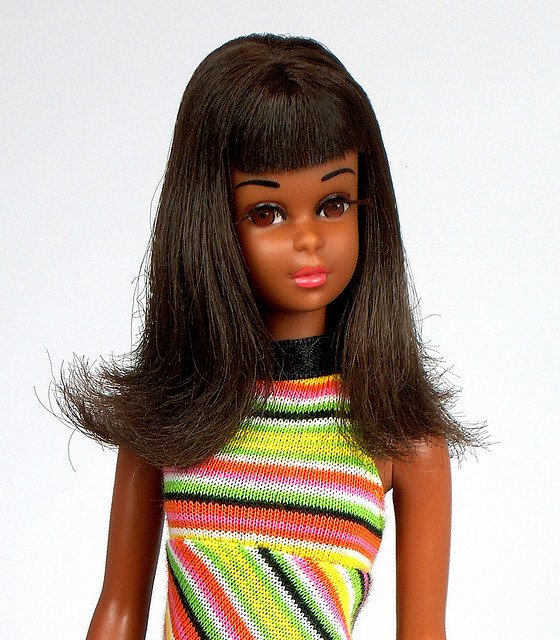
It’d be 12 more years before Barbie came on the scene in 1959, and 7 more before Francie—Mattel’s first “Black” doll—was released in 1967.

“Black” because Francie was essentially a Barbie in blackface. Skin color aside, Francie was indistinguishable from her white counterpart.

Two years later, Christie was introduced as the Civil Rights Movement swept the nation. Her unique face mold and hair styles finally gave Black women a progressive, fashionable vision of themselves in mainstream toys, but…

Francie, Christie, Curtis, Cara, Brad and all the other Black skinned dolls Mattel introduced weren’t Barbie.

Barbie had shifted from just a doll to a symbol of what was possible for modern women. Even Mattel’s other white dolls were still just sidekicks.

That is, until 1980—four years after Kitty Perkins walked through the door, and two years after Mattel promoted her to Principle Designer.

Kitty didn’t even own a Barbie before before her 1976 interview with Mattel. But she bought one, made six outfits for her—all of which were subsequently put into production—and was hired on the spot.

It was Kitty’s presence at Mattel that made an authentic Black Barbie an actual possibility, and it all boiled down to one simple desire: “I wanted my Black Barbie doll to look more like me.”

“I had a person that was in the hair department, a sculptor, a face painter, and most of their direction would come from me because I was Black,” she recounted to the New York Post.

It was 1980, and for the first time in American history, children of ALL races saw ordinary store shelves consistently stocked with Black dolls that were fashionable, authentic, and most importantly, beautiful.

Dr. Mamie Phipps-Clark‘s “Doll Test” found that among white and Black children, almost all of them associated only the white doll with being “good” and other positive qualities.

Some people probably ignored her, some probably hated her, but for others, especially those who’d lived the Doll Test first-hand, Black Barbies were monumental.

At the same rate, some Black girls didn’t want a Barbie. She’d been a white doll for so long that some people didn’t care that Mattel finally got around to representing them.

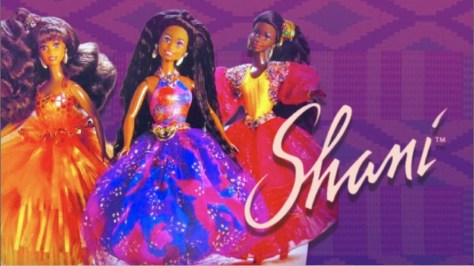
In 1991, Shani & Friends, a Mattel subsidiary also led by Kitty, introduced an entirely new line of Afrocentric Black dolls. From their clothes and jewelry featuring African prints and hoops, even down to their names borrowed from Swahili and real-life Black Barbie Nichelle Nichols, everything about Shani & Friends was inspired by the diaspora. The trio even had different body molds. And though they only lasted 3 years as an independent line, Shani, Asha, and Nichelle’s face and body sculpts were reintegrated into the Barbie line to increase their range of representation.

By 1989, nine years after the first Black Barbie found shelves, Mattel sold 22 million Barbies globally that year alone. By 2021, that number was 86 million, or 186 Barbies every MINUTE.

Today, you can buy a Barbie in almost every single physical representation you wish. They come in all colors—including vitiligo, all shapes and sizes, and even have a range of disabilities from prosthetic users to Down’s syndrome.

And though you can find just about any Barbie these days, in 2019, Mattel’s best-seller was Black with an Afro.

Kitty retired from Mattel in 2004 after 30 years leading Barbie’s design, but the company’s commitment to diversity is stronger than ever, and so are their profits.

Barbie isn’t just a doll these days. She’s graced countless cartoons and movies (including 2023’s live action), costumes, self-care products, bags and accessories and so much more. If it exists, Barbie’s probably been there.

And Barbie certainly wouldn’t be the doll she is without the Black woman who made Barbie more like her.

An array of today’s Black Barbies, representing a range of our beauty.

KEEP GOING BLACK IN HISTORY:

Watch “Black Barbie: The Documentary” on Netflix and visit the official website.

Learn more about Kitty’s life and work at ScreenRant.

DAY 1 — Elizabeth Jennings Graham

The Third Avenue Trolley conductor had no idea he’d picked the right one on the wrong day.

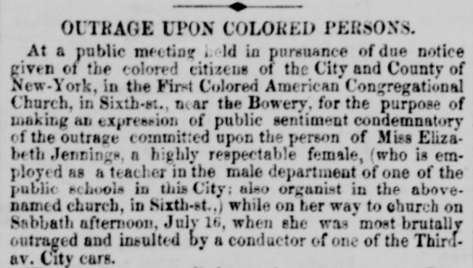
The organist for New York’s First Colored Congregational Church was running late for Sunday service.

But in her haste, Lizzie Jennings almost single-handedly desegregated the New York Public Transit system…

A full century before Montgomery met Rosa Parks.

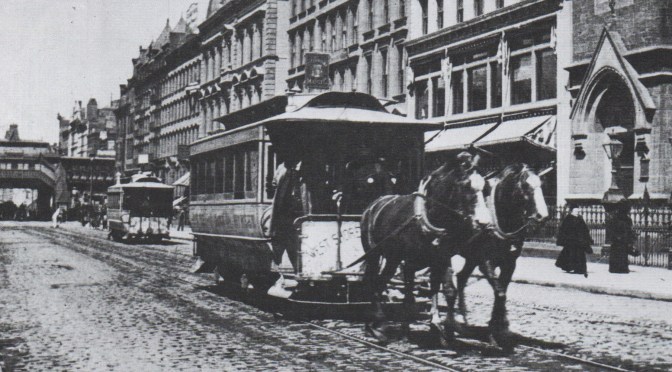
Two types of horse-drawn trolleys operated in the streets of New York: one was designated “colored riders allowed,” and the other’s ridership was left to the whims of the operator and his white passengers.

One trolley ran a regular, timely schedule. Guess which one did not?

New York’s Black citizens had two choices: wait or walk.

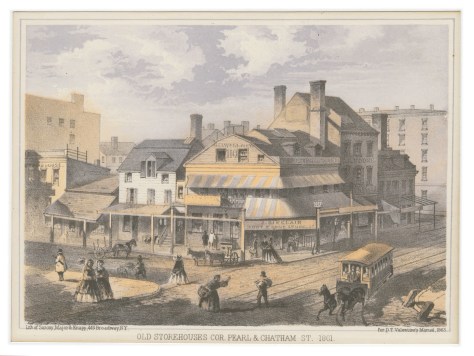
New York as it would have appeared to Lizzie Jennings. See the horse-drawn trolley at the bottom right corner.

On July 16, 1854, Lizzie Jennings didn’t have time for all that and boarded the first trolley she saw.

The operator still tried it.

Wait for the next car, he told her.

But she was in a hurry, Lizzie replied.

That one’s got your people, he persisted.

What people? Lizzie spouted back.

A car that allowed Black riders came and went because it was full.

Lizzie sat unmoved.

“He still kept driving me out or off the car,” Lizzie explained in her account published in the New York Tribune. “Said he had as much time as I had and could wait just as long.”

“I replied, ‘Very well. We’ll see.'”

The trolley operator’s eventual surrender came with a disclaimer: “if the passengers raise any objections, you shall go out… or I’ll put you out,” Lizzie wrote.

Quick to clap back, she “answered again and told him I was a respectable person, born and raised in New York, did not know where he was born and that he was a good-for-nothing impudent fellow for insulting decent persons while on their way to church.”

Big NYC energy from a little lady in 1854.

So big, the operator tried to physically remove her.

Lizzie grasped onto the window, his coat, anything within reach to keep from being forcibly removed. They scuffled for several minutes before the operator called on the trolley’s horse driver for an assist.

If they were going low, she’d meet them in hell.

“I screamed ‘murder’ with all my voice.”

The pair finally resorted to driving the trolley to the nearest police officer, with Lizzie kicking and screaming the whole way.

Pushing her onto the ground, the officer sneered at her to “get redress if [she] could.”

So she did. Remember when I said Lizzie was the right one?

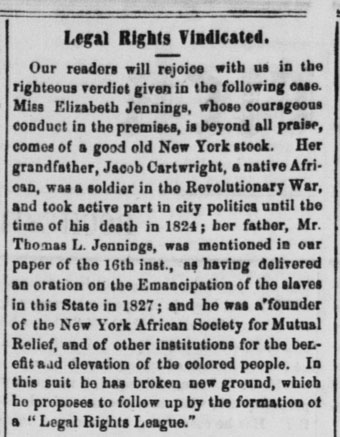
Elizabeth Jennings was the daughter of Thomas Jennings, the first Black person awarded a United States patent, owner of a profitable tailoring business, and a founder of THE Abyssinian Baptist Church, currently active in Harlem.

Her paternal grandfather had connections to Frederick Douglass’ Paper, and Lizzie’s personally written account of her mistreatment was published there, The New York Tribune, and many other abolitionist papers.

Lizzie’s powerful network didn’t stop there. They brought a 24-year-old upstart fresh out of law school to her door.

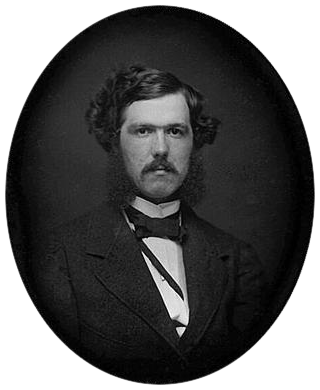
That man’s name was Chester Alan Arthur, future 21st President of the United States.

The Historical Society of the New York Courts documents a number of cases Arthur tried in support of African-American civil rights.

Against an all-white, all-male jury, Lizzie & Chester did the seemingly impossible: THEY WON.

News of Lizzie’s historic judgment in Frederick Douglass’ Paper.

Lizzie was awarded cash damages from the Third Avenue Railroad Company, but more importantly, an agreement to desegregate their trolleys, effective immediately.

“Railroads, steamboats, omnibuses, and ferry-boats will be admonished from this, as to the rights of respectable colored people,” The Tribune wrote.

Those who ignored the judgment weren’t far behind on the Jennings’ War Path.

The Legal Rights League, formed by Lizzie’s father Thomas, challenged every last New York transit hold out until in 1861, just seven years after Lizzie’s impromptu sit-in, ALL of them were finally desegregated.

After her case was won, Lizzie largely retreated into ordinary life, but she didn’t stop being an extraordinary person.

Until her death in 1901, Lizzie operated New York’s first kindergarten for Black children from her home.

All that history from a lady who just wanted to go to church, and hardly anybody knows her name.

But the city of New York is working to change that. There’s already a section of Park Row near her historic ride, dedicated to Elizabeth. She Built NYC, an arm of the NY Department of Cultural Affairs has fully funded five statues honoring trailblazing New York women.

Elizabeth Jennings is one of them.

As for the trolley operator, the horse driver and the policeman who abused her? They’ve virtually disappeared from history.

Maybe somebody should check with their people.


KEEP GOING BLACK IN HISTORY:

Lizzie is one of many famous New Yorker’s whose life and death were overlooked by the Times until modern days and their article on her here.

Read over Elizabeth’s first-hand account published in the NY Tribune at the Library of Congress.

Read The Search for Elizabeth Jennings, Heroine of a Sunday Afternoon in New York City for FREE at JSTOR.

STILL can’t get enough Elizabeth? Visit Dr. Katharine Perotta’s award-winning Elizabeth Jennings Project.

DAY 9 — Larry Houston

“Skip Intro” is a modern luxury, and according to Netflix, it’s here to stay since we smash it about 136 million times daily.

But it wasn’t always so. Just FIVE years ago, we proved our dedication to a series through the slow agony of watching the same intro over and over again, week after week, episode after episode.

The horror.

But every now and then, an intro kept us riveted, counting down the scenes until our favorite character was introduced for the thousandth time, or calling us from literally anywhere into the living room.

In 1992, one show gave us Xennials all of that and then some.

And that show—X-Men: The Animated Series—would have been nothing without the masterful touch of Larry Houston.

Thug tears, 31 years later.
Larry’s original comic book series, The Enforcers

Though Larry grew up reading Jack Kirby and Stan Lee comics, and even concepted, wrote, drew and ultimately published his own comic in high school, life led him to a more practical career as a computer systems analyst.

And then it led him right back.

He was twenty-something in 1980 when childhood wonder came calling, and Filmation—the production house that brought you tons of Saturday Morning Cartoon favorites like Fat Albert, The New Adventures of Mighty Mouse, Ghostbusters, He-Man and She-Ra—hired Larry as their first Black storyboard artist.

His first production credit was on Thundarr The Barbarian, and the next, on The Tarzan/Lone Ranger/Zorro Adventure Hour, both iconic in their own right.

But it was the next entry on his resume that truly brought everything full circle and launched Larry’s career into orbit. In 1982, he earned great responsibility as a storyboard artist on Marvel Productions’ Spider-Man.

Larry (obvious) with the Marvel crew, including Stan Lee immediately above him.
Courtesy of Larry Houston.

From there, his writing, storyboarding, and directing credits read like the Saturday Morning TV Guide.

Larry with Keith David, his “first and only choice” for the voice of T’Challa in “The Fantastic Four.”

The Incredible Hulk.
G.I. Joe.
The New Adventures of Jonny Quest.
Jem and the Holograms.
Teenage Mutant Ninja Turtles.
Captain Planet.
Double Dragon.

And of course, his 1992 pièce de résistance… X-Men: The Animated Series.

Of X-Men’s 76 episodes, Larry storyboarded 44, including the entire opening sequence. From 1992 to 1995, he also produced and directed the series, turning his childhood passion into the canonically-accurate, allegorically-rich, Easter-egg-riddled, gold standard of cartoons that we know and love today.

After all, who better than a BLERD (that’s BLack nERD for the uninitiated) to serve as steward of what Sean Howe, author of Marvel Comics: The Untold Story, called “the most explicitly political of the 1960s Marvel comics.” It was one of the first times in cartoon history that Black children saw themselves represented as powerful leaders rather than at best, sidekicks and comic relief, and at worst, mammies and savages, or dancing fools. Storm and Bishop manipulated weather and time to make weapons of the universe itself. Before a Black woman ever led the country, one led the X-Men. Though we didn’t know it then, a Black man entrusted with bringing all of this to life became a gift to an entire generation.

But he didn’t stop there. The list above is only a snippet of the incredible artistry Larry Houston brought to nearly every American under 50 years old. NBC’s “Community” even paid homage to his stellar career in 2014, tapping him as a lead storyboard artist in the episode titled “G.I. Jeff.”

An excerpt from “G.I. Jeff” on NBC’s “Community”

These days, Larry’s empire has grown into his own entertainment company, he’s writing a superhero screenplay, re-visiting his past comics, and still reminding kids big and small that sometimes a dream is the only superpower you need.


KEEP GOING BLACK IN HISTORY:

Learn more about Larry Houston’s tremendous contributions to comics and cartoons at his website and IMDB.

Keep up with Larry’s work, news and appearances on his Instagram.

Larry talks to SYFY Wire about how his comic expertise kept “X-Men: The Animated Series” true to Stan Lee’s original vision.

Read Rolling Stone’s lost interview with Stan Lee on how the X-Men came to be.

Check out how one of those kids inspired by Stan Lee’s Storm and her cartoon representation by Larry Houston ended up bringing the character to life.

DAY 7 — Lucy Harris

66-year-old Lusia Mae Harris wears the most animated expression, bubbly personality, and mischievous voice as she retells the story of her Mississippi high school classmates mocking her colossal six foot stature.

“They would tease me. ‘Long and tall and that’s all.’ That I was tall and I couldn’t do anything else.”

Suddenly, her doe eyes that were locked on the camera lens look away bashfully, and her voice drops nearly to a whisper.

“That wasn’t true.”

Lucy (her chosen nickname) was a humble and shy woman, so even when filmmaker Ben Proudfoot reached out to her directly to document her monumental career, she downplayed her own achievements.

“I had a few good years,” she told him.

“I said, ‘Lucy, you’re one of the greatest athletes of the 20th century.”

The few who know Lucy Harris call her the “The Queen of Basketball.” The rest have never even heard her name.

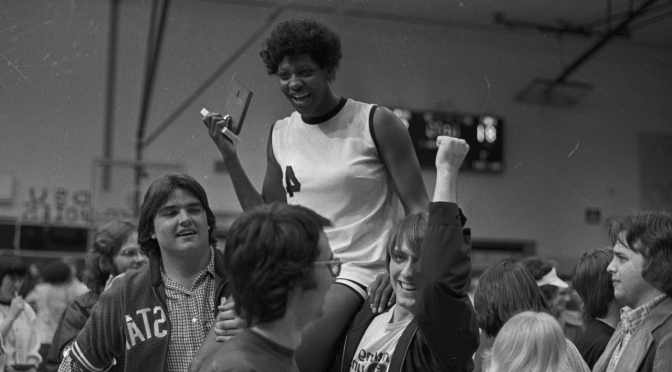
Lucy at the rim for Delta State in a file photo from Sports Illustrated, courtesy of the New York Times.

As the eleventh child of sharecroppers, little Lusia was already a pro at teamwork and routine. She’d go to school, come home to help pick the family’s quota of cotton, and wait for the other kids to flock to her front yard. The Harrises owned the neighborhood’s only basketball goal, and though it was a rickety thing, it’s where Lucy built her dreams. She’d even fall asleep at night with a blanket covering her head and a television tuned to Bill Russell or Wilt Chamberlain dominating the court.

When her high school classmates started teasing her, a basketball coach took notice and taught her the fundamentals. By the time she graduated, she’d led her school in Minter City—an unincorporated blip on the map—to the Mississippi state championship.

In 1973, five years after tiny Delta State University in rural Mississippi finally integrated, and just one year after President Nixon signed Title IX into law ensuring equal treatment of the sexes in programs receiving federal funds, Lucy became the only Black member of the Lady Statesmen basketball team.

A Delta State team photo featured in Ben Proudfoot’s “The Queen of Basketball”

It was the Lady Statesmens’ first year together too. In 1931, Delta State disbanded their team as basketball was “too rough for women.” Title IX brought the program back. In their second year, Lucy and the Lady Statesmen advanced all the way to the AIAW National Championship, equivalent to the NCAA which had not yet included women’s sports.

There was no way a tiny university in its second year of play with a rag-tag team of girls who barely knew each other could hold a candle to the three-time consecutive national champions they faced in the finals. But after a nail-biter of a game ending the first women’s tournament ever broadcast nationally by a major network, Lucy and the Lady Statesmen prevailed over the Immaculata Mighty Macs. Queen Lucy held court before millions, the same way she’d once watched the NBA greats.

Lucy is celebrated as the MVP of the Lady Statesmen’s 1975 national championship upset.

Just like their former rivals, Delta State became the team to beat, taking home the national title every year from 1975-1977. But Lucy Harris was absolutely incomparable. Each year, she was awarded the title of MVP and by the time she graduated, Lucy held a laundry list of jaw-dropping stats. 2,981 points and 1,662 rebounds, with an average of 25.9 points and 14.5 rebounds per game.

The 1975 United States Pan-American Games Women’s Basketball Team. Lucy stands at the back middle. Her teammate and future legendary coach Pat Summitt kneels immediately below her.

For all you folks who don’t follow, Lebron James just set the record as the NBA’s all time highest scorer. His average is 27.2 points per game. Kobe Bryant’s was 25. Lucy was putting up superstar numbers. And scouts took notice.

The United States national team hadn’t won a Pan American Games since 1963. After recruiting Lucy as their go-to scorer, the US team went undefeated to win the 1975 gold medal, besting every opponent by an average of over 30 points per game.

The very next year, Lucy took yet another shot seen around the world, becoming the very first woman to score in a women’s Olympic basketball game. The team left Montreal in 1976 draped in silver medals. Lucy left with more than she could have imagined.

Lucy scoring at the 1976 Montreal Olympic Summer Games. Courtesy of the New York Times/ABC Photo Archives/Disney, via Getty Images.

In 1977, with their 7th Draft pick, the New Orleans Jazz chose Olympic center #7, Lusia Mae Harris.

She was the first woman officially drafted to the NBA.

And she turned them down.

There were two reasons. Growing up in a big family, Lucy always wanted one of her own. A professional career came in direct conflict with settling down, and the secret she was carrying: Lucy couldn’t attend training camp pregnant with her first child, nor would she after Jazz officials had the nerve to suggest that they would own future draft rights to her unborn child.

But if she was being honest, “I didn’t think I was good enough,” Lucy told Ben Proudfoot.

In 4 years, Lucy Harris brought basketball’s highest honors to a college, a national team, and a country, ultimately becoming one of the first women inducted into the Basketball Hall of Fame… but didn’t think she was good enough.

Even Shaquille O’Neal disagrees. “Her numbers were way better than my numbers,” he laughed. “She was so good that the people used to watch her games and not the men’s game.” It’s a stark contrast to today’s attitudes towards women’s basketball, and he wanted the world to know exactly who they’d been missing.

“Listen, I’ve seen a lot of great women basketball players, but the fact that I’ve never heard of this woman, I think it was a shame,” he said. That’s why he and Steph Curry signed on as executive producers of Ben Proudfoot’s documentary on “The Queen of Basketball.”

Between Lucy’s remarkable story, Ben Proudfoot’s mastery in capturing it, and the publicity that two NBA legends brought to the table, “The Queen of Basketball” won the 2022 Academy Award for Best Documentary Short Subject. Unfortunately, two months before she saw that added to her win column, Lucy Harris passed away.

“Better late than never,” her son Chris Stewart told the NBA. “Her story is like so many extraordinary Black women especially in America who end up trail blazing and doing amazing things. They effectively get written out of history unfortunately.”

Ben Proudfoot cosigned that wholeheartedly in an op-ed to the the New York Times.

Lucy was so beloved by Delta State’s student body that she was elected their first Black Homecoming Queen. Courtesy of Ben Proudfoot.

“If you traveled to Cleveland to visit the coliseum, you might think Lucy Harris never existed,” he wrote. “You’d pass a towering bronze statue of her coach, Margaret Wade, who was white and never won a national championship without Ms. Harris. You’d pass a plaque in the lobby dedicating the building to Walter Sillers, who, as the longtime speaker of the Mississippi House of Representatives, fought tooth and nail to keep Black students out of Delta State. And finally, you’d arrive at the hardwood itself, which the university dedicated in 2015 to Lloyd Clark, the white high school coach it hired as head coach instead of Ms. Harris.”

That’s how Delta State has honored Lucy’s legacy, and Proudfoot hopes his documentary’s success is just one step toward one big change on campus. He “offered to loan the Oscar indefinitely for exhibition in the lobby of the coliseum — if the university would rename” it after Lusia Mae Harris.

A year later, Ben Proudfoot, Lucy’s family, and others like her former teammate and women’s basketball legend Pat Summitt who called barrier-breaking Lucy Harris “the first truly dominant player of modern women’s basketball,” are still waiting for Delta State to take Ben up on it.


KEEP GOING BLACK IN HISTORY:

You’ll be absolutely delighted by Lucy’s presence & story in the Academy Award winning “The Queen of Basketball”

Read the Friends of Lucy Harris‘ impassioned plea for Delta State to rename the Walter Sillers Coliseum, and sign your name to their petition.

Hear Lucy tell her story in full for the Women’s Basketball Oral History Project at The University of Kentucky Libraries.

Lucy’s entry at the Basketball Hall of Fame details her amazing career, stats, and multiple claims to fame.

Many of the same circumstances that led to Lucy being forgotten are being echoed in today’s treatment of WNBA and NCAA players. Connect the dots at the New York Times.

DAY 6 — Madame Abomah

Even though Ella Grigsby was born free, she still carried a slavemaster’s surname. Just 10 months earlier in January 1865, the 13th Amendment ensured that “Neither slavery nor involuntary servitude… shall exist within the United States, or any place subject to their jurisdiction.”

As human property in South Carolina, her parents had no choice in being labeled with their owner’s name.

As a free woman, Ella chose a new one, vowing that she’d never be owned by anyone again.

With nothing particularly extraordinary about her, Ella Williams would have disappeared into history…

…if a bout of malaria when she was 14 hadn’t yielded an extreme side effect: Ella kept getting taller.

And taller. And TALLER.

And by the time she stopped growing, Ella Williams stood at least seven feet tall.

Today, that would be exceptional.

But height & weight trends published by the USDA note that in 1866, US senators standing 5’8″ “exceed (in height) the average of mankind in all parts of the world as well as the average of our own country.”

By those standards, Ella wasn’t just exceptionally tall—she was a giant. And that got BIG attention. Circus owners and show business agents flocked to her door, promising unimaginable riches. Just sign on the dotted line…

…a premise she absolutely refused.

As human property stolen from Africa, Saartje Baartman had no choice over her nude body being displayed to paying Europeans, then her dead body too.

As a free woman, Ella had pride and agency. She paid her bills through honest work, tending to the home of a South Carolina couple.

Until the bills started coming faster than the paychecks.

Selling out still wasn’t an option. But neither was starving. So Ella chose Door #3: stardom.

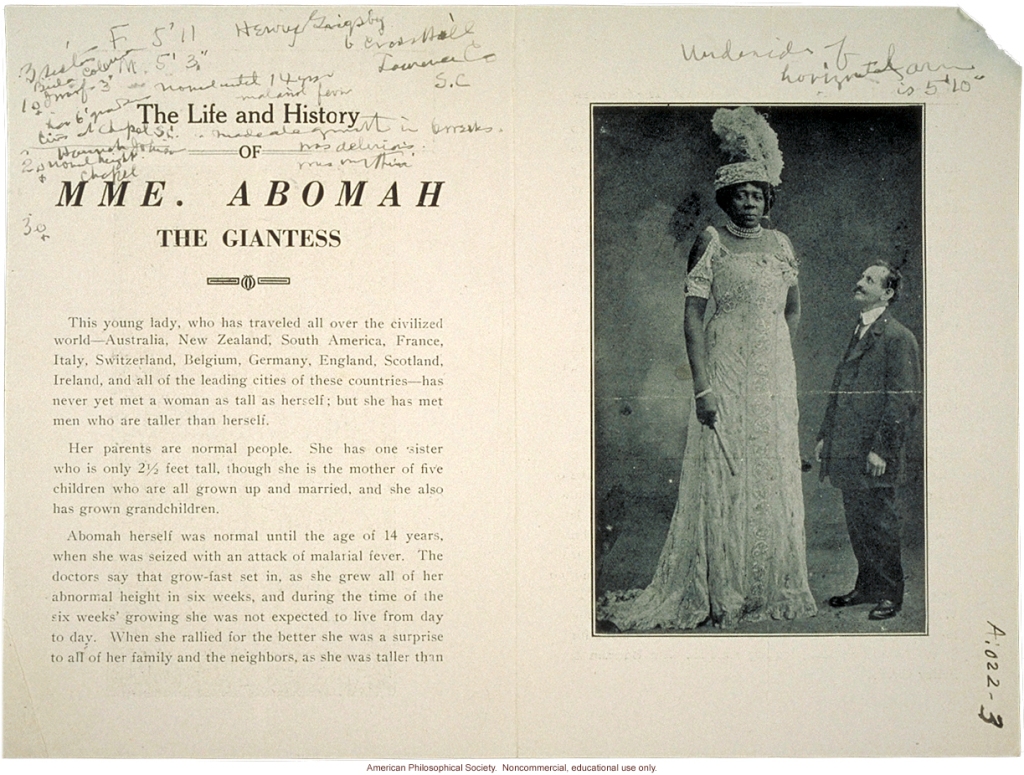
At 31 years old, Ella Williams was once again reborn as Madame Abomah.

“Madame Abomah” was a name chosen for both form and function. A different tall woman named Ella was already touring nationally, so audiences needed a way to distinguish the two.

But furthermore, “Madame Abomah” gave Ella a backstory and a brand. She was no one’s sideshow act. Madame Abomah was royalty. The name was a direct reference to Abomey, capital of the affluent Kingdom of Dahomey, known for its fiercely fighting female warriors. If that sounds familiar, you might recall the Dahomey Warriors as the inspiration for the Dora Milaje of Marvel’s “Black Panther.”

Read more about the Dora Milaje’s real-life predecessors at Teen Vogue.

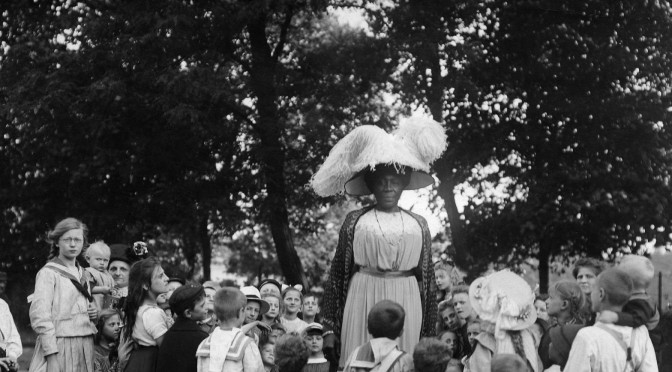
Mind you, Madame Abomah wasn’t an exotic spectacle decked with hoops, shells and a spear either. Instead, she towered over women and men, dripping in lace. Seamstresses stood on tiptoes to lay jewels on her chest. Madame Abomah was the picture of style and grace supersized.

Though it was now a “free country,” most performing venues were still segregated, so white audiences’ exposure to Black performers was largely limited to blackfaced minstrels and Black people with disabilities styled as “human oddities.” The ringmaster of “Greatest Show on Earth” even built his career on the back one of those Black people.

A poster promotes Joice Heth at the Barnum Hotel. Courtesy of the New York Heritage Digital Collection.

Joice Heth was an elderly enslaved woman so whittled and worn by time and hard labor that she was blind and paralyzed. P.T. Barnum rented Joice Heth from her enslaver, and reinvented her as his very first sideshow act: the 161-year-old nursemaid to George Washington. Not one bit of that was true, but it didn’t stop audiences from paying good money to see her, or popular newspapers from “covering Heth’s shows breathlessly,” according to the Smithsonian. On the other hand, The New England Courier roasted Barnum while painting a vividly gruesome picture of Joice’s treatment, writing, “Those who imagine they can contemplate with delight a breathing skeleton, subjected to the same sort of discipline that is sometimes exercised in a menagerie to induce the inferior animals to play unnatural pranks for the amusement of barren spectators, will find food to their taste by visiting Joice Heth.” Barnum even profited from her death, charging spectators for her public autopsy.

Madame Abomah was no “animal” imprisoned to a circus tent, and she refused to be another Black woman treated like one. Fleeing American stereotypes and exploitation, Madame Abomah traveled the world. In the UK, she was a nanny by day who performed at the famed London Music Hall by night. In New Zealand, her name graced headlines written in Māori. In Germany, she snuggled babies and laughed with children, instead of terrifying them from behind a velvet rope.

For 30 years, Madame Abomah’s story is almost exclusively told through newspapers and photographs captured around the world. But in 1914, Britain declared war on Germany, and the United States was soon to follow them into World War I, making it dangerous to be an American citizen abroad. It was here that Madame Abomah disappeared back into obscurity.

With the war in full swing, the demand for entertainment slowed to a halt, and after a lifetime of performing, there were few options available to an aging, Black tall woman. In her last known photos, Madame Abomah appears among the Ringling Bros. and Barnum & Bailey’s Congress of Freaks and at Coney Island. And though the once-tall feather in her fascinator reflects the unfortunate downturn in her career, there Madame Abomah stands with her head held high as a Black woman who repeatedly defied her labels as property to chase her destiny as a big star.


KEEP GOING BLACK IN HISTORY:

Learn about “A Brief History of the Business of Exhibiting Black Bodies for Profit” at Grid Philly.

There’s more about “African Americans and the Circus” at the Smithsonian Museum of African-American History.

DAY 3 — Dr. Mamie Phipps-Clark

With all the obvious arguments against discrimination and segregation, the smoking gun presented to the high court was little two baby dolls wielded by a Black woman.

Dr. Mamie Phipps-Clark photographed at Columbia University.

Dr. Mamie Phipps-Clark would have been a force against racism even without her groundbreaking research. Born in Hot Springs, AR in 1917, Dr. Mamie was one of the rare Black students with the privilege, persistence, and promise to graduate the city’s first high school for Black students with flying colors.

Attending Howard University at the peak of the Great Depression, she graduated with a Master’s in Psychology, a field where women, and especially Black women, were almost unheard of.

Certainly, this was more than anyone could have hoped from a small town girl in a segregated world. But Dr. Mamie’s barrier breaking was only just beginning.

In 1943, she became the first Black woman to graduate Columbia University with a Doctorate in Psychology. And she did so with a thesis that ultimately changed the shape of the nation.

Read the full study as published in the Journal of Social Psychology here.

Dr. Mamie originally presented “The Development of Consciousness of Self and the Emergence of Racial Identification in Negro Preschool Children” as her Master’s thesis at Howard. The topic occurred to her when she simply couldn’t remember a time that she didn’t know that she was Black.

“I became acutely aware of that in childhood, because you had to have a certain kind of protective armor about you, all the time … You learned the things not to do…so as to protect yourself,” she said, describing a phenomenon known to millions of Black children before and since. Dr. Mamie’s initial study included 150 Black children from a DC nursery school, and the results were summed up by her husband and fellow psychologist Dr. Kenneth Clark as “disturbing.” They wanted to dive deeper.

At Columbia, Dr. Mamie leveraged the university’s Ivy League status to further fund, explore and legitimize her work. The 1920s and 30s were widely known as “the era of scientific racism,” the belief that there is empirical and/or biological evidence to support white supremacy. By the late 1930s, Black and progressive white psychologists were working to debunk these theories, but a Black woman fearlessly asserting that “Black people were not limited by innate biological difference but by social and economic barriers to success” was entirely revolutionary.

And so was the evidence to prove it.

The “Doll Test,” as it’s come to be known, had a simple premise. 253 school-aged Black children—134 who attended segregated schools in Arkansas and 119 from integrated schools in Massachusetts—would be presented with four dolls—two Black, two white. But even that simplicity came with challenges: Black dolls weren’t manufactured in 1947, so Dr. Mamie had to paint white dolls Black instead.

Two of the dolls used in Mamie Clark’s studies, courtesy of the Smithsonian National Museum of African American History and Culture

With her dolls at the ready, the experiment was on:
“Give me the doll that you would like to play with or like best.”
“Give me the doll that is the nice doll.”
“Give me the doll that looks bad.”
“Give me the doll that is a nice color.”
“Give me the doll that looks like a White child.”
“Give me the doll that looks like a colored child.”
“Give me the doll that looks like a Negro child.”
“Give me the doll that looks like you.”

The majority associated positive traits to the white doll and negative traits to the Black doll. But these Black childrens’ responses to the last question shook the Clarks so deeply, they didn’t even want to publish the results. When asked to identify the doll that looked most like them, some of the children burst into tears.

Results showed that by age three, Black children were aware of their race and attached negative traits to their own identity, which were then perpetuated by a racist and segregated society. Dr. Kenneth’s summary of the Doll Test was especially clear and truly devastating: “These children saw themselves as inferior and they accepted the inferiority as part of reality.”

Dr. Mamie Phipps-Clark and the children she worked to give self-worth, shot for Vogue Magazine, 1968.

When a young upstart lawyer named Thurgood Marshall discovered the Clarks’ Doll Test, he presented its damning evidence to the Supreme Court in Brown v. Board of Education. And in a historically unanimous decision, Chief Justice Earl Warren agreed with Dr. Kenneth that “To separate [Black children] from others of similar age and qualifications solely because of their race generates a feeling of inferiority as to their status in the community that may affect their hearts and minds in a way unlikely ever to be undone.”

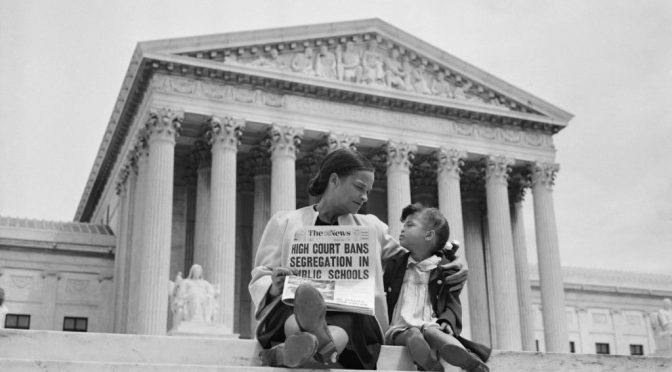
With the 1954 decision, segregation was ruled unconstitutional in the United States. And that’s not all. The Doll Test was the first time social science research was submitted as hard evidence in Supreme Court history.

Nettie Hunt and her daughter Nickie sit on the steps of the U.S. Supreme Court. Nettie explains to her daughter the meaning of the high court’s ruling in the Brown Vs. Board of Education case that segregation in public schools is unconstitutional.

In 2010, nearly 60 years after Brown v. Board, child psychologist and University of Chicago professor Margaret Beale Spencer revised the Doll Test for a pilot study testing both white and Black children. The results were not as progressive as one might hope.

Though all the children demonstrated a positive bias towards whiteness, white children much more frequently identified their own skin with positive attributes and darker skin with negative attributes. For instance, when asked to point to the dumb child, about 76% of the white children pointed to illustrations of the two darkest children. 66% identified the two darkest as “the mean child.” Dr. Spencer’s conclusion differed little from Dr. Kenneth’s all those decades before: “we are still living in a society where dark things are devalued and white things are valued.”

Devastated by the results of the Doll Test and the constant feeling of being an ”unwanted anomaly” in her field, Dr. Mamie Phipps-Clark left experimental psychology. Instead she focused her efforts on undoing the emotional, mental and educational damage inflicted upon Black children by a society that viewed them so negatively.

Read Dr. Mamie’s obituary detailing her many accomplishments at the New York Times.

As a psychologist at the Riverdale Home for Children, she counseled unhomed Black girls until 1946, when she and her husband opened the Northside Center for Child Development to provide psychological services to minority children in Harlem and study racial biases in education. 16 years later, the Clarks opened Harlem Youth Opportunities Unlimited to provide resources for Harlem schools and reduce unemployment among Black high school dropouts.

Though she died in 1983 without seeing her work complete, Dr. Mamie set about treating a wound the United States didn’t even know it had, setting us on a course to finally heal the toxic infection of racism.


KEEP GOING BLACK IN HISTORY:

Smithsonian Magazine details Dr. Mamie’s life, the Doll Test and the impact both had on the world.

Go in-depth into the “Case that Changed America” at the NAACP Legal Defense Fund.

See CNN’s coverage of the 2010 version of the Doll Test, and some responses from the parents of participating children.

If you think these results are unique to the United States, have a look at an amateur recreation of the Doll Test in Italy.

DAY 2 — Mary Jones

(Ed. Note: this Blackstory includes sex work. Discretion advised.)

Over a hundred years before Cardi B ever dreamed of hustling her clients, Mary Jones perfected the art. Like Cardi, Mary was a New York City sex worker and absolutely unashamed.

Unlike Cardi, Mary Jones was born anatomically male.

And the dignity with which Mary carried herself contrast against the notoriety of her crimes made Mary Jones one of the earliest documented transgender people in New York history.

Court records from 1848 misspell Peter’s given name as “Savori,” but include his known alias Julia Johnson and derogatory nickname “Beefsteak Pete.”

Born in 1803 as Peter Sewally, Mary Jones used a whole host of aliases in her exploits: Julia Johnson, Miss Ophelia, and Eliza Smith among a few. But according to The Sun, and many subsequent newspaper reports, the hustle was always consistent.

“During the day, he generally promenades the street, dressed in a dashing suit of male apparel, and at night prowls about the five points and other similar [poor, disreputable] parts of the city, in the disguise of a female, for the purpose of enticing men into the dens of prostitution, where he picks their pockets if practicable, an art in which he is a great adept.”

The papers didn’t expect their readers to ask the obvious question: who needs to dress as a woman JUST to pick pockets?

The papers most certainly didn’t expect that the first time Mary had to answer for her crimes, she’d appear before the court in full female attire so impeccable, officials would ask her to confirm her legal name and born sex, even though she wore the exact same dress she’d been arrested in the first place.

Lithograph depicting Mary Jones/Peter Sewally as “The Man-Monster”. Courtesy of the Smithsonian Museum of American History.

Though the Sun was very tight with details, the New York Herald gladly served the tea: “Sewally has for a long time past been doing a fair business [in] practical amalgamation.” To put it plainly in modern-day language: having interracial sex for money. And it was highly uncommon. Even sex work was segregated, so from opening statements to the reading of the verdict, Mary Jones’ trial was so scandalous that nearly every detail is still recorded in the New York City archives.

As a man, Peter did not simply “promenade the street in a dashing suit of male attire,” he lived and worked as the doorman and butler at a brothel.

“I have been in the practice of waiting upon Girls of ill fame and made up their Beds and received the Company at the door and received the money for Rooms and they induced me to dress in Women’s Clothes,” she testified. “Saying I looked so much better in them and I have always attended parties among the people of my own Colour dressed in this way — and in New Orleans I always dressed in this way —”

Testimony records reading “City and County of New York, Mary Jones being Examined.” Courtesy of NYDA Case Files, NYC Municipal Archives

Peter’s familiarity with sex work gave him a certain insight: dirty men would do anything to keep their dirty deeds quiet. So if he were to commit a dirty deed in return, what were the chances his crimes would actually be reported? And they would have stayed unreported, had Mary not looked SO much like a woman. One man wanted that woman to give him his money back.

A receipt issued by NYPD reads, “Recd. New York, July 16, 1836 rom the Police Office, Eighteen dollars by the order of the court, the same being part o the money stolen rom me by Mary Jones, alias Peter Sewally. Robert Haslem.”

On a Tuesday night in June 1836, Robert Haslem strolled past Bleecker Street where he met a Black woman, “dressed elegantly and in perfect style with white earrings and a gilt comb in her hair.”

“Where are you going, my pretty maid?” he asked, before gladly accompanying her to a nearby alleyway for some business, if you know what I mean. It wasn’t until departing her company that he noticed his own wallet was missing, and in its place was another man’s.

Haslem tried to return the wallet to its rightful owner, who vehemently denied it, before finally admitting he’d lost his wallet under the very same circumstances that his Good Samaritan had. With his wallet returned, there was even less reason to report. But Robert Haslem was still out of $100, and fully invested. The very next night, Mary was arrested for prostitution. Before being taken into custody, she made a last-ditch effort to dispose of a bit of evidence, but instead, the officer recovered two wallets, one of which belonged to Robert Haslem.

Up until the day of the trial, Robert Haslem insisted and even testified that he had relations with a WOMAN who robbed him. The night Mary was apprehended, even the constable had no reason to believe otherwise until his search uncovered a prosthetic. Realizing the full scope of the con, the cunning of its perpetrator, and the continued naivete of her victim, “his Honor the Recorder, the sedate grave Recorder, laughed till he cried.”

Every aspect of the case presented a truly outrageous scene for a 19th century courtroom. But Mary carried herself with such grace and dignity, despite onlookers who insisted on making her gender identity part of the spectacle.

The image of her reflects her appearance in court: soft, demure, feminine. But it’s titled “Man-Monster.” The trial appeared on the docket as “The People vs. Peter Sewally, alias Mary Jones,” so upon arriving, she was immediately outed and heckled mercilessly. One gallery member even snatched her wig off, eliciting “a tremendous roar of laughter throughout the room.”

Despite her poise and her plea, Mary Jones was found “Guilty” and sentenced to 5 years in Sing Sing for grand larceny.

Court documents show Peter Sewally, alias Mary Jones being sentenced to a term of five years imprisonment.

But she didn’t stop the hustle. Mary Jones and all her aliases appear again and again in newspaper archives and New York District Attorney’s case files as late as 1848, 12 years after her first trial.

Though mocked, maligned and misidentified, Mary Jones never backed down from who she was. Every time she was taken into custody, it was under a woman’s name. And with her courage, she created a precedent, as the first person in New York—home of the Stonewall Riots 133 years later—to go on the record as out, proud and unashamed.


KEEP GOING BLACK IN HISTORY:

Discover all of the spicy details behind Mary’s trial and continued arrests from historians, Jonathan Ned Katz and Tavia Nyong’o at OutHistory.

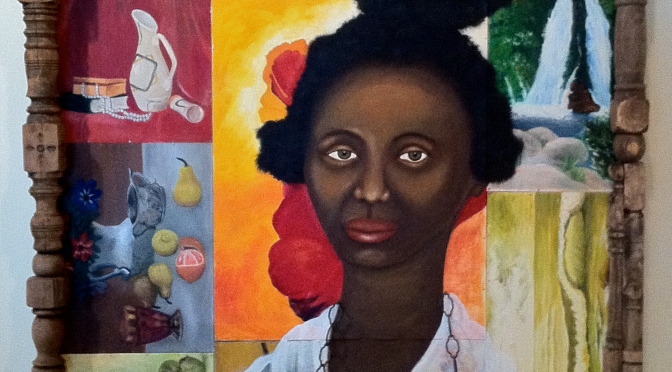
Image: “The Con Art of Peter Sewally” by Lezley Saar

Read more records preserved from the many trials of Peter Sewally in “The People vs Mary Jones: Rethinking Race, Sex and Gender through 19th-Century Court Records” via the NYC Archives.

Sort through a few clippings of Mary’s subsequent exploits at the Digital Transgender Archive.