If a photograph of Ellen Valenton ever existed, it didn’t survive nearly two centuries.
So I have no idea if she left her house in New Orleans’ 10th Ward wearing a tignon.
But Ellen was exactly who Tignon Laws were designed to oppress.
New Orleans’ femmes des couleur libre—free women of color—held a unique social status. They owned their own property and businesses, exercised their legal rights, and some achieved a net worth upward of $10,000.
With all this access, they’d become white men’s companions, white women’s competition, and total chaos to a social hierarchy established on skin color.
And Ellen DID leave a glimpse of that chaos behind.
Starting with the 1860 U.S. Census, she and her daughters are magically “white” then “negro” over and over again.
So, since they weren’t always clearly identifiable and could all use a visible reminder of their place, women of color — whether light or dark, free or enslaved — were forced to identify as a “slave class” whose hair would be covered in public with “tignons.”
But the moment Empress Joséphine Bonaparte saw women of all skin colors wearing gorgeous tignons and started wearing one of her own, the femmes des couleur libre’s Scarlet Letter was suddenly mainstream fashion.
So I can’t know for sure if Ellen wore a tignon for the culture, for the style, or if she refused altogether.
But I’m absolutely certain of the rest.
Because Ellen Valenton is my great-great-great-grandmother.
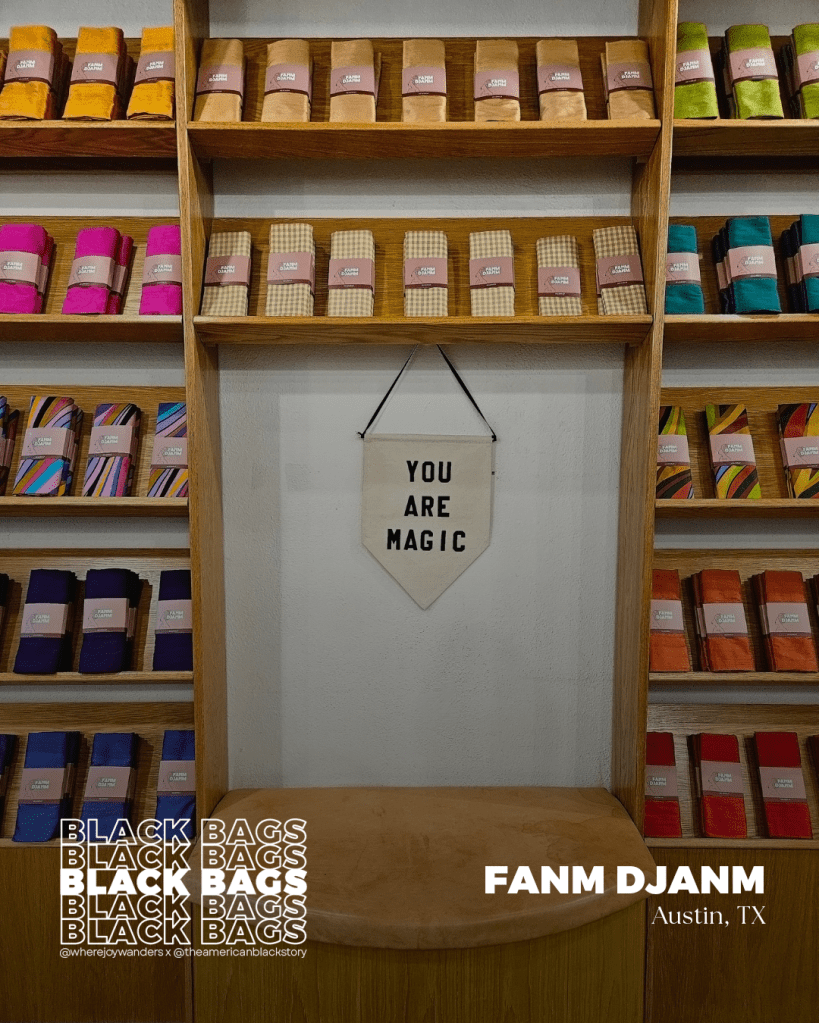
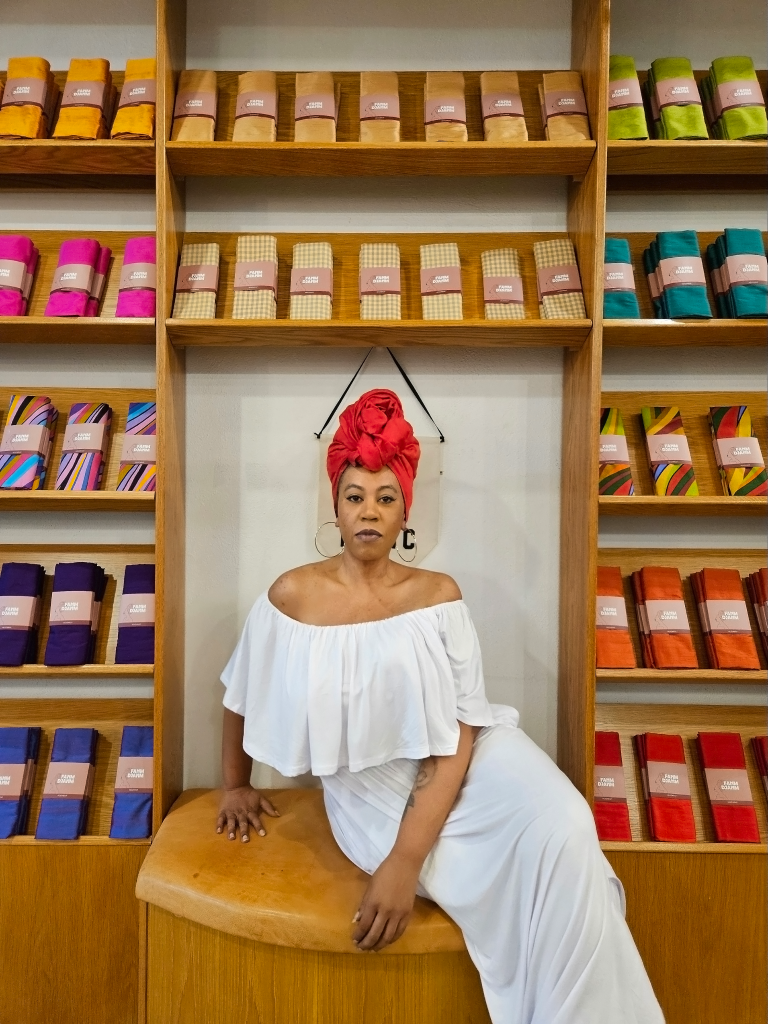
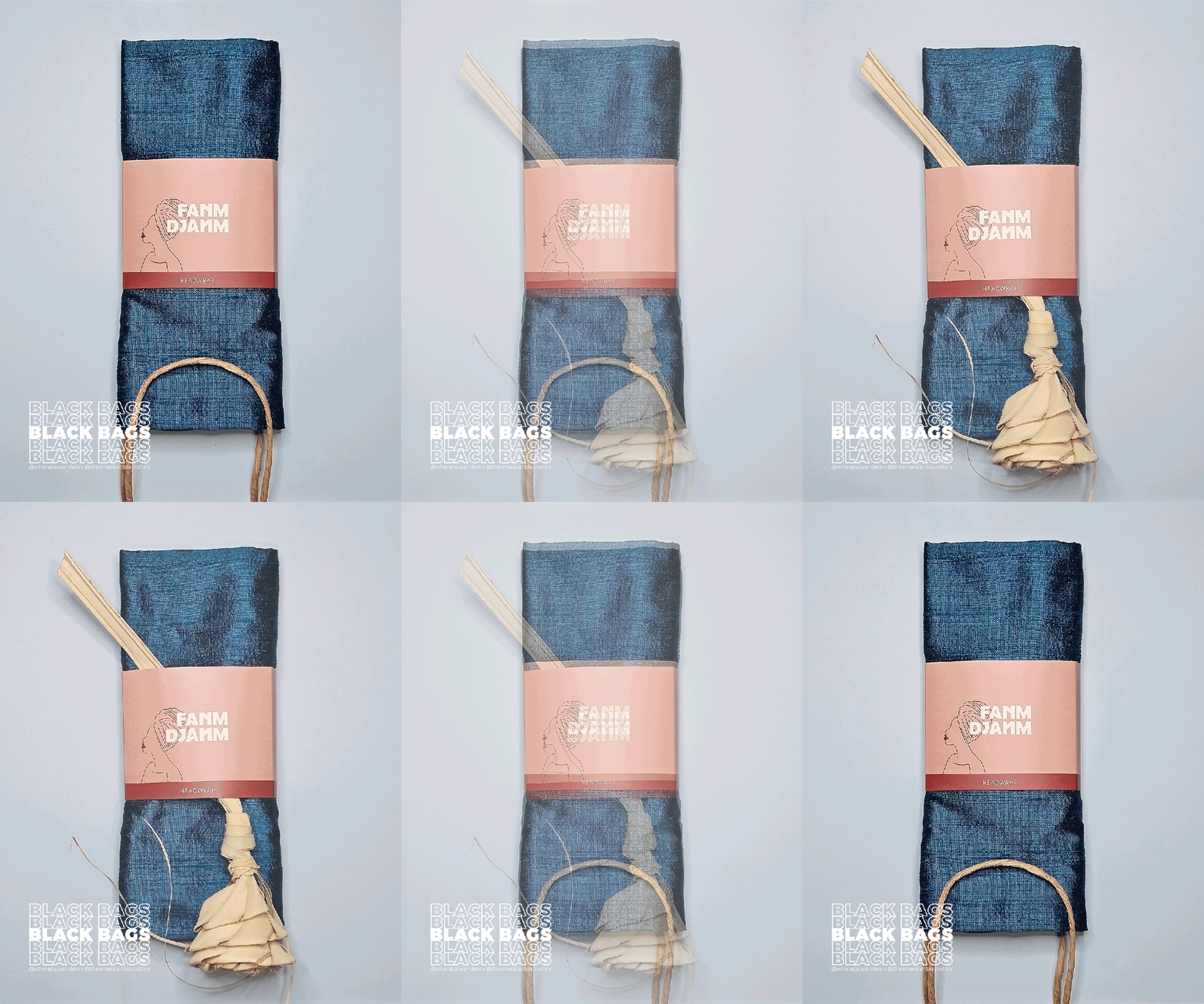
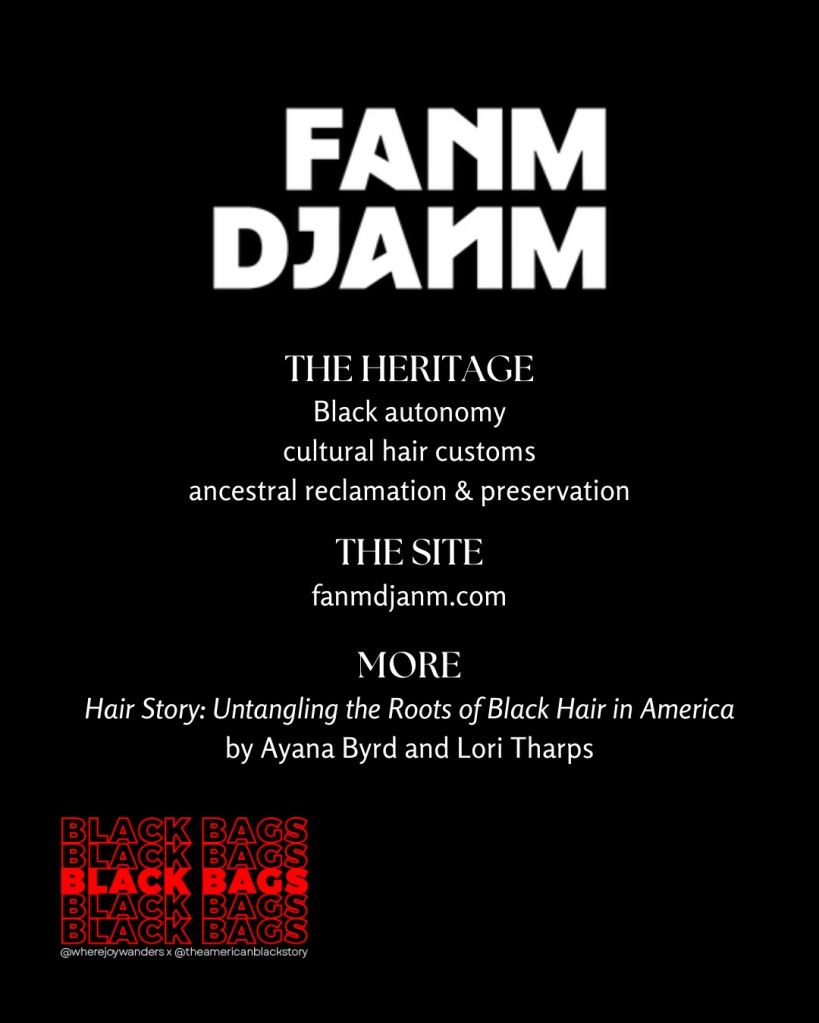
So I walked into @fanmdjanm (Haitian Kreyol for “strong woman”) less focused on spending money than what I had to gain.
Rich silk, crisp cotton, and buttery jersey lined a full wall like paint samples of both vibrant color and vivid history, with each one calling to mind some photograph, painting, or real life experience with women across the African diaspora.
But I can only imagine Ellen.
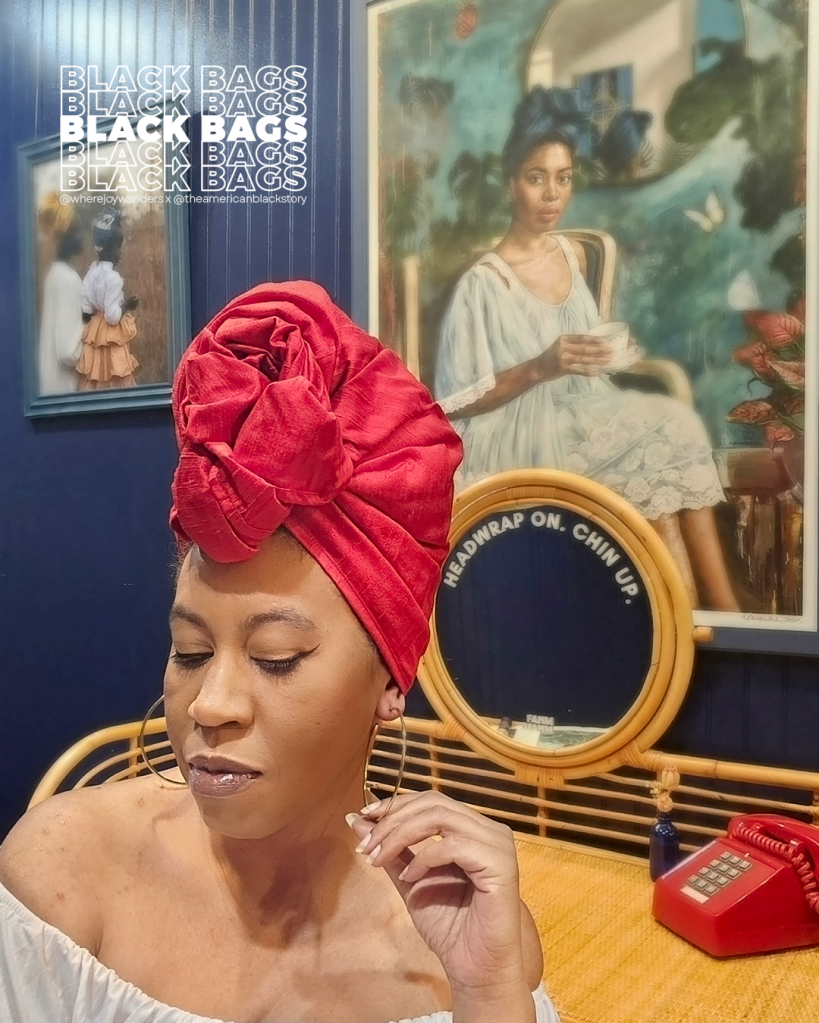
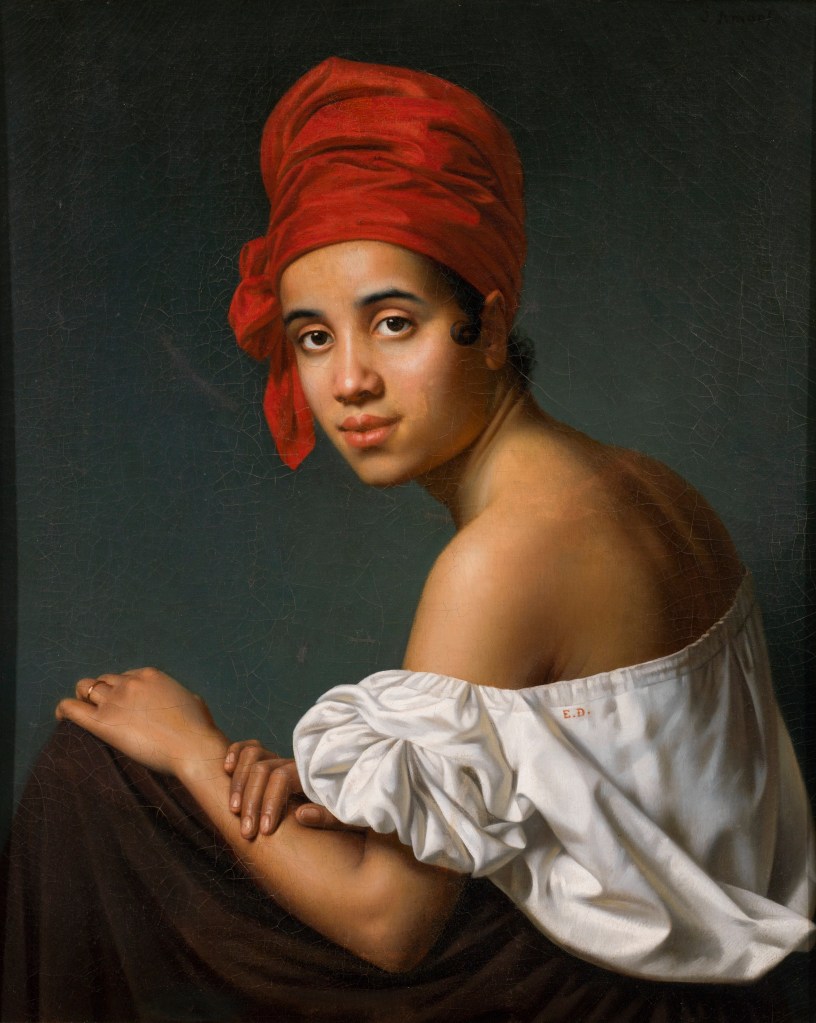
And when I do, a portrait comes to mind: Jacques Amans’ “Creole in a Red Headdress.”
I wonder how many other women walk into Fanm Djanm with that same vision.
And how many more walk out completely unaware that their paper bag is carrying a crown.
But the biggest slave revolt in United States history remains one of this country’s best kept secrets.
One of many plaques at the monument to the German Coast Uprising at the Whitney Plantation, just across the Mississippi from the former Andry Plantation.
The French, Spanish, and British armed forces couldn’t defeat the Haitians, and when news of enslaved people taking back their freedom spread through the Caribbean, it became literal wildfire on islands like the Virgin Islands, Jamaica, Barbados, Grenada and many more.
In 1811, just 7 years after the Haitian Revolution, that wildfire spread north to the States. Much like those in the Caribbean, climate conditions in Louisiana favored sugar cane, a crop so brutal to harvest, that when slavery ended, laws essentially legally enslaving convicted criminals (many of whom weren’t real convicts, but victims of the Black Codes) were enacted to fill the gap, because even for pay, Black people wouldn’t do it.
“Slave Uprising” by Haitian artist Ulrick Jean-Pierre who frequently paints scenes from the Haitian Revolution.
It was far from the first or last time enslaved people would take their freedom into their own hands. American historian Herbert Aptheker defines a slave revolt “as an action involving 10 or more slaves, with ‘freedom as the apparent aim [and] contemporary references labeling the event as an uprising, plot, insurrection, or the equivalent of these’,” according to PBS. By those standards, there are at least 250 recorded “revolts and conspiracies in the history of American Negro slavery.”
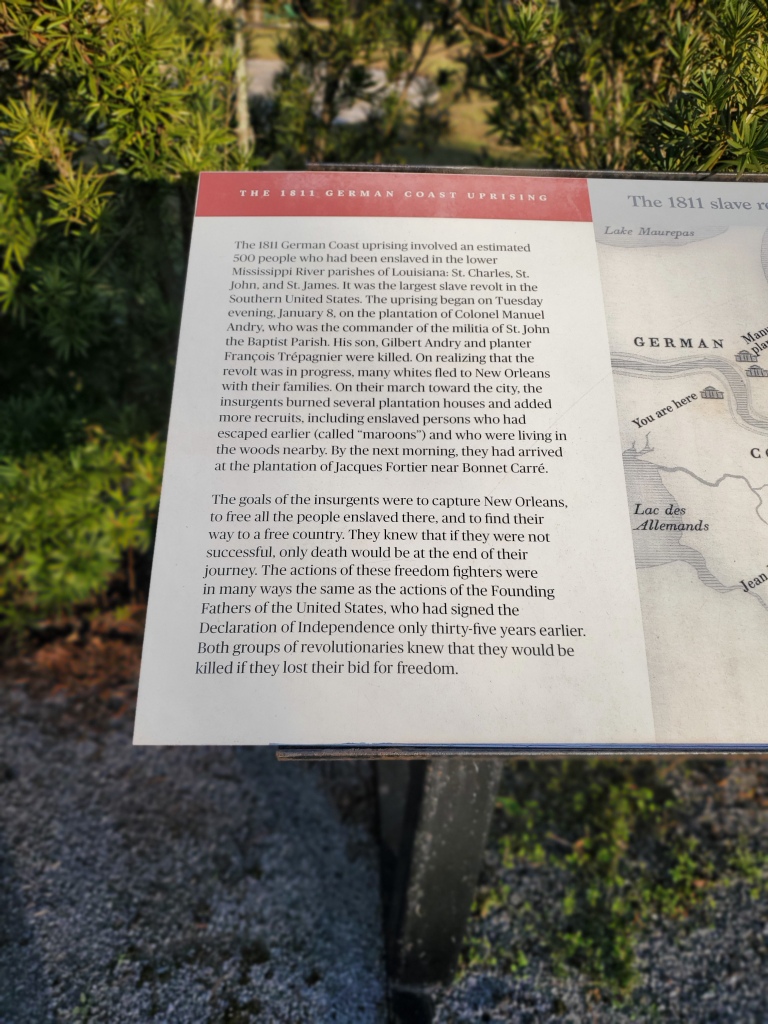
The largest of them was formed by the 500 participants of the German Coast Uprising that marched on New Orleans on January 8, 1811.
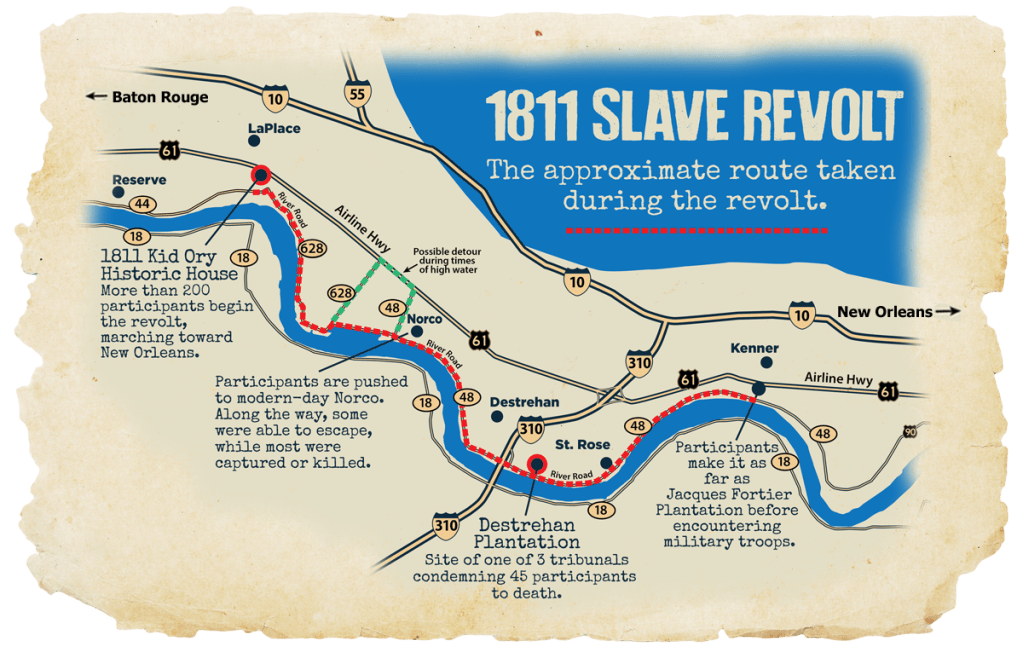
The rural night was even darker than usual 30 miles west of the Crescent City in LaPlace, Louisiana, where thunderheads poured in from the Gulf. Lulled by the rain and a misplaced sense of security, Manuel and Gilbert, father and son masters of the Andry Plantation, slept soundly in the big house, utterly unaware of the forces descending upon them. Led by Charles Deslondes, around a dozen enslaved men stormed the mansion, cornering and killing young Gilbert. His father slipped their grasp, fleeing into the Louisiana swampland with nothing but his jammies and slim chances of survival. And anyway, the rebels’ strategy was sounder than they’d been given credit for. It wasn’t simply an assault on a single plantation – enslaved allies in New Orleans had conspired with Deslondes & Co. to wage their own assault in the city when their reinforcements arrived. From either direction, the Mississippi River Plantations and the New Orleans slave trade were to meet their doom.
From the Andry Plantation, Charles Deslondes and his rebels marched downriver, gaining numbers at each plantation they passed, and leaving fire in their wake. By the time the rebellion reached the outskirts of New Orleans, 5 plantations were in flames and nearly 500 enslaved men and women had joined the cause. Those numbers may well have changed the entire face of the American South if not for one fatal mistake: Master Andry had indeed survived swamp, only to alert his fellow plantation owners. The early warning was still too late for 3 of the 5 plantations that ultimately burned to the ground, but was ultimately sufficient for local militias, 30 Army soldiers, and 40 Navy sailors to respond en force. Armed with very few guns and mostly field tools, the rebels were no match for military strength. On January 11, 4 days after it had begun, the German Coast Uprising was finally suppressed.
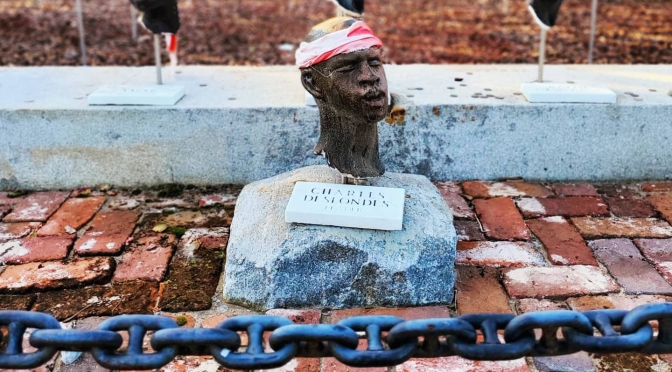
A day later, Charles Deslondes was captured, identified as the rebel leader and sentenced to a brutal death, without any trial at all. According to a Navy officer, his slow execution began as he was “shot in one thigh & then the other, until they were both broken – then shot in the body and before he had expired was put into a bundle of straw and roasted!”
But his was only the first of many gruesome executions, designed to terrorize any enslaved person who might ever again consider violence against their captors. A jury of 5 slave owners sentenced almost all of the rebels to death by beheading, with each head mounted on a pike in a 60-mile long stretch between LaPlace and New Orleans, and beyond. Their bodies were hung from the New Orleans levees, rotting in full display. At individual plantations, the same sentences were carried out, with every enslaved member of each house forced to watch.
A recreation of the sentence carried out on the German Coast rebels, erected at the Whitney Plantation.
It was a psychological torture that effectively erased any trace of the uprising. While the legal proceedings were recorded, nothing else about the events of January 8-11 ever saw the light of day, and enslaved people wouldn’t even dare speak of it lest they be accused of conspiracy as well. But they didn’t forget. 50 years later, the children and grandchildren of the German Coast rebels joined forces with the Union Army, numbering among the 28,000 men (only around 5,000 of them white) who left Louisiana to fight against the Confederacy in the Civil War, once again – and this time, more successfully – shedding their ancestors’ blood for freedom.
February 2022’s American Blackstory began with Henrietta Wood’s case for freedom. It ends with a fight for it that while suppressed, couldn’t be extinguished.
Unquenchable fire is our past, present and future, so let this American Blackstory, among the many others that those who’d rewrite history have attempted bury, be a constant inspiration to keep burning bright.
The leaders of the German Coast Uprising. Not slaves. Real men with real names and real lives demonstrating real courage.
The Times-Picayune/New Orleans Advocate documented the rebellion in their Tricentennial spread. Read the text-only version here.
Hear what the re-enactment means to the participants themselves in a short courtesy of PBS News Hour.
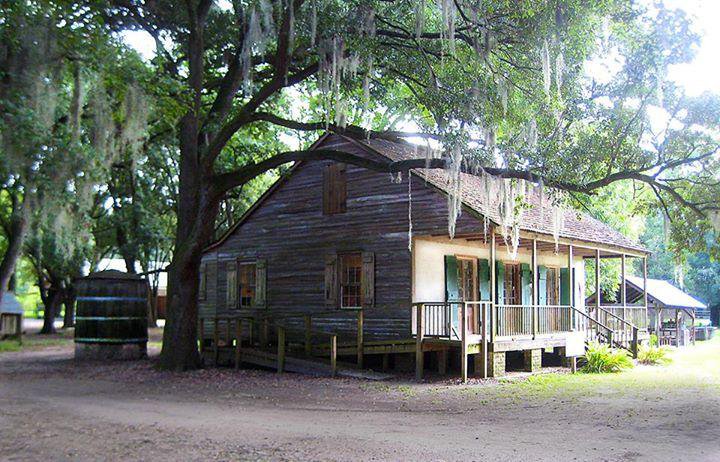
The Whitney Plantation, just across the river from the Andry Plantation (now known as the Kid Ory House), has a series of resources available for those who’d like to learn more about the geographic & historic context of the revolt.
The endless mazes of cypress and tupelo trees, cold-blooded predators lurking, and flesh-eating insects guarding the dark, murky Louisiana swamps were all a better fate than the chains waiting for the newly enslaved.
In fleeing their French captors, some survived the swamp’s perils, creating independent, hidden communities called “maroon camps.” (The inhabitants themselves were the “maroons.”) Others perished in the marshlands, but did so as free people, fighting to live.
Many who survived didn’t do it without an unexpected assist from the fiercely independent indigenous peoples of the Choctaw, Blackfoot, Seminole and other local tribes. When the French established the great city of New Orleans in the early 1700s, they did so on already occupied land. The Natives who weren’t scattered by the decimation of their tribes and sacred land were enslaved to build the future Crescent City. Unfortunately for the French, these peoples’ languages and customs, intimate relationship with the terrain, and strategic prowess made their frequent escape a constant liability.
The French didn’t have to wait long for replacement labor, though. In 1719, ships of enslaved people arrived from Africa, Haiti and the West Indies. Without the home advantages native people capitalized on, and terrified of a new, unfamiliar place where humans, plants and animals all held danger, the newly enslaved were much more vulnerable. Rather than live under a slavemaster’s whip, many fled into the nearby swamps, where natives who came upon them fed, clothed, guided them to safety, and sometimes welcomed the newly freed into their own tribal communities. The black and native people even established their own “Swampland Railroad” to liberate those who couldn’t escape to maroon camps on their own.
The deep alliance and mutual cultural respect black and indigenous people shared culminated into the French’s worst fear in the Natchez Revolt of 1729 when 280 slaves and 176 natives joined forces to destroy the tobacco farms further impinging on native lands and enslaving more black people. Their uprising was unsuccessful, but the relationship had been solidified. Though the French repeatedly implemented an assortment of laws and regulations – such as the “Code Noir” that regulated basic behavior like when, where, and if people of color were allowed to gather, leading to the establishment of New Orleans’ historic Congo Square – the two marginalized groups cultivated a friendship that only grew deeper with French suppression.
Having gained so much from the indigenous Americans, by 1746, the free black communities chose to honor and appreciate the tribes in the best way they knew how – by incorporating hallmarks of tribal culture, mythology and textile making into their own creations for the biggest celebration of the year, Mardi Gras. Black people were only allowed to attend the city festivities as servants, and once again couldn’t gather together under French law, but when police were occupied with peacekeeping among the major white-only parties, in black communities, vivid feathers, beaded story scenes, and tribal traditions learned from local natives became the fancy dress of choice. The bravest of black revelers would even craft masks to go with their elaborate suits, and sneak into the society events undetected. Masks were soon outlawed as well, but a centuries-long tradition was born.
Today, the Mardi Gras Indians – or Black Masking Indians as some prefer to be called, since people of color were historically segregated from the festival – preserve the tradition of their African and indigenous forefathers. During Mardi Gras, St. Joseph’s Day, and “Super Sunday” – in recognition of the only day of the week that black free and enslaved people were allowed to congregate, trade and socialize together in Congo Square – dozens of “tribes” of Black Masking Indians parade the streets of New Orleans, hoping they’ll be recognized by the crowds as the prettiest of them all.
“Beads and feathers have always been worn by indigenous people — you can’t hide among a people unless you resemble them,” explains Big Chief Shaka Zulu of the Golden Feather Hunters. “Masking” is the term used to describe dressing in your hand-crafted suit, likely derived from the tendency to subvert segregated Mardi Gras parties by donning a mask. In each tribe’s suit, elements of indigenous, African, and Afro-Caribbean influence all intermingle to create a distinctly southern African-American tradition.
“It is a tradition of resistance. It is an homage to the mutual struggles of both African Americans and indigenous Americans on their quest for freedom, self-actualization, and self-expression in America,” one Black Masking Indian queen proudly explains.
Each Black Masking tribe mirrors a typical native tribe’s hierarchy with a Big Chief, Big Queen, Spy Boy (scout) and Flag Boy (banner man). Tribes throughout New Orleans’ neighborhoods bear names as colorful as their suits, like the Young Maasai Hunters, Bayou Renegades, Black Seminoles and Yellow Pocahontas, many referencing the deep Native American, African and creole cultures that thrived together secretly for centuries. And the suits they hand-sew in the tradition of their allies and ancestors can cost up to $30,000, but are only worn for a single season. It’s a small price to pay to preserve and perpetuate such a beautiful expression of history.
Those who preserve that history today stress its importance to a cultural future in New Orleans, especially in the wake of Hurricane Katrina. “We still have some depressed neighborhoods in New Orleans,” one chief acknowledges. “When the Black Masking Indians meander through their communities, they provide a sense of belonging, a sense of self. It’s about uplifting and empowering [people] to feel good about themselves rather than feeling ‘less than.’”
Some of the Black Masking Indians can trace their lineage back to the original black and indigenous people of Louisiana, others were welcomed and initiated into the society by existing members. But either way, when the Black Masking Indians dance down the streets of New Orleans, cultures that once had to go into hiding come back to life in a bold, storied, and most of all, public display, of black and indigenous southern history at its most beautiful.





 THE AMERICAN BLACKSTORY