Tag Archives: JAMES VAN DER ZEE

NYC, DAY 4 — February 2

Days 2 & 3 were a working whirlwind, but I had a gust of energy behind me after a night with Valerie June.

Killed the pitch, met agency leadership, treated another team to lunch, mentored a junior, and still had time to text my old friend @reallouismendes.

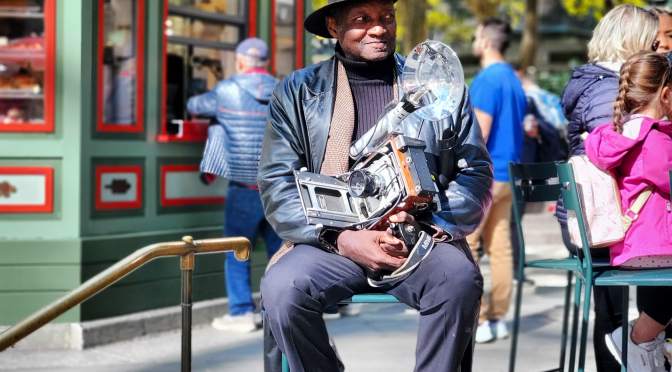
Back in 2022, we met in Bryant Park when I tried to take a picture of him and move on, but got acquainted with the legend instead.

He’d texted me months later to ask for the picture he’d taken of me. But there wasn’t one. We’d gotten too caught up in conversation. 🥺

So a year and a half later, I decided to shoot my shot, short notice and all.

And wouldn’t you know it, not only was Louis free, he lived mere blocks from my hotel. 🤗

He shuffled up 44th Street on a cold, wet, and gray Friday morning, with his trusty 1940s Speed Graphic camera shining like a lantern.

If I thought I was the only person who broke into a silly smile at the sight of him, the next few hours proved me sorely mistaken. Between his vintage cameras and impeccable style, strangers absolutely gravitate to Louis.

We rode the 2 Train from Times Square to Harlem for breakfast at Jimbo’s Hamburger Palace. From the station to the breakfast table and everywhere in between, I sat front row to the Louis Mendes Show.

“Hey, man, that’s a dope camera!” a young Latino man shouted from a car at a corner we crossed.

“WHAAAAAAT?! NO WAY!” A Lululemon soccer mom exclaimed from a train platform as she snapped as many pictures of him as she could before the doors shut.

And everywhere we went, he lifted my soul with New York’s stories, too. How the mosaic tile leading down to Times Square station was original, the irony of the Harlem Hospital once being segregated, how he’d met James Van Der Zee and even attended Gordon Parks’ funeral.

Like… 🤯

I asked his favorite places to take pictures. “Anywhere I can make money,” he retorted. (Louis has a witty response for just about everything, I quickly learned.)

But after breakfast, he said he’d take me to his favorite rainy day spot: Grand Central Station, one of my favorites too.

That’s where I finally got my picture.

And a couple of invitations to way, way more… 🥰

[Ed. Note: This post is part of a one-time February 2024 mini-series that took me to NYC where I was treated to an abundance of Blackstories first-hand. In place of my usual February content, I chose to share my own real-time (-ish) lived experience to honor the vibrant people New York put in my path.]

DAY 16 — James Van Der Zee

James Van Der Zee - The All-Seeing Eye of Harlem

James Van Der Zee was a master of composition, but his most brilliant works were created not behind his violin or piano, but through the lens of his camera.

When he made his way to Harlem in 1906, it wasn’t his first time. He’d visited often from his small hometown in Massachusetts, and marveled at the pictures he’d taken in the big city since he was 14, honing his eye along the way.

A couple enters James Van Der Zee’s 135th Street brownstone basement GGG Photo Studio in Harlem.

But photography couldn’t pay the bills, and surprisingly enough, his skill as a musician could, so he created and subsequently packed theater houses with the Harlem Orchestra. He even performed with jazz icons, but still his eye wandered back to the camera. Having regularly worked small jobs between music gigs, it was no surprise when in 1915, he landed one as a darkroom assistant whose skill was proven so quickly that he was promoted to portraitist within a year, and opened his own studio on 135th Street within two.

Jean-Michel Basquiat, and his cat.

His talent couldn’t have come to fruition at a more fortuitous time for both James and the residents of Harlem. With the start of the Harlem Renaissance around 1918, black art, literature and culture was gaining international recognition, and being celebrated within black communities on its own merits and for its success in the mainstream. Black photographers were included in this praise, and also key to capturing the social, economic, and personal benefits that many black people were enjoying for the first time in America. In James’s studio, some of the most meaningful moments in everyday black lives and in all of black history were captured on film. Baby pictures, young newlyweds, funerals, civic groups and iconic portraits of black leaders and celebrities were all included in his exquisite body of work which spanned until 1982, nearly right up until his death a year later at the age of 96.

But his photographs are so much more than the sum of their parts. He didn’t just capture a black middle-class in the height of their recognition by a society that had previously enslaved them. At the start of his professional career, he made it a point to sign, date and number each of his photographs. Such care for his craft and attention to detail meant that when his work was discovered in 1967 by a researcher for The New York Metropolitan Museum of Art, his then 75,000 photographs became one of the most fully verifiable and extensive archives of black life since slave records. Because marriage/birth records and the ability to freely own property weren’t available to black people until in some cases well after the Civil War ended in 1865, further proof of our generations, personal wealth and especially a positive visual record of both beyond often sparse government and media documentation was tremendous to the culture and to the further preservation of our place in America’s past.

As a black man positioned behind a camera during one of the most significant eras of black history, James was able to show the whole world an entirely novel perspective on his subjects, no matter their status or the gravity of the occasion. When asked why and how he created such ethereal and regal images, he remarked “I wanted to make the camera take what I thought should be there.” What James Van Der Zee and his camera left behind was a legacy of black excellence.


KEEP GOING BLACK IN HISTORY:

James’ Metropolitan Museum of Art exhibit was accompanied by a catalogue of newspaper articles and curated images from Van Der Zee and other black photographers, available here.