
In the months he spent writing letters, devising plans and scheduling secret rendezvous, Henry Brown was resolved to “conquer or die.”
But as he lay terrified and motionless to avoid detection, confined to a 3 x 2 x 2.5 foot crate onboard a steam ship en route to Philadelphia in 1849, Henry was convinced that the latter would indeed be his fate. “I felt my eyes swelling as though they would burst from their sockets,… and a cold sweat coming over me that seemed to be warning that death was about to terminate my earthly miseries,” he later recalled.
And there was nothing but misery. The only joy in Henry’s enslaved life – his pregnant wife Nancy and their three small children – had been torn away, sold to a distant plantation. “My agony was now complete, she with whom I had traveled the journey of life in chains … and the dear little pledges God had given us I could see plainly must now be separated from me forever, and I must continue, desolate and alone, to drag my chains through the world.”
With that utter sorrow in his heart and nothing left to lose, Henry was ready to risk his physical and mental well-being if that’s what it took to escape what he’d endured. And so, with the help of a number of abolitionists and today’s equivalent of $2700 to cover his transport fees, Henry left Richmond, VA and never looked back. Packing only a small bladder canteen and a couple of biscuits, he spent 27 hours contorted into an express crate addressed to a trusted member of the Pennsylvania Anti-Slavery Society 244 miles away.
“If you have never been deprived of your liberty, as I was,” he wrote in his memoir, “you cannot realize the power of that hope of freedom, which was to me indeed, an anchor to the soul both sure and steadfast.”
Henry transfixed his thoughts on that hope the entire journey, trying not to move or make a sound, and praying he wouldn’t suffocate before he arrived, whenever that might be.
Luckily, on the morning of March 30, Henry’s hope of freedom was realized when from outside of the darkness, there came a polite knock and four short words:
“All right in there?”
And with a little help, Henry climbed out of his box, exhausted, drenched in sweat, but alive.

The tale of the man who’d shipped himself out of slavery swept through the abolitionist community like wildfire. Many wanted to publicize Henry’s fantastic getaway, hoping it’d inspire others to devise their own similarly ambitious plans for escape. Others like Frederick Douglass saw greater strategy in keeping the details quiet, utilizing this covert operation to free as many others as possible themselves.
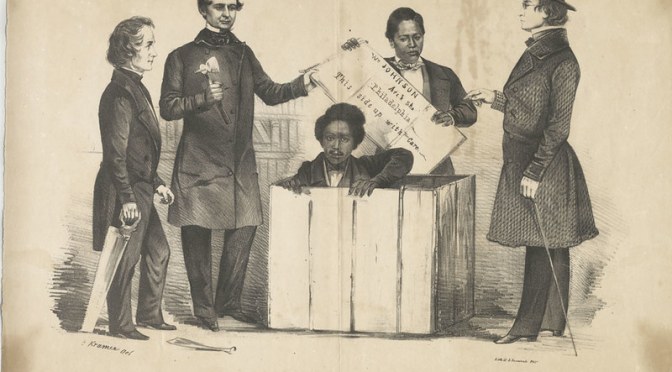
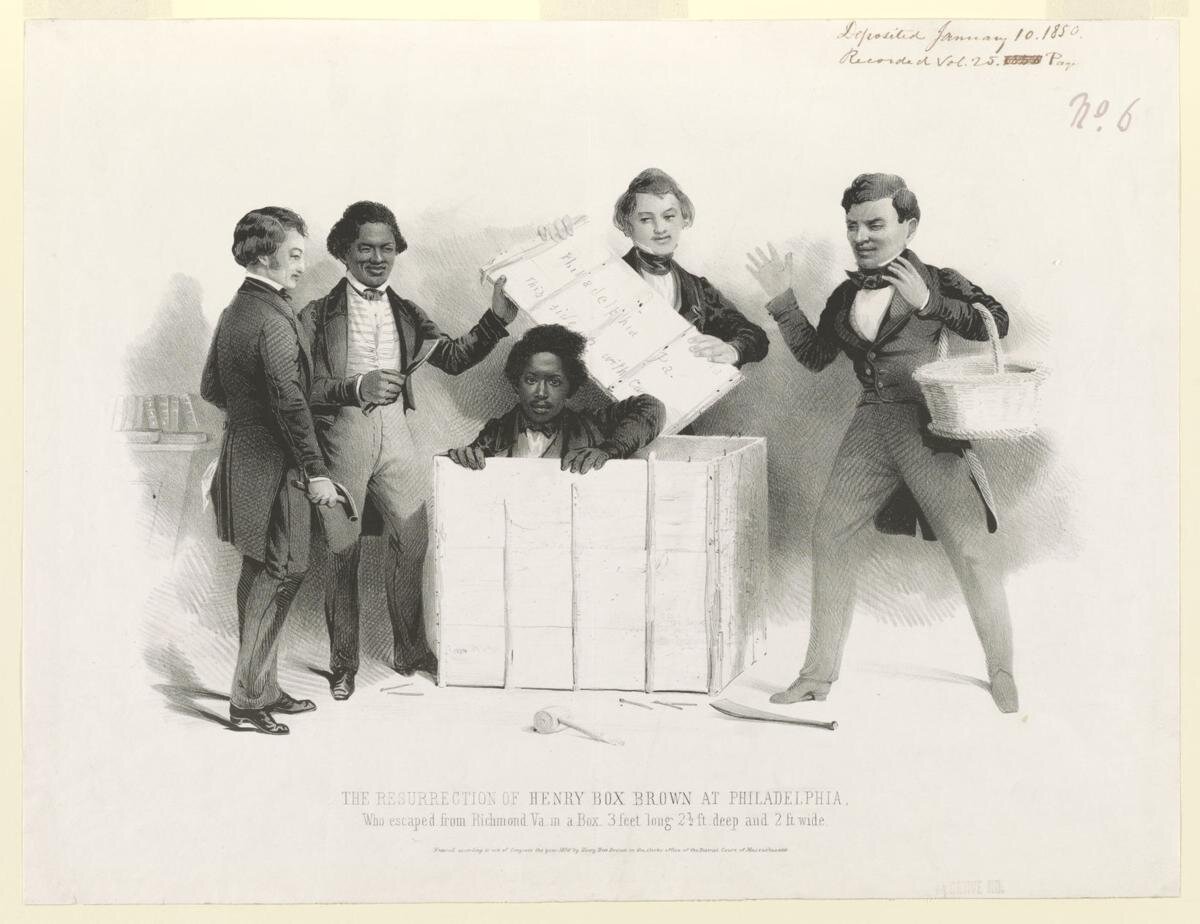
In the end, it was decided that Henry’s story would go public. And for a short time, Henry’s past miseries were replaced by his newfound freedom and fame. A memoir was written, lithographs memorializing his “resurrection” were printed, and “Henry Box Brown’s Mirror of Slavery,” a stage show complete with dioramas depicting various scenes from Henry’s life alongside his original, full-sized shipping box, played to New England audiences until October 1850, when enslavement threatened again.
The newly-passed Fugitive Slave Act entitled slave owners and the federal government to retrieve and punish escaped slaves, even if they’d found freedom in northern states. For a man who’d earned fame because of his daring escape and whose livelihood depended on retelling that story, it spelled grave danger. This time, Henry determined to put even more distance between him and his former life, sailing to England as a free man.
He continued to perform there, remarried, and eventually returned to the States, but his real work had been done. Henry Brown’s widely publicized escape made him a symbol of the Underground Railroad’s growing power and massive organization efforts, and inspired many more slaves, freedmen and abolitionists with the courage to be creative in the fight for life, liberty and the pursuit of happiness, even if it meant risking everything, every step of the way.
KEEP GOING BLACK IN HISTORY:

Read the “Narrative of the Life of Henry Box Brown” written by the man himself here.
 THE AMERICAN BLACKSTORY