Tag Archives: FUGITIVE SLAVE ACT

DAY 12 — Elizabeth Keckly

“Slavery” is a cold, factual word that tidily boxes up millions of personal indignities repeated over and over again.

“Freedom” is usually considered its opposite, but I’d propose another: “agency.”

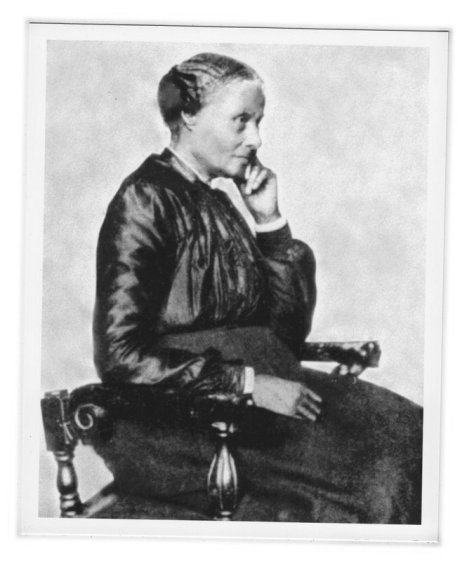
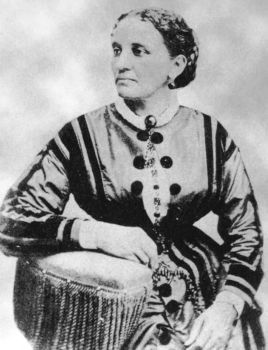
Elizabeth Keckly, in her prime. She came to be known as Madame Keckly among Washington D.C.’s high society.

Everything about the antebellum Virginia world Elizabeth Hobbs Keckly was born into was designed to deprive her of agency. She lived to take it back.

Elizabeth’s mother Aggy wasn’t as fortunate. Her daughter’s father wasn’t her husband George, but her owner Armistead Burwell. She’d attempted to claim what little agency she could in the circumstances by rejecting her enslaver/rapist’s last name in favor of her husband’s: Hobbs. Aggy didn’t share that truth with her daughter until her deathbed. Perhaps it brought back too many bad memories, like how Burwell gave the Hobbs family two hours notice before selling George to a slaver in the West. Elizabeth recalled their collective helplessness in her autobiography: “I can remember the scene as if it were but yesterday;–how my father cried out against the cruel separation; his last kiss; his wild straining of my mother to his bosom; the solemn prayer to Heaven; the tears and sobs–the fearful anguish of broken hearts… the last good-by; and he, my father, was gone, gone forever.”

Prized by the Burwells for her many talents, especially the seamstress skills that she was expected to teach her daughter, Aggy was kept. But Aggy could also read and write, and likely taught her daughter those skills as well. Instead of the domestication expected of her, Elizabeth eventually wielded her needle and pen as silent weapons of subversion instead.

That subversive streak simmered early on. As a teenager, she was sent to North Carolina to work in the service of her (then unknown) half-brother Robert. Perhaps because Robert’s wife Margaret easily guessed the source of Elizabeth’s light skin and wanted to punish her for it, or perhaps simply because she was cruel, Margaret enlisted the help of a neighbor to “break” Elizabeth. When the neighbor summoned Elizabeth, demanding that she strip down for her first humiliating beating, she replied, “You shall not whip me unless you prove the stronger. Nobody has a right to whip me but my own master, and nobody shall do so if I can prevent it.” She could not. Week after week, Elizabeth was beaten until her abuser was too exhausted to continue. Week after week, “I did not scream; I was too proud to let my tormentor know what I was suffering,” she wrote. Eventually, it was he who “burst into tears, and declared that it would be a sin” to continue inflicting such harm upon an innocent human being.

But her torment did not end, and a new owner inflicted a different physical punishment on Elizabeth. “For four years, a white man—I will spare the world his name—had base designs upon me. I do not care to dwell upon the subject, for it is one that is fraught with pain. Suffice it to say that he persecuted me for four years, and I… I became a mother,” she wrote.

Then and now, there is no greater personal indignity, but Elizabeth’s despair over that act went deeper: “I could not bear the thought of bringing children into slavery — of adding one single recruit to the millions bound in hopeless servitude.”

When Armistead Burwell died, Elizabeth returned to Virginia to care for his heirs, then accompanied them to St. Louis. That’s where she began stitching her terrible circumstances into gold.

By then, the family had grown to 17 members, and without a patriarch and his estate, they were destitute. Elizabeth was the only one among them with employable skills, and she was hired out to sew for other families, eventually growing that casual business arrangement into an actual business that single-handedly supported all 17 people.

Seeing her true value, Elizabeth made an offer to her owner. She would buy her freedom and her son’s for $1200. At first, he refused. Then he tried to trick her, saying he would accept no payment, but offering to pay her passage on the ferry across the Mississippi. She was smart enough to know that the Fugitive Slave Act meant she could be returned to her owner anytime, and she refused. In 1855, she finally gained her independence and made her first fateful decision. Elizabeth took her talents to the nation’s capital, where they caught the eye of a very important lady: Mary Todd Lincoln.

Mary Todd Lincoln in the gown Elizabeth made for the President’s inauguration ball.

Under the First Lady’s employ, Elizabeth flourished. In a single season she fashioned almost 20 dresses, many of which were complimented by the President himself. In Mrs. Lincoln, Elizabeth also found a timely friend. Elizabeth and Mary both lost sons in 1861 and 1862, respectively. That experience reshaped their very personal business relationship into a friendship. “Lizabeth, you are my best and kindest friend, and I love you,” Mrs. Lincoln once wrote. Best of all, she put her money where her mouth was.
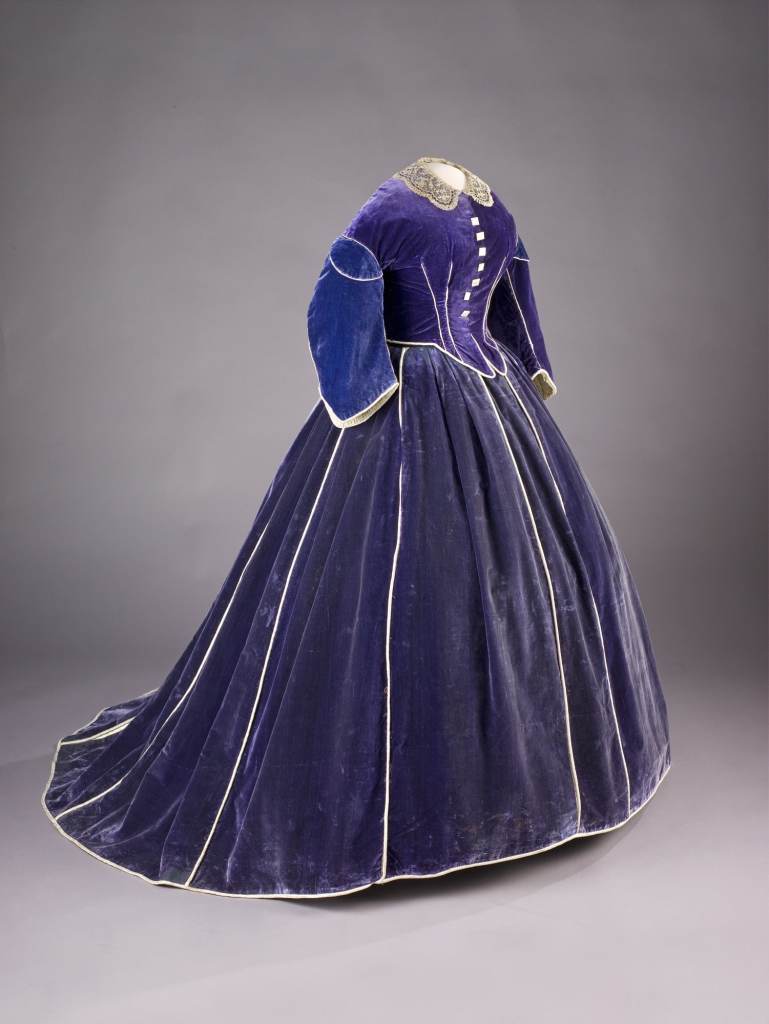
One of the winter dresses Elizabeth made for Mary. See more of her collection in FIT’s digital collection.

Elizabeth was in high demand among D.C.’s high society women, even the wives of Confederacy President Jefferson Davis and General Robert E. Lee. And in true subversive fashion, she used their old southern money to employ more Black women in her shop and create the Contraband Relief Association, an organization that provided support, relief and assistance to formerly enslaved people. 

The First Lady’s letter to the President requesting funds on Elizabeth’s behalf.

Mrs. Lincoln regularly donated to the Contraband Relief Association, and requested that her husband do the same. “Elizabeth Keckley, who is with me and is working for the Contraband Association, at Wash[ington]–is authorized…to collect anything for them here that she can….Out of the $1000 fund deposited with you by Gen Corcoran, I have given her the privilege of investing $200 her.. Please send check for $200…she will bring you on the bill,” she wrote to President Lincoln.

A quilt Elizabeth Keckly fashioned from Mary Todd’s discarded dresses.

But alas, everyone reading knows what came soon enough. President Lincoln was assassinated, and with his death, public opinion of Mary and the ladies’ friendship unraveled. Elizabeth published her autobiography, believing it would salvage both and bolster her income, but her good intentions backfired. 

Elizabeth’s autobiography, Behind the Scenes, or Thirty Years a Slave, and Four Years in the White House.

“Readers in her day, white readers — they took it as an audacious tell-all,” Jennifer Fleischner, author of “Mrs. Lincoln and Mrs. Keckly” said. “You know, ‘How dare she’? There were two categories: the faithful Negro servant or the angry Negro servant. Keckly was neither servant, nor faithful, nor angry. She presented herself, the White House and Mary Lincoln as she saw and knew them. And that didn’t work.”

Even the New York Times published a scathing review of Elizabeth’s book.

Mary was devastated by the personal revelations Elizabeth included, society women found it distasteful and didn’t want to appear in the pages of a book themselves, politicians spun it as reasons African-Americans shouldn’t be able to read, write or integrate with regular society, and that was that for Elizabeth. She died in her sleep in 1907, at a home for poor women & children that the Contraband Relief Association had founded.

But her story didn’t end there. Though it was suppressed upon its initial publication, Elizabeth’s biography is in print once again, and considered one of the most substantial documentations of the Lincoln White House surviving today, and proof of the value in owning your own story.
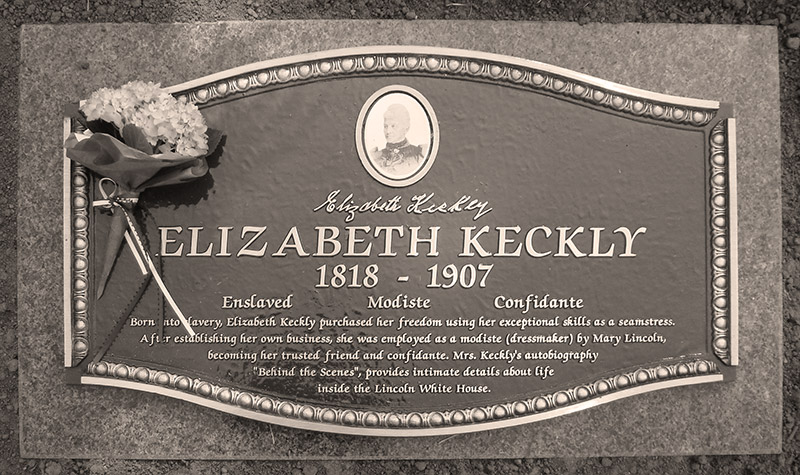
Elizabeth’s gravestone.

*Ed. Note: I’ve spelled Elizabeth’s last name as “Keckly” because that’s how she spelled it. She was historically recorded as “Keckley” and that spelling has persisted.


KEEP GOING BLACK IN HISTORY:
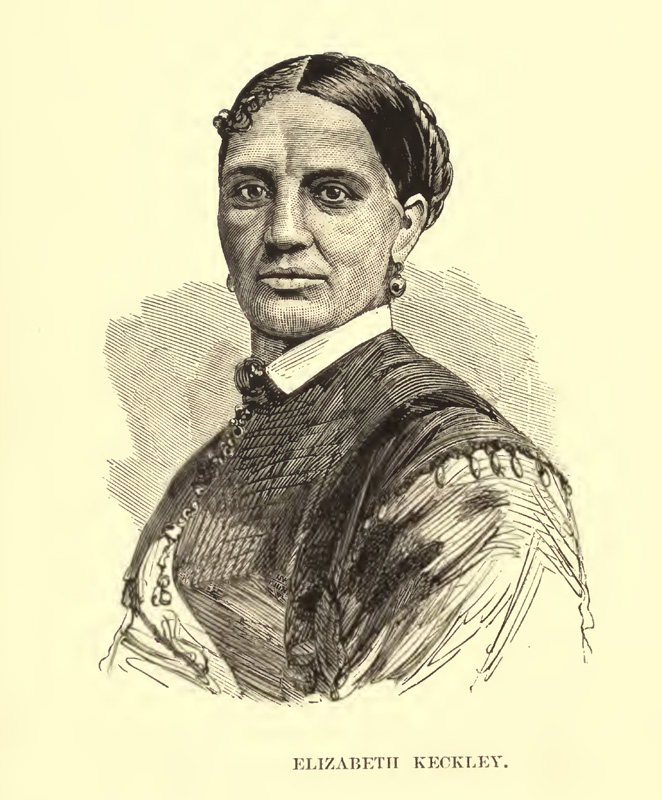
The Smithsonian National Museum of American History details how Elizabeth put her money to work for the people.

The New York Times featured Elizabeth’s biography in their “Overlooked” series that runs modern-day obituaries of famous contributors to American history that their paper overlooked at the time.
The White House Historical Association has thoroughly documented Elizabeth’s life from her autobiography and their own records as part of their “Slavery in the President’s Neighborhood” initiative.
DAY 1 — Henrietta Wood

The President may issue each year a proclamation designating February 1 as National Freedom Day to commemorate the signing by Abraham Lincoln on February 1, 1865, of the joint resolution adopted by the Senate and the House of Representatives that proposed the 13th amendment to the Constitution.

U.S. Code § 124 – National Freedom Day

But in 1853, Henrietta Wood couldn’t afford to keep waiting.

Until that year, her life had not been unlike that of most African-Americans. Henrietta was born into slavery around 1818 in northern Kentucky, worked for one master until he died, was sold to another, relocated elsewhere, rinse and repeat.

Until the day in 1844 when one of her masters, a merchant and French immigrant took leave from his New Orleans estate, and its mistress stole Henrietta away to the free state of Ohio, seeking to make her own fortune by hiring Henrietta out to Northerners in need of help. That plan backfired as creditors left high & dry in New Orleans saw Henrietta’s value too. Rather than allow her to be seized as an asset, the mistress begrudgingly granted Henrietta’s freedom. 

And for nine years, Henrietta savored it. But unwilling to let their dowry slip away, the master’s daughter and son-in-law hired Zebulon Ward, a notorious Kentucky deputy sheriff, slave trader, and future Father of Convict Leasing, to kidnap Henrietta back across state lines.

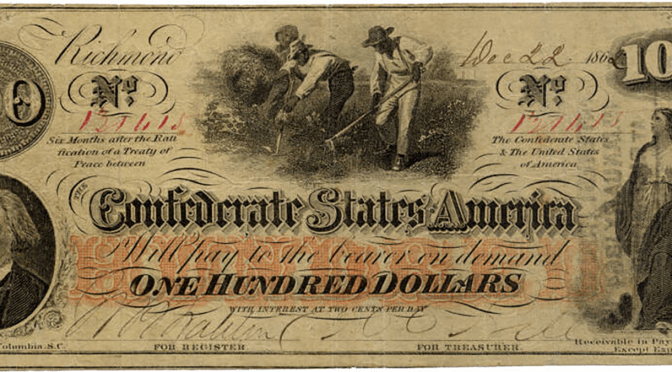
Slavery as the literal currency of the South. A Confederate States of America $100 bill bears enslaved people in cotton fields as its central image.

Despite her status, The Fugitive Slave Act of 1850 legislated Henrietta’s silence. Under its rule, enslaved people were not entitled to a trial, and were forbidden from speaking in their own defense should they obtain one. Adding insult to injury, Federal commissioners overseeing these sham proceedings were paid $10 for every person they deemed a fugitive, but only $5 for every freedman. Anyone mounting a case against the system was already at a loss.

But against those insurmountable odds came an intervention. John Joliffe—the same lawyer who’d defended Margaret Garner—argued a 2-year long lawsuit on Henrietta’s behalf. And once more, freedom seemed futile. The Cincinnati courthouse where Henrietta’s papers had been filed had burned to the ground, and any hope of defense with it.

She’d spend the next 14 years re-enslaved, sold this time to Gerard Brandon, the son of a Mississippi governor, in 1855. With the Brandons, freedom would only continue to be snatched from Henrietta’s grasp. Afer the Emancipation Proclamation was issued, Master Brandon marched all 300 of his slaves over 400 miles to Texas where it’d take Union soldiers another 2 years to arrive on June 19, 1865.

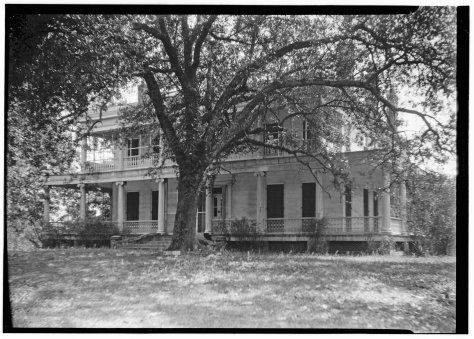
A 1936 photo of Brandon Hall in Natchez, MS, where Henrietta Wood was re-enslaved (via Library of Congress Prints and Photographs Division) vs. today (via Brandon Hall Plantation).

But papers and proclamations hardly made enslaved people free, and Henrietta was living proof. Slavery was still legal in many islands off the coast of the United States, and her own story demonstrated the lengths that slavers would go to profit off “free” human beings. Henrietta reluctantly accepted a formal employment contract from the Brandons promising $10 a month, which she held was never actually paid. Either way, the score was far from settled, her worth was much higher, and Henrietta had every intention of pursuing both.

A diagram of the arduous path Henrietta endured before finally gaining her freedom (via Smithsonian Mag)

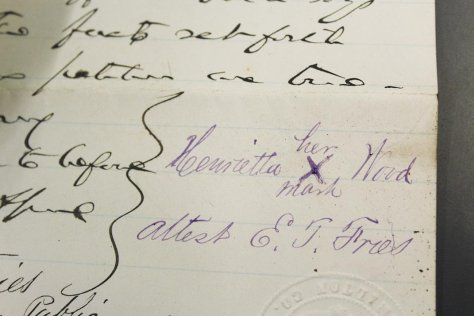
In 1878, Federal Judge Philip Swing presided over Wood vs. Ward, where the plaintiff sought $20,000 in restitution for her kidnapping and re-enslavement. Black people weren’t allowed to sit in juries until a 1935 case brought to the Supreme Court by one of the Scottsboro Boys made it illegal to systematically exclude Black people from service (note: systematically). So the notion that an all-white jury would see fit to award a formerly enslaved woman without documentation any dollar amount was likely more about the principle than the actual court judgment.

“Henrietta Wood V. Zeb Ward — Verdict
We the jury on the above titled cause, do find for the plaintiff and assess her damages in the premise of Two thousand and five hundred dollars $2500. (signed), Foreman.”

But in 1879, twenty-six years after Henrietta was sold back into slavery, a jury handed down $2,500—nearly $90,000 today—the highest dollar amount ever awarded by a court in restitution for enslavement.

That award funded her son Arthur’s college education. Born early into Henrietta’s re-enslavement, Arthur Simms had also lived on both sides of freedom, and took full advantage of his newfound rights. In 1889, he graduated as the first Black man to earn a degree from Northwestern University’s Union College of Law, and died as the school’s oldest living alumnus in 1951 at 95 years young, a testament that true freedom keeps paying dividends.

Happy Freedom Day & Happy Black History Month, y’all. Let it ring.


KEEP GOING BLACK IN HISTORY:

W. Caleb McDaniel, the same historian who allied against Fort Bend ISD in support of preserving the Sugar Land 95 uncovered Henrietta’s story. Read his take on her story and interact with Henrietta’s route to freedom at the Smithsonian.

Mr. McDaniel continued over at the New York Times, explaining how Henrietta’s case has re-opened a “dark chapter in American history that in many ways remains open.”

McDaniels’ book Sweet Taste of Liberty: A True Story of Slavery and Restitution in America won a 2020 Pulitzer Prize. Read an excerpt at the National Endowment for Humanities and see more about Harriet’s case at the book’s page.

In 1876, Henrietta told her own story to the Cincinnati Commercial newspaper. It’s collected here in four parts and is the most complete accounting of her story that survives.

Even Henrietta’s descendants didn’t know about her until Mr. McDaniel shared her incredible story. Read how they put together the pieces, and unknowingly, made her fight for freedom “worth it.”

DAY 28 — Margaret Garner

Sensational news of an enslaved mother murdering her own child was just one contributor to growing unrest over the morality of slavery.

Thomas, Samuel, and Priscilla were all the light of their mother’s life. But it was little Mary, Margaret Garner’s first daughter, who was her mother’s precious beloved.

Through the bitter cold and the blinding snowstorms of 1855’s Long Hard Winter, pregnant Margaret and her husband Robert had holed up together with their 4 children, until suddenly, the miserable chill became their method of escape. The Ohio River had completely frozen over, allowing the family safe and efficient passage from Kentucky where they were enslaved, to the free state of Ohio, a hub of the Underground Railroad.

And they would need it. Robert and Margaret both had individual troubles that threatened to destroy their little family. The most recent owner of their plantation was a cruel man who ruled with the whip just as surely as he ruled by his word. He’d long threatened Robert’s sale to another plantation, but repeated and ever-lengthening loans out to other slavemasters convinced the Garners that it was only a matter of time before Robert was gone forever. The babe still growing in 22-year-old Margaret’s belly belonged to her no more than her other children did, and boy or girl, had a lifetime of enslavement waiting to welcome it into the world. Winter’s brutal but short-lived punishment couldn’t begin to compare with a slave’s perpetually hellish existence.

So on the evening of Sunday, January 27th, 1856 the Garners bundled up their children and Robert’s parents hoping to cross the icy river into Cincinnati, where their family could be free. If all went according to plan, Margaret’s family would take them in until Levi Coffin himself, nicknamed the “President of the Underground Railroad,” came to carry them on to the next stop. By Monday morning, they’d survived patrols enforcing the Fugitive Slave Act and the driving snow to arrive cold, wet and hungry, but alive. With the worst behind them, it’d be just a few more hours before their allies would handle the rest of the journey.

That subsequent departure never came for the Garners. Unbeknownst to them, their master and the U.S. Marshals, unburdened by small children, elderly family members and all of their provisions and belongings, made fast time behind them and now had their cabin surrounded.

The adults knew the terrible fate ahead. IF they survived this confrontation, they’d all be sent back to their respective plantations where the retribution would be swift and without a doubt, severe. The oldest two children at 6 and 4, already knew the despair of slavery. But 2 year old Mary and 9 month old Priscilla were still their mother’s innocent girls. But not for long. Soon, they’d be expected to work, days would turn into years, and her girls would grow into women.

What came next, was no secret to Margaret, or to most enslaved women working in their master’s homes. After all, both of her girls, most likely her youngest son, and almost certainly the child she was carrying had all been fathered by her master A.K. Gaines, one of the men now pounding furiously at her door. A Southern wife’s last trimester was rather distastefully known as “the gander months,” when it was socially acceptable in some circles for her husband to take on a mistress, or enslaved woman, for his personal satisfaction. Almost like clockwork, with the exception of her oldest, Margaret’s babies were born 5 to 7 months after each of the Gaines children, and even Margaret herself was the daughter of a slavemaster.

In the chaos of her thoughts, the armed men moments from storming in, the family members scrambling to hide, and 4 tiny voices all crying in fear, Margaret made a heartbreaking declaration.

“Mother, I shall kill my children before they will be taken back, every one of them.”

Three of the four children suffered head wounds from shovel blows their mother inflicted. But beloved Mary was the last, her mother’s pride and joy, and whatever fate the rest of the family suffered would not, could not befall Margaret’s precious Mary. Just as the men burst through the front door, Margaret reached for a butcher’s knife on the kitchen table, and without hesitation, took her daughter’s life.

The scene was the real-life inspiration for Toni Morrison’s Pulitzer Prize winning book, Beloved.

And yet, the story didn’t end there. All except for little Mary, every member of the family was seized under the Fugitive Slave Act. But Margaret’s horrifying act complicated the matter tremendously. The crime had occurred in Ohio, where black people were free. But the Fugitive Slave Act was federal decree, and allowed slave owners to cross into any state their property might be located. Margaret’s two-week-long trial became a national spectacle and the longest fugitive slave trial in history. Ohio wanted a murder prosecution, fully expecting Margaret would be granted clemency due to the poignant circumstances. Their play was also a strategic one — finding Margaret guilty of murder would require the court to acknowledge her and her child as human beings, setting a federal precedent. On the other hand, indictment under the Fugitive Slave Act would charge Margaret with depriving an owner of his property, and ultimately require that she be returned to him too.

Thousands packed the frigid courtroom for each day’s heated arguments between the attorneys and the circus in the gallery, divided by northern and southern spectators. It was just 5 years before the start of the Civil War, and the trial not only humanized enslaved black people – women in particular – for passive northerners, but also absolutely incensed southerners who saw the trial as nothing but unwelcome northern interference and egotism. Lucy Stone, a white abolitionist did her best to plead on Margaret’s behalf and simultaneously shame her owner, pointing out that “the faded faces of the Negro children tell too plainly to what degradation the female slaves submit. Rather than give her daughter to that life, she killed it. If in her deep maternal love she felt the impulse to send her child back to God, to save it from coming woe, who shall say she had no right not to do so?”

But Lucy’s pleas for empathy fell on deaf ears, and the Garners were all deemed property to be sent back to their respective masters. Though the state of Ohio scrambled to bring their own charges against Margaret anyway, Slavemaster Gaines spirited her away, repeatedly relocating her each time relentless abolitionists closed in. Eventually, Gaines put Margaret and baby Priscilla on a ship to Arkansas, which subsequently wrecked. Priscilla was drowned, and though she didn’t succeed, onlookers reported that Margaret attempted to drown herself as well. Reunited once and for all, Robert and Margaret spent the rest of their days together in New Orleans until Margaret died in 1858, begging her husband to “never marry again in slavery, but to live in hope of freedom.”

Toni Morrison herself spoke to the heart of Margaret’s tragedy, saying “The interest is not the fact of slavery, but of what happens internally, emotionally, psychologically, when you are in fact enslaved and what you do to try to transcend that circumstance.” For Margaret, who loved her children so much that she would sacrifice herself and whatever future she had for them, if death was the only freedom to be found from slavery, better that than no freedom at all.


KEEP GOING BLACK IN HISTORY:

The events leading up to Margaret’s arrest and return to slavery were detailed in the abolitionist newspaper The Anti-Slavery Bugle and archived in the Library of Congress.
(zoom on the paper’s entire second column)

The Ohio Memory Project has an excellent archive of historical documents and newspapers related to Margaret’s tragedy.

When the Michigan Opera Theatre’s Detroit Opera House performed Toni Morrison’s libretto based on her book Beloved and Margaret Garner’s life, they shared one scholar’s essay detailing Margaret’s life and circumstances.

DAY 15 — Mary Ellen Pleasant

Mary Ellen Pleasant - Investor in Good Trouble

All of the money in California might not have been enough to buy freedom for black Americans still enslaved and oppressed in the mid-to-late 1800s.

But free woman Mary Ellen Pleasant sure had enough to try.

Through an early life enshrouded in mystery and speculation, by the 1840s, a twenty-something Mary Ellen was coming into her own and creating her story, both literally and figuratively. Mary Ellen and her first husband James, both born from mixed-raced parents, could easily pass for white, but rather than benefit selfishly, they put themselves at risk freeing the enslaved. With the fortune James inherited from his white father, he and his “white” wife financed all manner of slave escapes – purchasing their deeds only to release them later, funding their travels along the Underground Railroad, and even providing shelter in the couple’s own home, a monstrous Virginia plantation with no staff because they’d all been set free.

When James died only 4 years after they were married, Mary Ellen embraced her newfound freedom, living her life in a way that only a single woman with light skin, lots of money, and a little backbone could. She and James had been rebellious, but Mary Ellen became an unrepentant renegade who preferred to dress in disguise and concoct elaborate back stories that allowed her to “steal” slaves right off the plantation. Her brilliant surprise attacks were the stuff of legend, but after 4 years of these ruses, she was infamous among southern plantation owners and had to make an escape of her own.

Slowly moving west in the direction of growing cities and eventually remarrying along the way, Mary Ellen was soon forced to pick up the pace by the Fugitive Slave Act of 1850. Although she’d never technically been a slave (Massachusetts was a free state when she lived there as an indentured child servant instead), she also didn’t have the necessary papers to prove her freedom should anyone question her skin color and lineage. In a stroke of extraordinary luck, the free state of California was in the infancy of a Gold Rush and she had an eye on growing her fortunes. So with all of her money and her moxie, Mary Ellen landed in San Francisco, where she only became an even more formidable woman.

Gliding effortlessly between both white and black communities, Mary Ellen amassed millions. When she arrived in San Francisco, surveillance was her top priority. A brilliantly clever and well-educated woman, she relied on her domestic skills and society’s traditional gender roles to blend into the background of the upper-crust homes and restaurants she worked, knowing that no man would pay much attention to a servant woman, white or black, while discussing important financial business.

A photo of the home Mary Ellen shared with her business partner and also rented out for secondary income, reveals a sprawling property overlooking early San Francisco.

Her eavesdropping paid off extravagantly, granting her insider information on precious metals, natural resources and the stock market. Though she had to combine her investments with that of a white partner, since women – especially those masquerading as white – still didn’t have full property or financial rights, Mary Ellen’s savvy made them both rich to the tune of $30 million ($327 million today).

But Mary Ellen wasn’t the only transplant growing wealthy from California’s bounty. Southern slaveowners were migrating too, and though California was a free state, that didn’t apply to those who came as slaves. Her riches were propelling her rapid rise in San Francisco society, but Mary Ellen couldn’t overlook those who didn’t have the luxury of freedom she enjoyed.

Instead, she used her money and power to take her abolition efforts to the next level: California law. When black citizens were discriminated against on San Francisco’s trolleys, she sued on their behalf, winning multiple cases against the city and the state over the course of the 1860s. Forbidden from testifying in California courts, black defendants often found themselves robbed of any chance of a fair trial, an injustice that Mary Ellen saw to in 1863, successfully repealing the law. Those who needed the means to escape could rely on her to front the money, transportation, food and any other necessities. She was so beloved among the black citizens of California that they soon called her home “The Black City Hall.”

When Mary Ellen’s white partner suffered an untimely death, all of that began to change. His wife ran a full-page smear campaign on Mary Ellen in the San Francisco Chronicle that destroyed what was left of her fast-crumbling reputation. After the Civil War and free from any fear of retribution (or so she thought), Mary Ellen stunned all of San Francisco when she submitted her census documents with an extravagant checkmark through the box labeled “black.” Racist rumors circulated about voodoo and black magic being the source of her wealth and social graces, and soon, unable to defend against the crushing public opinion or to distinguish her finances from her partner’s, she was left destitute and living with friends, where she died in 1904 at the age of 90.

As civil rights were won though, the details of Mary Ellen’s philanthropic and strategic impacts on black communities nationwide finally began to be revealed. All of her efforts in aiding the black people of California came to light, but on her deathbed, Mary Ellen still had one more secret to share with the world. When abolitionist John Brown – famous for the 1859 rebellion in Harper’s Ferry, West Virginia where he and a small group of enslaved men stormed a confederate arsenal – was captured & hanged, a coded letter was found crumpled in his front pocket. “The ax is laid at the foot of the tree. When the first blow is struck, there will be more money to help,” it read. It was she who’d written that note, Mary Ellen revealed, and the “more money” she’d promised was in addition to the already $30,000 invested in Brown’s cause, just shy of $90K by today’s standards.

Her life of covert deeds now public knowledge and the record of her reputation set straight, the woman who once presided over “Black City Hall” and defiantly told those who tried to deter her she’d “rather be a corpse than a coward” is now known to all as “The Mother of California Civil Rights” and the “Harriet Tubman of the California Underground.”

Mary Ellen Pleasant’s contributions to California civil rights were memorialized in this Pacific Heights plaque reading:
”Mary Ellen Pleasant Memorial Park 1814 – 1904
Mother of Civil Rights in California
She supported the Western Terminus of the Underground Railway for fugitive slaves 1850-1865. This legendary pioneer once lived on this site and planted these six trees.
Placed by the San Francisco African American Historical and Cultural Society.”

KEEP GOING BLACK IN HISTORY:

The New York Times briefly chronicled Mary Ellen’s dramatic and eventful life in their “Overlooked” series.

Read more about Mary Ellen’s powerful sway in San Francisco and the wild scandals that led to her downfall in the Paris Review.

DAY 8 — Henry Box Brown

Henry Brown - An Out-of-the-Box Escape Plan

In the months he spent writing letters, devising plans and scheduling secret rendezvous, Henry Brown was resolved to “conquer or die.”

But as he lay terrified and motionless to avoid detection, confined to a 3 x 2 x 2.5 foot crate onboard a steam ship en route to Philadelphia in 1849, Henry was convinced that the latter would indeed be his fate. “I felt my eyes swelling as though they would burst from their sockets,… and a cold sweat coming over me that seemed to be warning that death was about to terminate my earthly miseries,” he later recalled.

And there was nothing but misery. The only joy in Henry’s enslaved life – his pregnant wife Nancy and their three small children – had been torn away, sold to a distant plantation. “My agony was now complete, she with whom I had traveled the journey of life in chains … and the dear little pledges God had given us I could see plainly must now be separated from me forever, and I must continue, desolate and alone, to drag my chains through the world.”

With that utter sorrow in his heart and nothing left to lose, Henry was ready to risk his physical and mental well-being if that’s what it took to escape what he’d endured. And so, with the help of a number of abolitionists and today’s equivalent of $2700 to cover his transport fees, Henry left Richmond, VA and never looked back. Packing only a small bladder canteen and a couple of biscuits, he spent 27 hours contorted into an express crate addressed to a trusted member of the Pennsylvania Anti-Slavery Society 244 miles away.

“If you have never been deprived of your liberty, as I was,” he wrote in his memoir, “you cannot realize the power of that hope of freedom, which was to me indeed, an anchor to the soul both sure and steadfast.”

Henry transfixed his thoughts on that hope the entire journey, trying not to move or make a sound, and praying he wouldn’t suffocate before he arrived, whenever that might be.

Luckily, on the morning of March 30, Henry’s hope of freedom was realized when from outside of the darkness, there came a polite knock and four short words:

“All right in there?”

And with a little help, Henry climbed out of his box, exhausted, drenched in sweat, but alive.

The tale of the man who’d shipped himself out of slavery swept through the abolitionist community like wildfire. Many wanted to publicize Henry’s fantastic getaway, hoping it’d inspire others to devise their own similarly ambitious plans for escape. Others like Frederick Douglass saw greater strategy in keeping the details quiet, utilizing this covert operation to free as many others as possible themselves.

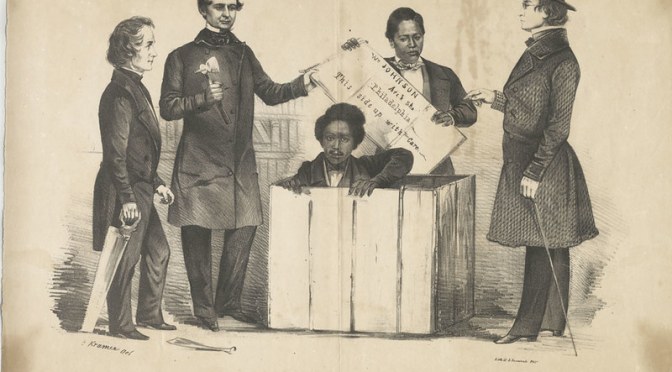
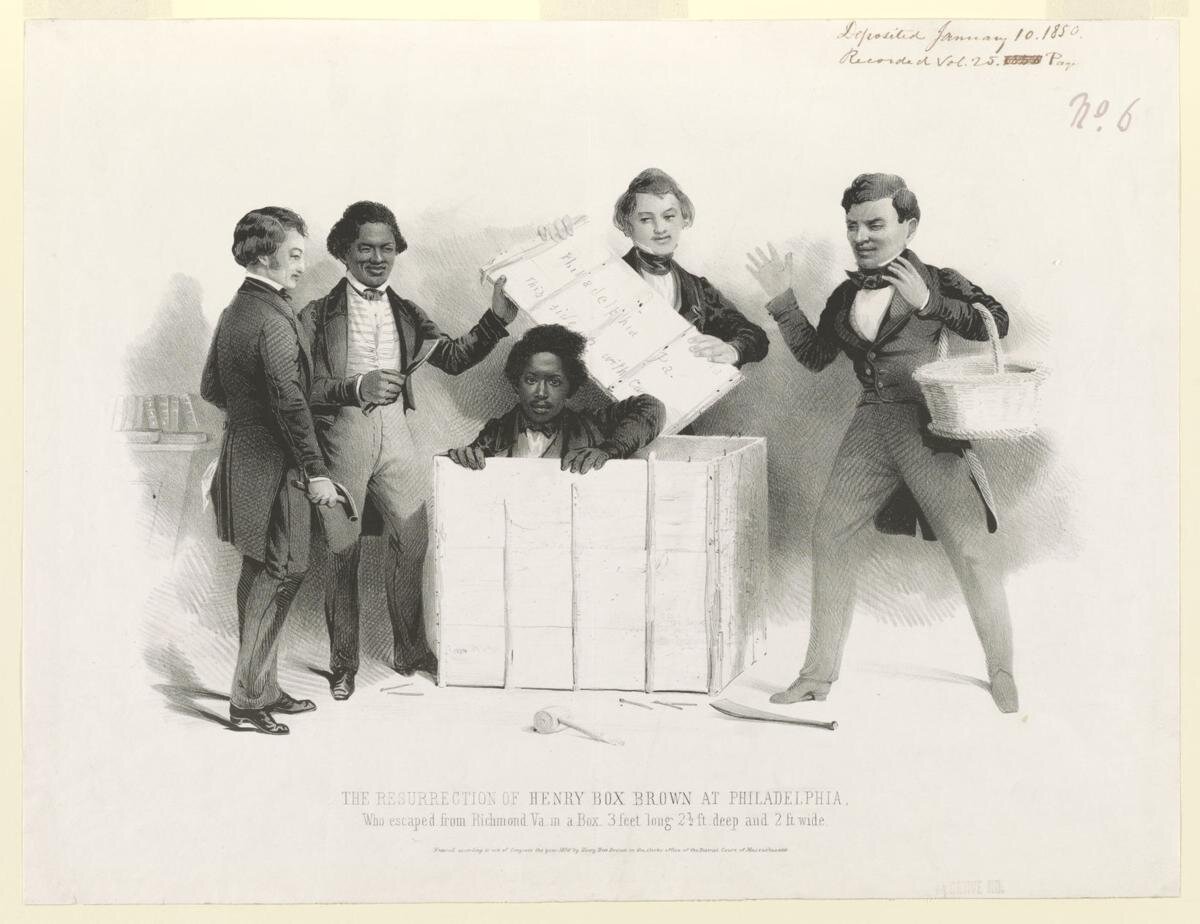
In the end, it was decided that Henry’s story would go public. And for a short time, Henry’s past miseries were replaced by his newfound freedom and fame. A memoir was written, lithographs memorializing his “resurrection” were printed, and “Henry Box Brown’s Mirror of Slavery,” a stage show complete with dioramas depicting various scenes from Henry’s life alongside his original, full-sized shipping box, played to New England audiences until October 1850, when enslavement threatened again.

The newly-passed Fugitive Slave Act entitled slave owners and the federal government to retrieve and punish escaped slaves, even if they’d found freedom in northern states. For a man who’d earned fame because of his daring escape and whose livelihood depended on retelling that story, it spelled grave danger. This time, Henry determined to put even more distance between him and his former life, sailing to England as a free man.

He continued to perform there, remarried, and eventually returned to the States, but his real work had been done. Henry Brown’s widely publicized escape made him a symbol of the Underground Railroad’s growing power and massive organization efforts, and inspired many more slaves, freedmen and abolitionists with the courage to be creative in the fight for life, liberty and the pursuit of happiness, even if it meant risking everything, every step of the way.


KEEP GOING BLACK IN HISTORY:

Read the “Narrative of the Life of Henry Box Brown” written by the man himself here.

DAY 27 — Ellen & William Craft

Ellen & William Craft - Lovers in Hiding in Plain Sight

“It is true, our condition as slaves was not by any means the worst; but the thought that we couldn’t call the bones and sinews that God gave us our own haunted us for years.”

William and Ellen Craft had lived with that demoralizing detachment as a married enslaved couple for 2 years, but their dread was only growing worse.

Ellen wanted children but refused because she herself had been torn from her family on her mistress’s whim as a child. Her light skin led strangers to mistake her for a member of her master’s family (and she was: he was her father), and it so infuriated the owner’s wife that when Ellen was 11, she was simply given away. Some of the Crafts’ friends had even suffered worse: each member of their family was separated from each other and sexually abused by their owners until they either escaped or bought each others freedom. Even if all they had was each other, William & Ellen had too much to lose.

A child of rape, Ellen’s skin was light enough to pass, an unfortunate circumstance she and William took full advantage of

But their escape in particular was more complicated by the fact that William and Ellen had two different owners. If they were going to flee Georgia, they’d have to figure out a way to do it together and be discreet about it, a tough task considering that their near opposite skin tones made them a conspicuous pair. Because they were both trusted in their households, they were each granted passes to visit family nearby. So with one problem down and a head start on their owners, they decided to hide in plain sight.

Whomever came looking for them would be keeping a watchful eye for a black man and white-passing woman, but William and Ellen both knew firsthand that no one batted an eye over a master accompanied by his or her slave. So they devised an elaborate scheme that both of them almost didn’t have the nerve to go through with. Ellen’s hair was cut short in the style of rich white plantation owners, and her jaw and neck were wrapped in gauze to appear as though she had some sort of affliction, when it was really to hide her soft, slender face and lack of facial hair from anyone who might look too closely. They even put her arm in a cast so as to deter anyone who might ask her to write or sign anything, as she’d never be taught to read or write. And on December 21, 1848, they made their daring escape by train, boat and on foot.

It was 6 full days before Ellen’s heart stopped pounding out of her chest.

Just a day into the trip, who was seated on the train next to them but a friend of Ellen’s master, a man who knew her well. He spent the whole ride shouting to make conversation with her. She spent it pretending she was deaf.

In South Carolina, their next passage was denied by a steward insisting on William’s ownership papers. Abolitionists had been kidnapping slaves from their rightful southern owners and granting them freedom in northern states, and this particular steward was serious about his job, refusing to sell them tickets until Ellen produced papers. Just then, the captain from their previous trip happened by & vouched for the couple, never realizing he’d been duped himself.

In Baltimore, the last stop to freedom, this time officials pulled them from the ship, demanding William’s documentation. Ellen pulled out every trick she knew, stalling, huffing and puffing until finally, the ship began to depart. Fooled by the cast and face wraps still hiding Ellen’s true identity, the official pitied a sickly man and allowed him (her) to carry on with the trip.

An artist’s depiction of Ellen Craft in disguise

The disguise was so good that even William found himself thwarting would be rescuers who advised him on how to abandon his disabled “master” for freedom in the north.

The couple arrived in Philadelphia on December 26, where Ellen collapsed into tears under the weight of the nearly weeklong ruse and relief from the fear of what being discovered would have meant for them.

They were taught to read, write, and found a prosperity in Philadelphia that neither of them had experienced before. But their great escape wasn’t over yet.

The Fugitive Slave Act allowed masters to recover their escaped property by any means necessary and with the help of federal authorities, which is exactly what William and Ellen’s owners did.

So in 1850, the pair fled again. This time to England, where rather than life out their days quietly as free people, they joined others who’d escaped slavery to successfully convince Parliament not to ally with Confederate forces in the Civil War. For the next 20 years, William and Ellen Clark made a name for themselves as prominent abolitionists, raised a family, and financed philanthropic causes in Africa.

But even in the worst of circumstances, there’s no place like home, so once slavery was finally abolished in the United States, the Clarks returned to Georgia in 1868, using the education they’d received in England to open a school for newly freed black students, putting their considerable finances toward purchasing a plantation of their own, and living the rest of their lives fighting for even greater black freedoms, together.


KEEP GOING BLACK IN HISTORY:

Read Ellen & William’s autobiography, including their daring escape, in the 1860 book, Running a Thousand Miles For Freedom.

DAY 20 — Ona Judge

*PRESIDENT’S DAY EDITION*

On May 24, 1796, the Pennsylvania Gazette published the ad here requesting the capture of Oney Judge, First Lady Martha Washington’s personal, runaway slave.

Ona “Oney” Judge was born into slavery at Mount Vernon, VA around 1773, and was groomed as Martha Washington’s body attendant. She was so treasured by the First Family that she was one of 8 slaves who moved to the nation’s new capitol of Philadelphia with them in 1790. Her status as an upper echelon household slave afforded Oney luxuries that others didn’t have — she could accompany her mistress in town, or go alone to enjoy the local attractions, she wore nice clothes, and she even had a room of her own! What more could a slave want?

The Washingtons soon found out. In 1796, Martha’s granddaughter back home was married, and she promised Oney to the newlyweds as a gift. Oney knew that if she went back south to Virginia, the home of American slavery, she’d never return. So when she packed her bags to leave the Washingtons, she decided that those bags were packed for freedom.

And for years, she ran. Oney escaped that day, but she was never actually free. The Washingtons were shocked & infuriated by her disloyalty, and doggedly attempted to recover her. Ads like the one shown here were placed in newspapers, and on at least three separate occasions over the years, the President’s friends & associates attempted to facilitate Oney’s return by negotiation or by force.

Oney settled in New Hampshire, married a free man & had children, but there was no statute of limitations on slavery. If she had ever been captured, she would have been immediately returned to the Washingtons, and her children would become slaves too — the Washingtons property rights over their mother took precedent over their free father’s parental rights. So for the next several decades, she hid until she was in her 70s, hoping to be forgotten or too old to be worth the trouble.

When she finally granted her first newspaper interview in 1845, the reporter asked if she regretted escaping into isolation & poverty, in contrast to the affluence she could have have had with the Washingtons. Her response was moving: “No, I am free.”


KEEP GOING BLACK IN HISTORY:

Read author transcriptions of two of the only surviving interviews of Oney Judge.

On Juneteenth 2021, Mount Vernon erected a historical marker to preserve Ona’s story in the place where it happened. It’s the first marker in all of Fairfax County, VA recognizing a Black person.

Ona is “among the 19 enslaved people highlighted in ‘Lives Bound Together: Slavery at George Washington’s Mount Vernon,’ and the subject of Never Caught: The Washingtons’ Relentless Pursuit of Their Runaway Slave, Ona Judge by Erica Armstrong Dunbar.
Read more on both at the New York Times.

Dive deeper into the daily lives of Ona & another of the Washingtons’ slaves, William Lee.