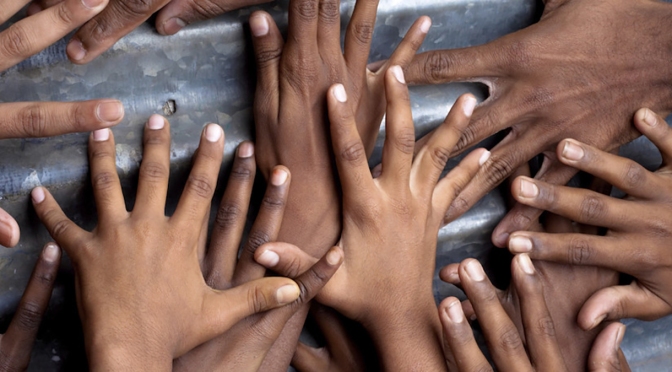
Social media personality Nakia Smith coined a saying: “My hands are loud enough.”
So instead of me, a hearing person, introducing you to Black American Sign Language, here’s Nakia speaking for herself.
On her social channels, she goes by Charmay, but as a woman who’s Black, deaf, and Black and deaf, she’s used to having multiple identities, each with its own unique set of circumstances and challenges to navigate.
But why does “Black and deaf” fall into a separate category?
Because Jim Crow didn’t give passes for disabilities.
Accommodations for deaf people have always been drastically behind those for the hearing, and it wasn’t even until 1817 that the first school for deaf children—the first in the entire Western Hemisphere, actually—was opened. Because that same school wouldn’t accommodate African-American students until 135 years later in 1952, racism essentially stripped Black deaf people of any community at all. In some southern states like Louisiana, deaf schools weren’t desegregated until 1978. Physically unable to communicate with people who looked like them, and legally unable to learn with people who communicated like them left Black deaf people in a very small circle. Within it, they built a community, schools, and a rich language of their own.

Americans typically think of the “Black version” of things as lesser, and English is no exception (see: the wholesale invalidation of Ebonics and African-American Vernacular English [AAVE]). Linguist John McWhorter explains, “The educated white person has often internalized a sense that it’s wrong to associate black people and ‘bad grammar’ at all. There’s a dissonance that person permits, which is to read southern white speech depicted in all of its glory and accept that as ‘the way they talk,’ but to bristle at Black people depicted speaking the same way. Human minds tolerate a lot of dissonance of that kind!”

Those concepts translate over to sign language quite fluidly because BASL uses different signs than ASL, but it’s visually different in practice as well. Where ASL largely uses one hand for signs and communicates around the shoulders and midsection, BASL uses two hands to sign in the face and forehead region more frequently. BASL users also employ a lot more of their personal space for communicating than ASL users do, with signs that use big motions around the body. In other words, as our friend Charmay says, “The biggest difference between BASL and ASL is that BASL got seasoning.” Teraca Florence, a former president of the Black Deaf Student Union at Gallaudet University, says “Our signing is louder, more expressive. It’s almost poetic.”
Charmay’s social channels are filled with videos documenting the history and celebrating users of BASL because she realized that many people in deaf and hearing communities didn’t even know Black American Sign Language existed. Because this is the Internet, for every bit of praise, Charmay received even more criticism. Even white deaf people weren’t fully in support, asking questions like “Why further divide the deaf community?” But questions like that were just more proof that her voice absolutely needed to be heard, because they were evidence of history repeating itself over a lack of shared experience. Felecia Redd, a Black deaf interpreter says, “I’m always told by deaf African Americans, ‘I am Black first; then I’m deaf.’ White deaf people are deaf first and then white.”
BASL didn’t develop out of Black people’s need for specialized communication. It developed out of their need to communicate AT ALL. It’s not a variant of ASL, “Black ASL could be considered the purer of the two forms,” says Ceil Davis of Gallaudet University. Because African-Americans weren’t allowed access to any advancements in hearing technology, they could only refer to the original curriculum used by Thomas Hopkins Gallaudet when he opened the first school for the deaf. From that curriculum, Black ASL developed nuance, syntax, slang, idioms and other language fundamentals that simply don’t exist or function differently in ASL, giving the Black deaf community something truly unique. That is, until schools integrated, and Black deaf students had no choice but to conform to ASL. Instead of being welcomed into the broader community, Black deaf students were only further marginalized, mocked and teased for having developed a separate language due to the racism forced upon them.
Even though Black deaf people are now “integrated” in the broader deaf community, many of the challenges they faced are unchanged. “In the United States, less Black people from the age of 25-64 are deaf—a rate of 1.8%, compared to the overall population at 2.3%,” according to the National Deaf Center. Of course, that means fewer translators in comparison as well. So when Black deaf people have to navigate places that already demonstrate unconscious bias against them, like say, doctor’s offices, they also find themselves facing a double language barrier as well. LeeAnne Valentine complained of constant abdominal pain to her hearing white doctor via white interpreter, but was routinely dismissed. When she visited the same doctor with a Black interpreter, her experience was night and day.
“She actually interpreted what I said, with the intent and the tone, plus my emotions,” LeeAnne said. “And she conveyed that to the doctor… and he finally took some action.” As a result, LeeAnne was rushed for emergency gallbladder surgery. Health services employees routinely report BASL users misunderstanding information about COVID and vaccines, if they receive it at all, because televised broadcasts rely on mostly white interpreters as though ASL is the only way for deaf Americans to communicate. Inherently tense social interactions like encounters with the police take on a whole new layer of complexity for Black deaf people. “Black Lives Matter” is even signed differently in BASL than ASL because Black people have an entirely different relationship to the movement than white people do. Even today with more accommodation than ever, the same physical and social barriers exist for Black deaf people, just in more modern spaces.
That’s where Charmay comes in. There’s no more modern space than TikTok. And with 402K followers, she’s speaking truth to power to an audience bigger than her ancestors could have even imagined. She’s the 5th generation of BASL users in her family, and like so many things precious to the Black diaspora, her language has only been handed down by oral tradition. Without Charmay and other visible BASL users on social media, university collections, and privately funded documentaries, the world might not know BASL existed at all. “Historically, so much has been taken away from us, and we’re finally feeling that ‘this is ours,’” she said. “‘This is mine. I own something.’” And she’s one of many claiming every bit of her history and guaranteeing its future with the power of her two Black hands.
KEEP GOING BLACK IN HISTORY:

Follow Nakia Smith (aka Charmay) on TikTok for more videos on Black American Sign Language and cameos from her family members!
If Instagram is more your speed, follow her here.

“I have to make sure my hands are not ashy before I sign.” Get even more insight on the life & times of Charmay & more Black ASL users past & present at the New York Times.

There’s an incredible repository of creative and accessible content “Celebrating Representation, Identity and Diversity of Black Deaf Families” here.

Find another amazing collection of resources examining “Black Deaf Culture Through the Lens of History” here.
 THE AMERICAN BLACKSTORY