Tag Archives: BROWN V. BOARD OF EDUCATION

DAY 3 — Dr. Mamie Phipps-Clark

With all the obvious arguments against discrimination and segregation, the smoking gun presented to the high court was little two baby dolls wielded by a Black woman.

Dr. Mamie Phipps-Clark photographed at Columbia University.

Dr. Mamie Phipps-Clark would have been a force against racism even without her groundbreaking research. Born in Hot Springs, AR in 1917, Dr. Mamie was one of the rare Black students with the privilege, persistence, and promise to graduate the city’s first high school for Black students with flying colors.

Attending Howard University at the peak of the Great Depression, she graduated with a Master’s in Psychology, a field where women, and especially Black women, were almost unheard of.

Certainly, this was more than anyone could have hoped from a small town girl in a segregated world. But Dr. Mamie’s barrier breaking was only just beginning.

In 1943, she became the first Black woman to graduate Columbia University with a Doctorate in Psychology. And she did so with a thesis that ultimately changed the shape of the nation.

Read the full study as published in the Journal of Social Psychology here.

Dr. Mamie originally presented “The Development of Consciousness of Self and the Emergence of Racial Identification in Negro Preschool Children” as her Master’s thesis at Howard. The topic occurred to her when she simply couldn’t remember a time that she didn’t know that she was Black.

“I became acutely aware of that in childhood, because you had to have a certain kind of protective armor about you, all the time … You learned the things not to do…so as to protect yourself,” she said, describing a phenomenon known to millions of Black children before and since. Dr. Mamie’s initial study included 150 Black children from a DC nursery school, and the results were summed up by her husband and fellow psychologist Dr. Kenneth Clark as “disturbing.” They wanted to dive deeper.

At Columbia, Dr. Mamie leveraged the university’s Ivy League status to further fund, explore and legitimize her work. The 1920s and 30s were widely known as “the era of scientific racism,” the belief that there is empirical and/or biological evidence to support white supremacy. By the late 1930s, Black and progressive white psychologists were working to debunk these theories, but a Black woman fearlessly asserting that “Black people were not limited by innate biological difference but by social and economic barriers to success” was entirely revolutionary.

And so was the evidence to prove it.

The “Doll Test,” as it’s come to be known, had a simple premise. 253 school-aged Black children—134 who attended segregated schools in Arkansas and 119 from integrated schools in Massachusetts—would be presented with four dolls—two Black, two white. But even that simplicity came with challenges: Black dolls weren’t manufactured in 1947, so Dr. Mamie had to paint white dolls Black instead.

Two of the dolls used in Mamie Clark’s studies, courtesy of the Smithsonian National Museum of African American History and Culture

With her dolls at the ready, the experiment was on:
“Give me the doll that you would like to play with or like best.”
“Give me the doll that is the nice doll.”
“Give me the doll that looks bad.”
“Give me the doll that is a nice color.”
“Give me the doll that looks like a White child.”
“Give me the doll that looks like a colored child.”
“Give me the doll that looks like a Negro child.”
“Give me the doll that looks like you.”

The majority associated positive traits to the white doll and negative traits to the Black doll. But these Black childrens’ responses to the last question shook the Clarks so deeply, they didn’t even want to publish the results. When asked to identify the doll that looked most like them, some of the children burst into tears.

Results showed that by age three, Black children were aware of their race and attached negative traits to their own identity, which were then perpetuated by a racist and segregated society. Dr. Kenneth’s summary of the Doll Test was especially clear and truly devastating: “These children saw themselves as inferior and they accepted the inferiority as part of reality.”

Dr. Mamie Phipps-Clark and the children she worked to give self-worth, shot for Vogue Magazine, 1968.

When a young upstart lawyer named Thurgood Marshall discovered the Clarks’ Doll Test, he presented its damning evidence to the Supreme Court in Brown v. Board of Education. And in a historically unanimous decision, Chief Justice Earl Warren agreed with Dr. Kenneth that “To separate [Black children] from others of similar age and qualifications solely because of their race generates a feeling of inferiority as to their status in the community that may affect their hearts and minds in a way unlikely ever to be undone.”

With the 1954 decision, segregation was ruled unconstitutional in the United States. And that’s not all. The Doll Test was the first time social science research was submitted as hard evidence in Supreme Court history.

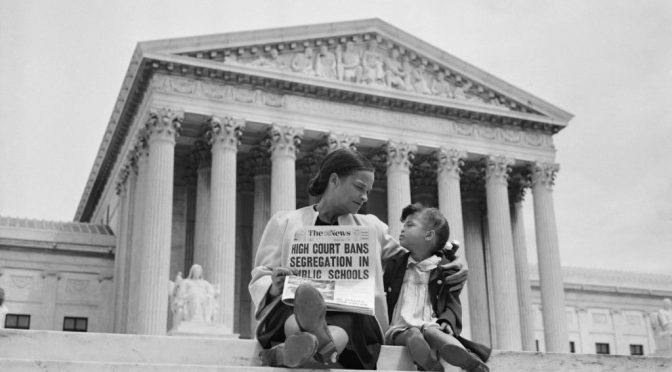
Nettie Hunt and her daughter Nickie sit on the steps of the U.S. Supreme Court. Nettie explains to her daughter the meaning of the high court’s ruling in the Brown Vs. Board of Education case that segregation in public schools is unconstitutional.

In 2010, nearly 60 years after Brown v. Board, child psychologist and University of Chicago professor Margaret Beale Spencer revised the Doll Test for a pilot study testing both white and Black children. The results were not as progressive as one might hope.

Though all the children demonstrated a positive bias towards whiteness, white children much more frequently identified their own skin with positive attributes and darker skin with negative attributes. For instance, when asked to point to the dumb child, about 76% of the white children pointed to illustrations of the two darkest children. 66% identified the two darkest as “the mean child.” Dr. Spencer’s conclusion differed little from Dr. Kenneth’s all those decades before: “we are still living in a society where dark things are devalued and white things are valued.”

Devastated by the results of the Doll Test and the constant feeling of being an ”unwanted anomaly” in her field, Dr. Mamie Phipps-Clark left experimental psychology. Instead she focused her efforts on undoing the emotional, mental and educational damage inflicted upon Black children by a society that viewed them so negatively.

Read Dr. Mamie’s obituary detailing her many accomplishments at the New York Times.

As a psychologist at the Riverdale Home for Children, she counseled unhomed Black girls until 1946, when she and her husband opened the Northside Center for Child Development to provide psychological services to minority children in Harlem and study racial biases in education. 16 years later, the Clarks opened Harlem Youth Opportunities Unlimited to provide resources for Harlem schools and reduce unemployment among Black high school dropouts.

Though she died in 1983 without seeing her work complete, Dr. Mamie set about treating a wound the United States didn’t even know it had, setting us on a course to finally heal the toxic infection of racism.


KEEP GOING BLACK IN HISTORY:

Smithsonian Magazine details Dr. Mamie’s life, the Doll Test and the impact both had on the world.

Go in-depth into the “Case that Changed America” at the NAACP Legal Defense Fund.

See CNN’s coverage of the 2010 version of the Doll Test, and some responses from the parents of participating children.

If you think these results are unique to the United States, have a look at an amateur recreation of the Doll Test in Italy.

DAY 22 — Autherine Lucy

Autherine Lucy - Bama’s Boldest

After her 3-year fight to become the The University of Alabama’s first black student was finally won on February 3, 1956, Autherine Lucy was put out within 3 days.

At least she’d actually attended. The friend who’d first suggested it was ousted before she even set foot on campus.

Autherine and Pollie Myers had several Associate’s and Bachelor’s degrees between them, and when they submitted letters of inquiry to the university for their Master’s in 1952, their pedigrees were so impressive that they both received offer letters back within less than 2 weeks. But as soon as they submitted their official applications denoting their race, Alabama rescinded their offers, apologizing for the admittance “mistake.”

The NAACP immediately took on the case, and a young lawyer by the name of Thurgood Marshall warned the ladies that they could expect an uphill battle. Two years in, the landmark Brown vs. Board of Education case that ruled segregation in public schools unconstitutional was an incredible victory for all black students, and 13 months later, Autherine & Pollie were successfully readmitted.

But during the course of the trial, the university had hired private investigators to dig up any dirt they could find on the girls, hoping to call their character into question. Sure enough, they’d discovered that Pollie, now married and with a child, had conceived her child before taking vows. That was a violation of the University of Alabama’s morality code and Pollie was once again disqualified from attending.

Since Pollie was the driving force behind the attempt anyway, university officials hoped Autherine would find the whole affair to be too much trouble and withdraw her application herself. She did not.

On February 3, 1956, Autherine Lucy proudly attended her first day of classes, and having survived her first 48 hours with only a few hundred rocks, eggs and slurs thrown her way, she thought it had actually gone about as well as could be expected.

By February 6, the riots had reached such a violent fever pitch that Autherine sat after her first class for hours, waiting for the mob outside to dissipate before officers would even attempt escorting her out to the police cruiser necessary to transport her around campus. That same day, the University of Alabama expelled Autherine “for her own safety.”

Once again, the NAACP lawyers brought charges against the university, but one of those initial charges alleged that the university had conspired in the riot. Unconvinced they could prove it in court, the charge was withdrawn, but not before Alabama caught wind of it. They claimed that the allegation amounted to defamation and this time, Autherine’s expulsion was official, final and devastating.

“Whatever happens in the future, remember for all concerned, that your contribution has been made toward equal justice for all Americans and that you have done everything in your power to bring this about,” Thurgood Marshall wrote to her, reassuring her that though her fight had been lost, it had not been in vain.

9 years later, Autherine’s fight indeed came to fruition when Vivian Malone became the University of Alabama’s first black graduate.

Autherine’s own redemption was much longer in the making.

After two Alabama history professors invited this living legend into their classrooms to share her firsthand account as a pioneer and petitioned the university to overturn her expulsion, 60-year-old Autherine Lucy returned to the University of Alabama for her Master’s in Elementary Education.

But this time, she didn’t go alone. Autherine and her daughter Grazia were both admitted in 1989 and subsequently graduated together in an incredibly touching and monumental moment that truly illustrated the impact Autherine’s sacrifice had.

Today, the Autherine Lucy Clock Tower, the Autherine Lucy $25,000 Scholarship Endowment, and three individual tributes stand on the University of Alabama campus in honor of the woman whose name school officials once couldn’t get off the register fast enough.


KEEP GOING BLACK IN HISTORY:

Watch 88-year-old Autherine Lucy speak at the 2017 dedication of her historical marker on the University of Alabama’s campus.

DAY 7 — Ruby Bridges

Norman Rockwell’s painting of Ruby Bridges being escorted to school and the real photograph.

You might recognize little Ruby Bridges from her depiction in this iconic Norman Rockwell painting, or you might even recognize her by name as the first black child to attend an all-white public school in the South.

Neither of these things tells her entire truth. Because truthfully, that day, Ruby didn’t desegregate anything.

When 6-year-old Ruby Bridges went to William J. Frantz Elementary School in New Orleans on November 14, 1960, she thought the rowdy crowd gathered nearby was there for Mardi Gras. In her innocence, she didn’t realize they were there because of her.

Ruby’s first day of school was spent in the principal’s office because no one else came to school that day. Ruby’s second day, a woman in the crowd threatened to poison her & federal marshals warned her to only eat food from home. By the end of the first week, Ruby’s school, which had an enrollment of almost 1,000 at the beginning of the year, had dwindled down to just three: Ruby and two white girls.

Ruby & her two schoolmates didn’t attend class or recess together, and only one teacher would even accept her as a student. Each of the girls were taught in a separate classroom, and although she could hear the others playing sometimes, Ruby wasn’t allowed to join them. It wasn’t until her second year that Ruby attended a single class with another child.

Although public schools were desegregated on paper in the 1954 Brown v. Board of Education Supreme Court case, many schools in the South technically remained segregated for much longer. In fact, the Texas Legislature fought integration until 1965 under threat of losing federal funds. My own school district in Beaumont, Texas didn’t fully integrate until court-ordered by the Justice Department in 1975, a task they were still trying to achieve through the 80s.

As for Ruby, she’s currently in the process of doing the work she was first sent to Frantz Elementary to do – she’s converting it into the Ruby Bridges School to “educate leaders for the 21st century who are committed to social justice, community service, equality, racial healing and nonviolence.”


KEEP GOING BLACK IN HISTORY:

Take 3 more minutes to actually hear & see the things Ruby experienced on her way to school through a PBS short featuring real footage from 1960, and a present-day interview with Ruby too.

In 2013, the school Ruby “desegregated” reopened as her very own Akili Aademy of New Orleans created to “prepare scholars to excel in rigorous high schools, to succeed in college, and to strengthen their community-oriented character.”