Tag Archives: BLACK COMMUNITIES

DAY 17 — Oscarville & Lake Lanier

Death looms so large over Georgia’s Lake Lanier that people say it’s haunted.

Since it was filled in 1956, it’s estimated that nearly 700 people have lost their lives in its waters or at its banks in boating accidents, drownings, and unexplained events. Official reports list at least 24 people as “missing” there because what lies below the lake’s surface makes searching it nearly impossible.

Beneath those unrecovered souls, wrecked boats, discarded nets, and silty waters lie the charred remains of the Africa-American community of Oscarville, GA.

Before 1912, Oscarville’s people thrived as farmers, teachers, ministers and tradespeople of all sorts.

Harrison, Rosalee, Bertie, Fred, Naomi, and Minor Brown were among the thriving residents of Oscarville, in a photo taken in 1896.

Their world started to unravel on September 5th of that year, when a white woman accused a Black man of entering her bedroom and attempting rape. When a local preacher mentioned that perhaps the woman had not been entirely forthcoming in her account, suggesting the encounter may have been consensual, he was nearly beaten to death right in front of the Oscarville courthouse.

Tensions between the segregated populations of Forsyth County were so high that the Governor of Georgia activated the National Guard to stand patrol and keep the peace.

Just 4 days later, that fragile peace was shattered when another white woman was found dying in the local woods, an apparent victim of yet another sexual assault. 

The only evidence police turned up was a pocket mirror claimed to be property of a 16-year-old boy named Ernest Knox. Hardly a smoking gun, but enough to satisfy the white folks of Oscarville, especially when Ernest confessed to the crime and gave up the people who were going to help him dispose of the body. Suppose it didn’t matter much that Ernest made that confession from the bottom of a well just before he was nearly drowned in it.

Ernest and 3 supposed co-conspirators—Oscar Daniel, Oscar’s 22-year old sister Trussie, her boyfriend Big Rob—plus an alleged witness, were all transported to the county jail in Cumming, GA. But there was no point. A mob estimated in the thousands stormed the jail, killed Big Rob, and dragged his body into the street. He was hung from a light post and used as target practice while the others inside could only listen to their potential fate.

A newspaper photo depicts all of the suspects for the rapes of two white women were still alive in their custody.
Left to Right: Trussie Daniel, Oscar Daniel, Tony Howell (defendant in the first case), Ed Collins (witness), Isaiah Pirkle (witness for Howell), and Ernest Knox.

Trussie accepted a plea bargain in exchange for testifying against her brother Oscar and was forced to be his executioner (see the sub-headline in the article above). Charges were dropped against the witness. But Big Rob was already dead, and Ernest and Oscar were doomed to the same fate.

On October 25, 1912, Oscar Daniel and Ernest Knox were publicly lynched before a crowd estimated at as many as 8,000 spectators. People gathered around the gallows for picnics, and PBS reports that one of the boys was so small a special noose was created to ensure the momentum wouldn’t decapitate him and splash anyone’s Sunday dress with blood.

You don’t even have to imagine the scene. You’ve probably seen the images of vast crowds gathering under the feet of a Black man. Though these images are rarities now, in 1908, they were so frequently mailed, the U.S. Postmaster was forced to ban them. “Even the Nazis did not stoop to selling souvenirs of Auschwitz,” TIME Magazine’s Richard Lacayo writes

A postcard shows the sprawling crowd gathered for the 1893 lynching of Henry Smith in Paris, TX.

But the terror didn’t end with two lynchings. Over the next few months, each sunset brought nightmares to Oscarville. 

“Night riders” went door-to-door demanding that Black people vacate the town. When some people didn’t comply, the threat escalated. Their homes were shot into, animals killed, crops destroyed. Anyone who remained after that fled their property in the middle of the night as it went up in flames. Nearly 1,100 African-Americans—around 98% of Forsyth County’s Black population—were forced out of Oscarville, some still paying on property they’d abandoned until it was foreclosed.

Of course, all of that land was immediately seized by you-know-who.

And nearly just as quickly, things started going wrong.

In 1915, a boll weevil infestation killed crops on Oscarville’s land that was illicitly seized by white farmers and banks. Though they ultimately survived the weevils, being one of the few regions in the state to escape total decimation made them eager to share their methods. (It was chicken poop. They got a bunch of chickens to poop in the soil.) Perhaps too eager. They gained the attention of the mayor of Atlanta, who was developing a dam to ensure the city’s water supply, hydroelectric needs, and flood control. He spent 2 years working with the Army Corps of Engineers to seize nearly all of that recovered farmland. What little was actually purchased was far undervalued, and left the handful of African-Americans left who owned their land through generations with nearly nothing.

When the dam was complete, the waters completely submerged charred buildings, cemeteries, bridges, and any trace left of those who lived and died in Oscarville. Then they named those waters after a Confederate soldier. Though Oscarville is the only Black community under Lake Lanier, it wasn’t the only one Black people were run out of. Towns, Union, Fannin, Gilmer and Dawson Counties all have a history of violently exiling its Black residents. Even today, only 4% of Forsyth County’s almost 250,000 residents are Black.

So is Lake Lanier haunted? No one can truly answer that question.

But is it filled with ghosts? Absolutely.

Even Tiktok knows you don’t go on Lake Lanier.

KEEP GOING BLACK IN HISTORY:

A diver captures footage of some of the structures lost under Lake Lanier, both visually and on sonar.
Local news coverage shows the efforts to keep African-Americans and their civil rights out of Forsyth County still alive and well in 1987.

Learn more about the tragic history of Forsyth County, GA in Patrick Phillips’ book, Blood at the Root, then pick up a copy from our friends at Marcus Books.

Get more local articles and historic sources from a story originally published by the Forsyth County News.

The terror in Oscarville and ongoing racial terrorism documented in Forsyth County and throughout the South is detailed at History.com

Read more about the taking of Oscarville and the forming of Lake Lanier at CNN.

Forsyth County church leaders took it upon themselves to create the Forsyth County Descendants Scholarship, “simply an act of love that will be helpful to some descendants whose families have suffered. Is it enough? Of course not. But it is a step.” Learn more & donate here.

Explore an interactive map and see the stories of documented racial terror lynchings throughout the States created by the Equal Justice Initiative.


DAY 20 — Mike Ford

Mike Ford - Building on Hip-Hop

From Atlanta where the players play to the drama of the LBC, and Brooklyn Zoo to 8 Mile Road too, there’s not a corner of this country that hasn’t been touched by hip-hop.

But when summer days driving 2 miles an hour so everybody sees you turn into nights with the sounds of street sweepers and AKs, and even where ya grandma stays carries consequences, one man is making it his mission to give ethnic communities better.

“We hear the lyrics in hip-hop, but the stories that they’re telling are a critique of the environment they live in, so when you hear someone talking about guns or drugs, instead of changing the station, we should be changing those environments,” says Mike Ford.

Mike’s two greatest loves are architecture and hip-hop. It’s an unlikely combination, but at its crossroads, he sees an opportunity to affect generations to come through design justice. It’s a principle that according to MIT Press “is led by marginalized communities and aims explicitly to challenge, rather than reproduce, structural inequalities.” Boiled down, design justice identifies the social, economic, environmental and political issues that exist in community spaces, and uses the community’s knowledge and insight to help solve them. When poor test scores lead to underfunded school districts, and eventually lower economic status or even incarceration, design justice practitioners might learn from moms that thin housing project walls mean kids can’t focus on their studies – solving potential lifelong pitfalls with one simple solution.

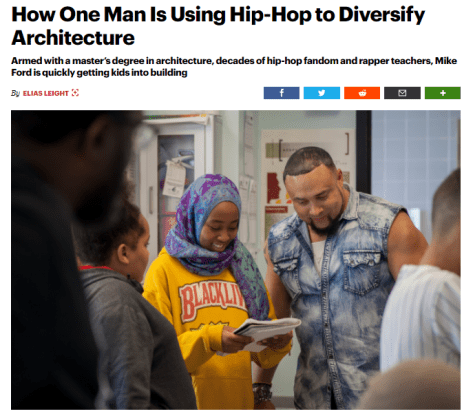
How the legends of hip-hop might have grown up writing different rhymes was a concept Mike was so invested in that instead of thinking about it, he decided to be about it, founding the Hip Hop Architecture Camp.

According to Mike, “The Hip Hop Architecture Camp® is a free, one week intensive experience, designed to introduce underrepresented youth to architecture, urban planning, creative place making and economic development through the lens of hip hop culture.” With the help of architects, urban planners, designers, community activists and hip hop artists, kids use professional drafting software and 3D models to build their own cities and communities “so that nobody has to tell those stories in their songs again.”

Aside from the change he hopes to bring to kids’ lives, Mike’s Hip Hop Architecture Camp serves another equally critical purpose, too. “Hip hop has always been the voice of the voiceless,” he says. “In architecture, less than 3% of the professionals are African American. Less than 1 in 5 architects identifies as a racial or ethnic minority, and black women comprise less than 1% of the field.” By giving kids their first introduction to architecture through hip hop, he’s introducing the field of architecture to them, too.

“I’m trying to show architects, planners, and designers that our profession is more than brick and mortar. We create incubators of culture,” Mike explains. “Even if someone is not a fan of hip-hop, or simply doesn’t like the culture, I challenge him or her to understand why it exists, and how our profession necessitated its birth through bad planning and housing practices.”

Take for example the Cross Bronx Expressway. Its construction on Manhattan Island in 1955, created a structural division and environmental nuisance that drove middle- and upper-class residents to build affluent communities and economic districts further south, but left people of color and the poverty-stricken isolated. Today, the Bronx is arguably considered the birthplace of hip hop, a detail that Mike knows isn’t a coincidence.

He regularly quotes NAS whose song “I Can” encourages kids to be – among other skilled professions – architects. Mike’s taking that song’s spirit and laying the foundation for the engineering, mathematical, imaginative, and critical thinking skills it takes to be successful in his field, as early as possible. After all, as an architect, he’s also familiar with the great communities of color like Greenwood in Tulsa and Black Bottom in Detroit, both long decimated. “I’m letting kids know we have a history of building spaces and places,” he contends.

For the 10-to-17-year-olds attending Mike’s Hip Hop Architecture Camp in dozens of cities nationwide, learning their history, analyzing their playlists and tinkering in models are more than just fun ways to spend a week. It’s what Mike hopes builds the right knowledge, experience and dedication to see to it that the people influenced by trap house environments can graduate to corner offices where they’re empowered to change them.


KEEP GOING BLACK IN HISTORY:

Host, attend or just learn more about a national Hip Hop Architecture Camp.

Check out Rolling Stone’s feature on Mike Ford & his camps.

Each session of campers produces their own rap video based on their camp experience and rooted in their city’s history and musical style. Watch & listen to the 2018 Detroit Camp’s banger.

DAY 11 — Seneca Village

Seneca Village - Central Park’s Stolen Foundation

There’s a dark secret buried beneath the greenery of Central Park.

In the mid-1850s, New York was was just beginning to blossom into the global city it’s now become. Brimming with tourists, businessmen and immigrants from around the world, the city needed a grand outdoor space to rival those of London, Paris and other European metropolises, according to New York’s officials and prominent residents too.

Where they didn’t have space to build, city planners took what they needed from the nearby “shanty wasteland” inhabited by “insects, squatters, and bloodsuckers,” as the local papers characterized the small enclave of Seneca Village and its people.

But those descriptions couldn’t have been further from the truth. No one was more invested in the well-being and upkeep of their small corner of the Big Apple than Seneca Village’s own citizens – it had stood as New York’s first community of free black people for 30 years.

Despite the fact that the state of New York didn’t officially free slaves until 1827 and the United States didn’t follow until 1863, the free black men and women of Seneca Village established their middle-class settlement by purchasing adjacent plots of property in 1825. But so much more than pride bound them so fiercely to their estates. In those days, black men were only eligible to vote if they owned at least $250 of land. Of the nearly 14,000 black people documented in New York at the time, only 91 had voting rights and of those, 10 lived in Seneca Village. For their small town, preservation was power.

Albro and Mary Beth Lyons were two prominent abolitionists who were also known citizens of Seneca Village.

But unbeknownst to all of them, just two weeks before the church’s cornerstone was set, city officials had ordered the entire village, from 81st to 89th Streets between 7th and 8th Avenues (near what’s now Central Park West), condemned to make space for their vanity.

With 3 churches, 3 schools, 2 cemeteries and dozens of free-standing homes up to three stories tall, Seneca Village was a thriving community with nearly 600 total residents during the 3 decades it existed. And they had plans for greater longevity. When the cornerstone for their First African Methodist Episcopal Zion Church was laid in 1853, a time capsule was placed inside to preserve the significance for future residents. As a suspected Underground Railroad stop due to the presence of so many abolitionists and the constant influx of new residents, it had become a place of hope for all who passed through and a realized vision of what free black people could be.

An article from the New York Herald documents the coffins unearthed in 1871, noting that they had not been there just 5 years before when trees were planted in the park. Unlikely, as excavations later established it as the location of one of Seneca Village’s cemeteries. (Also note the coffin’s description.)

4 years later in 1857, it was all gone. Despite protests from the citizens and lawsuits that they brought against the city for failing to pay what the property was worth, if they paid anything at all, the then 300 or so men, women and children of Seneca Village didn’t stand a chance against New York’s elite.

It wasn’t just black history that was destroyed either. By the time it was razed, Seneca Village was a shining example of an integrated community, with as many as 30% of its residents having been Irish or German, all attending the same schools, churches and local gatherings.

Seneca Village was only one of many black communities, cemeteries and landmarks lost to the rise of New York, and the city has begun to address this shameful history through places like the African Burial Ground National Monument and historical markers. But some mistakes can never be undone. As signified on the plaque where Seneca Village once stood, after their property and voting rights were lost, Seneca Village was never rebuilt, and while remains have been unearthed there sporadically since 1871, not a single living descendant of the community’s black citizens has ever been found. to make something brand new.

Where Seneca Village would have stood today

KEEP GOING BLACK IN HISTORY:

Explore the study & excavation of this historic community at Columbia University’s Seneca Village Project.

DAY 19 — Greenwood, Tulsa

Greenwood District, Tulsa, Oklahoma - The Black Wall Street Massacre

In the early 20th century, black businessmen bought land in Tulsa, Oklahoma, and developed it into one of the most successful & affluent black communities ever built in America.

The Greenwood district in Tulsa, Oklahoma was once so self-sufficient & financially stable that it was known as “Black Wall Street” where black people lived, worked, bought, sold & traded with others, and everyone succeeded for it. Greenwood had its own banks, pharmacies, lawyers, doctors (including a Mayo Clinic endorsed surgeon), and published two newspapers. Large segments of the population lived with trappings of wealth that were rare even for black people in integrated northern states, like private planes.

But on May 31, 1921, it all literally burned to the ground. In a story that plays like a broken record, a rumor about a black man assaulting a white woman somehow justified genocide, and Tulsa’s racists, bolstered by the KKK, destroyed EVERYTHING in Greenwood. The community was bombed from the air & torched from below in a 2-day riot that no law enforcement official stopped & no one was ever held accountable for.

Over 800 people were injured, an estimated 10,000 were left homeless when 35 city blocks of over 1,256 residences were destroyed, more than a dozen churches and 600 successful businesses were lost, including 21 restaurants, 30 grocery stores, two movie theaters and a hospital. Greenwood’s founder alone lost over $200,000 in property assets. Archaeologists & historians estimate that as many as 300 died that day, and their bodies were dumped in a mass grave outside of the local cemetery. Known today as the Tulsa Race Riot, if estimates are correct, it ranks as the second deadliest attack on American soil behind 9/11.

Needless to say, Greenwood never recovered its original glory, and the story of what happened there only survived history because it destroyed a key milestone in black history. But it was hardly the only story of its kind. Between 1906 and 1923, notable mass murders of dozens of black people were carried out in Atlanta, East St. Louis, Rosewood, FL, and Slocum, TX. Similarly to the Tulsa Riot, ultimately, no one was held responsible for committing any of these crimes of murder, arson, kidnapping, rape, robbery and so on.

Today, when we point elsewhere to condemn senseless acts of terrorism, we should humbly acknowledge that our country has much to atone for to our own citizens in our not-so-distant past as well.


KEEP GOING BLACK IN HISTORY:

The Tulsa Historical Society & Museum has preserved an incredible collection of images of the day of the massacre, but also of black life in Greenwood before it was stolen away.

CNN produced a very thorough 7-minute short featuring images of Greenwood & its citizens in their prime, more from the day of the massacre, newspaper articles, and an interview with an elderly survivor.