All posts by The Griot

DAY 2 — Jack Trice

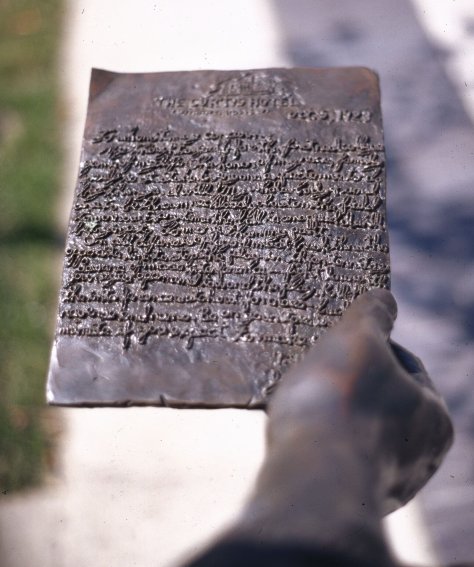
“My thoughts just before the first real college game of my life. The honor of my race, family, and self are at stake. Everyone is expecting me to do big things. I will!”

In pointed, anxious cursive, Jack Trice took his innermost thoughts to the stationery of the Curtis Hotel in Minneapolis, Minnesota. After all, there was no one else for the 21-year-old to share his excitement, anticipation, and gameplan with. As Iowa State University’s only black player, the segregated accommodations at away games meant he ate dinner in an empty room, and unburdened his true feelings to the only person he could: himself. Once he’d claimed his victory on paper, he folded the letter, humbly tucked it inside his suit pocket and prepared for the game of his life.

Three days later, that bright young life was lost. Jack Trice died on October 8, 1923 from injuries sustained in his second ever college varsity football game.

Back then, for a football player to be critically injured, or even die, wasn’t entirely out of the norm. Without the protection of pads, facemasks and other safety developments that came later, the game could be brutal. But in Jack’s case, there was another dynamic at play. In 1923, Iowa State was one of only 10 integrated major college football teams. On the field, the 215-pound tackle, who by all accounts was a quiet force who worked hard to succeed and blend in at Iowa State, couldn’t have stood out more to the University of Minnesota Gophers. Whether it was out of fear of his race, his indomitable blocking, or both, the opposing team focused their efforts on one man.

His teammate Johnny Behm reflected on the events that led to Jack’s untimely death, quite aptly capturing the conflicting feelings about what was at least a very public demise: “One person told me that nothing out of the ordinary happened. Another who saw it said it was murder.”

In just the second play of the game, Jack’s collarbone was broken, but he insisted on staying in. Toward the end of the third quarter, Jack was trampled by Minnesota linemen, and still only begrudgingly allowed himself to be carried off the field. He was treated and sent home to Ames with his team, where he finally succumbed to internal bleeding days later.

Despite “we’re sorry” chants from Minnesota’s fans as the Cyclones hauled Jack’s broken body off the field, that game’s events led to Iowa State’s refusal to play Minnesota again for 66 years in protest of Trice’s mistreatment on the Gophers’ home field. Jack’s integrity and tenacity so inspired Iowa State fans that they launched a 24-year-long campaign to officially name their football stadium in his honor, making it the only NCAA Football Division I stadium to bear the name of a black man.

One account surmised that Jack was so determined to stay on the field in spite of his fateful injuries because he hadn’t achieved what he set out to do in his letter, which was to “make good” on his promises to himself. But by 1930, just 7 years after Jack’s death, four more Division I teams were integrated, and 42 years later, every major college football program in the United States had a black player. Though he didn’t survive to see it, Jack Trice’s legacy was to open the door for thousands of others to make good on his handwritten promises forever.


KEEP GOING BLACK IN HISTORY:

See more Jack Trice images and history at the Iowa State Digital Archives.

DAY 1 — The Sugar Land 95

A single backhoe’s load of dirt in early 2018 was all it took to unearth 95 battered and discarded skeletons and a history that the Imperial Sugar Corporation, the State of Texas, and the entire southern United States might have preferred remain buried.

But they had been well-warned. Reginald Moore, a former prison guard and caretaker of the state’s Old Imperial Farm Prison Cemetery had spent over 25 years researching the history of prisons, plantations and slavery in the southeastern “Sugar Bowl of Texas,” and he’d pleaded with city officials to conduct archaeological surveys before continuing development. He cautioned them that eventually, the dark history of the region’s sugar economy would come back to haunt the town just outside of Houston so aptly named Sugar Land.

Sugar caning had a long-standing reputation of being such miserable, back-breaking work that farms couldn’t even pay people to work the fields. It didn’t take long for most of the local sugar plantations to go entirely bankrupt once their unwilling workforce found freedom in 1865 when Texas was emancipated.

But the enterprising owners of a successful plantation that would go on to become the Imperial Sugar Company had another gambit to play. Since 1844, their neighbors in Louisiana had engaged in a practice known as “convict leasing.” Despite its relatively unassuming name, convict leasing was state-sanctioned slavery that was mutually beneficial for both plantation owners AND southern states. The enactment of “Black Codes” in southern states ensured a constant supply of prisoners (and thus constant income) by frivolously jailing black men for things like failing to get their employer’s permission to change jobs or flirting with white women, and plantation owners now had hassle-free labor with an added bonus: unlike slaves, leased convicts were easily replaceable and didn’t need to be well-fed or particularly cared for at all. If they died, plantation owners buried them where they fell, chains and all, and simply requisitioned another.

Victims of the “Black Codes” at work as prison laborers. Children.

And so in 1878, just 13 years after slaves were freed in Texas, the Imperial Sugar Company became one of the largest convict lease owners in American history, buying rights to the ENTIRE state’s prison population, and gaining a brand new nickname that reflected the horrific conditions that convict leasing allowed them to inflict on workers: “The Hellhole on the Brazos.” One inmate wrote that Imperial’s prison guards routinely reminded them that “the men did not cost them any money and the mules did,” a mentality that led to treatment so bad that “nobody was relieved until he dropped in his tracks.”

The painful legacy that Reginald Moore had begged Sugar Land officials to face was now one that they couldn’t look away from.

“The Sugar Land 95” (94 men and 1 woman) unearthed that day ranged from 14 to 70 years old, all with significant trauma to their bones. Despite outcry by 225 Texas historians asking the Fort Bend county officials to “make choices that acknowledge the national significance of this discovery… a burial ground [like which none other] has been found,” after DNA collection and artifact cataloguing, the Sugar Land 95 were reinterred back at the Fort Bend ISD construction site where they were found, with a memorial ceremony planned for this Spring.

When he spoke to the school district on behalf of the Sugar Land 95 he’d long fought to see acknowledged, Mr. Moore mourned that they were “being treated today in death the way they were treated when they were alive,” but took comfort in knowing that finally their truth could not be denied: “They existed.”

“A contract for convict labor, used during the convict leasing system that forced thousands of African Americans to work as forced labor after slavery ended specifically asks for ‘Negro workers.’”
(Read on at USA Today)

KEEP GOING BLACK IN HISTORY:

Read details of Reginald Moore’s campaign for justice for the Sugar Land 95 at Texas Monthly.

The Houston Chronicle dives into the dark history of contract labor surrounding the “Hellhole on the Brazos.”
Sam Collins of the Convict Leasing and Labor Project speaks about their purpose and the history of convict leasing and the Sugar Land 95 on the Texas State Capitol, built by convict laborers.

In 2009, Douglas A. Blackmon’s book “Slavery By Another Name” won the Pulitzer Prize, and it’s another excellent source should you want to learn more about the convict leasing system.

Caleb McDaniel, a historian at Rice University, has been one of the most vocal allies of preserving the entire site where the Sugar Land 95 were found. Find his official statement and petition (endorsed by the 225 historians referenced above) here.

DAY 28 — Vilissa Thompson

Vilissa Thompson - Bringing Black Disability Awareness

“Children like you didn’t go to school when I was your age—you stayed at home.”

Vilissa Thompson’s grandmother Viola constantly reminded her that every day with her disability was an opportunity.

Back in her day well before Vilissa was born, Viola had seen black children with disabilities become disposable to others – left out of school, left out of activities, and resigned to watching life pass them by.

Viola refused to let that be Vilissa’s story too. Her granddaughter had been born with a genetic disorder called Osteogenesis Imperfecta (OI), better known as Brittle Bone Disease, and was only expected to live a few years at best. Overwhelmed with the prospects of being a single parent with a terminally ill child, Vilissa’s mother placed her in a children’s home where they’d have the support to care for her. But Viola refused. Rather than leave Vilissa to strangers, she’d love her, teach her and encourage her to lead a full and happy life, no matter how long it might be.

“My Grandmother ensured that I received a quality education and healthcare during a time when such rights were in their infancy. She knew that I deserved the same opportunities as everyone else, and her determination, unconditional love, and support were instrumental to my growth as a disabled young girl.”

They were also instrumental to Vilissa’s future calling.

Whether it was Viola’s nurturing or just Vilissa overcoming the odds, turns out, Vilissa had many more years to live and turn her story into one that made a difference for disabled people.

In 2012, she graduated with a Master’s degree in social work and founded her own organization the next year. Vilissa’s Ramp Your Voice “spotlight[s] the issues and barriers of disabled people, as well as create[s] effective social and political changes to ensure that all people have the ability to succeed and prosper, regardless of their ability, ethnicity, religion, educational level, or place of origin.”

Just as she’d had an advocate in her life, Ramp Your Voice helped Vilissa empower other disabled women of color, especially black women, to live their lives out loud instead of locked away – physically or mentally – and ashamed.

But one fateful day on Twitter, the community that Vilissa’d created in her little corner of the internet went global.

She, like so many other disabled women, were thrilled to see an article on xoJane about how disability and beauty were not mutually exclusive, but as they scrolled through, the story was that of three traditionally beautiful white women’s experiences in the world with their disabilities. It even included the line “If we don’t truly see the diversity, we don’t see the injustice. In race or gender this translates to things like discrimination and income inequality. In disability this can mean lack of accessibility, or issues of employability.”

It was an interesting take for an article that didn’t include a single person at the intersection of all of those issues, like a disabled black woman. So in one quick tweet, Vilissa called it out:

Unsurprisingly, Vilissa’s hashtag went viral, with over 13,000 tweets in 24 hours as more disabled voices joined the chorus:

#DisabilityTooWhite when you have to wait twice as long for a medical diagnosis or to receive adequate medical care b/c of medical racism.”

#DisabilityTooWhite when people still think ‘#autism is a white people thing’ and black children go undiagnosed”

#DisabilityTooWhite when so many disabled PoC, especially black folks, end up in jail because they’re being ‘odd in public’. Ex: Neli Latson”

Vilissa was stunned and spurred by the firestorm one little tweet had set off. “I don’t think I’ve seen so many disabled POC speak so freely about themselves in my life,” she recalled.

That tweet, backed by Vilissa’s strong academic pedigree and the bold spirit instilled in her by her grandmother, helped boost her visibility beyond a niche community and out into the world. Today, at 31, Vilissa’s a public disability rights expert, featured in media outlets worldwide speaking to the black disabled experience and how easily it’s excluded from both mainstream representation AND black social movements. And as if that’s not enough, she’s still hard at work as a social worker and now a disability rights consultant, challenging ableism at national, global and cultural levels to ensure that there’s an equal playing field for everyone, no matter what body they’re born in.


KEEP GOING BLACK IN HISTORY:

Find empowerment, education, inclusion, and self-advocacy for disabled people and their allies at Ramp Your Voice!

Vilissa’s Tools You Can Use section is filled with free or low-cost resources to help disabled individuals improve their quality of life.

DAY 27 — Ellen & William Craft

Ellen & William Craft - Lovers in Hiding in Plain Sight

“It is true, our condition as slaves was not by any means the worst; but the thought that we couldn’t call the bones and sinews that God gave us our own haunted us for years.”

William and Ellen Craft had lived with that demoralizing detachment as a married enslaved couple for 2 years, but their dread was only growing worse.

Ellen wanted children but refused because she herself had been torn from her family on her mistress’s whim as a child. Her light skin led strangers to mistake her for a member of her master’s family (and she was: he was her father), and it so infuriated the owner’s wife that when Ellen was 11, she was simply given away. Some of the Crafts’ friends had even suffered worse: each member of their family was separated from each other and sexually abused by their owners until they either escaped or bought each others freedom. Even if all they had was each other, William & Ellen had too much to lose.

A child of rape, Ellen’s skin was light enough to pass, an unfortunate circumstance she and William took full advantage of

But their escape in particular was more complicated by the fact that William and Ellen had two different owners. If they were going to flee Georgia, they’d have to figure out a way to do it together and be discreet about it, a tough task considering that their near opposite skin tones made them a conspicuous pair. Because they were both trusted in their households, they were each granted passes to visit family nearby. So with one problem down and a head start on their owners, they decided to hide in plain sight.

Whomever came looking for them would be keeping a watchful eye for a black man and white-passing woman, but William and Ellen both knew firsthand that no one batted an eye over a master accompanied by his or her slave. So they devised an elaborate scheme that both of them almost didn’t have the nerve to go through with. Ellen’s hair was cut short in the style of rich white plantation owners, and her jaw and neck were wrapped in gauze to appear as though she had some sort of affliction, when it was really to hide her soft, slender face and lack of facial hair from anyone who might look too closely. They even put her arm in a cast so as to deter anyone who might ask her to write or sign anything, as she’d never be taught to read or write. And on December 21, 1848, they made their daring escape by train, boat and on foot.

It was 6 full days before Ellen’s heart stopped pounding out of her chest.

Just a day into the trip, who was seated on the train next to them but a friend of Ellen’s master, a man who knew her well. He spent the whole ride shouting to make conversation with her. She spent it pretending she was deaf.

In South Carolina, their next passage was denied by a steward insisting on William’s ownership papers. Abolitionists had been kidnapping slaves from their rightful southern owners and granting them freedom in northern states, and this particular steward was serious about his job, refusing to sell them tickets until Ellen produced papers. Just then, the captain from their previous trip happened by & vouched for the couple, never realizing he’d been duped himself.

In Baltimore, the last stop to freedom, this time officials pulled them from the ship, demanding William’s documentation. Ellen pulled out every trick she knew, stalling, huffing and puffing until finally, the ship began to depart. Fooled by the cast and face wraps still hiding Ellen’s true identity, the official pitied a sickly man and allowed him (her) to carry on with the trip.

An artist’s depiction of Ellen Craft in disguise

The disguise was so good that even William found himself thwarting would be rescuers who advised him on how to abandon his disabled “master” for freedom in the north.

The couple arrived in Philadelphia on December 26, where Ellen collapsed into tears under the weight of the nearly weeklong ruse and relief from the fear of what being discovered would have meant for them.

They were taught to read, write, and found a prosperity in Philadelphia that neither of them had experienced before. But their great escape wasn’t over yet.

The Fugitive Slave Act allowed masters to recover their escaped property by any means necessary and with the help of federal authorities, which is exactly what William and Ellen’s owners did.

So in 1850, the pair fled again. This time to England, where rather than life out their days quietly as free people, they joined others who’d escaped slavery to successfully convince Parliament not to ally with Confederate forces in the Civil War. For the next 20 years, William and Ellen Clark made a name for themselves as prominent abolitionists, raised a family, and financed philanthropic causes in Africa.

But even in the worst of circumstances, there’s no place like home, so once slavery was finally abolished in the United States, the Clarks returned to Georgia in 1868, using the education they’d received in England to open a school for newly freed black students, putting their considerable finances toward purchasing a plantation of their own, and living the rest of their lives fighting for even greater black freedoms, together.


KEEP GOING BLACK IN HISTORY:

Read Ellen & William’s autobiography, including their daring escape, in the 1860 book, Running a Thousand Miles For Freedom.

DAY 26 — Victor Green & The Green Book

Victor Green - The Black Guide to America

“Would a Negro like to pursue a little happiness at a theater, a beach, pool, hotel, restaurant, on a train, plane, or ship, a golf course, summer or winter resort? Would he like to stop overnight at a tourist camp while he motors about his native land ‘Seeing America First?’ Well, just let him try!”

That was the state of affairs according to the NAACP’s magazine in 1947, as they warned black people against buying into the Great Northern Railway & National Park Service’s ad campaign encouraging Americans to vacation close to home. And lest someone doubt it, they need only look to examples of the plain warnings posted just outside thousands of “sundown towns”:

“N—–, Don’t Let The Sun Go Down On You.”

These weren’t just occasional backwoods towns. As late as the 1960’s there were still as many as 10,000 active sundown towns documented in the United States, some that were well-known and well-populated like Glendale, CA and over half of the incorporated towns in Illinois.

It was a difficult dilemma for black people who’d been encouraged to buy cars as soon as they could to avoid the humiliation of being forced to the back of public transportation vehicles, but couldn’t freely use those cars to travel beyond the relative safety of their immediate surroundings. If they did, they often packed extra food, gas and portable facilities to avoid being forced in dangerous situations for necessities.

Victor Hugo Green had done his share of getting around. As a postal worker, and later World War II soldier and music manager, he’d learned to navigate where he was welcome and would repeatedly visit those same establishments for both his own safety and to contribute to their continued success.

After some close calls himself and hearing stories from strangers and friends alike about running into racism whether traveling for business or pleasure, he decided that he’d curate a book to help “give the Negro traveler information that will keep him from running into difficulties, embarrassments and to make his trip more enjoyable.”

When he ran his inaugural 10-page issue in 1936, it was titled the “Negro Motorist Green Book,” and it primarily focused on lodgings, gas stations, restaurants and travel advice in New York, but by the very next year, it was popular enough to reach national distribution. By picking the brains of his fellow postal workers and offering to pay the Green Book’s readers $1 for providing new leads, Victor grew his publication annually until he left for the war in 1940, and when he returned in 1946, he began expanding the Green Book to include safe spaces in international destinations like Mexico, Canada, the Bahamas and Europe. By 1949, the Green Book was up to 80 pages including ads, many of which were from black female entrepreneurs who found freedom and greater personal wealth in running their own businesses and benefited from the word-of-mouth.

But what the Green Book omitted was as much a warning as inclusion was a welcome. Not a single restaurant was featured in Alabama in the 1949 issue. In Texas, only Austin and Waco were included in ANY Green Book. On the contrary, New Mexico was highlighted as a state that primarily practiced “cash over color.” The information contained (or not) within the pages of the Green Book was so extensive and reputable, a member of the Little Rock Nine even called it “one of the survival tools of segregated life.”

Recognizing that ultimately, black travelers just wanted to have positive experiences, Victor always ensured that the tone of the Green Book, while cautious was always uplifting, and he often featured travel quotes like his twist on Mark Twain’s “Travel is fatal to prejudice” to reassure black travelers that eventually things would change. In fact, at their peak of printing 15,000 copies annually, Victor himself once wrote, “There will be a day sometime in the near future when this guide will not have to be published… It will be a great day for us to suspend this publication for then we can go wherever we please, and without embarrassment.”

Victor passed away in 1960 and didn’t live to see the signing of the Civil Rights Act of 1964 outlawing discrimination on the basis of race, but his hope was indeed realized. With the passage of the Act, the dire necessity for his guide slowly decreased, and after nearly 30 years in circulation, the Green Book was finally retired in 1966, having made a whole era of travel possible for black people who wanted to take their growing freedoms on the road too.


KEEP GOING BLACK IN HISTORY:

Explore the New York Public Library’s digital catalogue of Green Books published 1936-1967.

The Bitter Southerner created a really lovely featurette illustrating personal vignettes about using the Green Book.

DAY 25 — Edouardo Jordan

Edouardo Jordan - Five-Star Soul Food

When Edouardo Jordan won the James Beard Foundation’s 2018 Best Chef: Northwest Award, it celebrated the eccentric story of a black chef innovating Italian and French food in Seattle.

When he won a second James Beard award recognizing his second establishment as 2018’s Best New Restaurant, he became a trailblazer as the first black chef to receive one of cooking’s top honors.

That this second and now Best New Restaurant serves a cuisine most easily described as “black southern soul food” could not have been a sweeter cherry on top.

Visit the website of any given national award-winning chef, and you might find technical definitions for cuts of meat, the terminology of a cocktail, or the difference between poaching and sous-vide.

But at Edouardo Jordan’s JuneBaby, food isn’t just defined, it’s given a place in history.

There, you’ll learn the branches of the African Diaspora; find cool cups, yams and chitlins on the menu; discover why Aunt Jemima has racist roots; and of course, leave with a deeper appreciation of why black food is American food and has been since our ancestors arrived here.

So when JuneBaby’s unapologetically black cuisine won it the equivalent of the “Best Picture of the Food World,” yeah, it was a really big deal.

And yet, Edouardo wasn’t always so bold.

His first establishment Salare Restaurant (the one for which he won Best Chef: Northwest) was born from his journey to master and then personalize the classic arts of Italian and French cuisines. But Eduardo readily admits it was also where he started to avoid being known as “THAT chef.”

“I didn’t want to become ‘the chef that opened a black restaurant because he’s a black chef and that’s what he’s supposed to do.’ I wanted to bring another aspect to who I am and showcase myself as a chef. I trained to become a great chef. That’s what I want to be recognized as: a great chef — not a great Southern chef, not a great black chef, but a great chef.”

But as the reservation list at Salare grew and his name gained status in culinary circles, Edouardo realized that rather than becoming cliche and niche, he had an opportunity to cast a new light on the black Southern food he grew up with in the Deep South and bring it the reverence it deserved.

He had a new ambition to break “the stereotypes of like, ‘Oh, that’s black-people food.’ No, actually, it’s the food that fed America. That’s the reality. There were many hundreds and thousands of people that were not slaves that ate that food and really enjoyed that food and took something away from that food. We’re talking about what’s American cuisine.”

The fact that soul food itself wasn’t exactly new to the modern culinary world actually gave him even more motivation to push ahead in getting back to his roots.

“There’s some great chefs of non-color telling beautiful stories about Southern food, and that’s appreciated and needed. That helped put Southern food back on the map, but my issue was, well, what happened to all the African-American chefs that been grinding it all this time and may have had a small shop and never got recognized? Because I’m like, wow, this is not the Southern food that I know of. There was no one of color truly talking about the food from their perspective, in their eyes,” he observed.

It feels like such a poetic storybook ending that the food Edouardo once shied away from cooking for an elite audience is that one that earned him the most acclaim, but he wouldn’t have done it any other way, explaining that “the path I was on helped me to express myself as a culinarian first.”

Anyone who’d doubt his dedication to his second and Best New Restaurant need only read how he describes his menu to understand that he’s in it for the long haul: “Southern food reflects hard times and resourcefulness and is nothing short of beautiful. It is a cuisine to be respected and celebrated.”

And with that outlook, it’s not hard to imagine that Edouardo Jordan’s got many more successes and culinary delights to share with the world – his award-winning reputation and personal investments notwithstanding, he’s literally got generations of skin in the game.


KEEP GOING BLACK IN HISTORY:

Visit JuneBaby’s website (especially their extensive and informative encyclopedia)!

Chef Edouardo Jordan discusses the global diaspora and complicated history of fried chicken in Season 1, Episode 6 of Netflix’s “Ugly Delicious.”

Don’t miss Junebaby’s Instagram for the perfect (mouthwatering) representation of how the restaurant blends black food & history.

Chef Edouardo was even listed among People’s 10 Sexiest Chefs of 2018 too. He’s truly highly acclaimed.

DAY 24 — Aesha Ash

Aesha Ash - Real Life Black Swan

Aesha Ash was living the dream.

Sort of.

She’d attended the prestigious School of American Ballet by 13, and joined the New York City Ballet by 18. Both achievements no one could ever have imagined for the black girl from Rochester, a city whose claim to fame was an astronomical crime rate.

But this talented dancer would cry herself to sleep at night because despite performing on some of the world’s biggest stages and among some of its brightest talents, every day was a reminder that she couldn’t be more alone.

Being a ballerina at such an elite level was a challenge for anyone. But being a black ballerina at this level came with its own unique set of difficulties to overcome. Other girls teasing her about hair that didn’t gracefully tumble from its bun so much as it slowly fluffed, being turned away from the backstage makeup chair because there was nothing in her shade, and feeling every eye in the room burn into her when a tactless director scolded dancers who were spending too much time in the sun saying, “I don’t want to see any dark skin on that stage” were just a few of the thousand tiny cuts Aesha endured daily.

It reminded her of growing up in Rochester, where she & other inner-city students were bussed to suburban schools and the local kids couldn’t wait to remind her where she came from, constantly asking about drug dealers and shootings instead of accepting her as a regular kid not all that different from them. It seemed that no matter where you go, some things never change.

But there were also the handful of other times when a lone black woman would approach her after a show or recognize her on the street to thank her for just being present as an inspiration. It was those moments that revitalized and reassured her that she wasn’t as alone as she thought.

She spent 8 years with the New York City Ballet before dancing as a soloist in Switzerland, and finally moving back to dance in San Francisco, all along noting that no matter what stage she found herself on anywhere in the world, she was almost always the only person who looked like her. She retired in 2008, but not without realizing that she had a special insight and a special story that could change the whole landscape of ballet and black representation.

Her task was a tricky one though. The problems she identified were intersectional and that made them hard to attack from just one angle. Ballet is an art form with a constant financial commitment that she knew firsthand by how hard her parents had worked and how much they’d sacrificed to fund her continuing training. A lot of families couldn’t afford it, but inner-city black families disproportionately affected by poverty, single households and lack of transportation especially struggled to participate. Just coming from where they did made it hard for city dancers to break the class ceiling on a high art like ballet. And of course, like Aesha had, black ballerinas also find themselves fighting racism within the craft because no one checks their biases at the door, and since black women are constantly represented as angry, overly built, vulgar, loud and hypersexual, that’s how ballet’s elite who were so rarely exposed to real black women saw her too. In short, everything a stereotypical ballerina is not.

“That always frustrated me,” she recalls. “We’re human beings. We also have moments of weakness, of softness and sweetness and gentleness. Ballet embraces the soft, ethereal and majestic side to women, and yet we often don’t see the media portray black women in this light. I wanted to help change the demoralized, objectified and caricatured images of African-American women by showing the world that beauty is not reserved for any particular race or socio-economic background.”

Aesha decided that despite being retired, she could start by being an image of what was possible for little girls in her own community. So she began dancing right there in it, on the streets, sidewalks, anywhere. And then she photographed and shared those moments on social media. What she initially created to uplift girls in her own community soon became a global phenomenon, and The Swan Dreams Project was born.

“I was expecting young girls to like the images or say they were powerful for them,” she recalls. “But it was adult women [emailing me], saying the image brought them to tears, wishing they would never have given up their dreams. What not having representation meant to them. I found it very powerful.”

Swan Dreams isn’t just an inspirational and aesthetic project though, it’s functional too. Through it, Aesha’s raised money to create pointe shoe funds for students at the City Ballet of Los Angeles school to help relieve the equipment burden that forces many of them out of ballet. She’s remodeled run down ballet schools with new barres and floors so that students could receive proper training. She’s even teaching a free after-school program herself so that those who might go without the joy of ballet altogether have the opportunity to be a part of it. And when she was honored in 2016 by the National Women’s History Museum for her contribution to diversifying the arts, it was just one more step to making a difference beyond her little corner of the world.

After 13 years dancing professionally, Aesha’s pirouetted right back to where she began, carving out space for little girls to reach beyond their limitations to bring diversity to ballet and claim a new image for themselves where their dreams don’t take second stage to the color of their skin.


KEEP GOING BLACK IN HISTORY:
Learn more about The Swan Dreams Project, make an immediate donation, or purchase prints and other merch featuring gorgeous photos of Aesha dancing in the inner-city with the proceeds benefiting her organization.

DAY 23 — Robert Abbott

Robert Abbott - Defender of Black Voices

Twice, Robert Abbott had risen to his full potential only to be thwarted by the color of his skin.

He’d studied the printing trade in college, but when he graduated, the only jobs he was offered were in unskilled labor for which he was overqualified.

He’d gone back to school and graduated with a law degree, but before he could build his own practice, an established Chicago lawyer informed him that he was “a little too dark to make any impression on a court.”

So Robert combined his talents and went to work for someone who’d never stand in his way: himself and the people who looked just like him.

In 1905, The Chicago Defender was established.

What started with a 25 cent investment and a 300-copy first run printed from Robert’s landlady’s kitchen grew to 250,000 copies per week and became the most highly circulated black newspaper in the country.

When Robert read white mainstream papers, he was disheartened that the primary news of black people revolved around their crimes, lynchings and the riots against them. He knew better.

His newspaper painted black people in a whole new light. He featured black successes, ran news of black interest, promoted black landlords and properties, rallied for black equality, and once his paper’s distribution reached over 100,000 with nearly two-thirds of that beyond Chicago, he created a whole campaign designed to improve the lot of black readers everywhere. Having noticed that a large number of the derogatory stories and negative events around black people were coming from Southern states where slavery (and thus its effects) had lingered, he appealed to those affected readers to move to Chicago where there was more freedom, a richly cultured and diverse black community and most importantly, personal opportunity.

The “Great Migration” as the surge of black Southerners to northern states was called, began in 1915, but Robert put an urgency to it, even calling for a “Great Northern Drive” on May 15, 1917 as a mass protest exodus of sorts. Between 1916 when The Defender’s campaign began and 1918, Chicago’s black population more than tripled from 40,000 to 150,000, a growth rate that many today and back then largely attributed to Robert’s successful advertising.

It’s no surprise that such a positive force for black people quickly drew the wrong kind of attention and in many southern states, The Defender became anathema. Just before World War I, the U.S. government investigated Robert on charges of sedition after he called for black servicemen to demand equal rights in the military. Klansmen began attacking anyone black seen reading the The Defender, news outlets refused to carry it, and for a very short time, the paper was in jeopardy.

But by then, Robert was a master at using his hustle to overcome adversity.

He bundled the paper in luggage and distributed it among black railroad porters who created a network that gained him an even greater readership than he’d had before. They’d deliver individual copies to riders covertly, redistribute weekly editions among themselves, or drop off whole stacks in local black barber shops, churches and community centers where they’d be seen and shared by up to 500,000 black readers per edition.

While the Defender had long grown from its kitchen production, its distribution eventually had such a high volume that it had to be moved to its own building entirely, becoming the first black newspaper with its own printing press, and in the early 1920’s, its founder who originally couldn’t break into the printing industry became one of America’s first self-made black millionaires.

Robert Abbott died in 1940, but by 1956, The Chicago Defender had become the largest black owned daily newspaper in the world. Although it’s circulation is much smaller now, (as are most newspapers) it’s still in print today, and the goals of its founding principles are just as relevant in 2019 as they were in 1905 when one man determined to overcome racism made a difference for millions.


“The Chicago Defender’s Bible”

1. American race prejudice must be destroyed;
2. Opening up all trade unions to blacks as well as whites;
3. Representation in the President’s Cabinet;
4. Hiring black engineers, firemen, and conductors on all American railroads, and to all jobs in government;
5. Gaining representation in all departments of the police forces over the entire United States;
6. Government schools giving preference to American citizens before foreigners;
7. Hiring black motormen and conductors on surface, elevated, and motor bus lines throughout America;
8. Federal legislation to abolish lynching; and
9. Full enfranchisement of all American citizens.


KEEP GOING BLACK IN HISTORY:

The Chicago Defender continues its legacy of reporting on positivity in the Black community still today.

DAY 22 — Autherine Lucy

Autherine Lucy - Bama’s Boldest

After her 3-year fight to become the The University of Alabama’s first black student was finally won on February 3, 1956, Autherine Lucy was put out within 3 days.

At least she’d actually attended. The friend who’d first suggested it was ousted before she even set foot on campus.

Autherine and Pollie Myers had several Associate’s and Bachelor’s degrees between them, and when they submitted letters of inquiry to the university for their Master’s in 1952, their pedigrees were so impressive that they both received offer letters back within less than 2 weeks. But as soon as they submitted their official applications denoting their race, Alabama rescinded their offers, apologizing for the admittance “mistake.”

The NAACP immediately took on the case, and a young lawyer by the name of Thurgood Marshall warned the ladies that they could expect an uphill battle. Two years in, the landmark Brown vs. Board of Education case that ruled segregation in public schools unconstitutional was an incredible victory for all black students, and 13 months later, Autherine & Pollie were successfully readmitted.

But during the course of the trial, the university had hired private investigators to dig up any dirt they could find on the girls, hoping to call their character into question. Sure enough, they’d discovered that Pollie, now married and with a child, had conceived her child before taking vows. That was a violation of the University of Alabama’s morality code and Pollie was once again disqualified from attending.

Since Pollie was the driving force behind the attempt anyway, university officials hoped Autherine would find the whole affair to be too much trouble and withdraw her application herself. She did not.

On February 3, 1956, Autherine Lucy proudly attended her first day of classes, and having survived her first 48 hours with only a few hundred rocks, eggs and slurs thrown her way, she thought it had actually gone about as well as could be expected.

By February 6, the riots had reached such a violent fever pitch that Autherine sat after her first class for hours, waiting for the mob outside to dissipate before officers would even attempt escorting her out to the police cruiser necessary to transport her around campus. That same day, the University of Alabama expelled Autherine “for her own safety.”

Once again, the NAACP lawyers brought charges against the university, but one of those initial charges alleged that the university had conspired in the riot. Unconvinced they could prove it in court, the charge was withdrawn, but not before Alabama caught wind of it. They claimed that the allegation amounted to defamation and this time, Autherine’s expulsion was official, final and devastating.

“Whatever happens in the future, remember for all concerned, that your contribution has been made toward equal justice for all Americans and that you have done everything in your power to bring this about,” Thurgood Marshall wrote to her, reassuring her that though her fight had been lost, it had not been in vain.

9 years later, Autherine’s fight indeed came to fruition when Vivian Malone became the University of Alabama’s first black graduate.

Autherine’s own redemption was much longer in the making.

After two Alabama history professors invited this living legend into their classrooms to share her firsthand account as a pioneer and petitioned the university to overturn her expulsion, 60-year-old Autherine Lucy returned to the University of Alabama for her Master’s in Elementary Education.

But this time, she didn’t go alone. Autherine and her daughter Grazia were both admitted in 1989 and subsequently graduated together in an incredibly touching and monumental moment that truly illustrated the impact Autherine’s sacrifice had.

Today, the Autherine Lucy Clock Tower, the Autherine Lucy $25,000 Scholarship Endowment, and three individual tributes stand on the University of Alabama campus in honor of the woman whose name school officials once couldn’t get off the register fast enough.


KEEP GOING BLACK IN HISTORY:

Watch 88-year-old Autherine Lucy speak at the 2017 dedication of her historical marker on the University of Alabama’s campus.

DAY 21 — Maurice Ashley

Maurice Ashley - Chess’s Dark Knight

“Survive. Just survive.”

Maurice Ashley couldn’t stress that enough to the defeated young man in front of him.

He’d carried that advice with him from his early childhood in Jamaica, to skirmishes in Brooklyn’s Prospect Park, and on through college. It had been just as true in each of those places as it was in this moment right now, consoling a child whom he had just squarely beat the pants off in chess.

It was lesson he didn’t mind teaching: he’d been that kid once.

After being defeated within a few minutes by one of the old masters in Prospect Park, well known for its revolving chess games, Maurice went to a local library, buried his head in chess books, and learned the game forwards and especially backwards.

“There are consequences to every single move you make in life,” he said.

And growing up in a rough part of Brooklyn, he knew it firsthand. Chess had kept him at home on Friday nights, learning strategies, building character and practicing with his friends instead of selling drugs or running with gangs like a lot of the other kids in his neighborhood did.

It certainly didn’t make him very popular, but it did put him on the path to the success that brought him full-circle.

After nearly 20 years of dedication to the craft, in 1999 Maurice Ashley became Grandmaster Maurice Ashley, the world’s very first black man to hold the chess title.

And then, he immediately went back to work in the community where it all started, founding the Harlem Chess Center just 6 months later to bring chess out of academic settings and into communities, bridging the gap between formal competition and street matches.

“People who think the game is slow and boring should come in here,” he said. ”Kids eat it. It takes nothing to get kids excited about chess. I put the pieces down, and the kids want to touch them — they’re alluring, tactile. The game is magic for kids.”

Since then, he’s channeled his competitive nature into sharing a love of chess with as many people as possible, starting with those with the least access.

In 2005, he wrote “Chess for Success” to share chess with beginners in a context that he’s always espoused: when you learn about chess, you learn about life. It’s full of lessons that “build determination, focus concentration, and teach you about yourself” but it also teaches players how to approach the world around them too.

In fact, being a chessmaster has already taken him places in the world no one would have anticipated a kid like him could go. In 2016, he was inducted into the Chess Hall of Fame for his combined professional success and efforts to bring more diverse groups of people everywhere into the game. In addition to his local grassroots work, he’s traveled the Caribbean teaching children how to play, built a critically acclaimed chess app, and he’s currently working with MIT Media Lab to integrate games like chess and their foundations into school curriculums to improve learning comprehension and application for all students.

In particular, Maurice wants to share a strategy that he uses to play, learn and live called “retrograde analysis.” Rather than teaching players to anticipate things out of their control, it teaches them to focus on the patterns, read their opponents’ previous moves, and force simple outcomes from complex, chaotic scenarios.

It’s a strategy that hasn’t just paid off for Maurice personally, or the people who are fortunate enough to learn from him, but motivates every move he makes today to benefit the kids who’ll lead our world tomorrow.

“When the kids see me walk in, they say, ‘Here’s a brother who looks like me and who is at the pinnacle of his field. I can do that, too.’ And when I see chess captivates their eyes as they’re trying to solve these complicated problems, that’s the most beautiful picture for our people to see.”


KEEP GOING BLACK IN HISTORY:

In 6 minutes, Maurice can teach you the quick steps to “retrograde analysis” so you can learn to look at things differently, even if chess isn’t for you.
Mashable produced a great 5-minute short on Maurice & it’s a fun little watch!