All posts by The Griot

DAY 25 — Bayard Rustin

Bayard Rustin literally wrote the book on successful protest organization. When an unbelievable 200,000 people participated in the civil rights March On Washington for Jobs and Freedom in August 1963, it was Bayard Rustin who’d planned EVERYTHING from advertising to uniting feuding speakers, and from barring violent racists to bathroom logistics. And there’s a reason that he’s been largely left out of history.

Bayard Rustin was openly gay.

If there was a person who most typified The Resistance of the time, it could be argued that it was him. In 1944, he was sentenced to 2 years in prison for refusing his World War II draft order due to his deep-seated, strictly non-violent Quaker faith. In 1953, he spent 60 days in jail for homosexuality (“sex perversion” was the specific charge). And 13 years before Rosa Parks had, Bayard was one of the first to refuse to give up his seat to white people on a Mississippi bus, a monumental action that led to the founding of the Southern Christian Leadership Coalition and his role as a key advisor to Dr. Martin Luther King.

But strangely enough, Bayard found himself fighting twice as hard against unlikely enemies. Because he was gay, both black and white people tried to blackmail him in efforts to discredit him. His skills were so revolutionary & so effective that white enemies like Senator Strom Thurmond knew that removing him from the movement would be devastating. The power he held within the movement was so great that heterosexual blacks didn’t feel that a gay man should have it & sought it for themselves.

But Bayard didn’t let that stop him one way or another. He knew that he was fighting at the intersection of two historic causes, both of which were too significant to be undermined. His partner, Walter Naegle recounted that “Bayard was willing to stand up for people — even though they had mistreated him — it was a matter of principle.”

Bayard & Walter. An interracial gay couple with a huge age difference. Such scandal.

After the Civil Rights and Voter Rights Acts were passed in the 60s, he was actively involved in the Gay Rights Movement, but felt compelled to take up a third cause. He became a vocal proponent of Workers’ Rights, demanding increased minimum wage (which was only a ridiculous 75 cents at the time) and federal programs to train & place unemployed workers.

Over the course of his life, Bayard successfully advanced the efforts of three of the most significant modern rights movements in the world, and few people recognized him. In 2013, just two months after the 50th anniversary of what Dr. King called “the greatest demonstration for freedom in American history,” President Obama posthumously awarded Bayard with the Presidential Medal of Freedom, an honor that Walter touchingly accepted on his behalf.

In a quote that sums up the person he was, the values he held, and the hopes he had for future generations, Bayard once said “We need, in every community, a group of angelic troublemakers.”


KEEP GOING BLACK IN HISTORY:

Take a moment to enjoy a short super reel of Bayard’s incredible speeches and the power he had to mobilize the people.

DAY 24 — Adm. Michelle Howard

Michelle Howard - First Female Four-Star Admiral

Michelle Howard just wanted to do her job. She was a black woman who’d excelled in the U.S. Navy for years, so naturally, all sorts of organizations wanted her to come share her stories, or to clink glasses with her at their parties.

In 1999, she’d become the first black woman to command a Navy ship, the USS Rushmore (LSD 47). And over the years, she’d also commanded tsunami rescue efforts, maritime security operations, and counter-piracy strikes. In fact, just three days into her counter-piracy command, she successfully led the well-documented rescue of Captain Richard Phillips from Somali pirates who’d hijacked & kidnapped him from the Maersk Alabama.

By then, she’d also won the Women of Color STEM Career Achievement Award, the USO Military Woman of the Year Award, the NAACP Chairman’s Award, and the Secretary of the Navy’s Captain Winifred Collins Award. She’d even started her career famously as one of the first women admitted to the United States Naval Academy.

Michelle didn’t get where she was by entertaining distractions. Back when she was little, she’d learned to stay focused after kids on the playground called her a n*gger and when she ran home crying, her father told her “You gotta toughen up. This is the country you live in.”

She wanted to shut out everything but the job when a few words from her mother changed her entire perspective: “You are where you are historically.”

So she embraced her place in history, and anything else that came along with it. Two years later, Michelle came to take it all.

Adm. Howard is pictured here with Rear Adm. Annie B. Andrews (L) and Rear Adm. Lillian E. Fishburne (C, ret.) as the first three black female admirals in the Navy.

On July 1, 2014, she became the first female four-star admiral, as well as the first black person and first woman to serve as Vice Chief of Naval Operations.

On June 7, 2016, she stepped down as Vice Chief of Naval Operations… to lead U.S. Naval Forces Europe-Africa/U.S. Sixth Fleet, becoming the first female four-star admiral to command operational forces in the process. She also leads NATO’s Allied Joint Force Command Naples – JFCNP in Italy. All that, and she’s only 56.

So when it comes to doing her job, as the highest ranking female in U.S. military history, I think it’s safe to say that she’s doing an all-around damn good one.


KEEP GOING BLACK IN HISTORY:

Adm. Howard discusses her experiences overcoming race & gender barriers with The Empowerment Project.

DAY 23 — Bessie Stringfield

Bessie Stringfield - Lifelong Motorcyclist

When 16-year-old Bessie Stringfield asked for a motorcycle, she didn’t even know how to ride one.

That didn’t stop her from becoming the first black woman to complete a solo cross-country motorcycle ride 3 years later in 1930.

Bessie & her 1928 Indian Motorcycle Scout traveled to all 48 continental States, and even a handful of international destinations. But she did so with the knowledge that it would be harder out there on the road for her, especially alone, because she was black. Bessie sometimes slept in parking lots on her motorcycle because no one would rent a room to a black person. A white man once followed and ran her off the road, just because he could. Later in her career, she was regularly harassed by police officers in Miami who would pull her over constantly & told her that “n*gger women are not allowed to ride motorcycles.” They obviously didn’t know Bessie.

Bessie funded her motorcycle rides by performing stunts in local carnivals and winning prize money in motorcycle competitions, and she was so good, people eventually called her the “the Motorcycle Queen of Miami.” But perhaps they should have called her the Motorcycle Queen of the United States, because Bessie wasn’t just an incredible leisure rider — she found a way to use her passion to serve her country too.

During World War II, Bessie was a civilian dispatch rider for the U.S. Army, responsible for carrying messages across distances to other domestic bases, especially when there were fears that military communications were compromised. And she had the perfect cover — no one would have suspected that a black woman on a motorcycle would be carrying important missives for the armed forces, and yet, there she was.

After her first Indian, she switched to Harleys and rode 27 of them in her lifetime, so in 1990, the American Motorcyclist Association honored her in their inaugural “Heroes of Harley-Davidson” exhibit. In 2000, the AMA recognized her again with the “Bessie Stringfield Award,” presented annually to individuals who’d made great strides in introducing new communities to motorcycling. And finally, she was inducted into the AMA Motorcycle Hall of Fame in 2002. Bessie died in 1993 at the ripe old age of 82, so she didn’t live to see most of the honors she received, but when she passed, she was undoubtedly happy. Before her death, doctors advised her to give up riding. Her answer? “I told him if I don’t ride, I won’t live long. And so I never did quit.”


KEEP GOING BLACK IN HISTORY:

DAY 22 — Tom Burrell

Tom Burrell - Advertising copywriter

When Tom Burrell became the first black man to break into Chicago advertising (which is to say, national advertising), he introduced the entire ad world to a novel concept:

“Black people are not dark-skinned white people.”

It was 1961. Seriously.

Tom started in Wade Advertising’s mailroom as a college student & within 6 months he was their first black copywriter. He went on to work as a copywriter & creative director for some of the biggest agencies in the world until he later started his own.

Before he broke into the industry, brands were placing ads in Ebony Magazine praising how the 1800s were a great time for beer. Which is wonderful, except that apparently, back then, beer had it better than black people. Makes for a hard sell. Marlboro was trying to sell cigarettes to black consumers using a brooding, white cowboy with a lasso at his side. Not exactly the most historically trustworthy figure for brown-skinned people, you know?

And that’s where Tom got his biggest break. When Philip Morris approached Tom, they needed a way to do better with black consumers. So he introduced them to black culture. He showed the world what it was to be black, cool, communal, relevant and hopeful but with a history.

And when he did, EVERYONE came calling. First, it was McDonald’s in 1972. And then more of the world’s biggest brands followed — Coca-Cola, Ford Motor Company, and P&G. And it was all because for the first time ever, black people were seeing versions of themselves on tv, in print, on billboards, and everywhere else that Tom could get them, portrayed as positive, intelligent, talented, diverse, family-oriented, worthy, and in short, REAL.

After decades of success in advertising, Tom’s retired now, but he serves as chairman emeritus for his agency, Burrell Communications, and is still active in the advertising community. Because of Tom’s work, today’s brands have recognized the value in speaking to EVERYONE in their own voice. In short, you COULD say that what Tom did changed the face of advertising, but considering how many people are only exposed to others by what they see on TV, I think there’s an argument to be made that Tom’s work actually changed the world.


KEEP GOING BLACK IN HISTORY:

Burrell Advertising won their first Clio for this classic 1978 Coca-Cola TV ad featuring hallmarks of the black community.
And I know y’all remember McDonald’s Calvin! That commercial was created under Tom’s direction too.

Tom’s book, Brainwashed: Challenging the Myth of Black Inferiority, details the “greatest propaganda campaign of all time.”

DAY 21 — Dr. Rick Kittles

For many black Americans with longstanding roots outside of Africa, their genealogy’s paper trail ends at a bill of sale, if the trail even goes that far.

(PAUSE. Let the historical, social, economic & personal implications of that sink in. Then you may continue.)

Dr. Rick Kittles is changing that.

He’s the world’s leading African-American DNA geneticist, and his work has lead to incredible breakthroughs in sickle cell disease, colon cancer, prostate cancer and more. He’s also the geneticist behind the PBS series Finding Your Roots.

When Dr. Kittles studied West African genes & noticed that his own chromosomes (he has a Nigerian heritage) differed, he started connecting the dots. He built databases of African-American men around the United States and was able to identify not only those men’s African lineage down to the tribe, but also the European colonial control of those countries & their distribution of slaves throughout the United States. Through DNA alone. The differences he observed were from the significant European contributions, sometimes upwards of 35%, present in every African-American man’s strands.

But his breakthrough meant more than ancestral lineage for a community. It meant present discovery for EVERYONE. With such a huge database of complex Caucasian and African-American DNA distributions, he’s been able to read genetic data for how certain diseases present in a lineage, what links and/or triggers those diseases might have (like vitamin D deficiency’s link to prostate cancer), and what environmental factors might impact diseases in affected DNA. Dr. Kittles’ method of using specific genetic markers to decipher ancestry was once rejected by the scientific community. Now, it’s the standard in biomedical research.

In his “free time,” Dr. Kittles is also the director of AfricanAncestry.com, using his database of over 30,000 indigenous African samples to help black Americans establish a history for themselves that goes beyond enslavement and into empowerment.


KEEP GOING BLACK IN HISTORY:

Dive deeper into the implications of Dr. Kittles’ work in his TED talk, “The Biology of Race in the Absence of Biological Races.”

DAY 20 — Ona Judge

*PRESIDENT’S DAY EDITION*

On May 24, 1796, the Pennsylvania Gazette published the ad here requesting the capture of Oney Judge, First Lady Martha Washington’s personal, runaway slave.

Ona “Oney” Judge was born into slavery at Mount Vernon, VA around 1773, and was groomed as Martha Washington’s body attendant. She was so treasured by the First Family that she was one of 8 slaves who moved to the nation’s new capitol of Philadelphia with them in 1790. Her status as an upper echelon household slave afforded Oney luxuries that others didn’t have — she could accompany her mistress in town, or go alone to enjoy the local attractions, she wore nice clothes, and she even had a room of her own! What more could a slave want?

The Washingtons soon found out. In 1796, Martha’s granddaughter back home was married, and she promised Oney to the newlyweds as a gift. Oney knew that if she went back south to Virginia, the home of American slavery, she’d never return. So when she packed her bags to leave the Washingtons, she decided that those bags were packed for freedom.

And for years, she ran. Oney escaped that day, but she was never actually free. The Washingtons were shocked & infuriated by her disloyalty, and doggedly attempted to recover her. Ads like the one shown here were placed in newspapers, and on at least three separate occasions over the years, the President’s friends & associates attempted to facilitate Oney’s return by negotiation or by force.

Oney settled in New Hampshire, married a free man & had children, but there was no statute of limitations on slavery. If she had ever been captured, she would have been immediately returned to the Washingtons, and her children would become slaves too — the Washingtons property rights over their mother took precedent over their free father’s parental rights. So for the next several decades, she hid until she was in her 70s, hoping to be forgotten or too old to be worth the trouble.

When she finally granted her first newspaper interview in 1845, the reporter asked if she regretted escaping into isolation & poverty, in contrast to the affluence she could have have had with the Washingtons. Her response was moving: “No, I am free.”


KEEP GOING BLACK IN HISTORY:

Read author transcriptions of two of the only surviving interviews of Oney Judge.

On Juneteenth 2021, Mount Vernon erected a historical marker to preserve Ona’s story in the place where it happened. It’s the first marker in all of Fairfax County, VA recognizing a Black person.

Ona is “among the 19 enslaved people highlighted in ‘Lives Bound Together: Slavery at George Washington’s Mount Vernon,’ and the subject of Never Caught: The Washingtons’ Relentless Pursuit of Their Runaway Slave, Ona Judge by Erica Armstrong Dunbar.
Read more on both at the New York Times.

Dive deeper into the daily lives of Ona & another of the Washingtons’ slaves, William Lee.

DAY 19 — Greenwood, Tulsa

Greenwood District, Tulsa, Oklahoma - The Black Wall Street Massacre

In the early 20th century, black businessmen bought land in Tulsa, Oklahoma, and developed it into one of the most successful & affluent black communities ever built in America.

The Greenwood district in Tulsa, Oklahoma was once so self-sufficient & financially stable that it was known as “Black Wall Street” where black people lived, worked, bought, sold & traded with others, and everyone succeeded for it. Greenwood had its own banks, pharmacies, lawyers, doctors (including a Mayo Clinic endorsed surgeon), and published two newspapers. Large segments of the population lived with trappings of wealth that were rare even for black people in integrated northern states, like private planes.

But on May 31, 1921, it all literally burned to the ground. In a story that plays like a broken record, a rumor about a black man assaulting a white woman somehow justified genocide, and Tulsa’s racists, bolstered by the KKK, destroyed EVERYTHING in Greenwood. The community was bombed from the air & torched from below in a 2-day riot that no law enforcement official stopped & no one was ever held accountable for.

Over 800 people were injured, an estimated 10,000 were left homeless when 35 city blocks of over 1,256 residences were destroyed, more than a dozen churches and 600 successful businesses were lost, including 21 restaurants, 30 grocery stores, two movie theaters and a hospital. Greenwood’s founder alone lost over $200,000 in property assets. Archaeologists & historians estimate that as many as 300 died that day, and their bodies were dumped in a mass grave outside of the local cemetery. Known today as the Tulsa Race Riot, if estimates are correct, it ranks as the second deadliest attack on American soil behind 9/11.

Needless to say, Greenwood never recovered its original glory, and the story of what happened there only survived history because it destroyed a key milestone in black history. But it was hardly the only story of its kind. Between 1906 and 1923, notable mass murders of dozens of black people were carried out in Atlanta, East St. Louis, Rosewood, FL, and Slocum, TX. Similarly to the Tulsa Riot, ultimately, no one was held responsible for committing any of these crimes of murder, arson, kidnapping, rape, robbery and so on.

Today, when we point elsewhere to condemn senseless acts of terrorism, we should humbly acknowledge that our country has much to atone for to our own citizens in our not-so-distant past as well.


KEEP GOING BLACK IN HISTORY:

The Tulsa Historical Society & Museum has preserved an incredible collection of images of the day of the massacre, but also of black life in Greenwood before it was stolen away.

CNN produced a very thorough 7-minute short featuring images of Greenwood & its citizens in their prime, more from the day of the massacre, newspaper articles, and an interview with an elderly survivor.

DAY 18 — Tatyana Fazlalizadeh

Tatyana Fazlalizadeh - Street Artist

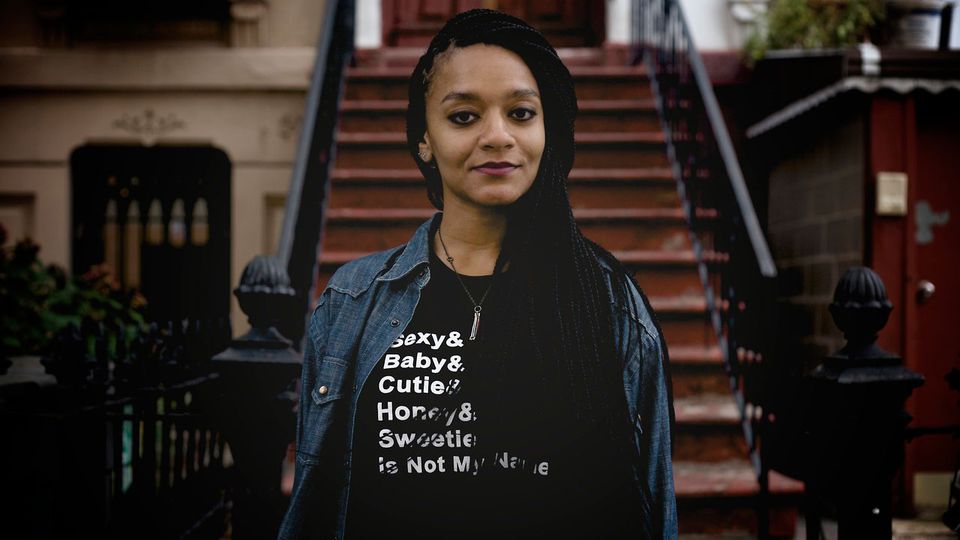
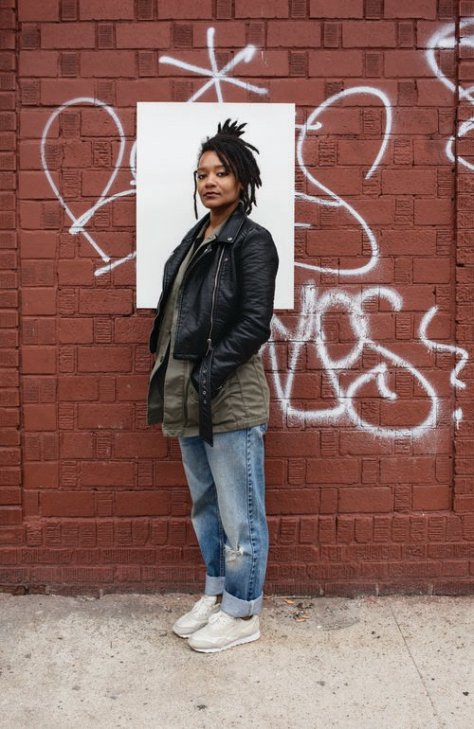
Tatyana Fazlalizadeh is inspired by the world she sees & experiences around her, so it’s no wonder that her art is charged with female, black, musical and diasporic energy. And you might have even seen it, even if you don’t know her name.

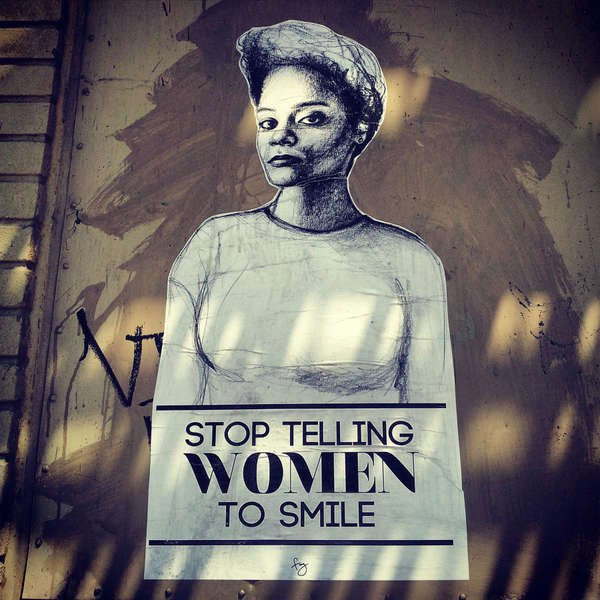
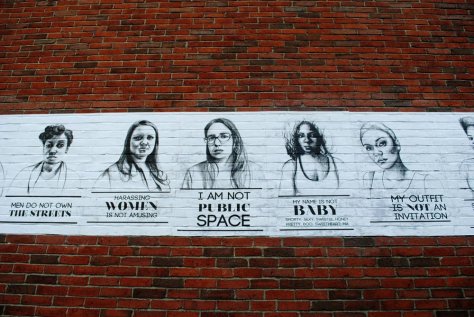
She’s the artist behind the Stop Telling Women to Smile campaign that started with her wheat paste posters on the streets of New York, combining hand-drawn sketches of diverse women, with their often non-verbalized responses to street harassment. It’s estimated that over 80% of women worldwide have experienced street harassment, and her art so resonated with them that its further development was crowdfunded through Kickstarter. Her work is now in cities nationwide, plus Paris & Mexico City, with many more being requested daily.

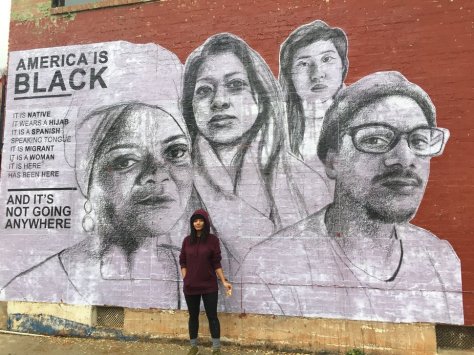
As a black & Iranian woman, Tatyana’s art reflects her identity, and is first and foremost art, not a political statement. So when she created her “America Is…” mural in her home state of Oklahoma, a state that’s 72% white, 9% Native American, 8% Hispanic, and 7% black, it was an affirmation that even though we aren’t always exposed to others like us, we’re ALL what makes and has made America what it is.

Tatyana’s also been commissioned by BET to paint portraits for their Black Girls Rock! music series and her work has appeared on book covers & movies posters. She’s created murals at Coney Island and for the musical group The Roots, and is skilled in oil painting, illustration and photography as well.

When asked about why she does what she does, Tatyana says “I’m telling the stories of the people who I know, who look like me, whose lives I think need to be told, [those] who aren’t really represented in these traditional oil paintings, who aren’t represented in art, in mainstream media. So how do I tell those stories? How do I make it clear that these people and these stories are important?”

For her, one way is by literally taking it to the streets.


KEEP GOING BLACK IN HISTORY:

Check out Tatyana’s Instagram for more of her street art and her full portfolio.

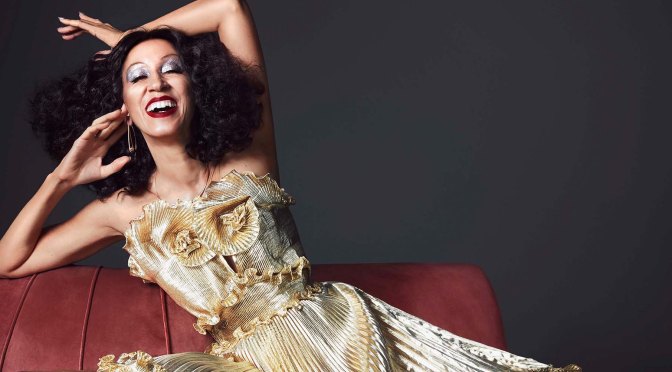
DAY 17 — Pat Cleveland

Pat Cleveland - International Cover Girl

“Patricia, we have very few colored girls in our agency. The only reason I took you is because Oleg Cassini recommended you. But I really think you will never make it in the modeling business. You see, you don’t look like an American. Your face is not pretty. Your nose is strange.”

Pat Cleveland was 18 in the late 60s when she sat in the Ford Models Manhattan headquarters, listening to the company’s founder tell her that her beauty, her allies & her goals didn’t matter because she was black.

But she kind of already knew that. Pat’s career started at 14 with the Ebony Fashion Fair Tour, a traveling showcase of black models in high fashion. In northern states & abroad, the tour drew middle- and upper-class black audiences in droves. In the South, they attracted an entirely different crowd. In Arkansas, the KKK threw Molotov cocktails at their bus & one of the girls was nearly raped. Even using a restroom and going for a walk turned violent against them.

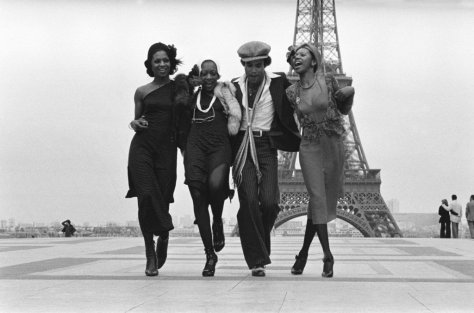
But working with black agencies had been limiting too, because for the black culture of the time, darker skin was in. (Although she did appear in Essence Magazine repeatedly.) She was too light-skinned to be successful on one hand, and too dark-skinned on another. Since the problem was with American society, not Pat’s skin, she solved it the only way she knew how & left for Paris, home to many black creatives seeking opportunities they weren’t afforded in America.

Her success was almost immediate. She graced runways for designers like Yves Saint Laurent, KENZO, KARL LAGERFELD, Halston, and Valentino; posed for Andy Warhol, Salvador Dali & illustrator Antonio Lopez; and appeared in high-end fashion magazines regularly. And once she was in demand, she leveraged that success & refused to return to the U.S. until a black model had appeared on the cover of American Vogue. (Ms. Beverly Johnson became their first in 1984.)

Before pioneering black models like Iman, Naomi Sims, and Beverly Johnson, there was Pat Cleveland, and as early as 1980, she was recognized as the world’s first black supermodel, strange nose and all.


KEEP GOING BLACK IN HISTORY:

Vogue Paris created a reel of Pat’s runway walks as a Chloé model from 1978-1986, looking completely fabulous in her own skin.

Listen in or read through NPR’s interview about the tradition of black American migration to Paris since the 19th Century.

DAY 16 — Wereth 11

Wereth 11 - Heroic Artillery Battalion

World War II’s 333rd Field Army Battalion was composed of some of the first black enlisted men trained in combat, rather than service positions.

The 11 men who were the 333rd’s Charley Battery quickly made names for themselves through their deadly accuracy with artillery, destroying a German tank 9 miles away in 90 seconds. But that fame also made them targets to a German army gasping for its last breath.

On December 16, 1944, Charley Battery was separated from their unit. They found safety in the tiny 9-house hamlet of Wereth, Belgium, just on the German border. The Nazi SS was tipped off & raided the village, demanding the soldiers’ surrender. To prevent any harm to the locals, Charley Battery surrendered peacefully.

Rather than being kept as prisoners of war or executed immediately, the 11 men were brutally tortured. Many were missing fingers, had broken legs, suffered bayonet & barrel stock wounds to the eyes & head, and suffered multiple, non-lethal gunshot wounds before they were finally killed & left in the snow, where their bodies remained until documented by the Army in February 1945.

These weren’t the only American soldiers the SS committed war crimes against. But they were the only soldiers whose sacrifice went seemingly ignored. The 1949 Senate Armed Forces subcommittee recorded a dozen similar SS atrocities, but omitted the massacre of Charley Battery. On the 50th Anniversary of the soldiers’ deaths, the son of the man who’d sheltered them erected the monument pictured here, memorializing them as the “Wereth 11.” It’s the only known monument in Europe that honors the black soldiers who fought in World War II.

In 2013, Congress passed a resolution reissuing the original 1949 subcommittee report to include the Wereth 11, awarding them with multiple combat medals, including the Bronze Star and the Purple Heart.

Like many black soldiers who fought in American wars at home & abroad, the Wereth 11 bravely defended a country that didn’t defend them. Throughout our country’s history, but now more than ever, we’ve needed to be reminded that red-blooded Americans come in every color.

In honor of the sacrifices of:
Corporal Bradley Mager
Staff Sergeant Thomas J. Forte
Technical Corporal Robert L. Green
Technical Sergeant William E. Pritchett
Technical Sergeant James A. Stewart
PFC George Davis
PFC Jimmie L. Leatherwood
PFC George W. Moten
PFC Due W. Turner
Private Curtis Adams
Private Nathaniel Moss


KEEP GOING BLACK IN HISTORY:

Read the resolution that finally officially recognized the Wereth 11.