
Between civil rights, gay rights, and war protests, the New York City of the 1960s seemed in constant unrest.
Marie Van Brittan Brown just wanted to go to work and come home.
As a wife, mother and nurse, caring for others was a round-the-clock task, and in the little downtime she had, feeling safe in her own home didn’t seem like much for 43-year-old Marie to ask.
But with riots and crime falling so close to her Queens doorstep and an overextended police force, the chain lock on Marie’s front door was barely an obstacle to the discontent outside threatening the peaceful home she’d made for her babies. Like so many working parents, opposing schedules between Marie and her electronics tech husband often found them passing each other in the night, and spending her alone time wondering who might be on the other side of the door didn’t sit well with her.
So she stepped up.
And when she did, Marie’s creation didn’t just protect her family – it’s protecting yours, too.
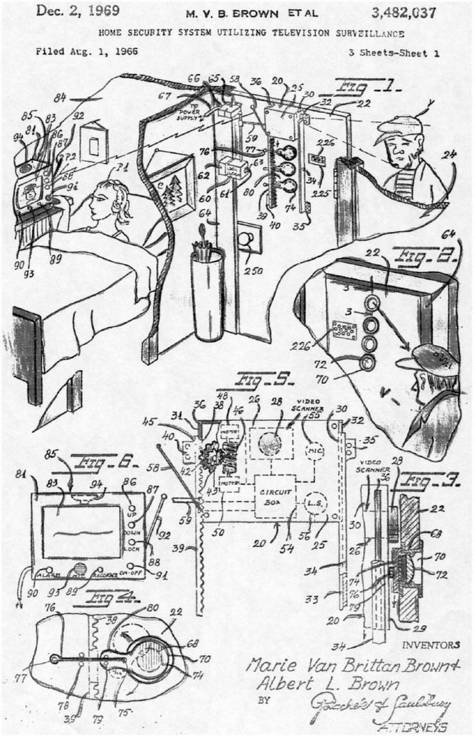
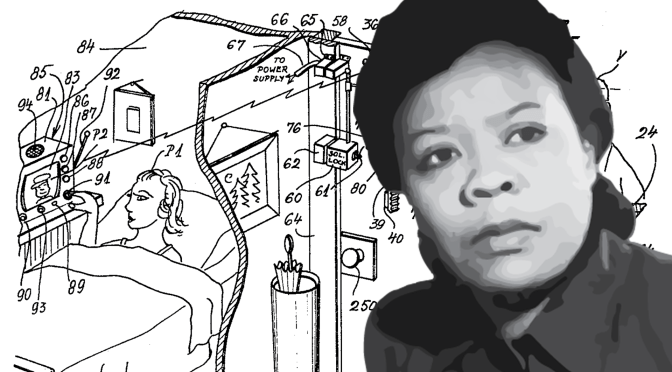
On August 1, 1966, Mrs. Brown’s “Home Security System Utilizing Television Surveillance” was filed with the United States Patent and Trademark Office, and three years later when it was approved, the mother of 2 became the mother of modern home security as well.
Sketching a concept with the working mother in mind, Marie designed the system to operate from one central and special place to her: the bed. When the little ones climbed in or she’d just gotten settled after a long shift, the last thing she wanted to do was make herself more vulnerable to the world by leaving her bed to crack the front door. Her design took every one of those considerations in mind.
Fitted with 4 peepholes and a cabinet housing a video camera, the door’s mechanical system could be remotely operated to put her face-to-face with tall strangers or her children’s tiny playmates, and even unlock to welcome trusted guests in. An integrated audio channel allowed two-way communication with visitors as well, and should what she saw or heard give her cause for alarm, Marie’s system was so sophisticated, it could alert the authorities too.
Just days after her patent was approved, Marie, her husband and her original concept sketch were photographed for the pages of The New York Times, which had already recognized the magnitude of her achievement. After pages and pages of newsprint, department store ads and classifieds, Marie and Albert Brown appear in a rare image of the quiet couple, one of the few photographs found there at all.


While little else is known about them and Marie passed away in 1999, the Browns’ 54-year-old invention is still a global technology. In a market that’s expected to be valued at $75 billion by 2032, most modern home security patents – some filed as recently as 2013 – still reference Marie’s original design.
That design has even been broken down into its components to create the everyday security measures we take for granted. Remote-controlled doors and gates, button-trigger alarms, closed-circuit video monitors, and even instant alerts to home security agencies from your open front door each reference Marie’s patent in their builds. But the design isn’t only operational on the small scale. Global security firms, multi-unit dwellings, and military communication and surveillance systems all utilize the invention born from one mother’s necessity to protect her own.
KEEP GOING BLACK IN HISTORY:

Follow the evolution of Marie’s design to today’s Ring doorbell and the social implications of a Black woman’s design being used for surveillance rather than safety.

“You could imagine that in the late ’60s and early ’70s, as a Black woman, she wasn’t going to get accolades and money because the world wasn’t built for us in that way.” Read on about what Marie built in a world that wasn’t built to recognize her.
 THE AMERICAN BLACKSTORY
One thought on “DAY 11 — Marie Van Britten Brown”
Comments are closed.