Ladies, gentlemen, and non-conforming friends! Read closely, for the man I’m about to introduce was an instigator of illusion, master of mysticism, and a benefactor of black advancement the likes of which the early 1900s had never seen.
Come and read of the great enigma, Black Herman.
A traveling ruse is where young Benjamin Rucker’s fortuitous future first took shape. While his mentor and fellow black magician Prince Herman drew crowds with his sleight-of-hand roadshow, 17-year-old Benjamin oversaw the real money-making part of their venture: African tonics to satisfy the superstitions of both black and white audiences.

Upon Prince Herman’s departure to the afterlife in 1910, Benjamin took the moniker for himself, dispensed with the side hustle, and immersed himself in magic as “Black Herman.” One part of the original show he preserved was the tie to his roots. Intertwined in his traditional magic act were hallmarks of the black experience, African religion and voodoo practice. Audiences flocked to be mesmerized by the show that only a magician of Black Herman’s caliber and race could put on. His fantastic escapes from impossible rope bindings were passed down from African tribes who evaded enslaving captors, he crooned. His communion with the spirit world could only be attempted by those with intensive mystical training by Zulu priests, he warned. And no Klansman could be his match as he was an immortal black being, insusceptible to the physical assaults of white men. Make no bones about it, Black Herman became a legend in the eyes of audiences, newspapers, and even among other magicians who nicknamed him “Black Houdini.”
So all-encompassing was the god-like persona that Black Herman built for himself, even institutional racism became a part of his marvelous lore. Repeated arrests and imprisonments for performing his act, despite white magicians regularly performing with impunity, only lent themselves to the tale that Black Herman couldn’t be held by even the most fearsome human authority.
Unbelievably diligent and favored by fortune, Black Herman eventually made a home for himself in the heart of the Harlem Renaissance, where steeped in the rising black cultural class and befriended by the likes of Marcus Garvey and Booker T. Washington, his dedication to the black cause only grew with his celebrity. In 1923, his show having exceeded his wildest dreams and sole capabilities, Black Herman employed as many as 50 black men and women in his production, and transformed his profits into loans for black business owners. Behind his dark persona, Black Herman’s devout Christianity inspired substantial donations to churches, especially those active in the civil rights movement.
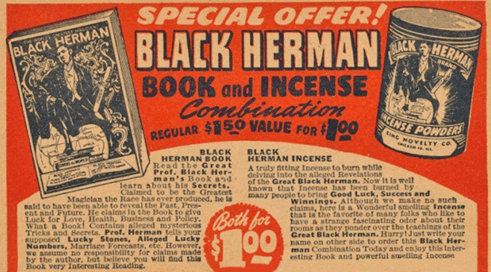
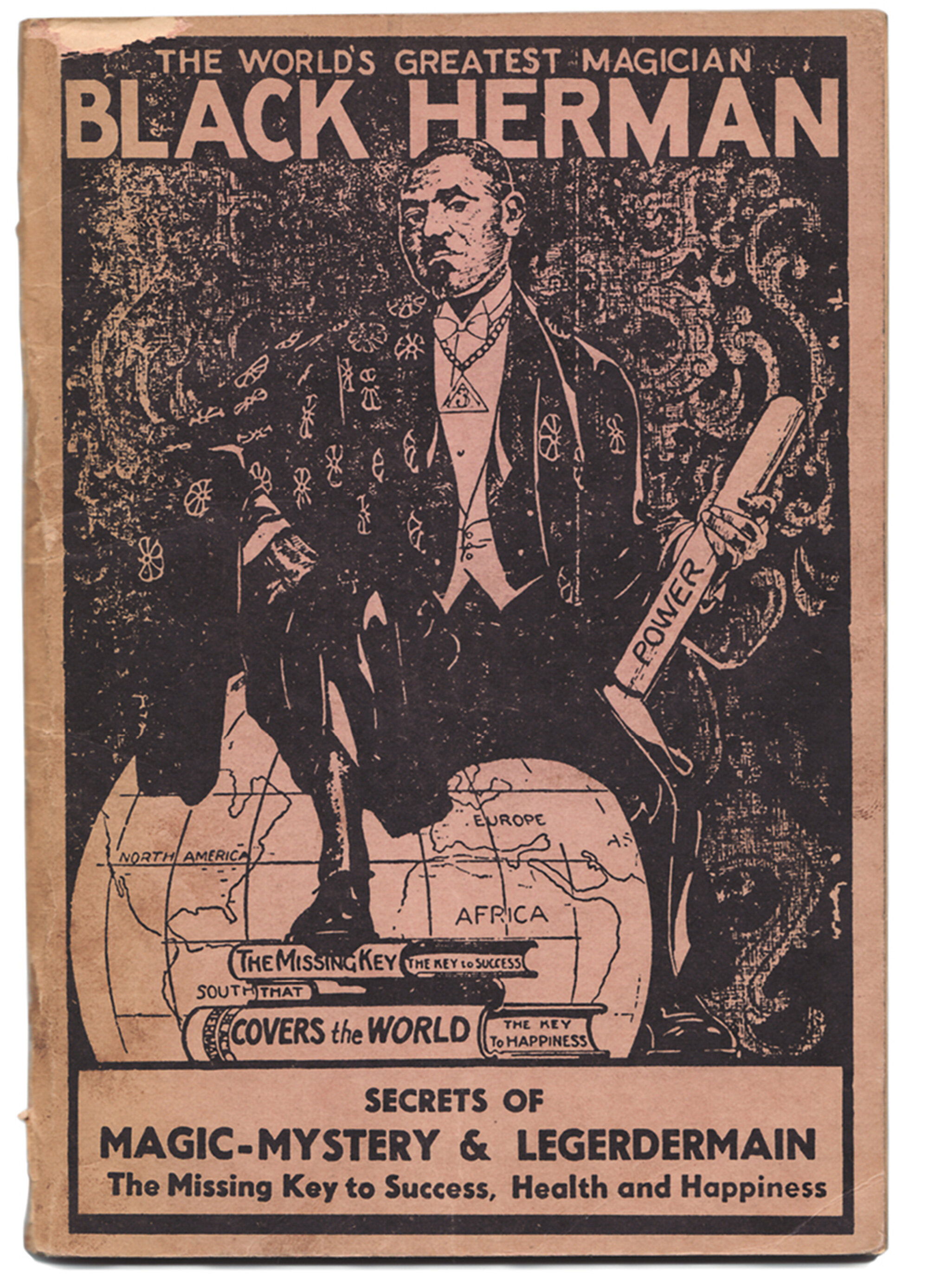
Having conjured up a rather comfortable life for himself, Black Herman reincorporated his early experiences into a whole new series of ventures. To protect from the threat of outside forces, he purchased his own printing company for the production of his widely circulated 1925 book, “Secrets of Magic, Mystery, and Legerdemain,” sold at his shows and even by mail. Voodoo potions and African tonics, incense and other spiritual ephemera were included in Black Herman’s menagerie of self-produced goods available to the public. And when Black Herman predicted a great financial disaster, advising his audiences to cease their Wall Street activities and put their money into more tangible commodities, the 1929 Black Friday Stock Market Crash diverted that money right into his pocket, and by extension, once again, the black community.

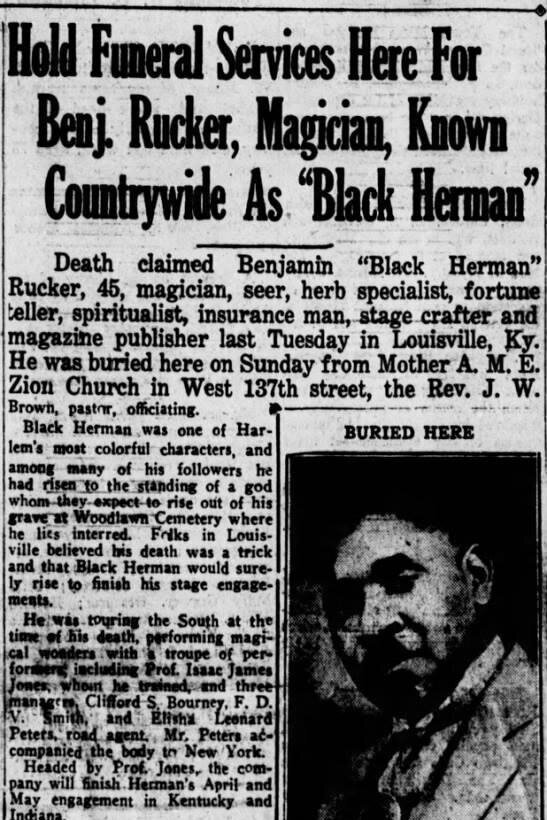
Despite his claims of immortality, Death eventually came for Black Herman. Ever a man enshrouded in mystery, even the circumstances of his 1934 demise at only 45 years old are questionable. Some report that he collapsed in the middle of a stage show, baffling audiences who weren’t sure if it was part of the act. Others report that he had a premonition of his death, wrote a letter to his wife, and upon signing it, died in his bed. Either way, so widely regarded was Black Herman’s showmanship, particularly in his variation of the “Buried Alive” trick that saw him resurrected after three days in the grave, no one believed that he was actually dead until his assistant arranged for a public viewing where thousands astonished by Black Herman could see the proof with their own eyes.
Or did they? As many as 5 different men reportedly masqueraded as Black Herman during his imprisonments and after his death, though none came close to matching his character in either performance or virtue. In perhaps his greatest feat of all, Black Herman inspired and embodied a whole race’s determination to transcend the limitations of an oppressive society and be recognized as truly amazing.
KEEP GOING BLACK IN HISTORY:
 THE AMERICAN BLACKSTORY
One thought on “DAY 7 — Black Herman”
Comments are closed.