DAY 18 — Charles Gittens

Charles Gittens - Black At the President’s Side

It was the dead of night when hysterical screams came from the First Lady’s Hyannisport bedroom.

Luckily, one of the United States Secret Service’s most level-headed agents was the first to Jackie Kennedy’s side… even though her assailant was only a giant flying bat.

From an early age, the call to serve his country in some capacity was so strong that shortly before he graduated from high school, Charles Gittens decided to enlist in the U.S. Army instead.

There, he earned his GED and a whole lot more. He ultimately served as a lieutenant in Japan during the Korean War, and once discharged, he earned two 4-year degrees in English and Spanish within just 3, with Magna Cum Laude designation.

He’d spent a year teaching in North Carolina when his friends encouraged him to take a government civil service exam. The Drug Enforcement Administration (DEA) was recruiting black agents and it couldn’t hurt to try, right? His high test scores, bilingualism and military background caught the attention of the Secret Service instead.

And so, in 1956, Charles Gittens became the first black agent in the United States Secret Service.

But it almost didn’t come to pass. The civil service exam was given in two parts: written and oral. After having passed the written exam, he traveled to an Atlanta regional office for the oral portion, where for one reason or another, the facilitator had it out for him. “The guy in charge had scribbled things down like, ‘speaks incoherently’ or ‘can’t be understood.’ Can you imagine such a thing?” he recounted. When he insisted on another facilitator he passed with flying colors, but never did get an explanation for the wild discrepancy.

Of course, Charles didn’t let the rough start hold him back. From his initial appointment in North Carolina, he was promoted to the agency’s largest field office in New York, where he investigated counterfeits and protected visiting presidents along with other dignitaries for 10 years. He was such an impressive and inspiring leader that he was subsequently promoted to senior agent of the Island of Puerto Rico, and finally in 1971, special agent in charge of the Washington, D.C. office, a job that put him on regular presidential protection and supervisory duties over more than 100 other agents.

He’d been so welcomed by his peers, dignitaries and presidents, and had operated in a world so separate from civilians that it was often easy to forget the racism that lurked just beyond the government’s most protected walls. But that didn’t mean he was immune to them.

“At that time, I was not a ‘negro,’ I was a Secret Service agent,” explaining how his job had become second nature to him. But the looks on the faces of the diners as he walked straight past a “No Negros” sign and into a restaurant where he was meeting other agents for breakfast told him otherwise. After an awkward wait, the manager came out and told the other agents they wouldn’t serve a black man. Despite the others coming to his defense, Charlie kept his dignity and left the situation, reminding them that they were always representing the President of the United States. (One account says the owner caught up to Charlie, apologized for the disrespect and served him after all.)

By the time Charlie ended his Secret Service career in 1979, he’d become the deputy assistant director overseeing all of the Secret Service field offices. In his 23 years of service, he protected Presidents Eisenhower, Kennedy, Johnson, and Nixon, countless diplomats, and the best interests of the country in myriad ways. And he continued doing so. After retiring from the Secret Service, he joined the Department of Justice’s Office of Special Investigations, tracking down and bringing war criminals hiding in the US to pay for their crimes.

Though he died in 2011 at the age of 82, he left a legacy of inclusion as a living testament to his devotion. During his career, he was a founding member of the National Organization of Black Law Enforcement Executives (NOBLE), dedicated to “fairness in the administration of justice, police community relations, [and greater inclusion] of black police officers.” In each of his ranking positions, the Secret Service encouraged Charlie to recruit more female and black agents. Today, there are nearly 400 of each among approximately 3500 special agents due largely in part to Charlie’s efforts, his leadership and his determination to serve, no matter the return.


KEEP GOING BLACK IN HISTORY:

Upon his death, The Boston Globe featured a complete and truly inspiring obituary for Agent Gittens.

DAY 17 — Dr. Patricia Bath

Dr. Patricia Bath - Ophthalmology Visionary

Early on, it was evident that Patricia Bath had a special insight.

By the time she was in high school, she’d outpaced her fellow students so quickly that she graduated within two years. Having heard about Dr. Albert Schweitzer’s work treating lepers in Africa, she knew that she too had work to do.

And she set to it without delay. When she won a scholarship to attend a 1959 National Science Foundation (NSF) cancer research summer workshop, the 16-year-old made a key observation that led her to develop an equation predicting cancer growth rates. So impressed were the head researchers that part of her work was included in their final research white paper.

As was her habit, Patricia breezed through studies at Hunter College and Howard University, enriching her traditional studies with travel every opportunity she could. But it was Dr. Martin Luther King’s assassination in 1968, the same year she came back home to Harlem to attend Columbia University in the City of New York, that truly opened her eyes to a problem that had been right in front of her the whole time.

Troubled by the work that Dr. King’s untimely death had left undone, and inspired by his Poor People’s Campaign that advocated the idea that all Americans should have what they need to live, she started working double duty between an ophthalmology fellowship at Columbia University, and an internship at the Harlem Hospital, where she was the only ophthalmology specialist on site. That was where she noticed a stunning disparity. A great deal of the work she did at Columbia was in preventative and minor emergency treatment, but almost all of her patients in Harlem had severe cataracts and/or were nearly blind.

Naturally, she began a study. And that study concluded that black patients were almost twice as likely to suffer from blindness as the general population, and eight times as likely to develop glaucoma than white patients. And the cause? Lack of access in both proximity and in financial means were the major factor in the very preventable eye disease Patricia observed in poorer populations of all races. She developed a program in conjunction with the doctors at Columbia to operate on Harlem’s blind patients, volunteered her time as a surgical assistant and as a result, performed the Harlem Hospital’s first major eye surgery in 1970.

That same year, she became the first black woman in residence for New York University’s ophthalmology department. Patricia used her platform to create the American Institute for the Prevention of Blindness with the founding principle that all humans had the right to eyesight. Her expertise and her compassionate care had become a calling card that was in high demand.

So in 1974 when UCLA did indeed call with an offer to make her the first female faculty member in their Department of Ophthalmology, she took it. But when she arrived, she immediately had to set things straight. The office they’d reserved for her was in the basement with the lab animals. “I didn’t say it was racist or sexist. I said it was inappropriate and succeeded in getting acceptable office space. I decided I was just going to do my work,” she remarked. And by 1983, she’d co-founded and chaired UCLA’s Ophthalmology Residency Program, becoming the first woman in the country to hold such a position.

But she hadn’t forgotten her original purpose. During these years, Patricia implemented another program to intercede on behalf of the less fortunate, but with more experience in the medical system under her belt, this time, she took things global. Over the course of the late 70s and early 80s, Patricia Bath spearheaded a new medical discipline she dubbed Community Ophthalmology. Combining public health, community medicine and ophthalmology methodologies, her program galvanized volunteers and doctors in communities worldwide to identify patients in need of treatment where they were – at home, schools, or local clinics – and provide visual treatment from glasses to major surgery at low to no cost to the patient. Today, it’s an international practice utilized by the World Health Organization and non-governmental organizations like Doctors Without Borders which developed their programs based on her model.

Dr. Patricia Bath today. Breaker of Glass Ceilings, Restorer of Eyesight.

Despite her success, Dr. Bath recognized that one thing that was entirely out of her control interfered with her ability to do her best work: the glass ceiling established by racism and sexism. And like so many other black creators before her, she left for Europe where racial and gender equality were light years ahead and new technologies were available for her research. Because most laser development in the U.S. was reserved for military purposes, when Patricia arrived in Berlin, she was able to continue developing a treatment that she’d begun in California back in 1981, but been unable to finish without the tools.

By 1988, Dr. Patricia Bath’s Laserphaco Probe was finally patented, making her the first black woman in the United States with a medical patent. (She currently has 4 others in the US, among others in Japan, Canada and Europe.) The device utilizes lasers to dissolve cataracts, remove debris, irrigate the eye and prepare it for the insertion of a new lens. The machine revolutionized eye surgeries, making them cheaper and faster so that millions more patients could be treated worldwide, and has been successful in restoring sight to those who’ve been blind for as many as 30 years.

Though she retired from official practice and her esteemed role at UCLA in 1993, Dr. Bath is still using technology to drive her work. She’s held positions at Howard University and worldwide focusing on telemedicine to help patients in even the most remote parts of the globe get the care they need. She’s been recognized, awarded and honored more times and by more organizations that I can share with you here, but there’s one thing that she points to as her reason for a lifetime dedicated to her work: “The ability to restore sight is the ultimate reward.”


KEEP GOING BLACK IN HISTORY:

View the full scope of Dr. Bath’s work at her website.

Dr. Bath regularly appeared in the New York Times, ultimately including her 2019 obituary.

Dr. Bath’s 2022 induction into the National Inventors Hall of Fame is well-earned. Read up on her achievements, or just skim the 10 Things You Need to Know About Patricia Bath.

DAY 16 — James Van Der Zee

James Van Der Zee - The All-Seeing Eye of Harlem

James Van Der Zee was a master of composition, but his most brilliant works were created not behind his violin or piano, but through the lens of his camera.

When he made his way to Harlem in 1906, it wasn’t his first time. He’d visited often from his small hometown in Massachusetts, and marveled at the pictures he’d taken in the big city since he was 14, honing his eye along the way.

A couple enters James Van Der Zee’s 135th Street brownstone basement GGG Photo Studio in Harlem.

But photography couldn’t pay the bills, and surprisingly enough, his skill as a musician could, so he created and subsequently packed theater houses with the Harlem Orchestra. He even performed with jazz icons, but still his eye wandered back to the camera. Having regularly worked small jobs between music gigs, it was no surprise when in 1915, he landed one as a darkroom assistant whose skill was proven so quickly that he was promoted to portraitist within a year, and opened his own studio on 135th Street within two.

Jean-Michel Basquiat, and his cat.

His talent couldn’t have come to fruition at a more fortuitous time for both James and the residents of Harlem. With the start of the Harlem Renaissance around 1918, black art, literature and culture was gaining international recognition, and being celebrated within black communities on its own merits and for its success in the mainstream. Black photographers were included in this praise, and also key to capturing the social, economic, and personal benefits that many black people were enjoying for the first time in America. In James’s studio, some of the most meaningful moments in everyday black lives and in all of black history were captured on film. Baby pictures, young newlyweds, funerals, civic groups and iconic portraits of black leaders and celebrities were all included in his exquisite body of work which spanned until 1982, nearly right up until his death a year later at the age of 96.

But his photographs are so much more than the sum of their parts. He didn’t just capture a black middle-class in the height of their recognition by a society that had previously enslaved them. At the start of his professional career, he made it a point to sign, date and number each of his photographs. Such care for his craft and attention to detail meant that when his work was discovered in 1967 by a researcher for The New York Metropolitan Museum of Art, his then 75,000 photographs became one of the most fully verifiable and extensive archives of black life since slave records. Because marriage/birth records and the ability to freely own property weren’t available to black people until in some cases well after the Civil War ended in 1865, further proof of our generations, personal wealth and especially a positive visual record of both beyond often sparse government and media documentation was tremendous to the culture and to the further preservation of our place in America’s past.

As a black man positioned behind a camera during one of the most significant eras of black history, James was able to show the whole world an entirely novel perspective on his subjects, no matter their status or the gravity of the occasion. When asked why and how he created such ethereal and regal images, he remarked “I wanted to make the camera take what I thought should be there.” What James Van Der Zee and his camera left behind was a legacy of black excellence.


KEEP GOING BLACK IN HISTORY:

James’ Metropolitan Museum of Art exhibit was accompanied by a catalogue of newspaper articles and curated images from Van Der Zee and other black photographers, available here.

DAY 15 — Fredi Washington

Fredi Washington - Light Skinned Actress Leading the Way

Fredi Washington’s porcelain skin and peridot green eyes bought her a level of privilege that was unheard of for black people in the 1920s and 30s.

What was even more unheard of was that she didn’t want it.

Back then, when black actors got mainstream film roles, they were typically small parts as some form of help – maids, teachers, and of course, slaves. Otherwise, their filmographies were exclusively “race films,” segregated movies with all-black casts made for black audiences, and for the first few jobs, this was Fredi’s experience too.

Until 1934, when she landed what’s arguably one of the most pivotal roles performed by a black actress in the history of cinema.

Fredi’s “Imitation of Life” title card

“Imitation of Life,” based on a 1933 book, told the story of an enterprising duo of single mothers, a white widow and black maid, raising their daughters together in the same home. But there was a twist. The black daughter, Peola, had skin light enough to “pass” as a white woman instead. The movie explored the dynamic of white and black women’s friendships and their ingenuity in finding empowerment in a sexist society, but even more impactfully, the ongoing mental, emotional and familial effects of slavery, racial segregation laws and deeply ingrained social stigmas faced by black women in particular. For its groundbreaking work, the movie earned three 1935 Academy Award nominations, including Best Picture.

Having tasted success, Fredi used her platform and privilege to empower others, establishing the Negro Actors Guild in 1937 to provide black actors with more mainstream opportunities and non-stereotypical roles in film. But due in large part to her critically acclaimed performance in “Imitation of Life,” Fredi found herself fighting a typecasting battle of her own. Her crossover success had inspired other filmmakers to explore “passing,” and of course, they all wanted to cast the most recognized name in the business as a black woman capitalizing on her white skin.

But they had gotten Fredi all wrong. As far as she was concerned, she was a black actress portraying black experiences on-screen. It had never been her intention to pass. “You don’t have to be white to be good. No matter how white I look, on the inside I feel black,” she insisted.

And that conviction was truly tested. She was too talented and pretty to be cast in a subservient background role in mainstream white films, but film production codes in Hollywood at the time strictly forbid interracial relationships, so the outspokenly black actress couldn’t be cast as a romantic female lead either. Conversely, her light skin made her a costly distraction in race films. When she attempted radio instead, she found few dramatic roles for black talent, and even fewer with black female protagonists. Because of her stance against being someone she was not, Fredi never again found the level of fame that “Imitation of Life” gained her.

Naturally, journalists were curious why she didn’t follow the example of other actresses at the time like Rita Hayworth (who was actually a passing Spanish-American) and simply pass as a white actress to find the success she so rightfully deserved. She offered without hesitation: “You see I’m a mighty proud gal, and I can’t for the life of me find any valid reason why anyone should lie about their origin, or anything else for that matter. Frankly, I do not ascribe to the stupid theory of white supremacy and hiding the fact that I am a Negro for economic or any other reasons. If I do, I would be agreeing that to be a Negro makes me inferior and that I have swallowed whole hog all of the propaganda dished out by our fascist-minded white citizens.”

Retiring from show business in the 40s, she quickly offered her insider knowledge to assist the NAACP in fighting racism and exclusion in Hollywood, and continued to work toward equality for black creators until her death in 1994. Although Fredi won very few honors herself, her role as a leading black woman in a Hollywood-produced film opened doors to equally iconic black mainstream roles for some of the world’s most influential black thespians like Sidney Poitier and Louis Gossett, Jr., among others.
Fredi struggled to fit in as a light-skinned black creative in her era, but her work has found its way among the most treasured American films of all time. “Imitation of Life” was added to the preserved collection in the United States National Film Registry at The Library of Congress in 2005, and in 2007, TIME Magazine recognized it as one of “The 25 Most Important Films on Race,” solidifying Fredi’s place in history right where she would have wanted it – beloved for being undeniably black.


KEEP GOING BLACK IN HISTORY:

“Imitation of Life” is available on Amazon Prime for $3.99, and I guarantee it’ll be money well spent.

The Amistad Research Center at Tulane University archives an assortment of Fredi’s personal belongings, and a blog entry from the center details how “Imitation of Life” impacted Fredi’s own.

DAY 14 — Dr. Heber Brown

Rev. Dr. Heber Brown - Securing Soul Food for the People

Every Sunday, Reverend Dr. Heber Brown III delivered sermons about daily bread, nourishing one’s soul, and the fruits of the Spirit with conviction.

But all the preaching and praying one man could do couldn’t change one simple fact: his congregation’s tangible food was killing them.

The Pleasant Hope Baptist Church is located in North Baltimore, where 34% of black residents live in “healthy food priority zones” (once referred to as “food deserts”), communities where access to fresh food is nearly nonexistent while convenience stores and fast food thrive. What little fresh food Reverend Brown’s congregation did have available to them was too expensive for most on limited incomes. It was a problem universities, social anthropologists and every level of government had been researching for decades, yielding very few actual results. His congregants suffering from diet-related diseases couldn’t afford to keep waiting while the diabetes and heart disease that disproportionately affects black people caught up to them.

“I had what some would call a divine discontent,” which led Reverend Brown to a simple, but novel solution in 2015 that’s grown into the The Black Church Food Security Network today.

To start, he began sowing real seeds in a 1,500 square-foot garden he cleared on the church’s property. That garden now yields half a ton of produce per year, all of which is given freely at Pleasant Hope. But that was only halfway to the self-sufficiency Reverend Brown felt was so desperately missing from the equation.

So he took it a step further by sourcing local black farmers to run pop-up markets in the church lot after every Sunday’s service. The local farmers could guarantee profitability, and the local citizens could guarantee that the produce they needed to build healthier diets would be available regularly, affordably and that their money would go right back into sustaining their own.

Soon enough, the pews were full, the congregants were happier and healthier, and churches of all ethnicities came calling to find out how to do the same. Today, the Black Church Food Security Network serves 14 different congregations in Baltimore, and many more in Washington D.C., North Carolina, and Virginia as well.

As his organization has grown, so has Reverend Brown’s faith in his cause. “Food is always going to be a priority for our communities. And churches and faith-based organizations, I got a strong hunch, will always be here,” he said. That’s why it’s crucial that the black churches with economically disadvantaged congregations relying on them can provide. Where he once led, he now teaches, consulting with churches nationally to provide them with the skills they need to do the same work he’s done in Baltimore, and spreading the gospel of good food all along the way.


KEEP GOING BLACK IN HISTORY:

Read more about The Black Church Food Security Network‘s mission and donate or invest in their future.

DAY 13 — Cheryl Brown

Cheryl Brown - The Realest Representation of Miss America

“Contestants must be of good health and of the white race.”

Rule 7 of the Miss America Pageant Handbook had been on paper since 1930, and finally overturned in 1950, but here it was 1970 and still not a single black contestant.

Even that hadn’t been without a fight though. Two years beforehand, the NAACP had challenged the lack of diversity in the pageant, and the Miss America organization had responded less enthusiastically than they’d hoped. So black entrepreneurs created their own Miss Black America Pageant in 1968 and held it in Atlantic City on the very same day as their counterpart to point out the hypocrisy in a “Miss America” without women of color, and to challenge European beauty standards that automatically disqualified black women’s dark skin, full lips, round noses, kinky hair and thick curves.

A 1968 clipping from The New York Times features the Miss America and Miss Black America pageant winners side-by-side. Read both articles for a good laugh, especially from the first blonde Miss America in 11 years.

At the same time, feminists from all races were protesting the existence of the Miss America Pageant altogether, with white women likening it to a meat market and women of color calling it “racism with roses,” in reference to their official and unofficial exclusion for so many years.

Amidst all this ongoing unrest, a black ballet dancer from New York won the title of Miss Iowa 1970, allowing her to compete as the Miss America Pageant’s first black contestant in their then 50-year history.

Cheryl Adrienne Browne was only in Iowa to attend Luther College at her pastor’s recommendation. She had participated in the pageant to win scholarship money to support her while she was away from her family, and was just as surprised as anyone else when she actually won both the swimsuit and talent competitions, and then the whole thing.

But that success didn’t come without its share of obstacles, too. When she wasn’t fighting the criticism that a black woman wasn’t worthy of a pageant win, she had to answer to those who didn’t want a non-native Iowan representing them, and those who fell into both camps. Between this and the other protests, there was so much controversy surrounding Cheryl’s win that even other Miss America contestants couldn’t help but notice the increased security presence in and around their rehearsals, travel routes and hotels.

Cheryl and Miss Maryland Sharon Ann Cannon, on the Atlantic City Boardwalk just before the Miss America 1971 pageant.

On September 12, 1970, Cheryl didn’t win the Miss America 1971 crown. She didn’t even place in the Top 10. But she did go on to represent the pageant on USO tours in one of the last groups to visit Vietnam, and served as a judge to bring equality to subsequent competitions. Today, she’s very humble about her place in history, saying “I don’t feel I personally changed the pageant, but I feel that my presence expanded people’s minds and their acceptance. And, in subsequent years, they were much more open to African-American candidates.”

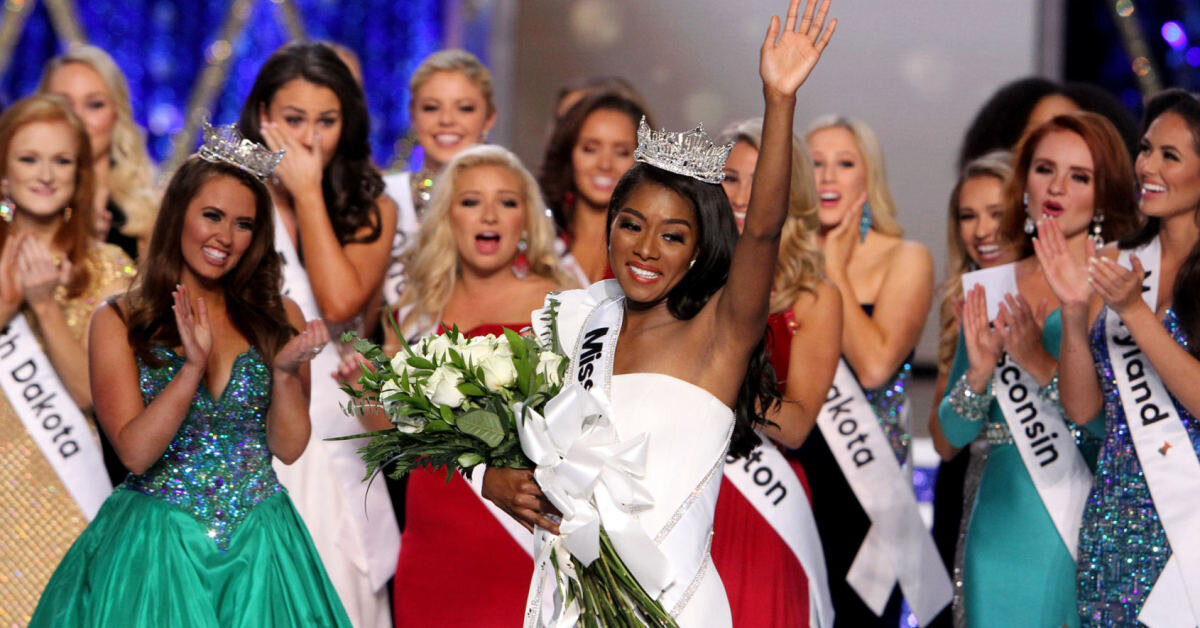
Nia Imani Franklin, Miss America 2019.

And indeed they were. 13 years later, Vanessa Williams was crowned the first black Miss America in 1983, and there have been 8 more since, including this year’s Nia Franklin, all living proof that beauty, talent and brains know no racial boundaries.


KEEP GOING BLACK IN HISTORY:

DAY 12 — Malika Whitley

Malika Whitley - Happier Through the Power of Song

Her voice was the only thing in the world Malika Whitley had.

It hadn’t been that long ago that she’d had so much more. Straight A’s. A family. A home.

The quiet time was the worst. That was when the memories of those all things came flooding back, including the memory of how she’d ended up where she was in the first place. After a slow spiral into schizophrenia and bipolar disorder, Malika’s mother was jeopardizing her daughter’s safety. And with no resources, no one to trust and nowhere to go, Malika had ended up on the street, alone, trafficked and invisible.

But on Wednesdays, she could escape all of that. Slipping into a dark church basement through the side door, she found that one thing stopped all of those thoughts and gave her hope, security and control again: singing.

It was Wednesday nights that got her through her circumstances, kept her working, going to school and ultimately graduating college with degrees in international communications, cultural relations, and social economics. But she recognized that her success was unique. Thousands of kids worldwide and even right down the block from her never climbed their way out of the darkness she escaped.

During a 2010 music internship in Cape Town, South Africa, it clicked for her. She passed homeless children, who despite their situation – or because of it – sang and danced joyfully in the street. So she started a program connecting them to professionals at recording company she worked for. When her post-grad work found her in Hyderabad, India where children gathered around her to show off their creations and vie for a sale, she knew that the program she created in South Africa could have meaning here too.

So when she finally returned to the States in 2012, she set to work on building an actual program to give homeless kids the same thing she found in singing, and that she saw in the children in South Africa and Hyderabad. Since that fateful decision, her organization ChopArt (pronounced “shahp,” Cape Town slang for hello, goodbye, cool, congratulations) has given 60,000 homeless kids & teens art outreach programs, summer art camps, and year-round events to attend. But even more, ChopArt has given those children trusted circles of friends, something to look forward to each day, and a purpose to pursue. In fact, some of those kids have gone on to pursue careers in the arts with the skills they’ve developed under ChopArt’s guidance.

It’s grown from a small donation-based operation to a global non-profit bolstered by funding from socially minded corporations like Mailchimp along with thousands in competitive, merit-based, and international government grants. Today, ChopArt serves Atlanta, New Orleans, Hyderabad and Accra, Ghana to combat the effects of homelessness, sex trafficking, suicide and drug abuse on one of our most vulnerable communities. Malika’s work has been instrumental in bringing greater awareness to the 1.3 million school-aged homeless children in America alone.

And to her surprise, in her work, Malika’s found an even greater voice. “I would never be able to talk about my experience if those kids hadn’t had so much courage and trust in me,” she said. And without Malika, thousands of homeless children with stories like hers wouldn’t have had the opportunity ChopArt’s given them to change their lives through the power of creativity.


KEEP GOING BLACK IN HISTORY:

Support the work that ChopArt’s doing all over the world in “providing dignity, community, and opportunity to middle and high school aged youth experiencing homelessness through multidisciplinary arts immersion and mentorship.”

Watch Malika’s TED Talk detailing how she came to be founder & CEO of an organization helping homeless kids differently

DAY 11 — Seneca Village

Seneca Village - Central Park’s Stolen Foundation

There’s a dark secret buried beneath the greenery of Central Park.

In the mid-1850s, New York was was just beginning to blossom into the global city it’s now become. Brimming with tourists, businessmen and immigrants from around the world, the city needed a grand outdoor space to rival those of London, Paris and other European metropolises, according to New York’s officials and prominent residents too.

Where they didn’t have space to build, city planners took what they needed from the nearby “shanty wasteland” inhabited by “insects, squatters, and bloodsuckers,” as the local papers characterized the small enclave of Seneca Village and its people.

But those descriptions couldn’t have been further from the truth. No one was more invested in the well-being and upkeep of their small corner of the Big Apple than Seneca Village’s own citizens – it had stood as New York’s first community of free black people for 30 years.

Despite the fact that the state of New York didn’t officially free slaves until 1827 and the United States didn’t follow until 1863, the free black men and women of Seneca Village established their middle-class settlement by purchasing adjacent plots of property in 1825. But so much more than pride bound them so fiercely to their estates. In those days, black men were only eligible to vote if they owned at least $250 of land. Of the nearly 14,000 black people documented in New York at the time, only 91 had voting rights and of those, 10 lived in Seneca Village. For their small town, preservation was power.

Albro and Mary Beth Lyons were two prominent abolitionists who were also known citizens of Seneca Village.

But unbeknownst to all of them, just two weeks before the church’s cornerstone was set, city officials had ordered the entire village, from 81st to 89th Streets between 7th and 8th Avenues (near what’s now Central Park West), condemned to make space for their vanity.

With 3 churches, 3 schools, 2 cemeteries and dozens of free-standing homes up to three stories tall, Seneca Village was a thriving community with nearly 600 total residents during the 3 decades it existed. And they had plans for greater longevity. When the cornerstone for their First African Methodist Episcopal Zion Church was laid in 1853, a time capsule was placed inside to preserve the significance for future residents. As a suspected Underground Railroad stop due to the presence of so many abolitionists and the constant influx of new residents, it had become a place of hope for all who passed through and a realized vision of what free black people could be.

An article from the New York Herald documents the coffins unearthed in 1871, noting that they had not been there just 5 years before when trees were planted in the park. Unlikely, as excavations later established it as the location of one of Seneca Village’s cemeteries. (Also note the coffin’s description.)

4 years later in 1857, it was all gone. Despite protests from the citizens and lawsuits that they brought against the city for failing to pay what the property was worth, if they paid anything at all, the then 300 or so men, women and children of Seneca Village didn’t stand a chance against New York’s elite.

It wasn’t just black history that was destroyed either. By the time it was razed, Seneca Village was a shining example of an integrated community, with as many as 30% of its residents having been Irish or German, all attending the same schools, churches and local gatherings.

Seneca Village was only one of many black communities, cemeteries and landmarks lost to the rise of New York, and the city has begun to address this shameful history through places like the African Burial Ground National Monument and historical markers. But some mistakes can never be undone. As signified on the plaque where Seneca Village once stood, after their property and voting rights were lost, Seneca Village was never rebuilt, and while remains have been unearthed there sporadically since 1871, not a single living descendant of the community’s black citizens has ever been found. to make something brand new.

Where Seneca Village would have stood today

KEEP GOING BLACK IN HISTORY:

Explore the study & excavation of this historic community at Columbia University’s Seneca Village Project.

DAY 10 — Louis Jordan

Louis Jordan - Big Band’s Biggest Breakthrough

Louis Jordan didn’t mean to be a show-stealer.

He’d never quite fit in just right, running off to play the clarinet, piano and saxophone, instead of work the farm. Joining the brass section of one the best black big bands of the 1930s, only to be mistaken for its leader.

He wasn’t trying to be the center of attention. He just played that way.

So when he was fired from aforementioned big band in 1938, it’s only natural that he would go on to do something REALLY big.

Louis Jordan & the Tympany Five

And the Tympany Five was most certainly not your average big band. Composed of only a guitar, bass, drums, piano and horns, Louis’s band was a stark departure from everything in music at the time. Because the big band sound was so popular among audiences black and white, no one dared change the style, content and respectability that white big bands had established in the genre.

Not Louis. He’d gotten where he was black and he was going to stay that way.

And he was richly rewarded for it. Within a few years of setting out on his own, Louis’s “jump music” – a fast-paced blend of jazz, swing, blues and boogie-woogie styles combined with call-and-response vocals filled with slang and controversial topics – was topping the charts. 1942’s “I’m Gonna Leave You on the Outskirts of Town” hit Billboard’s Harlem Hit Parade charts at # 2 and remained for weeks.

In fact, turning new experiments into wild successes was something that Louis Jordan and the Tympany Five began making a habit of. In 1942, Louis started creating theatrically directed film shorts called “soundies” to accompany his music. Adding a visual component to his already unexpected sound made him irresistible to just about everyone. His 1943 song “Ration Blues” reached number 1 on the R&B charts… then the country charts… and finally landed on the exclusively white pop charts at #11, making him one of the very first “crossover” artists AND one of the forefathers of the modern day music video.

The tremendous response to his music, his performances and the wild abandon with which he approached both was entirely unprecedented. Between 1943 and 1950, Jordan had a song holding the number one spot on the R&B charts for 113 weeks, a feat that earned him the nickname “King of the Jukebox.” His longest running #1 hit, “Saturday Night Fish Fry,” held the spot for 12 weeks straight, a feat that wouldn’t be accomplished again until 45 years later in 1993. That song is also considered among music academia as one example of both the original rap performance and first rock track.

But Louis wasn’t just changing the face of popular music across races and genres, he was changing the entire structure of it. The success of his five piece set meant that venues and labels could book a huge sound for a lot less money than a big band, and that money went further among a smaller group too. It was a win-win for everybody. Combined with the fact that Louis was the first to regularly use the word “rock” in his electric guitar and vocals-driven music, he’s widely credited as the true Godfather of Modern Day Rock and Roll.

Unfortunately, the complex musical arrangements that gave Louis Jordan and the Tympany Five their signature sound made their music nearly impossible to precisely duplicate, and that untouchability meant he was left out of the revolution he created. Because white musicians who had greater access to radio and TV audiences couldn’t successfully cover his songs, they covered those he’d inspired instead, leading Chubby Checker, Little Richard, Chuck Berry and so on to widespread fame.

But Louis wasn’t one to fade away. Although his last hit was in 1951, he recorded through 1972, had a significant role in 6 mainstream films and a TV show, and appeared alongside greats like Bing Crosby and Ella Fitzgerald along the way before he died in 1975. He was posthumously inducted into the Rock & Roll Hall of Fame in 1987 as an “Early Influencer,” solidifying his legacy as a magician of sound and showmanship who stole a space for artists of all races, but especially people of color, to make something brand new.


KEEP GOING BLACK IN HISTORY:

DAY 9 — Marley Dias

Marley Dias - Black Girl Bookworm

Marley Dias was living a little black girl’s version of “Groundhog Day.”

She was a voracious reader, but she was also getting her fill of the same story over and over again.

White boy and dog teach words. White boy and dog go on adventures. White boy and dog avert disaster. White boy and dog come of age together.

It had become a predictable set up. What Marley wasn’t expecting was that a complaint to her mother about the predicament would be turned back on her in the form of a question: If you’re so bothered by it, what are you going to do about it?

And indeed, something needed to be done. Of the 3,500 children’s books written in 2017 and made available to public schools & libraries from U.S. publishers, only 319 featured black main characters and only 116 were by black American authors.

For a 10-year-old girl, Marley approached her choice thoughtfully:

“Option 1: focus on me, get myself more books; have my dad take me to Barnes and Noble and just be done, live my perfect life in suburban New Jersey.

Option 2: find some authors, beg them to write more black girl books so I’d have some of my own, special editions, treat myself a bit,” she quipped.

“Or… Option 3: start a campaign that collects books with black girls as the main characters, donate them to communities, develop a resource guide to find those books, talk to educators and legislators about how to increase the pipeline of diverse books, and lastly, write my own book, so that I can see black girl books collected and I can see my story reflected in the books I have to read.”

It goes without saying which one Marley chose.

Her #1000BlackGirlBooks movement started in 2015 as a drive to collect and distribute 1,000 books featuring black girls and women to underprivileged girls at a handful of schools. By early 2018, Marley had collected and distributed over 11,000 books worldwide. That same year, for her 13th birthday, she added one more book to the list: her own.

The book Marley Dias Gets It Done And So Can You! was written to empower girls who want to formulate their own plans “for social change, motivate people, and give strategies for the ones who need to stand up and do something and speak out—because I can guarantee [they]’re not the only person who feels that way.”

And she shows no signs of stopping there. She’s recently become ELLE.com’s youngest Editor-in-Residence, using her platform to interview writers/creators of color and share their stories with the girls who need to read them. She’s been recognized on the 2018 Forbes Under 30 list and honored with the Smithsonian Magazine 2017 American Ingenuity Award as well. And of course, she’s steadily amassed more books along the way. Marley plans to collect and distribute 1 million black girl books globally, and has created a searchable “Black Girl Book Guide” along with a companion app she’s currently developing to make it easier for EVERYONE to explore “a world where modern black girls are the main characters — not invisible, not just the sidekick. A world where black girls are free to be complicated, honest, human; to have adventures and emotions unique just to them. A world where black girls’ stories matter.”


KEEP GOING BLACK IN HISTORY:

Follow along with Marley’s story at her website.